ENO: Magic Flute

Mozart: Magic Flute
English National Opera
The Coliseum, 2 April 2019

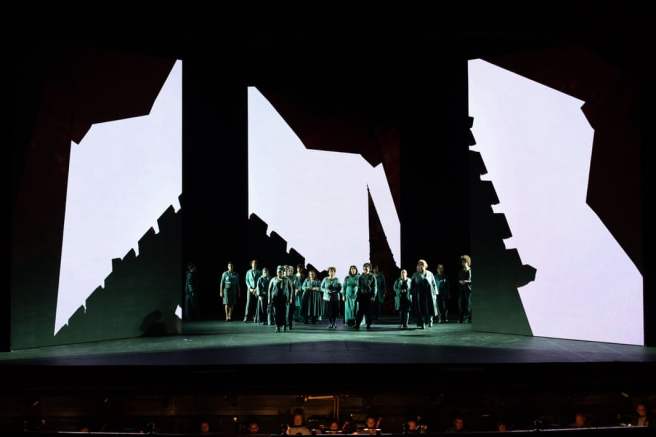
Sometimes an opera production just needs to grow on you. This is the case for the most recent ENO production of Magic Flute, directed by Simon McBurney, which has returned for its third run since opening in 2013.  Is was then the first new ENO production of The Magic Flute for around 25 years, and replaced Nicholas Hytner’s much-loved if rather traditional take. My review of the opening of McBurney’s version commented that: “In contrast to the previous production, this Magic Flute is dark, mysterious and more than a little weird. A flood of ideas drenched the stage, aided by a commentator sitting in a box in the corner, chalking up comments onto a large video screen. But there seems, at least to me, on first sight, little coherence to link it all together. Masonic references are played down, but the element of a cult is still stressed through colour-coded camps in conflict . . . It may well be that, in 25 years time, I will miss this production.  But, in the meantime, it will certainly take me some time to get used to it”. Continue reading

Handel: Berenice

Handel: Berenice
Royal Opera House / London Handel Festival
Linbury Theatre, Royal Opera House, Covent Garden. 1 April 2019

Handel’s Berenice was first performed in May 1737 in the Covent Garden Theatre, now the home of the Royal Opera House.  It was a tricky time for Handel and the London opera scene, with two opera houses competing for a limited audience. Handel promoted a large-scale 1736/7 season, but none of his new operas (Armino, Giustino, and Berenice) was successful. Handel also suffered a serious decline in his health, not least suffering a stroke in April 1737 that paralysed his right hand. It seems that Berenice only had three performances, probably rehearsed and directed by John Christopher Smith Jnr.  It returns to the present day Covent Garden (or, at least, the bowels of the present day Covent Garden) for the first time since its premiere, in the newly restored basement Linbury Theatre, in a Royal Opera House production in conjunction with the London Handel Festival. Continue reading

LHF: Helen Charlston

London Handel Festival
Helen Charlston, Baroque Ensemble LUX
St George’s, Hanover Square, 1 April 2019

This year’s London Handel Festival has the theme of  ‘Handel’s Divas’, and explores the female singers associated with Handel. One of the key events of the annual festival is the Handel Singing Competition, with the winners and finalists of each year’s competition playing a key part in following festival events. Last year’s winner was mezzo-soprano Helen Charlston with Lauren Lodge-Campbell winning the second and audience prizes. I heard both in last year’s semi-finals rather than the final, and was very impressed with both: it was a rare occasion when I agree with the LHF judges! Both give solo lunchtime recitals this week, starting with Helen Charlston. Her programme featured the (exclusively male) heroes and villains found in Handel’s operas and solo cantatas, giving Helen Charlston ample opportunity to display a wealth of different personalities and moods.  Continue reading

ROSL Annual Music Competition

ROSL (Royal Over-Seas League) Annual Music Competition
Mixed Ensembles Section Final
Princess Alexandra Hall, Over-Seas House, London. 19 March 2019

The Royal Over-Seas League (ROSL) has, since 1952, run an annual music competition through their ROSL ARTS, open to young Commonwealth classical musicians under the age of 30. A series of section finals for solo performers leads to a Gold Medal Final which, this year, will be held in the Queen Elizabeth Hall on 30 May. Past winners of the section finals and the Gold Medal have gone on to become well-known names. Alongside the section finals for solo performers (in wind & brass, voice, strings, and keyboard), are two ensemble finals, for strings and mixed ensembles. More than £75,000 is offered in awards, with a £15,000 first prize for solo performers and two chamber ensemble awards of £10,000. Winners of the solo sections receive £5,000 each. Details of the 2019 competition can be found here. Continue reading

LPO Isle of Noises: Handel & Purcell

Isle of Noises
London Philharmonic Orchestra
The Schütz Choir, Sir Roger Norrington
Royal Festival Hall, 30 January 2019

Handel: Suites from The Water Music 
Purcell: Dido and Aeneas

The London Philharmonic Orchestra opened their year-long series Isle of Noises (a celebration of British music) with a concert that, by all the normal conventions of concert programming over the past 50 years or so, shouldn’t have happened. Since the early music period-instrument revolution, and as the pioneering work of the early period specialists took root, most traditional orchestras took fright and stopped performing any music from Mozart or before. Gone were the days of a Mozart concerto opening a concert that would finish with Mahler. In recent years, some of those same early music specialists have enthused modern instrument players and orchestras, by far the most prominent being Sir Roger Norrington, perhaps most notably for his work with the Stuttgart Radio Symphony Orchestra. Continue reading

Requiem masses for murdered royalty

Requiem masses for murdered royalty
Le Concert Spirituel, Hervé Niquet
Barbican. 25 January 2019

Plantade Requiem in D minor, in memory of Marie-Antoinette
Berlioz Tristia
Cherubini Requiem in C minor, in memory of Louis XVI


Le Concert Spirituel and their founder-director Hervé Niquet brought the programme of their 2017 recording of the Plantade and Cherubini Requiems to The Barbican, together with Berlioz’s rarely performed Tristia, a sequence of three ‘sad pieces’ published in 1852 from three short pieces composed in 1831, 1842, and 1844. An unusual, but interesting programme with music that, perhaps because of the nature of the pieces, was compelling, but never really reached the heights of musical perfection. Cherubini’s Requiem was the first to be performed, in 1817, shortly after the restoration of the monarchy and in memory of Louis XVI. It was followed in 1823 by Plantade’s Messe des morts on the 30th anniversary of the death of Marie-Antoinette. Plantade knew Marie-Antoinette and Louis XVI, and there are elements of the earlier musical style of their court in his Requiem together with the style of the music of the Revolution. As with the Cherubini, there are no solo voices. Both works are intended for liturgical performance. Continue reading

Barbara Strozzi: Star of Venice

Barbara Strozzi: Star of Venice
Orchestra & Choir of the Age of Enlightenment
Mary Bevan, Christian Curnyn
Kings Place, 10 January 2018

Barbara Strozzi: L’amante modesto, Pace arrabbiata, Lagrime Mie, Canto di bella bocca,
E pazzo il mio core, Le tre Gratie a Venere, 
Silenzio nocivo
Claudio Monteverdi: Volgendo il ciel, Il ballo delle ingrate

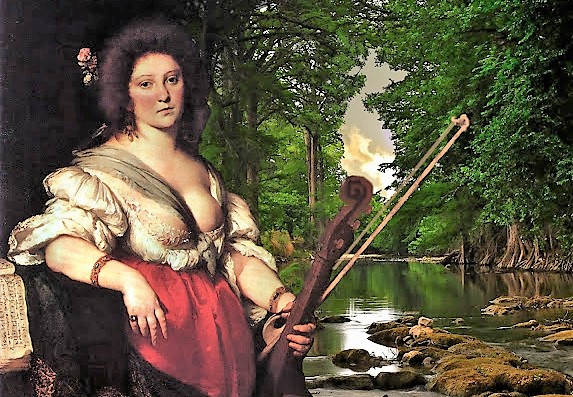
For several years now, Kings Place has selected a specific theme for each year under the banner of ‘Unwrapped’. Past examples have included Time Unwrapped, Cello Unwrapped, Baroque Unwrapped, and Minimalism Unwrapped. Their offering for 2019 is the enticing named Venus Unwrapped. The year-long series of around 60 concerts aims to “unlock the secret history of music by women”. It opened with a focus on Barbara Strozzi, one of the best known of the very few female composers of the Baroque era – or, indeed, of any era if musical history is to be believed. The painting below (The Viola da Gamba Player) is believed to be off Barbara Strozzi.

Strozzi.jpg

The distinguished conductor Christian Curnyn directed a group of singers and instrumentalists from the Orchestra & Choir of the Age of Enlightenment, with Mary Bevan as the main billed soloist, although several other singers had prominent roles.

Continue reading

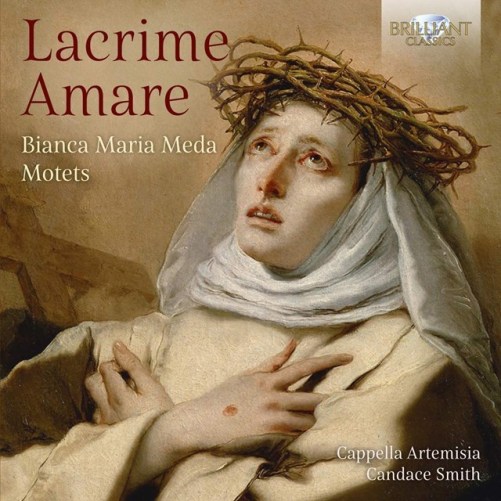
Lacrime Amare: Bianca Maria Meda motets

Lacrime Amare
Bianca Maria Meda motets (1691)
Cappella Artemisia, Candace Smith
Brilliant Classics 95736. 79’04

01-440142.jpg

Jesu mi clementissime, Vibrate, Anime belle, O quante contra me, In foco ardentissime,
O lacrime amare, Volo vivere, No non tentate, Spirate vos zeffiri

This is potentially an important recording from Cappella Artemisia, an all-female choir and orchestra, founded in 1991 by Candace Smith, a Californian long resident in Italy. Little is known of Bianca Maria Meda. She was born around 1665 and died around 1700 and was a Benedictine nun in San Martino del Leano Pavia. Her only published work is the Mottetti a 1, 2, 3, e 4 voci, con violini (Bologna, 1691). Judging by the quality of the nine examples on this recording, she was a very accomplished composer. Cappella Artemisia is an all-female choir and orchestra who specialise in music composed in, and for, 16/17th-century Italian convents. It founded in 1991 by Candace Smith, a Californian long resident in Italy.  Continue reading

Baroque at the Edge

Baroque at the Edge
Saint James, Clerkenwell, St Luke’s Old Street
Saturday 6 January 2019

Imagine.jpg

With a headline of “Imagine if Bach was a jazzman, Purcell a folk-fiddler, or Monteverdi a minimalist…”, the second annual Baroque at the Edge festival made a fitting opening to the 2019 London musical calendar. Founded in 2018 by Lindsay Kemp and Lucy Bending, the team behind the London Festival of Baroque Music and the earlier Lufthansa Festival, the festival invites musicians with a classical, jazz, or folk background to “take the music of the Baroque and see where it leads them” with the promise of “No rules, no programme notes, no lectures: all you need to know is how to listen”. The festival was spread over a three day weekend, with most of the events taking place on Saturday, 6 January, after a Friday night piano recital and before a Sunday family folksinging workshop and linked lunchtime concert. Continue reading

Bach: Christmas Oratorio

Bach: Christmas Oratorio
Choir of Trinity College Cambridge, Stephen Layton

Orchestra of the Age of Enlightenment
St John’s, Smith Square, 22 December 2018

Whatever joys the St John’s Smith Square Christmas Festival comes up with year after year (this is the 33rd), the climax comes with the final two (always sold-out) concerts conducted by the festival director, Stephen Layton, firstly with his own Trinity College Cambridge choir, and then with his professional choir, Polyphony. In recent years both concerts have been accompanied by the Orchestra of the Age of Enlightenment (OAE). The first of the two concerts is usually Bach’s Christmas Oratorio (Parts 1, 2, 3 & 6), sung by the student choir of Trinity College, the second, Messiah, sung by Polyphony.

No automatic alt text available.

Continue reading

Les Surprises: Baroque Christmas around the World

Baroque Christmas around the World
Les Surprises, Louis-Noël Bestion de Camboulas
St John’s, Smith Square. 18 December 2018

I have reviewed the French group Les Surprises several times on CD, and in concerts during festivals in France, but this was their first visit to the UK. Their well-chosen sequence of music was from the Baroque era from France and Quebec, Spain and Ibero-America, China and Italy. Five instrumentalists supported soprano Eugénie Lefebvre, her clear and focused voice excelling in a wide range of musical styles. I particularly liked her distinctive diction, with consonants that many English singers would envy.

Continue reading

Gesualdo Six: There is no rose

There is no rose
The Gesualdo Six, Owain Park
St John’s, Smith Square, 14 December 2018

Although only formed four years ago, The Gesualdo Six have gained an impressive following, not least at St John’s, Smith Square where they were one of the four members of the second Young Artists Scheme in 2015/16. They used that residency to launch their Composition Competition at SJSS, with the second following in 2019. For their concert in this year’s SJSS Christmas Festival, they gave a mixed programme of Christmas music ranging from plainchant and the early 15th century Trinity Carol Roll and music by Taverner and Tallis, through to living composers, including their own director Owain Park. Continue reading

Il Santissimo Natale

Il Santissimo Natale
The English Concert & Choir, Laurence Cummings
St John’s, Smith Square, 12 December 2018

The 33rd St John’s, Smith Square Christmas Festival continued with a very welcome first-half performance (by The English Concert and Choir, directed by Laurence Cummings) of Alessandro Scarlatti’s Missa per il Santíssimo Natale. Scarlatti is usually overlooked in comparison with other composers, both in his many operas and his few compositions for the church. His il Santíssimo Natal Mass was composed in 1707, during Scarlatti’s brief time as maestro di cappella at the Basilica of S Maria Maggiore in Rome. The two jubilant Kyries contrasted with a reflective central Christe. The gentle mood continued into the opening of the Gloria, before the bouncy rhythms returned. As in the later parts of the Mass, frequent changes of mood were a compositional feature, dissolving from one to the other with delightful ease, helped by some well-judged directed from conductor Laurence Cummings. The final Agnus sequence is a gently expansive movement, providing a suitably reflective conclusion to an impressive composition, Scarlatti’s operatic experience never far from the surface, without imposing. Continue reading

Mater Inviolata

Mater Inviolata
European music for the Christ-Child and His Mother
The Brabant Ensemble, Stephen Rice
St John’s, Smith Square, 11 December 2018

The 33rd St John’s, Smith Square Christmas Festival has taken a slightly more eclectic approach to the traditional seasonal offerings, although its roots in early music remain, as exemplified by this concert by The Brabant Ensemble, directed by Stephen Rice. Their programme focussed on Mary, the focus for devotion in the late Renaissance era. The geographical focus was, as the group’s name suggests, the old Duchy of Brabant, covering present-day parts of Belgium and the Netherlands. The Franco-Flemish composers included Josquin, Lassus, and Josquin’s contemporary Pierre de la Rue in the 500th year of his death together with the latter composers, Clemens non Papa, Crecquillon, and Mouton, with his well-known Nesciens mater. Continue reading

ENO: Britten War Requiem

Britten: War Requiem
English National Opera
The Coliseum, 16 November 2018

English National Opera has a record of performing Benjamin Britten operas, as well as creating operas from the Bach Passions and other choral works, so it was no surprise that they would turn to Benjamin Britten’s famed War Requiem. As with the Bach Passions, when I first saw them staged, I was a little apprehensive as to what I was to see. Just how would they stage a work with such vastly contrasting moods and scenes, combining the heart-wrenching poems of Wilfred Owen and the words of a traditional Latin Requiem Mass? Britten himself accented this contrast by giving the two male soloists who sing the Owen poems their own chamber orchestra, to be positioned closest to the audience and with its own conductor. The Requiem settings are for a large chorus and orchestra and a soprano soloist, together with boys choir and accompanying organ which are to be situated some distance away from the main orchestras.

Tillmans 3.jpg Continue reading

London International Exhibition of Early Music

London International Exhibition of Early Music
Early Music Young Ensemble Competition Finals
Blackheath, 8-10 November 2018

The London International Exhibition of Early Music is the latest incarnation of an annual event organised over many years by the Early Music Shop. It has had a number of names over the years, the most recent one being the Royal Greenwich International Early Music Festival, although it had been resident in Blackheath for a couple of years. My review of last year’s festival can be found here. Concerts have always been an important addition to the musical instrument exhibition, ranging from demonstration recitals on behalf of instrument makers, Performers Platforms, competition winner’s recitals and, this year, for the first time, the Early Music Young Ensemble Competition Finals, alongside more formal evening concerts by some leading names in the early music world. This year’s complete events diary can be seen here. The instrument exhibition itself takes place in the newly restored Blackheath Halls, with the concerts taking place in nearby churches. Continue reading

Steinitz Bach Players 50th

London Bach Society’s Bachfest 2018
Steinitz Bach Players, Rodolfo Richter
St John’s, Smith Square, 6 November 2918

For the fourth and final day of their 2018 Bachfest, the London Bach Society (LBS) celebrated the 50th anniversary of their own orchestra, the Steinitz Bach Players, with this St John’s, Smith Square concert. The orchestra was founded, along with the London Bach Society, by Paul Steinitz (1909-88), one of the pioneers of the British Bach revival. Made up of leading freelance period instrumentalists, the orchestra performs under different directors during the annual Bachfest. On this occasion, they performed without a conductor, but with direction from the violin by Rodolfo Richter, a practice that I am sure Bach himself would have approved of.   Continue reading

Purcell: The Fairy Queen

Purcell: The Fairy Queen
Gabrieli Consort and Players, Paul McCreesh

St John’s, Smith Square. 1 November 2018

The Gabrieli Consort and Players could probably perform The Fairy Queen in their sleep, such is their experience of Purcell’s music, and this particular work, over many years. They have performed it at the BBC Proms, the Barbican, the Spitalfields Festival and many other venues around the world. They now plan to record it, along with King Arthur, early in the New Year, with the same forces as appeared in this St John’s, Smith Square performance. Their crowdfunding campaign page can be found here.

One of the continuing successes of the Gabrieli’s and their director Paul McCreesh is their ability to reinvent themselves and to continually question and push boundaries in their approach to their music making. For this particular recording (and this concert) they stress that “Gabrieli also brings a forensic understanding of contemporaneous performance techniques to this repertoire, including a new bow hold for string players which transforms articulation and influences tempi; wind instruments using more basic, coarser reeds, for a more martial sound; and natural trumpets performing on instruments without holes, playing entirely through the adjustment of embouchure – a high wire act!“. This was also the premiere of a new performing edition, prepared by McCreesh and Christopher Suckling, their principal bass violinist. It was performed at the low ‘French’ pitch of 392Hz and the violins played using French bow holds.  If this suggests an academic approach to music making, the experience of this concert proved to be anything but. It was a compelling and exuberant performance, semi-staged, albeit with only one ‘prop’ – in the shape of an enormous bleached-white wig for Mopsa, aka Charles Daniels. Continue reading

Other Worlds

”Other Worlds’
London Contemporary Orchestra and Choir
Robert Ames, conductor
Barbican 31 October 2018

Giacinto Scelsi: Uaxuctum
John Luther Adams: Become Ocean

It was an achievement that this concert took place at all. Giacinto Scelsi’s Uaxuctum is one of the most complicated orchestral works to perform. Although composed in 1969, nobody attempted to perform in until 1987. This was its UK premiere. The score includes four amplified solo singers and a chorus singing the most complex microtonal music in up to twelve parts. The large orchestra includes a solo ondes-martenot, vibraphone, clarinets, horns, trumpets, trombones, bass and double bass tubas, and timpani. A battery of other percussionists play instruments such as a two-hundred litre. The subtitle of Uaxuctum is ‘The Legend of the Maya City, destroyed by themselves for religious reasons’, and the music evokes that atmosphere of despair that led to the apparent self-destruction, around 900 CE, of this Mayan city (in what is now Guatemala) after a few centuries of varying fortunes since their conquest in the 4th century, . Its five movements move from evocative mysticism to violent outbursts in an arch form, the final movement reflective of the first. It last just over 20 minutes.  Continue reading

Echoes of Venice/NCEM Young Composers

‘Echoes of Venice’
The English Cornett & Sackbut Ensemble
Turner Sims, University of Southampton. 30 October 2018

As part of their 25th-anniversary celebrations (which also included the release of this excellent CD), The English Cornett & Sackbut Ensemble (ECSE) joined with the National Centre for Early Music (NCEM) in the 2018 NCEM Young Composers Award. UK composers aged 25 and under were invited to compose a piece to be performed by The English Cornett & Sackbut Ensemble. Composers were”encouraged to “look to Venice for inspiration, and to treat the cornetts and sackbuts as ‘wordless voices’, closer in spirit to a vocal ensemble than to a modern brass ensemble“. They were offered this brief outline of Venetian art and writing. During the final of the award in May, the ECSE performed the six shortlisted pieces and helped to select two prizewinners, one for those 18 and under, and one for 19 to 25 year-olds. All the finalist’s pieces can be heard on the NCEM Young Composers Award website here. The two winning pieces were performed during this Turner Sims concert: ‘Bridge of Sighs’ by Lilly Vadaneaux (18 years and under) and ‘Isole’ by Andrew Blair (19-25 years). Extracts from the concert will be broadcast on BBC Radio 3’s Early Music Show at 2pm on Sunday 18 November and will be available for a few weeks after that. Continue reading

Festival d’Ambronay/Festival eemerging: 2018

Vibrations: Cosmos
Festival d’Ambronay/Festival eeemerging
Centre culterel de recontre d’Ambronay
28-30 September 2018

The 39th Festival d’Ambronay saw the conclusion of an annual triptych devoted to the theme of Vibrations, in this case with the subtext of ‘Cosmos’. Spread over four weekends, it was described as “An evocation in music of a cosmos alternately spiritual or material, intimate or grandiose, in-depth or elevation … An evocation of the stars, elements and spirituality, a look at the harmony of man and the universe“. As well as hosting the annual festival, the Centre culterel de recontre d’Ambronay is also the base for the eeemerging project (Emerging European Ensembles), a European Union-wide cooperation project dedicated to the selection, training and promotion of young early music ensembles. It brings together partners from the UK, Latvia, Romania, Slovenia, Italy and Germany in a four-year cooperation project. Alongside festival events, the third weekend of the four-weekend festival was devoted to the ensembles selected for the 2018 eeemerging round, with six young groups of musicians performing, alongside one of the previous eeemerging ensembles and one of the most established groups in recent history. The comparison between the young musicians and some of the more established performers in the festival was of particular interest, leaving me with the view that the latter, with few exceptions, have a lot to learn from the former.

IMG_20181002_155857192.jpg Continue reading

French Baroque music meets Indian Classical Dance

French Baroque music meets Indian Classical Dance
BBC Singers, Academy of Ancient Music, Sofi Jeannin
Sanskriti UK & Ankh Dance
Milton Court, 19 October 2018

Lully: Te Deum 
Rameau: In convertendo Dominus;
extracts from 
Les Indes galantes, Les fêtes d’Hébé Castor et Pollux 

In what was a rather brave bit of programming for a live BBC Radio 3 broadcast, the BBC Singers and the Academy of Music, directed by Sofi Jeannin, the new Chief Conductor of the BBC Singers, presented an evening of French Baroque music, the second half of which was accompanied by two contrasting forms of Indian dance. The first half was of liturgical pieces, starting with Lully’s jubilant 1677 setting of the Te Deum. This was first heard at Fontainebleau and later became the piece that led to Lully’s death after he stabbed himself in the foot with his conducting baton during Chapel Royal celebrations for the Sun King’s recovery from surgery – surgery that Lully decided, fatally, to refuse. No such calamity occurred here as Sofi Jeannin demonstrated her commendably straightforward style of conducting, her focus clearly on the music itself rather than on any sense of self-aggrandisement. She coped well with the complications of this particular occasion, which included a late start after an overrun of the previous Radio 3 show, and complicated coordination between dances, singers, instrumentalists, a BBC announcer and the paraphernalia of a live BBC broadcast.  Continue reading

Bach: St Matthew Passion

Bach: St Matthew Passion
English Touring Opera
Temple Church, London. 18 October 2018

English Touring Opera (ETO) is an ambitious organisation that run extensive annual tours of staged operas around the UK, alongside one-off projects like their current adaptation of Bach’s St Matthew Passion. They start their tours in London, usually at the Hackney Empire, where they have just staged Radamisto and a triple-bill of Dido and Aeneas, Carissimi’s Jonas, and Gesualdo madrigals. Details of their current tour can be found here. For the Matthew Passion, as in previous such projects, they enrol local amateur choirs, community groups, and schools. For their London performance, these were the Collegium Musicum of London Chamber Choir (whose musical director is assistant organist at The Temple Church) and an almost exclusively female flock of children from the Holy Trinity and Saint Silas Church of England Primary School in Camden. The orchestra was the professional period instrument Old Street Band. Continue reading

ENO: Salome

Richard Strauss: Salome
English National Opera, Martyn Brabbins, Adena Jacobs
The Coliseum, 3 October 2018

In a production that veered from My Little Pony, via Lolita, to the Texans Chainsaw Massacre, there were two clear winners: the music of Richard Strauss, given a superb reading by Martyn Brabbins and the Orchestra of English National Opera, and mezzo Allison Cook in her strangely compelling and insightful interpretation of the complex role of Salome – a role and ENO debut. Usually depicted as the archetypical seductive femme fatale, for most of this production, directed by Adena Jacobs in an ENO debut, she seemed far more like a confused, hormone-ridden teenage girl, becoming increasingly fragile, delicate, and in need of protection. Perhaps I was viewing it through the mind of a father, rather than a voyeur, but it was an incredibly powerful image. Her first appearance was as a black-clad, demanding and confident long-haired princess arguing to see the imprisoned Jokanaan. As events unfolded, she mutated into a slight and vulnerable bare-breasted child-woman in minuscule schoolgirl gym knickers and with makeup smeared all over her face.

Salome 5.jpg Continue reading

Academy of Ancient Music: Dido and Aeneas

Dido and Aeneas
Academy of Ancient Music, Richard Egarr, Thomas Guthrie
The Barbican, 2 October 2018

For anybody who was not already familiar with the story of Purcell’s Dido and Aeneas, the Academy of Ancient Music’s semi-staged performance (directed by Thomas Guthrie) at The Barbican opened with something of a plot-spoiler. The first half was a 40-minute exploration of the funeral rites of the dead Dido, albeit a couple of hours or more before she was ‘laid in earth’. Actually, laid in earth she wasn’t, instead lying on a funeral catafalque over which Belinda, Aeneas and assorted mourners (the AAM chorus, who opened the show with some rhythmic drum bashing) acted out their reaction to her death as they remembered her. And when I write ‘she’ in fact it was a half-size puppet of the upper half of Dido who represented her throughout the evening. The full panoply of puppets came to the fore in the second half performance of Dido and Aeneas itself where the entire cast of soloists and chorus sported puppets – torsos for Dido and Aeneas, heads and gauze cloths for the rest. Continue reading

RFH International Organ Series: Renée Anne Louprette

Renée Anne Louprette, organ
Royal Festival Hall, 19 September 2018

JS Bach: Prelude and Fugue in G
Marin Marais: Suite from Alcyone (arr. Louprette)
Jehan Alain: Variations sur un thème de Clément Jannequin
Ad Wammes: Mytò
Nadia Boulanger: Improvisation from 3 Pièces
Duruflé: Suite, Op.5

The Royal Festival Hall’s ‘International Organ Series‘, most of which is made up of UK, rather than international organists, made up for that fact by replacing an indisposed UK performer with Renée Anne Louprette, an American organist who spent some of her student days in London. She has held posts in several important New York churches, alongside academic posts, and is now University Organist and Coordinator of the Organ Department at the Rutgers University Mason Gross School of the Arts in New Jersey.

Her largely French programme opened with Bach’s flamboyant Prelude and Fugue in G (BWV 541), a distinctly non-French piece. From the very first few notes, it was clear that Renée Anne Louprette is an outstanding Bach interpreter. Her sense of touch, rhetoric and the way she sensitively articulated the opening flourish and the repeated notes in both Prelude and Fugue showed a real (and sadly rather rare) understanding of Baroque concepts such as the hierarchy of the bar. Her choice of registration was spot-on. Continue reading

BBC Prom 74: Handel – Theodora

Handel: Theodora
Arcangelo, Jonathan Cohen
Royal Albert Hall, 7 September 2018

Of all Handel oratorios, the one that is probably most likely to put you off Christianity (or put you even further off Christianity) is Theodora. Set during the reign of the Emperor Diocletian, the story is of two love-struck Christians who refuse to honour the Roman gods, and then vie with each other as to which of them is to be put to death as a result, each insisting on taking the place of the other until the exasperated Valens, President of Antioch, has them both sent to their heaven. It was unusual for an opera or oratorio to end badly for the leading lights, which perhaps explains its lack of success at the time. The text doesn’t bear much scrutiny either, the earlier arias of the Christian contingent and their confidence that the Lord would provide protection ‘here and everywhere’,  and the chorus’s response that the Everlasting One was ‘Mighty to save in perils, storm and death’, seemed a little ill-judged in the forthcoming circumstances.   But, setting aside the silly plot, the text and music express aspects of love, religious freedom, bloody-mindedness, and the assumptions that Christians are far more musically intelligent than ‘heathens’. The latter is a particular feature of Handel’s music, with the choir switching between Heathen and Christian to distinctly different music, the former generally rather four-square, clumpy, and harmonically unadventurous, the latter tuneful and svelte.  Continue reading

BBC Prom 73: Tallis Scholars

Before the Ending of the Day
Tallis Scholars, Peter Phillips
Royal Albert Hall, 6 September 2018

The late-night concert on 6 September, following the Britten War Requiem, was a quasi-liturgical performance of the service of Compline, the concluding service of the daily eight canonical hours in Catholic liturgy. After the concluding litany of the War Requiem: “Let us sleep now” it was an appropriate add-on. Traditionally followed in monastic settings by the ‘Great Silence’ that lasted until the first service of the morning, its roots go back to St Benedict at the beginning of the sixth century. The name of the service comes from the word ‘complete’ reflecting the completion of the working day – or, in this case, for most of us, the end of a musical day.  Continue reading

BBC Prom 72: War Requiem

Benjamin Britten: War Requiem
Royal Scottish National Orchestra, Peter Oundjian
Huddersfield Choral Society, RSNO Chorus, RSNO Junior Chorus
Erin Wall, Allan Clayton, Russell Braun
Royal Albert Hall, 5 September 2018

As we approach the centenary of The Armistice that ended the First World War, it was an appropriate moment for The Proms to programme Benjamin Britten’s War Requiem. It is a piece that has had fluctuating enthusiasm over the years since its first performance in May 1962 in the new Coventry Cathedral, designed by Basil Spence, and built alongside the ruins of the medieval cathedral building, destroyed during the 1940 Battle of Britain. A committed pacifist and almost certainly agnostic or atheist, Britten was perhaps not the most obvious choice to compose a requiem, but this combination of personal beliefs led to one of the most powerful of all compositions related to war. Combining the traditional Catholic Latin Requiem Mass with the poems of the war poet Wilfred Owen, resulting in an often heart-wrenching combination of pleas for peace with reflections on the horrors of war.  Continue reading

Innsbrucker Festwochen der Alten Musik 2018

Innsbrucker Festwochen der Alten Musik 2018
Innsbruck, 23-25 August 2017

The Innsbruck Festival of Early Music runs annually for about three weeks during August. It was founded in 1976 and has traditionally focussed on Baroque opera. In recent years it has included three each season, including the Barockoper:Jung. This uses singers chosen from the finalists of the previous year’s International Singing Competition for Baroque Opera Pietro Antonio Cesti, named after Antonio Cesti, a 17th-century Italian singer and composer who served at the Innsbruck court of Archduke Ferdinand Charles of Austria. Unfortunately, I was only able to attend for three days but those included two of the operas and the Cesti final.

IMG_20180823_212452154.jpg Continue reading