Rhythm Across Time
Academy of Ancient Music, Wave Quartet, Bojan Čičić
Milton Court, 14 May 2026
Bertali: Ciaccona in C major
Geminiani: Concerto Grosso No 12 ‘La Folia’, after Corelli Op 5
Handel: Chaconne in G major HWV 435
Bach: Concerto in A minor BWV 1065 (arr for marimbas and strings)
Piazzolla: Concerto ‘Aconcagua’: Moderato, Presto
Festa: Variations on ‘La Spagna’ – Contrapunto 46, 88, 77 and 108
Bach: Harpsichord Concerto in C major BWV 1061 (arr for marimbas and strings)
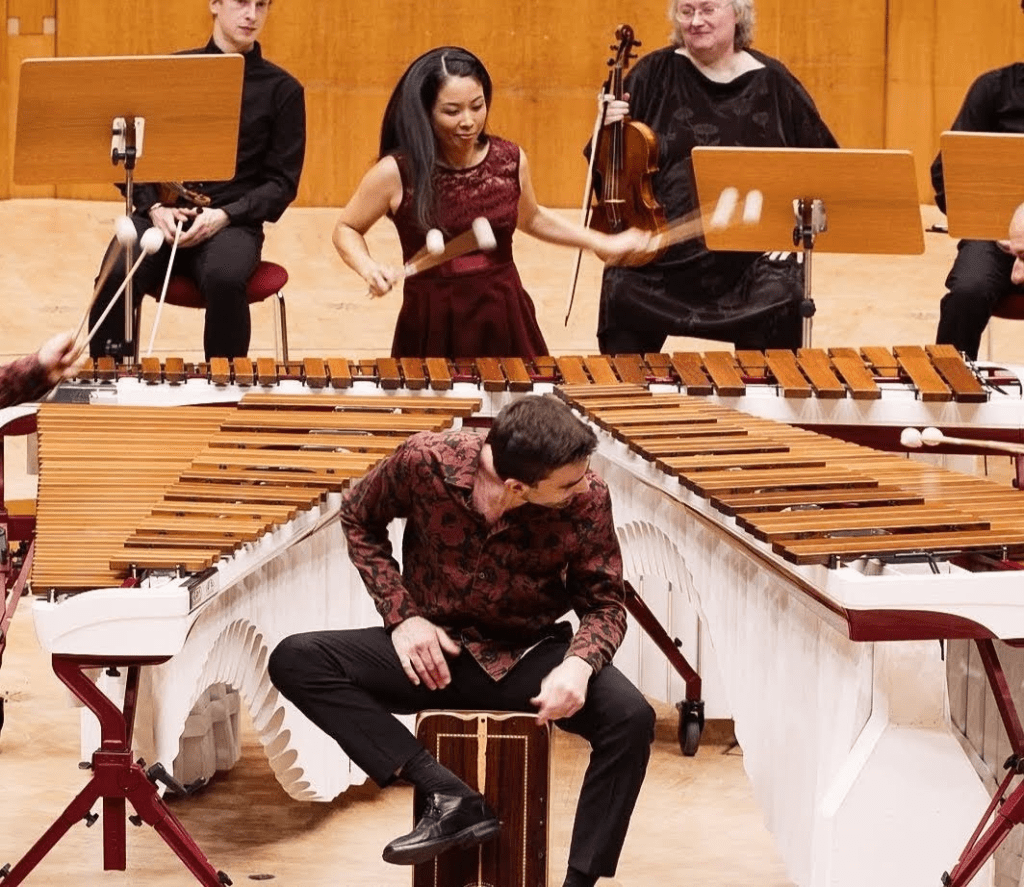
The Academy of Ancient Music (AAM) continued its innovative sequence of concerts during its 2015/16 Cambridge and London season, a collaboration with the Wave Quartet of four marimba players, based in Vienna. In their pre-concert talk, mention was made of a shared Austro-Hungarian Empire heritage between the Croatian AAM director Bojan Čičić and the Romanian founder of Wave, Bogdan Bacanu, although the fact that the Dual Monarchy ended in 1918 suggests that the cultural link was perhaps not so strong. It could be argued that the same applied to this concert, where, I suggest, there were several cultural clashes. The catalyst for this concert was a similar combined event in 2019, also in Milton Court.
Founded in 2008 to perform their own version of Bach’s C major Concerto for Two Harpsichords, BWV1061a on marimbas, Wave has continued to combine an interest in Bach and more recent works for their combination of instruments. The mallet-truck wooden-barred marimba has its roots in, and gets its name from, the sub-Saharan Bantu region of Africa, although it also appeared in various forms in other parts of the world.
The first possible culture clash came between the two principal players of the Wave Quartet in the opening c1662 Ciaccona by Antonio Bertali the Kapelmeister to the Holy Roma Emperor in Vienna. Christoph Sietzen, a former student of Wave founder Bogdan Bacanu, seemed to be set on outdoing his former teacher, not just in volume but also in stage flamboyance. But, despite the volume of the two marimbas, both were outshone in musical technique by the AAM director, Bojan Čičić, who excelled in some virtuosic violin playing, performed with commendably professional restraint. Christoph Sietzen was, in theory, reduced to a continuo role in Geminiani’s Concerto Grosso No 12, a remake of Corelli’s La Folia, but again made his presence felt by breaking most of the standard baroque rules of harpsichord continuo playing, including, once again, playing too loudly. On this occasion, he was outshone by AAM cellist Joseph Crouch’s virtuosic playing, again with no sense of self-promotion.
Handel’s Harpsichord Chaconne in G major (HWV 435), was played on two marimbas, sticking more-or-less to Handel’s notes but with an enormous range of dynamics. I was learning to love the gentle sounds of the marimbas, but not the more violent moments when the players raised their mallets well above head height to bring them crashing down on the marimbas. How much of that was for show, or was needed to produce the sound they wanted, remains a mystery, but the contrast in performing styles and musicality between Wave and the AAM was becoming increasingly obvious. That was further emphasised when the AAM and Wave, now expanded to four players, joined forces for an arrangement of Bach’s Concerto in A minor (BWV 1065). Originally based on a composition by Vivaldi, Bach arranged it for four harpsichords before this arrangement for four marimbas and string orchestra. The central Largo featured the marimbas, albeit not quite agreeing on the speed of their individual lines.
The second half opened with solo marimbas and the final movement of Piazzolla’s 1979 Aconcagua Concerto, not a piece I really warmed to, although I liked the sotto voce opening section. My favourite moment came next, with five members of the AAM gathered to one side of the stage to play four of the 125 variations on La Spagna by Costanzo Festa (c1484-1645), a musician in the Sistine Chapel. Various permutations of a violin, two violas and two cellos produced a beautifully sensitive and musical sound. They returned to Bach for the final piece, an arrangement of Bach’s Harpsichord Concerto in C major (BWV 1061), originally composed for two harpsichords but then arranged by Bach for harpsichords and orchestras. The final fugue highlighted one of the issues with Wave in that the first two voices dominated the other two marimba players, making a nonsense of normal fugal orchestrations. There were moments, however, when, within the normal fugal structure, the third and fourth marimbas were played alone without being dominated. I particularly liked the finesse of Emiko Uchiyama, the arranger of the earlier Piazzolla.
Another worthwhile experiment from the AAM, and the encouraging audience applause, suggests that I was alone in my criticisms. But I would have preferred it if Wave didn’t seem to treat the distinguished musicians of the Academy of Ancient Music as a mere backing group. Incidentally, after some criticism from me on recent AAM Programme notes, I should record my admiration of Katie Hawks’ notes in this programme, not least for presenting the music information in the order of the performance.

