BBC Proms: Purcell’s The Fairy Queen
Les Arts Florissants, Le Jardin des Voix, Compagnie KÄFIG
Paul Agnew, conductor, Mourad Merzouki, choreographer/stage director
Royal Albert Hall, 6 August 2024

There are many ways to perform Purcell’s The Fairy Queen, but this must rank as one of the most inventive and entertaining. I have seen many versions of this musical extravaganza, including a bottom-numbingly-long version that attempted to recreate the original 1692 production when Purcell’s five masques were interspersed between sections of the spoken play, which was an appallingly turgid adaptation of Shakespeare’s Midsummer Night’s Dream. Composed to celebrate the anniversary of William and Mary’s wedding, Purcell’s five masques bear a marginal and rather metaphysical and academic relationship (explained here) to Shakespeare’s play, the revised version concentrating on the dream-like world of the fairies. The five masques are all introduced by Titania or Oberon, who may well have been played by eight or nine-year-old children, seemingly joined by a wider cast of young children.
As the production photos suggest, this was no ordinary musical or operatic performance. The cast of eight singers from Le Jardin des Voix, Les Arts Florissants’ vocal academy for young singers, combined with six dancers from the dance troupe Compagnie KÄFIG. The 14-strong ensemble merged into a single group for much of the evening – the dances occasionally sang, and the singers spent a lot of time joining in the less-acrobatic actions of the dancers. They wore similar costumes (dark suits in the first half and more bucolic garb for the rest), but the dancers could be recognised not just for their extraordinary antics, but also for performing in bare feet.
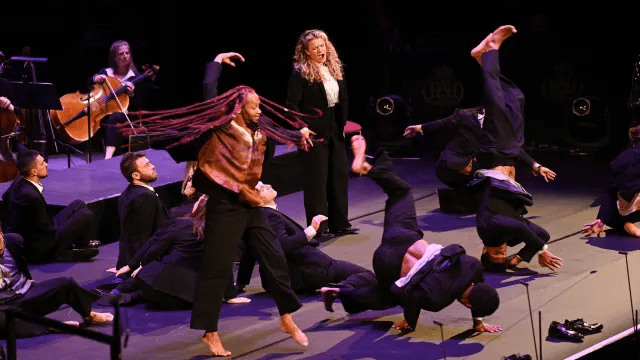
The dancing was in the form of hip-hop or breakdancing – or, as the Olympics would have it, ‘Breaking’. I returned to this review after watching some of the Olympic Breaking competition, so can now slot the gyrations of the six Purcell dancers into a recognisable art form. And, apparently, in Olympic terminology, they should more correctly be called B-BOYS. They combined elements of gymnastics, acrobatics, circus acts and burlesque – all things that I am sure Purcell would have loved. Incidentally, the dancers of Compagnie KÄFIG appeared at the opening of the Paris Olympics.
The five masques and the related instrumental pieces were run together, the whole divided into two halves with the interval coming after the Masque for Bottom‘s Dialogue between Coridon and Mopsa. The dramatic multi-section Symphony and the Masque of the Seasons opened the second half. The bizarre absence in the BBC’s programme booklet of any real idea of what each masque or musical number was all about meant that you really needed to know the music to make much sense of it all – a curious omission considering the aim of Mourad Merzouki’s stage direction to “bring the music “de-sacralise the elitist approach” to classical music. The texts were displayed on two large high-level screens and a video screen on the organ case.
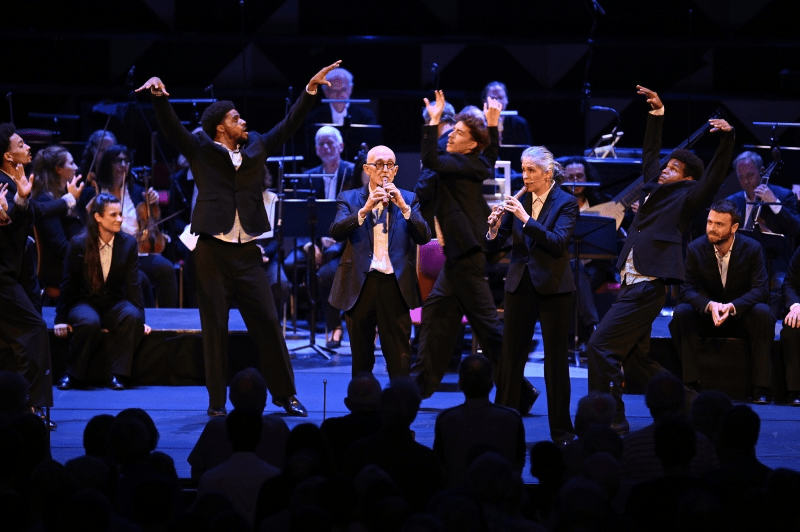
Several of the instrumentalists of Les Arts Florissants contributed to the drama, notably Sébastien Marq and Nathalie Petibon, recorders, providing the birdsong during the Masque for Titania, which featured a memorable bird-inspired dance sequence, and violinist Augusta McKay Lodge who turned The Plaint “O let me weep” into a delightful duet as she followed the inspiring singer around the stage. The impressive continuo group included Nicholas Milne viola da gamba, cellist Felix Knecht, Sergio Bucheli, theorbo, with Benoit Harton playing harpsichord and organ.
Another BBC programme booklet oddity was that none of the singers were named against their individual contributions. I could attempt to allocate names based on analysing voice types, but that is unlikely to be accurate. But I can name the performers:
Le Jardin des Voix
Paulina Francisco (soprano}; Georgia Burashko, Rebecca Leggett, Juliette Mey (mezzo-sopranos); Rodrigo Carreto, Ilja Aksionov (tenors); Hugo Herman-Wilson (baritone); Benjamin Schilperoort (bass-baritone).
Compagnie KÄFIG
Baptiste Coppin, Samuel Florimond, Samuel Florimond,
Anahi Passi, Alary-Youra Ravin, Timothée Zig
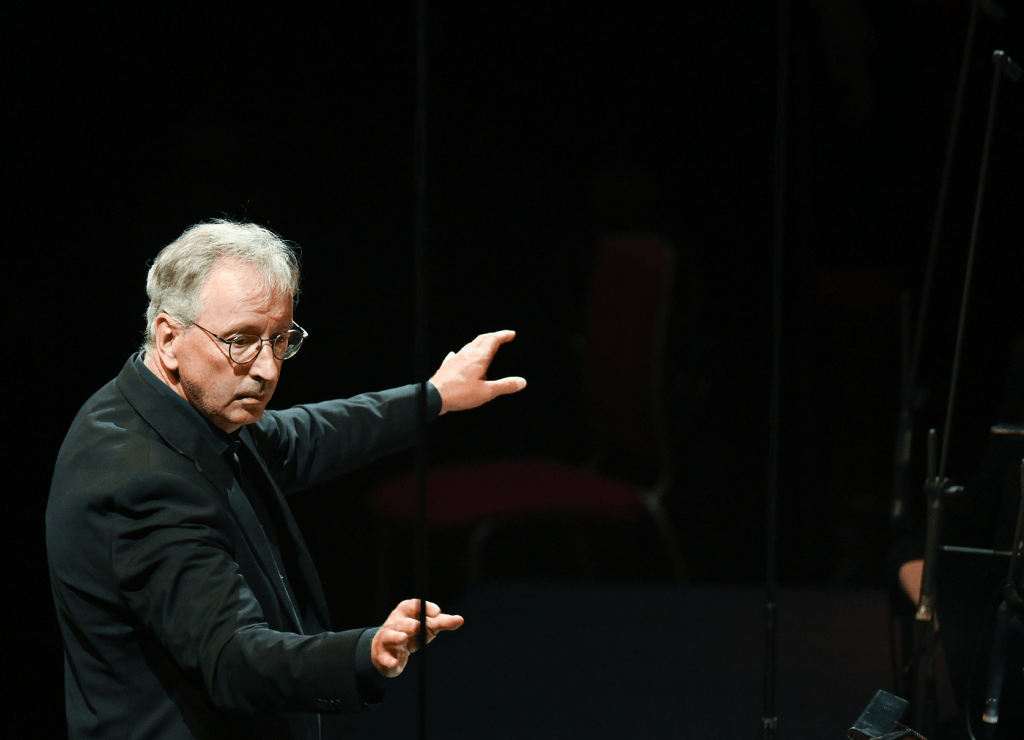
Paul Agnew has appeared at the Proms many times in the past facing in the other direction as an inspirational high tenor singer. Now the Co-Director of Les Arts Florissants alongside its founder and Musical Director William Christie, he demonstrated a wonderfully sensitive feeling for the music and the musicians.
I did wonder if this would have been far better staged by moving the Prommers onto the stage area and using their amphitheatre as a central stage, to take advantage of the Royal Albert Hall’s focus. As it was, only the few who managed to get to the very front row of the downstairs Prommers had much of a chance to appreciate what was going on. Those seats to either side could get a sideways view, but I think the spotlights would have affected their view. For anyone further back, it was quite a distant view. The BBC 3 live broadcast (available here until October) is frustratingly full of the thumps and bumps of the dancers, but without any idea what they were doing. Another bizarre BBC decision was not to televise this oh-so-visual performance. Of all the possible Proms performances to be televised this was the only one that absolutely cried out to be included.
To make up for that, I offer here a recording of an earlier performance in Budapest, complete with irritating adverts and the entertaining conducting of William Christie who, as is his want, makes himself very much part of the performance. More videos of earlier performances can be also viewed here with links to other extracts, recorded during a festival in Christie’s own garden.
Production images: Chris Christodoulou/BBC

