Laus Polyphoniae 2026
Voices of Europe circa 1600: continent of counterpoint
Antwerp
21 – 29 August 2026

Laus Polyphoniae is the annual summer festival organised by AMUZ (Flanders Festival Antwerp), dedicated to the music of the Middle Ages and Renaissance. Since its inception in 1994, the festival has become the largest festival dedicated to the western heritage of polyphony following a focus on Historically Informed Performance (HIP). Following last year’s festival devoted to “Polyphony from the age of cathedral builders (1140-1440)”, this year the focus was on music of the decades around 1600 with Voices of Europe circa 1600: continent of counterpoint reflecting a period when music was at a defining moment of change as the polyphony of Palestrina gave way to the early Baroque gestures of Monteverdi. Music that would later be called Renaissance or Baroque existed in parallel, as demonstrated by the festival’s portrait of this many-voiced Europe as music printing opened the transmission of new ideas, as composers and scores migrated. Laus Polyphoniae also focuses on young up-and-coming talent through the International Young Artist’s Presentation (IYAP), reviewed here, held on the first Saturday of the Festival.
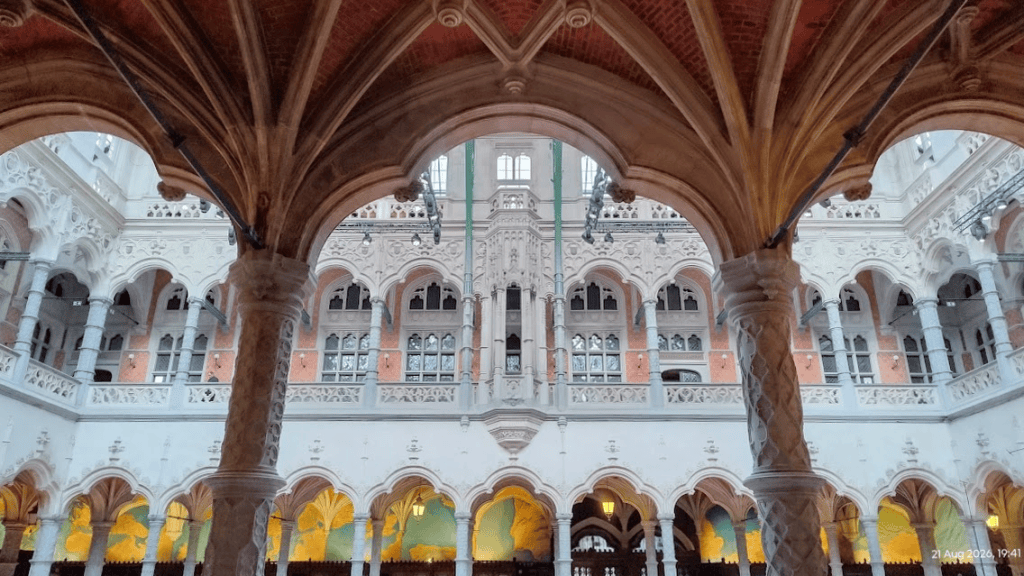
The festival opened (Friday 21 August) in the spectacular and recently restored 1872 neo-Gothic Handelsbeurs (the historic stock exchange) with Tenebrae‘s performance of the Missa pro defunctis, à 6 by Tomás Luis de Victoria. It was described as “music you recognise right away, as if it were imprinted on our collective memory . . . a great blanket of sound, full of hope and trust, that wraps comfortingly around you”. The 16 singers of Tenebrae started behind their eventual stage with an embarrassingly long period of silence, presumably awaiting for a long-delayed signal from the live radio broadcast people. They opened with Lobo’s Versa est in luctum and a plainhant Pange ligua while processing onto the stage for a sequence of five responses from Victoria’s 1585 Holy Week Offices.
Victoria’s Missa pro defunctis (published in 1605 as the Officium defunctorum) was composed for the 1603 funeral of Empress Maria of Austria and, according to the festival’s rather colourful promotional text, portrays “a paragon of genuinely felt serenity . . . voices that carry, embrace and release each other in a play of shadow and light”. It turned out to be Victoria’s last composition and is generally recognised as being one of the finest of all the Renaissance musical works. Not surprisingly, given the reason for its composition, it is a large-scale work, including all but two of the movements of the Missa pro defunctis followed by the extra-liturgical motet, Versa est in luctum and an absolution consisting of the Libera me responsory and Kyrie. Most of the piece contrasts elaborate polyphony with austere plainchant, with a uniting cantus firmus throughout. The singing was impressive, as was the unobtrusive direction by Nigel Short. The acoustics cannot have been easy to sing into, not least because the capacity crowd would have considerably changed the acoustic from a rehearsal in an empty space.
The Saturday 8pm concert was given by Les Meslanges with their programme Les Voyages d’Orphée in the St.-Andrieskerk. It focussed on the music of Jehan Titelouze (c1563-1633). He was born in Saint-Omer and was canon and organist at Rouen Cathedral and represents a transitional stage between the Renaissance and the Baroque, combining Franco-French polyphony and a new, expressive, French musical language. The music incorporated vocal and organ music by Titelouze within the context of the wider musical spectrum of the Low Countries, including Orlandus Lassus. They included the recently rediscovered Missa sex vocem cantate by Titelouze himself: a rare glimpse of the vocal oeuvre of a composer knows best as a pioneer organ composer. The Titelouze Mass was interspersed with organ solos improvised by François Ménissier, who also played organ pieces from Titelouze’s 1623 Hymnes de l’Eglise alternating with verses of an Ave maris stella by Lassus and Du Caurroy and a Bournonville Magnificat. There was also an earlier organ solo of a Cornet Fantasia played with impressively crisp ornamentation.
Alongside the seven singers, a rich orchestration included cornetts, mute cornetts, recorders, dulcians, trombones, a rather prominent serpent, and organ all combining to give an impressive portrayal of the sound world of the era. Of course, Titelouze’s organ music was composed for the principal organ of Rouen Cathedral which would have produced a very different sound from the impressive looking, but compatitively weedy sounding, organ used in this performance.
The Saturday late night (10pm) concert was given in AMUZ‘s own concert hall by Philippe Herreweghe and the Collegium Vocale Gent with a performance of Lagrime di San Pietro by Orlandus Lassus. The rather gushing festival promotional blurb described this as “a monumental bridge between the past and future. It is like stepping into a diary: 21 miniatures in which every voice is a character, silences thrum with emotion and melodies weave between the parts like thoughts that refuse to be banished . . . Collegium Vocale Gent know this piece like no others, giving voice to the many layers of Lassus’ final composition without smoothing away the tension or vulnerability. The result sounds precise, clear and authentic, free of sentiment but so very intense: every turn in the music holds meaning, and every combination of notes is a moment of connection and insight.” Composed while Kapellmeister in Munich in 1593/4, Lassus dedicated it to Pope Clemens VIII in May 1594, just three weeks before he died. The 21 madrigale spirituale was set for seven voices, a number full of symbolism, which work their way through seven of the eight Psalm modes (symbolically omitting the eighth tone), the final piece (actually a motet, rather than a madrigal) being set in the tonus perigrinus, independent of the Renaissance modal system.
The light and unforced voices of Collegium Vocale Gent and Philippe Herreweghe’s sensative direction made this something of a spiritual occasion, regardless of any personal beliefs. Despite the detailed programme book that included all the texts and Flemish translations, it was noticiable that in all the concerts I attended, very few people were actually following the text or the order of the pieces, rather reinforcing the perfectly valid approach to listening to Renaissance music (or any music, for that matter) by just letting it wash over you.

The Sunday evening 8pm concert in the recently restored St.-Jacobskerk were festival favourites Stile Antico with their programme The Other Face of Carlo Gesualdo. This concentrated on Gesualdo’s two 1603 volumes of Sacrarum Cantionum, composed for 5 voices and 6 or 7 voices respectively, and was aided by research by the Alamire Foundation and earlier reconstruction work of the 6 and 7 voice motets by the musicologist James Wood, Described as “the soundtrack to a quest for calm, clarity and order”, these songs are seen as a far cry from his more extreme madrigals with their “capricious melodies and crazed harmonies”. This rarely performed collection of pieces revealed a more profoundly spiritual Gesualdo. Stile Antico always impress with their supurb consort singing and involvement with the music, which is helped by them performing with no director, bringing a very personal involvement to the music they perform.
The well-constructed programme of motets showed the varied style of the music, from the slowly unfolding polyphony and harmonic density of Peccantem me quoditie, notably at the words Miserere mei, to the gloriously joyous flurry of notes of the concluding Veni Creator Spiritus. The various permutations of the 13 singers of Stile Antico produced a spectacular sound in the vast acoustic of the sparkling church, carefully .controlling their volume to suit the mood of each motet. This was one of the finest of the concerts that I attended in this years Laus Polyphoniae.
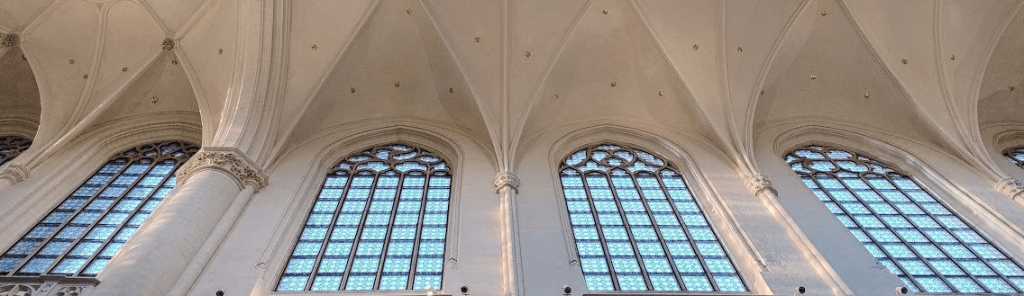
An evening walk across the historic city centre of Antwerp brought me to the St.-Andrieskerk for the late Sunday evening concert of The Psalms of Claude Le Jeune by festival regulars, the Huelgas Ensemble. Considered by his contemporaries as the rightful heir to Lassus, the devout Huguenot, Le Jeune gave the psalms, according to the festival’s publicity, “a distinct voice, with rhythmic sharpness and surprising chromaticism, driven by the cadence of the French language. Le Jeune’s polyphony sounds both cautious and rebellious: a polyphony that is aware of the changing times and thus finds itself stretched almost to breaking point”. With a confusing range of movements of the singers on and off and around the stage, this wasn’t always an easy concert to concentrate on. Claude Le Jeune’s 1564 Les dix psaumes de David was dedicated to the Hugenots of France, and used Geneva psalm melodies as the basis for the settings. Written when he was in his thirties, the deceptively simple structure of these four-voice Psalms setting belies a depth of musical thought, demonstrated by the contrasts between the settings. Simple harmonisations give way to passages with complex inner movement, while the Psalm tone was usually fairly obvious.
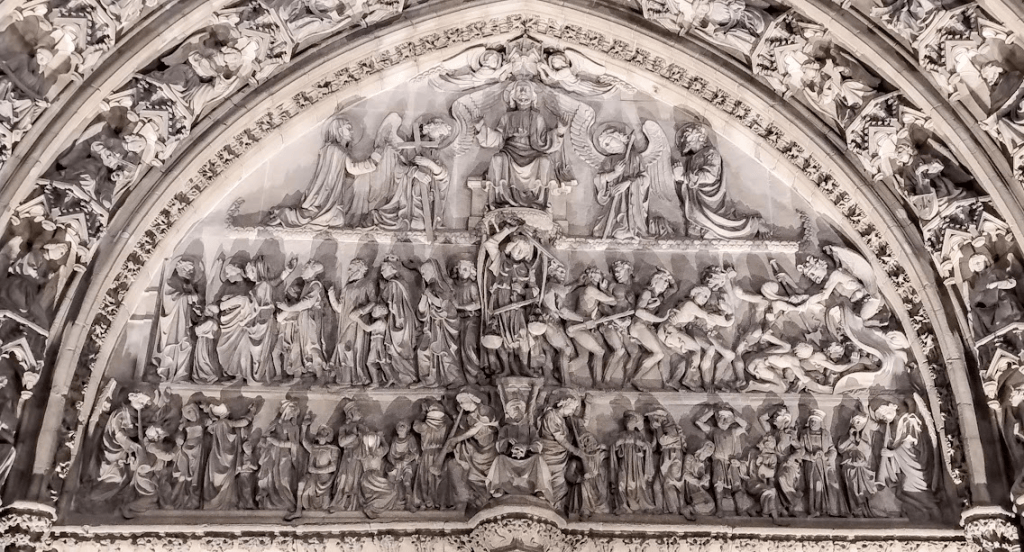
The Monday lunchtime concert in the AMUZ concert hall (a magnificent converted church) was given by Transports Publics with their programme, The Coudenberg Connection: Richard Dering in Brussels. Dering was one of many Catholic convert English musicians who saw no future in England and, in 1617, sought refuge in the Low Countries, where English musicians had long enjoyed an outstanding reputation. He found work at a Brussels Benedictine convent at the foot of the Coudenberg, opposite the cathedral. He later returned home as a private organist to Queen Henrietta Maria and a musician to Charles I. The two singers and six instrumentalists of Transports Publics’ followed Dering’s musical travels with madrigals, instrumental dances and motets, several referencing exile and return.
They opening with a Pavan for two trebles, here played by violin and viola with viols and theorbo support, followed by And the king was moved, in this case, King David over the death of his son, Absalom. A Fantasia followed, built on a pattern of repeated descending notes, cleverly linked to the Italian-style O donna troppo crudo. This was followed by an instrumental In Nomine a6, with the chant melody sung by the soprano. The impressively clear and agile voices made the texts and the musical line clear, and the supporting instruments provided varied accompaniments.
The first (8pm) Monday evening concert was in AMUZ and featured Paul O’Dette and an intimate programme of lesser known lute music from Central Europe aound 1600, covering parts of Germany, Alcase, Poland, and Hungary, and the composers included Valentin Bakfark, Matthias Reymann, Melchior Neusidler, Wojciech Dlugoraj, and Jakob Reis. With around 30 pieces from composers I was not familiar with, it wasn’t easy to keep up with what was what, by the programme was well-planned with a variety of musical genres, ranging from simple homophony to complex polyphonic interplay and echo sequences. Not surprisingly, several pieces reminded me of examples of keyboard music of the period, a repertoire that is often shared.
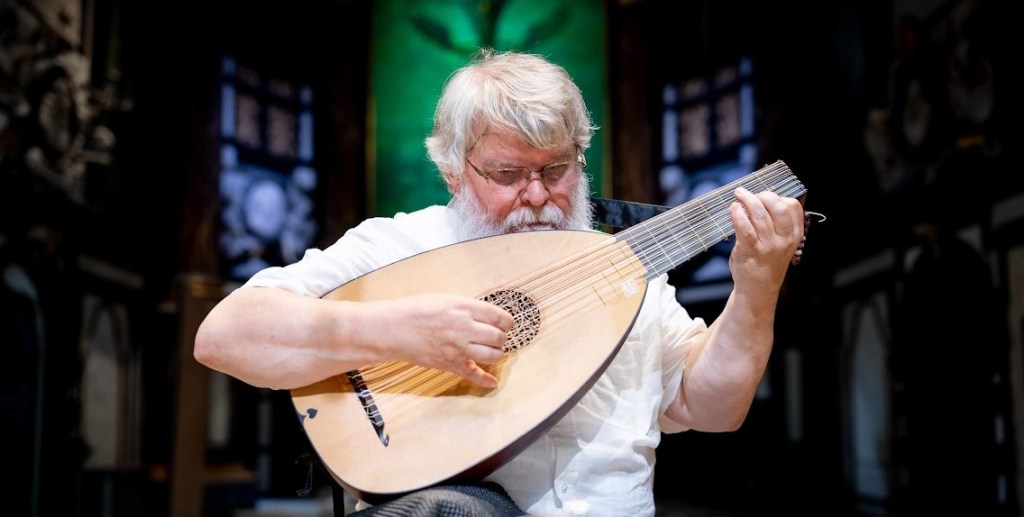
Performance photo © AMUZ / Johan Beckers
The later (10pm) concert was in St.-Carolus Borromeuskerk with Comet Musicke and their programme The Astonishing Madrigals of Pomponio Nenna. It turned out to be the polar opposite of the meditatave lute recital I had just heard. Set in Naples around 1580 when Nenna published his madrigals, the music explored the influence of Gesualdo on the young member of minor nobillity who had become governer of a small town in Puglia under the aegis of the local Duke, who was soon to be murdered by Gesualdo when he was caught in flagrante with in Gesualdo’s wife. His music was described as combining “clever polyphony with harsh dissonances, sharp modulations and a razor-sharp treatment of the text (when) old techniques, such as the fauxbourdon, collided with new expressive freedoms, offering a foretaste of what would come to be known as the seconda pratica”. Nenna madrigals were contrasted with instrumental pieces by Giovanni de Macque, Giovanni Maria Trabaci and Stefano Felis.
Unfortunately there were far too many distractions from the performers to engage me with the music they were performing, not least the distracting habit of several of the singers to conduct themselves and use extravagent hand gestures while singing. The were frequent lapses of singing or playing in consort, and the voices rarely blended succesfully. Several pieces were performed far too quickly for the enormous acoustic of the space. The mid-concert tuning sessions were anarchic rather than organised, and the over-acted story line was incomprehensible, not least through alternating several different languages. They didn’t so much as allow space for audience applause as ostentationally demand it by spinning round to face the audience. The end was unprofessional in several ways, including not having rehearsed how to take their bows, an unashamed plug for a CD recording, an untimetly rush to the exit for self-congratulatory mutual hugs and aggressively desparate CD sales tactics that, incredibly, continued outside the church.
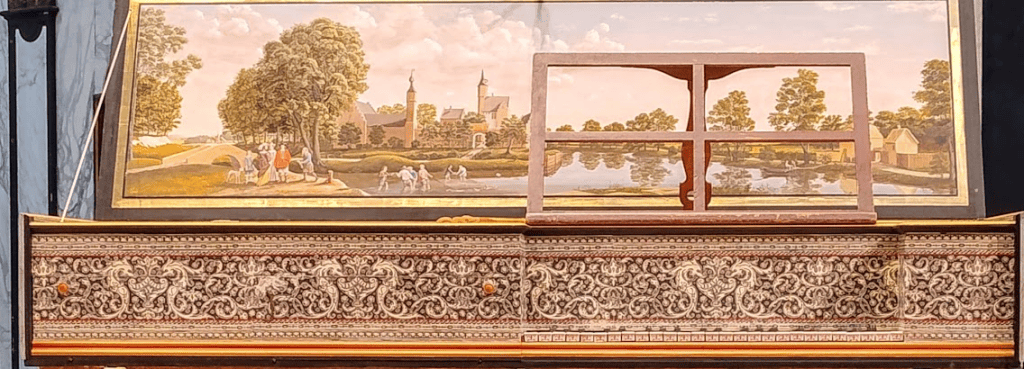
The lunchtime concert on Tuesday 25 August was in AMUZ, with Près de votre Oreille and their programme, Blessed Echoes, featuring English music around 1600, notably John Dowland. It was described in the festival publicity as an occasion when “The warm sound of the viol and the elegant energy of the lute create a combination that sounds both intimate and rich: a velvet bed of sound for the voice to sink into. AMUZ becomes a room in Elizabethan London for the evening (sic), where people listen breathlessly to music that swells their hearts”. The four singers and four instrumentalists (two viols, virginals, and lute/cittern/guitar), made effective use of the space of the stage and the hall, although there was an occasioanal mismatch between the vocal styles of the singers, with one featuring excessive vibrato throughout. It was good to hear the delicate sound of the virginal, and the balance of the instruments was generally good. I thought it was totally inappropriate, not least because of the specialist nature of Laus Polyphoniae, to finish the concert with a very long piece composed by the group’s director, a piece that had no relation to the topic of the programme. I guess it was inevitable that he would then, equally inappropriately, intervene to demand silence as the audience departed so that could offer gushng thanks to the organisers for inviting them, etc, etc and to tell us all about his new CD.
The final two concerts of my time in Antwerp thankfully more than made up for my various concerns about earlier concerts. The first of the two evening concerts featured InAlto and their programme Pierre Bonhomme & La Grande Entrée. It was based on music from the prince bishopric of Liège around 1600, notably the grandes entrées of Ernest and Ferdinand of Bavaria, archbishops and prince-electors of Cologne. A volatile crossroads between France and the the Holy Roman Empire, this occasion became a form of political theatre designed to radiate authority, including triumphal arches, the ringing of bells, cannon fire and impressive music. The drama of the ceremonial was reconstructed by In Alto through motets, songs and madrigals, including music by Jean de Castro representing the local music scene, Anton Gosswin reflecting Bavarian connections while René del Mel, Pierre Bonhomme and Bernardino Mosto illustrated the cosmopolitan taste of the Liège court. The climax of the celebrations was Jean Guyot’s majestic Te Deum.
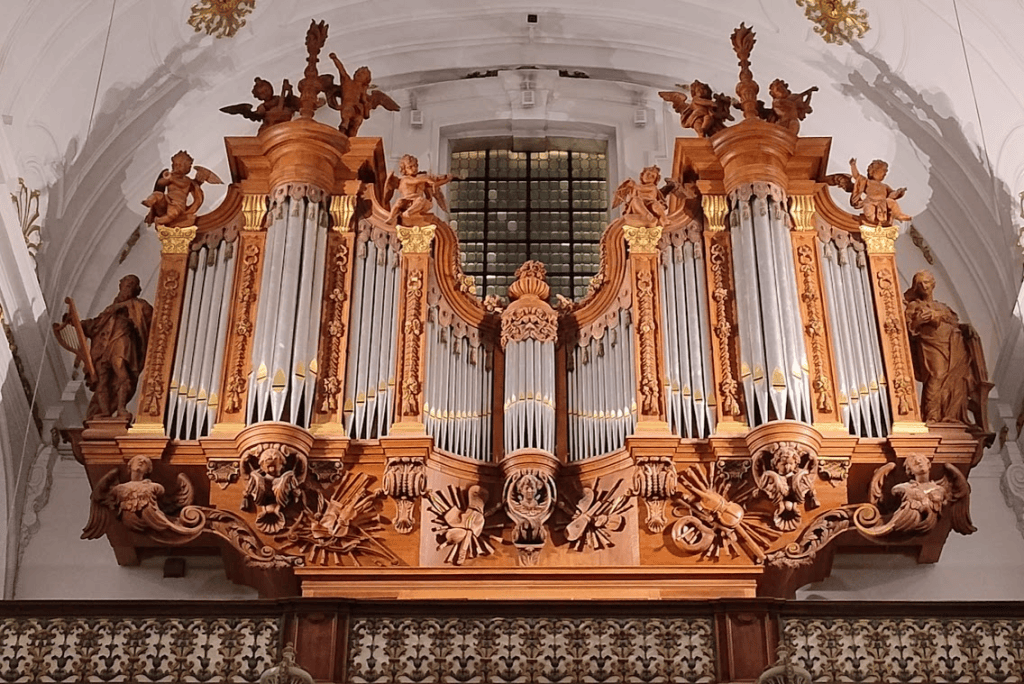
The sense of consort from the eight singers and seven instrumentalists was excellent, as was the individual performances, Key to the vocal consort were the two sopranos, Alice Foccroulle and Ann-Kathryn Olsen, while cornettists Friederike Otto and Lambert Colson provided the flourishes that topped the four trombones. Organist Joseph Rassam provided eloquent accompaniments throughout as well as excelling in a solo performance of a Fantasia by Peter Philips, playing on an attractive looking organ which, like the organ mentioned earlier, at least had a visible display of pipes above the keyboard, as opposed to one of those little box organs. Given the antics of some other ensemble directors, I was also very impressed with Lambert Colson’s unobtrusive and professioanal direction, including well-thought out and indiscrete movement of the musicians between pieces. In Alto are staying in Antwerp to record this programme – it will be worth hearing.
My final event was the 10pm concert on Tuesday 25 August in St.-Andrieskerk, given by the elevn singers of Officium Ensemble under the title of the Glory Days of Portuguese Polyphony. Often overlooked against the Spanish repertoire of the late Renaissance, this was a chance to redress the balance with Portuguese polyphony that was equally rich and refined, notably in music from Évora, a centre of humanism, with its cathedral and university, and the Alentejo region. Their programme contrasted intimate passion music and grandiose polychoral works, some of which have not been heard for centuries. The sensitively unforced voices and excellent sense of consort was one of the highlights, as was the Lamentations by Estêvão Lopes Morago, with their delightfully inventive incipits. and the rhythmic interest of Estêvão de Brito’s Vide Dominicum and the concluding Surge Propera by Manual de Tavares.

A personal postscript.
I’ve mentioned two of the organs that were used during these concerts, both a considerable improvement on the little box organs so often used in present day performances of early music. But that leads me onto some personal thoughts about the role of the organ in future Laus Polyphoniae events and the related historically informed performances of early music that are at the heart of AMUZ. At the liturgical west end of the former 1639 Sint Augustinuskerk, now used as the AMUZ performing space, stands the currently empty case of the organ built by Theodoor Smet in 1839. This organ reused parts of an earlier organ, including some pipework and elements of the impressive Baroque-style organ case, some of which could conceivably date back to the foundation of the church in the early 17th century. The 1839 Smet organ was added to in 1860 and completely rebuilt in 1891, resulting in a romantic organ with twenty-four stops. Although the case has been restored, there is discussion about the evenentual restoration of the pipework (currenrlt removed from the case), much of which of general interest to the City of Antwerp as an example a mid-19th century romantic organ, albeit currently removed from a distinctly Baroque style case.
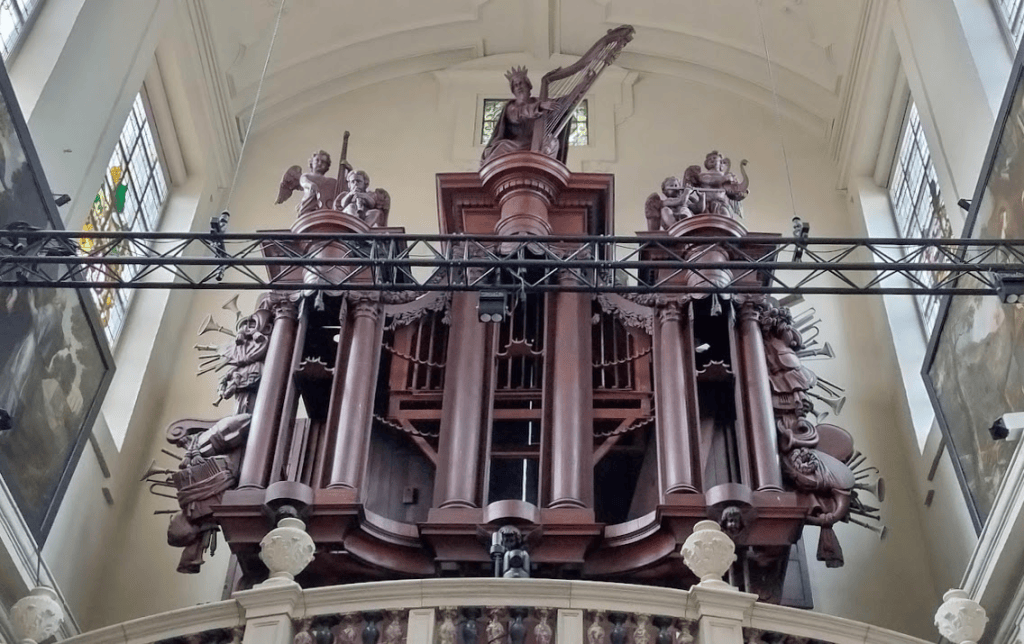
If the organ in AMUZ is going to be restored, I suggest that needs to be restored in such a condition as would encourage use in AMUZ events. A late 19th-century romantic organ is unlikely to meet any of the musical requirements of AMUZ and Laus Polyphoniae events. There is a precedent in Antwerp of an historic organ that had been added to in the romantic era, having the romantic pipework removed and incorporated into a new organ elsewhere in the building, while the earlier pipework formed the basis of a reconstruction of the original 17th-century organ in its original case. While a new romantic organ is unlikely to find a use with AMUZ, the (possible) 17th century case, and what might turn out to be a core of similarly dated pipework, would certainly find an active position within AMUZ and Laus Polyphoniae. The hall’s seating is flexible, so it would be easy to organise concerts with the audience facing the organ with other musicians either located in the spacious organ gallery, or on a stage below.
The type of organ that would most suit the location, and the case, is one which is capable of playing, with a reasonable degree of authenticity, the organ music of the likes of Frescobaldi, Titelouze, Sweelinck, Arauxo, Byrd and other composers of the Renaissance and early Baroque eras. European organs of that period have generally not developed the strong regional variations and characteristics that occured during the Baroque era, so an organ designed with an appropriate specification, voicing, temperament, and pitch could work for a wider variety of music than one designed for Baroque music. Such an organ would be an important part of the ongoing activities of AMUZ, including the Laus Polyphoniae festival.
Anyway, just a thought. There are people involved in the ongoing discussions, and much research on the current pipework and documentation of the organs of the 1639 Sint Augustinuskerk.
I wish them luck!
 Andrew Benson-Wilson : Early Music Reviews +