
Laus Polyphoniae 2026
International Young Artist’s Presentation (IYAP)
AMUZ, Antwerp. 22 August 2026
The annual International Young Artist’s Presentation (IYAP) is a coaching and presentation scheme promoted by AMUZ (the Flanders Festival Antwerp) and Musica. Its aim is to help promising young musicians “grow into tomorrow’s stars”. Six young early music ensembles are invited to three days of coaching by early music specialists before performing short programmes during public concerts on the first Saturday of the Laus Polyphoniae festival (reviewed here). Although part of the festival, their music is not linked to the festival programme. Unlike many similar international young artist events, this is not a competition but an informal opportunity for young musicians to develop their performing style. An invited group of concert promoters and influential others comment privately on these public performances. Scarily for me (and possibly them) my reviews are far from private, but I hope they will be equally helpful.
Ossian’s Dream – Gestillte Sehnsucht
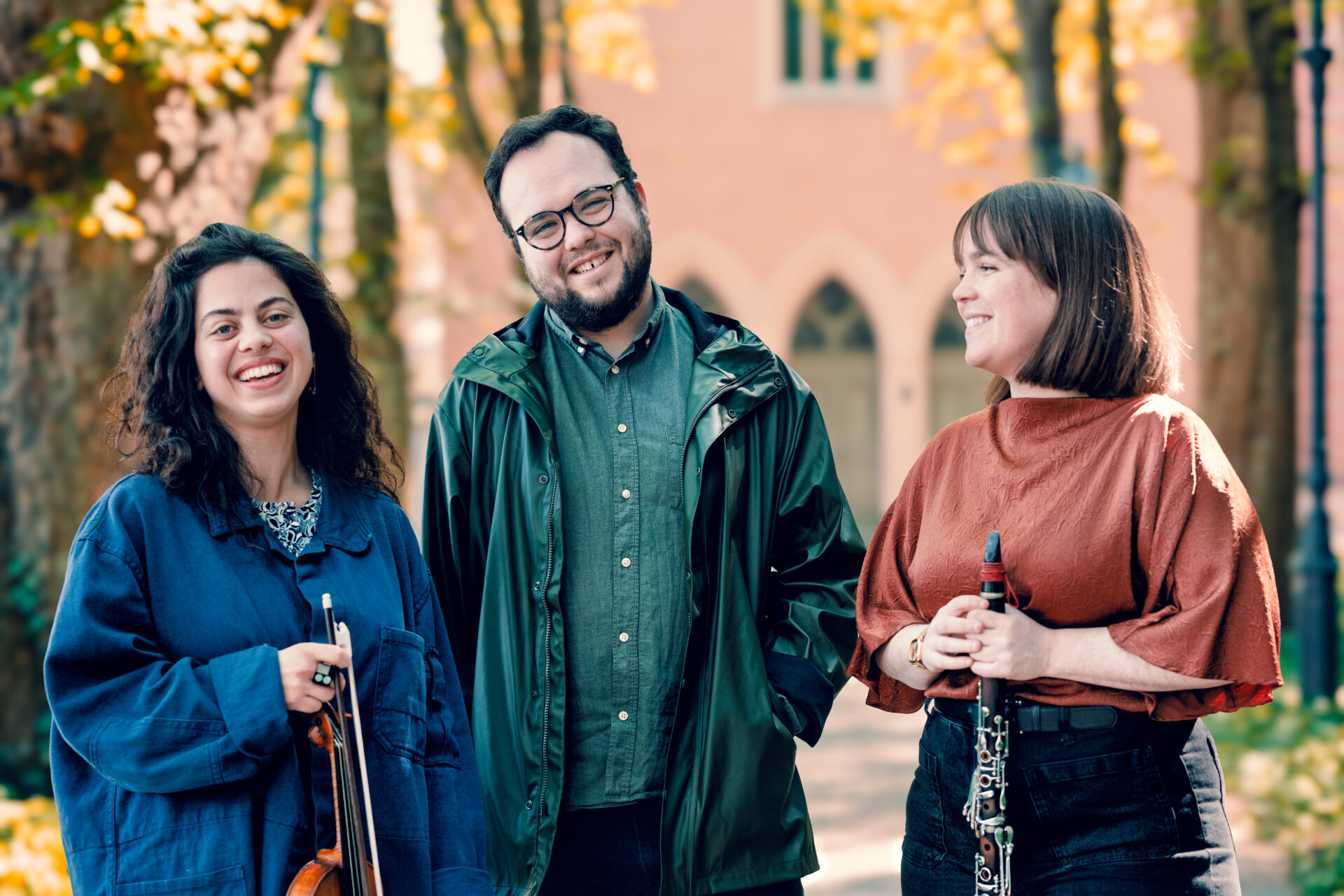
Ossian’s Dream (Claudia Reyes Segovia, clarinet, Léa Al-Saghir, violin & viola, Pau Fernández Benlloch, piano) describe themselves as “an award-winning, flexible collective dedicated to performing 18th- and 19th-century chamber music on historical instruments. They are named after Dominique Ingres’ famous painting of the mythical Celtic bard. Their mission is to revive the historic salon culture as a vibrant space for artistic freedom and interdisciplinary exchange, the ensemble brings the Romantic spirit to life through unique arrangements, melodramas, and improvisation. The ensemble’s innovative approach has earned it significant international acclaim, most notably winning First Prize at both the 2025 International Van Wassenaer Competition and the 2024 Schola Cantorum Basiliensis Ensemble Competition”. I recently heard them play, and win yet another prize, in a slightly larger format, in the 2026 York Early Music International Young Artists Competition.
Their programme was based aound music performed in a late-19th century saloon, the mood aided by one of them sitting in a saloon chair at the start, and with a drape layered over the side of the forte piano. Their programme differered sligtly from that printed in the main festival programme, but included three extracts from Max Bruch’s opus 83 Acht Stücke for clarinet, viola and piano, a selection from Carl Reinecke’s Fantasiestücke, Zwei Gesänge by Johannes Brahms, and the Berceuse by Pauline Viardot-García. Their programme was extremely well presented and played, with some excellent fortepiano links between the pieces giving an attractive flow to the music. One aspect that surprised me was the antics during and between pieces. I can only assume this was something developed during the three days of pre-concert training, but it was very much at odds with the group’s apparent performing and presentational style and with the music. This was not the only group that seems to have been encouraged to add theatrical frivolity to their performance, and it certainly didn’t work for me. Assuming this was the case for this and other groups, I do not see this as the role of the facilitators from Musica when working with young performers. That said, violinist Léa Al-Saghir gamely entered into the spirit, not least with some cheeky and agile interference with her fellow musicians while they were playing.
Ensemble Pampinea – Fortuna, wil you spare us?
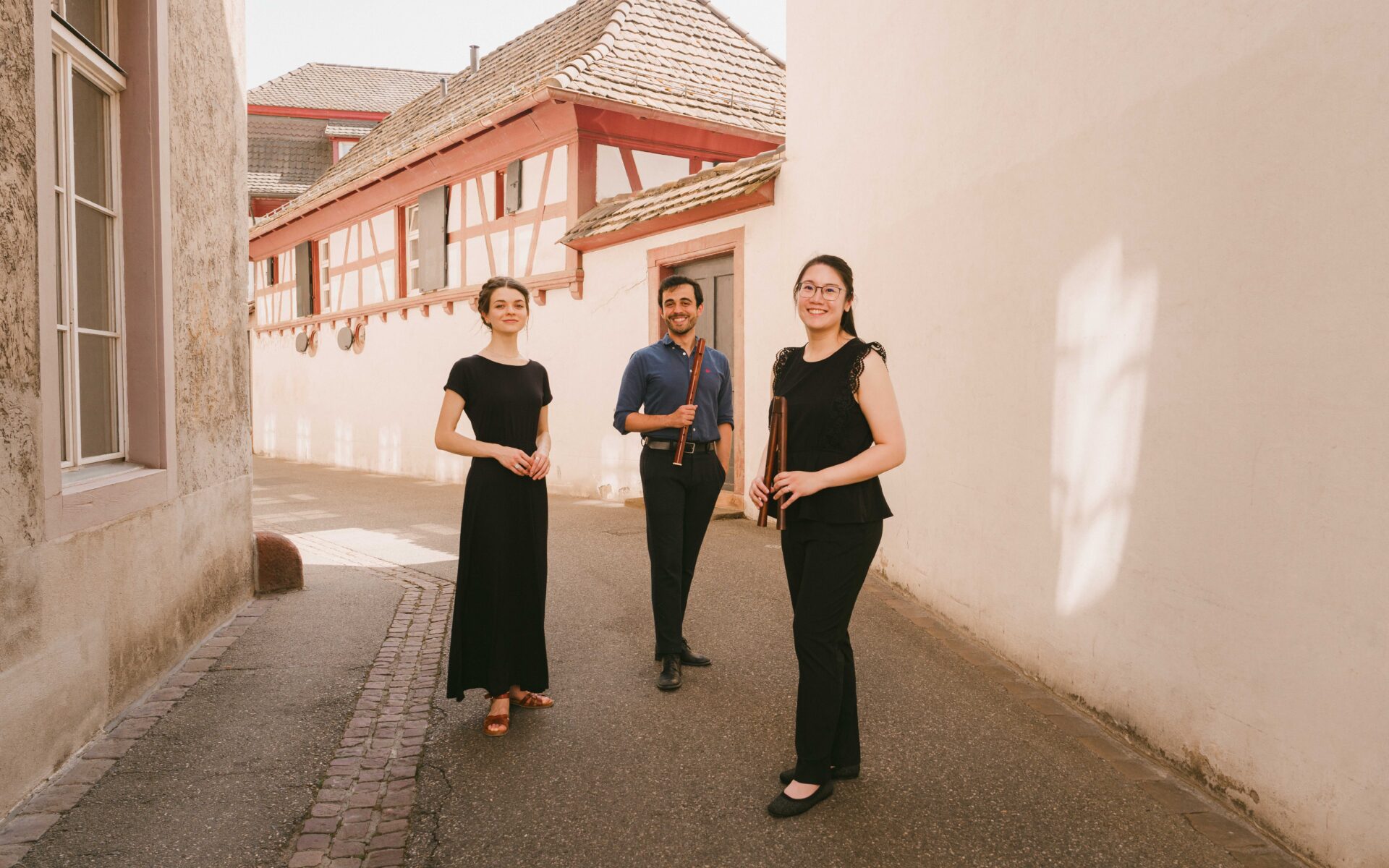
Ensemble Pampinea (Emile Ribokaite, voice, António Godinho, recorder, Fiona Kizzie Lee, organetto, pipe and tabor, recorders & artistic direction) is “a passionate and vibrant early music ensemble based in Basel, bringing medieval and Renaissance repertoire to life through a compelling blend of historical depth and contemporary flair. It is weaving together programs that span Boccaccio’s Decameron with 14th-century Florentine music, Ars Nova and Ars Subtilior, and Burgundian soundscapes inspired by Jan van Eyck. All three musicians trained at the renowned Schola Cantorum Basiliensis, and the ensemble has earned growing international recognition through a First Prize at the London Early Music Young Ensemble Competition (2022), performances at the London International Festival of Early Music (2023), a finalist spot at Musikfestspiele Potsdam Sanssouci, and tours across Europe and Canada”.
They also added a degree of theatricality to their performance by inviting members of the audience on stage to throw a large dice into the air, thereby determining the order of the pieces to be played. Although this might have been something that they have bought with them, rather than encouraged by the facilitors, I am not convinced that it added much to what was otherwise a well-played programme of music from the 15th century. Emile Ribokaite’s voice had a slightly ‘innocent’ feel to it which suited the music well.
Il Concerto Intempestivo – The invisible cities

Il Concerto Intempestivo (Rahel Boell & Jaume Guri Batlle, violin, Rebecca Krieg, cello, Eliot Xaquin Dios, harpsichord) is a baroque ensemble founded in 2023 by graduates of the Schola Cantorum Basiliensis that “bridges historical performance practice with a bold contemporary creative voice. Rather than presenting conventional concert programmes, the group crafts immersive musical narratives – most notably their The Rite of Spring – Baroque edition – earning them the First Prize at the Musikfestspiele Potsdam Sanssouci Competition (2025) and the Emerging Artist Competition in Vancouver (2024), alongside appearances at leading early music festivals”. They aim to “push early music to its most imaginative possibilities”. They did this with a programme centered around a mythical and rather esotetic journey with instrumental music composed by Jean-Féry Rebel, Salomone Rossi, Pepusch, Guillaume Du Fay, and two members of the group.
I might have missed something, but I wasn’t convinced about the story that they built up around the music, which ranged in date across several centuries from Du Fay to the present day. Their spoken interludes didn’t add much, at least to me. As with the two previous presentations, I did wonder why they didn’t just concentrate on playing music suited to their instruments. Good music, played well, and with conviction, doesn’t need the addition of theatre, drama, poetry, or mythical journeys.
Primo Getto – Until peace comes

Primo Getto (Katerina Blížkovská, mezzo-soprano, Emanuele Petracco, tenor, Anna Antonuccio Johansen, bass violin and Marcin Kranz, theorbo (replacing Nicola Benetti, harpsichord & organ) describe themselves as “a young ensemble bringing together voice, harpsichord, organ and bass violin in performances praised for their rare intimacy and depth of connection. Founded in 2025, the ensemble has already made a strong impression as finalists at the Première competition at FestiVita in Brussels (2026). Their debut programme Until Peace Comes, a journey through early German sacred music in the shadow of the Thirty Years’ War, has been performed in Brussels, Perugia, and Verona, with upcoming concerts in Denmark and Sweden confirming their growing reach across Europe”. And it was performed on this occasion as well, a fascinating and well presented programme of music composed during the horrors of the Thirty Years War with music by Scheidt, Schein, Schütz, Hildebrand, and Hammerschmidt.
It is easy to forget the conditions under which composers of this period suffered while producing some of the most heartfelt music of the 17th century, on this occasion, perhaps best represented by Johann Hildebrand’s pleas for peace, Ach Gott! Wir haben. Other highlights were Schütz’s Wann und’re Angen schlafen ein with its distinctive descending chromotic lines, and Hammerschmidt’s declamatory O bone Jesu. I was impressed with Primo Getto’s interaction and engagement with the audience, which included gentle indications as to when applause was appropriate.
Trio Turbulences – Between heaven and earth
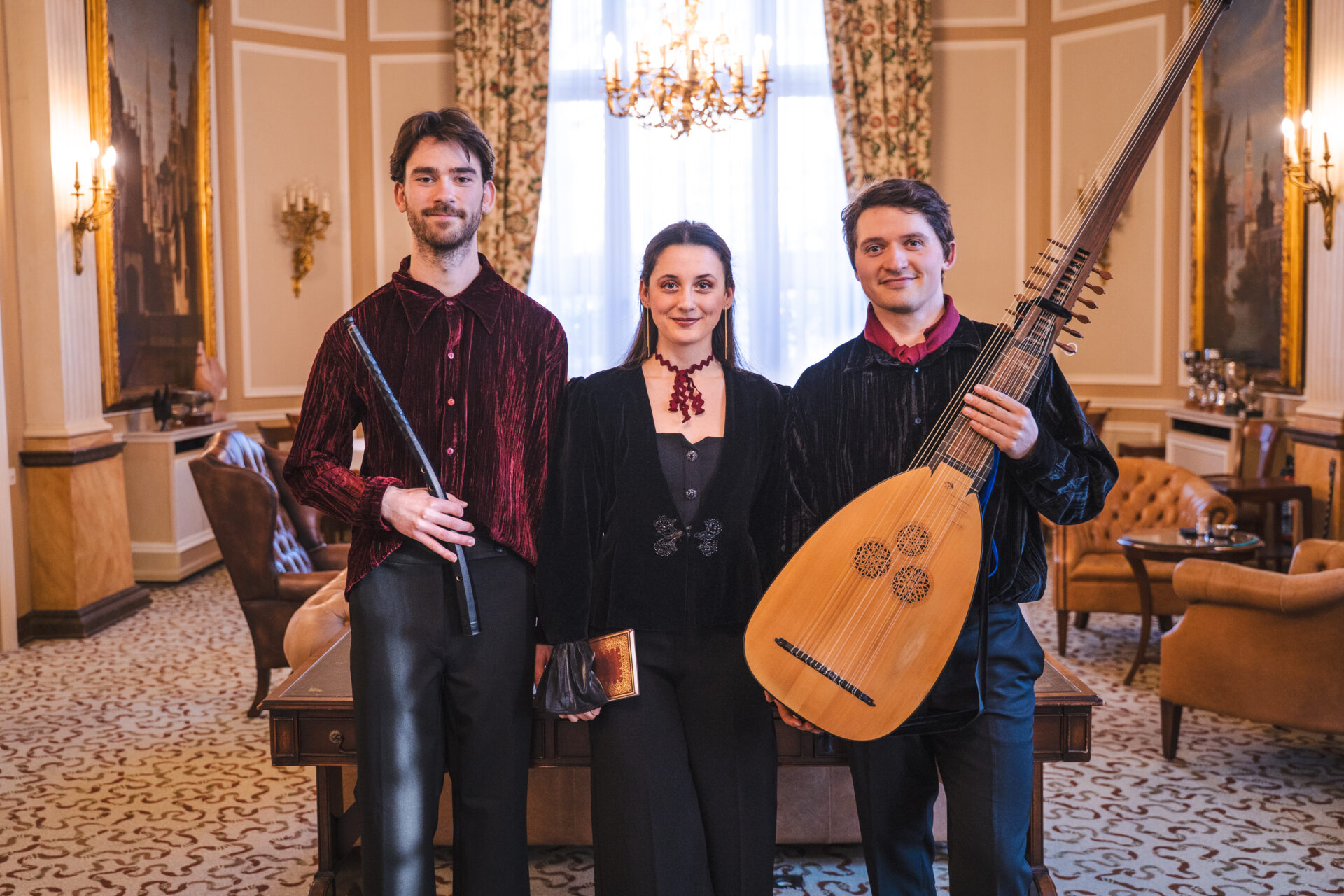
Trio Turbulences (Ana Parejo Belando, voice, Tim Meulenbeld, cornett, Eric Meier, lute) was founded in 2024 at the Haute École de Musique de Genève. They describe themselves as a group that “unites voice, cornett and lute in an artistic practice rooted in original historical sources, where improvisation and composition are as central to the performance as the repertoire itself. Its deliberately intimate instrumentation allows the cornett’s voice-like timbre to blend seamlessly with the singer, creating a rare expressive and rhetorical intensity that brings 16th- and early 17th-century music to life as a living, breathing creative act. Winners of the First Prize at the Première Chamber Music Competition at FestiVita! Brussels (2026), the ensemble has performed in collaboration with the Musée d’Art et d’Histoire de Genève and the Musée de la Réforme, appeared at the L’Estivale Festival and the Théâtre de l’Orangerie”.
Their programme for this showcase event featured music that they linked to the power of nature as reflected by poets and writers over time and the music they inspired, including d’India, Tessier, Luzzaschic, de Rore, Merula, Foccroulle, and Nauwach. The highlight for me was Merulo’s extraordinary Canzonetta spirituale sopra alla nana with its moving combination of lullaby and lament, the whole built on an accompaniment of just two adjoining notes. It was interesting hearing the cornett contrasted with the voice, a pairing of importance in the 16th and 17th centuries.
KIMA – Foolish men and refined beasts

KIMA (Kaho Inoue, soprano, Ivana Ivanovic, mezzo-soprano, Léon Roch, tenor, Arthur Baldensperger, baritone) was founded in 2023. They describe themselves as “a vocal ensemble that brings early music to life through a boldly theatrical and sensory stage language. Drawing on repertoire from the 14th to 16th century, the Basel-based musicians, all formed at the Schola Cantorum Basiliensis, craft performances that are as intimate and expressive as they are scenic and immersive, weaving movement and narrative into every concert so that audiences become participants in a living story. Since winning an internal competition at the Schola Cantorum Basiliensis and performing at the fringe of the Festival Oude Muziek Utrecht in 2024, KIMA has continued to build its reputation across Europe with appearances at Festival Linee in San Marino, ReRenaissance Basel, Kloster Schönthal, and concert venues in Basel and Mulhouse”.
Their programme drew on the animal kingdom for inspiration, with music from the late medieval era by Firenze, Bologna, Molins, Hasprois, Solage, and anon. Much was made of theatrical devices to depict animals as a “symbol of idea”, a “satirical mirror of human flaws”, and “the human mind, on the verge of madness”. Much was made of Flauval’s horses head, amongst complex arrangements of chairs and a table, all of which was, at least to me, a bit of a distraction from the music itself.
Next year’s Laus Polyphoniae 2027 is from Friday 20th August 2026, so the IYAP presentation will presumably be on Saturday 21st August.
 Andrew Benson-Wilson : Early Music Reviews +