Rossini’s Petite messe solennelle
Monteverdi Choir, Orchestre Révolutionnaire et Romantique, Jakob Lehmann,
Robyn Allegra Parton, Natalie Lewis, Petr Nekoranec, Bogdan Talos
Alexandra Palace Theatre, 18 October 2026
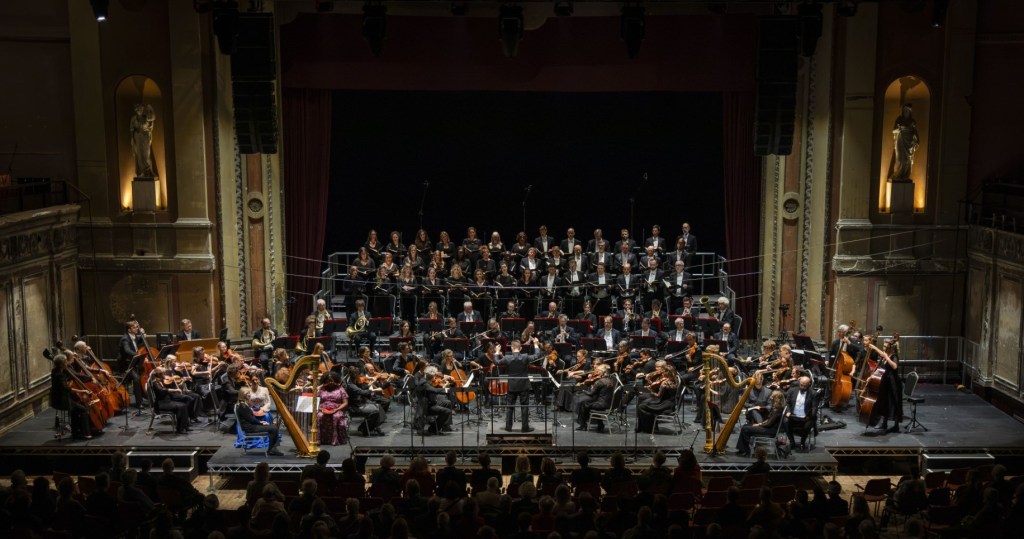
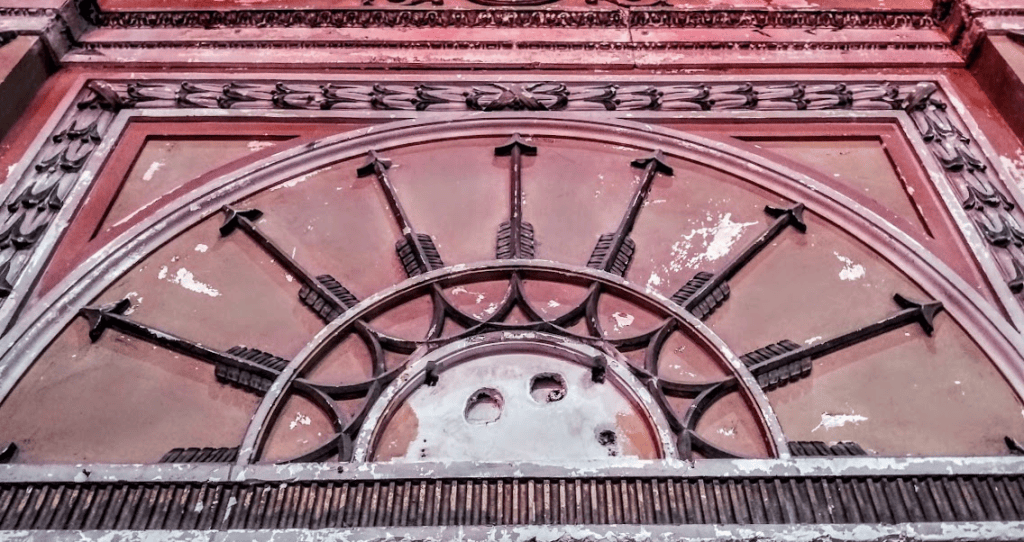
This event was a musical revelation! Billed as “the first performance in modern times on period instruments” of the orchestrated version of Rossini’s Petite messe solennelle, this concert made it abundantly clear why it is so important to hear music played with the sound that the composer and early audiences would have heard. On this occasion, it was the orchestral forces of the appropriately named Orchestre Révolutionnaire et Romantique with the Monteverdi Choir, brilliantly led by the very knowledgeable conductor Jakob Lehmann who had very obviously done a lot of research into the score and the musical background and performing conventions of the time. The venue was the enormous theatre in the Alexandra Palace complex with a surprisingly good acoustic for these musical forces, all enlivened by the sparse remains of some delightful wall decorations, all in a state of arrested decay.
The Petite messe solennelle was first composed in 1863 for 12 singers accompanied by two pianos and a harmonium. It was Rossini’s first composition for about 20 years, and he described it as “the last of my sins of old age”. Three years after the first performance (in a private mansion in Paris), Rossini orchestrated the accompaniment, seemingly to prevent others doing it after his death. He disliked the sound of boys’ choirs, so asked the pope for permission to perform the work in church with female voices. That request was rejected, so he decreed that the orchestral version must not be performed after his death. In any case, he apparently preferred the chamber music version. The first performance of this orchestral version took place in February 1869, three months after his death.
Rossini is a little outside of my usual ‘early music’ reviewing and performing remit, but it is work I have heard a few times in its original format. The sheer scale of this event was a shock for me, not least with the transformation from 12 singers, two pianos and a harmonium to around 45 singers and an orchestra of about 65. The Alexandra Palace theatre is a very large space, but the orchestra spanned the entire width of the hall, with the choir sensibly placed within the proscenium arch so that their voices projected forwards rather than up into the theatre fly tower. The positioning of the instruments was notable with, for example, the seven double basses (using the four-string set-up requested by Rossini) divided to the far left and right of the orchestra, the use of the distinctive, if rather industrial looking, ophicliede positioned where the tuba now usually sits to the right of the trombones, and the placing of the two harps in the Qui tollis of the Gloria to the right and left of the conducer at the very front of the stage – a very effective position that reflected the too and fro nature of Rossini’s harp writing.
Another instrumental innovation of this performance was the use of a digital organ whose sound was based on recordings of a Cavaillé-Coll organ, the principal French organ builder of the 19th century. It is not entirely clear what sort of organ Rossini invisaged for the orchestrated version although, given his query about using female voices, it was clearly intened for performance in a church, rather than the Salle Ventadour theatre/opera house which was its enventual first venue. On this occasion, the organ was used in an almost inaudible (at least from my seat) supporting role in several movements, but came to the fore in the instrumental Preludio religioso which acts as the liturgical Offertory within the context of the Mass setting. It lasts for about seven minutes and, apart from a very short (and loud) brass introduction and coda, is a lengthy and highly chromatic fugal organ solo. This far from easy score was performed with assured confidence by William Whitehead.
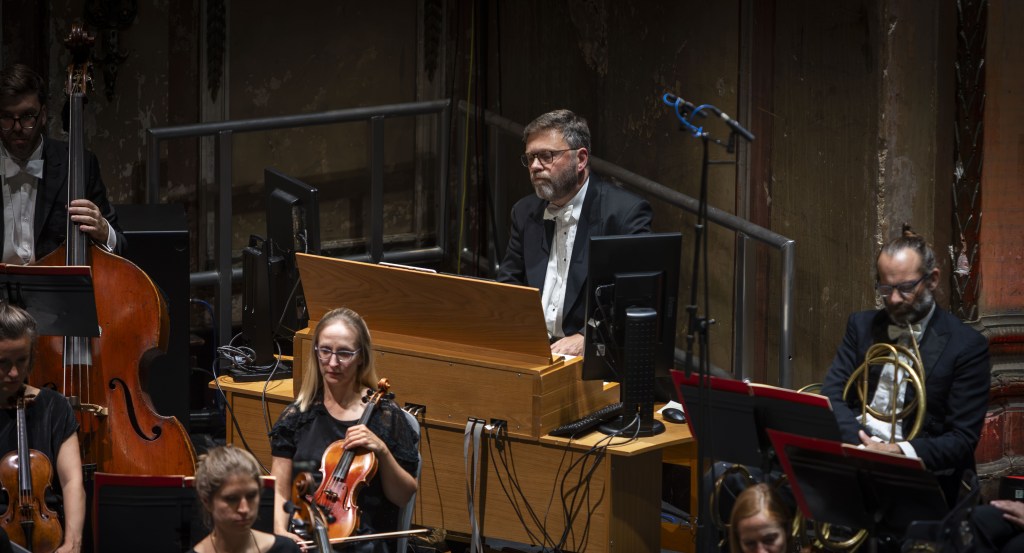
William Whitehead, with Hauptwerk organ
I have some thoughts about the organ’s sound and volume. The score (at least the one I could access online) marks the organ solo in the Preludio religioso as for “Hrm or Pf” (harmonium or piano). The score supports that, with no independent pedal line indications and several indication of piano or harmomium use. There is only one (ornamental) note during the fugue that goes below the compass of a French 19th century church organ. Although a little bit louder than before, with the recognisable sounds of a Cavaillé-Coll organ (it was a Hauptwerk version of the large organ in Notre Dame de Metz), I was unsure if it was intended to represent a large harmonium or a real large Cavaillé-Coll church organ. If the latter, it should have been very much louder (dynamics are marked from pp to ff) and with a much greater audible presence and depth. I overheard somebody refer to it as a “chamber organ”. From what I could see, the organ’s speakers were next to it on the far left of the orchestra between the double basses and the horn section. I did wonder if they had tried using the hall’s enormous speaker towers suspended high and to the sides of the proscenium arch. That would gave allowed a much greater acoustic depth and volume and as well as being roughly where a large-scale French west gallery organ would have been positioned above a choir and orchestra.
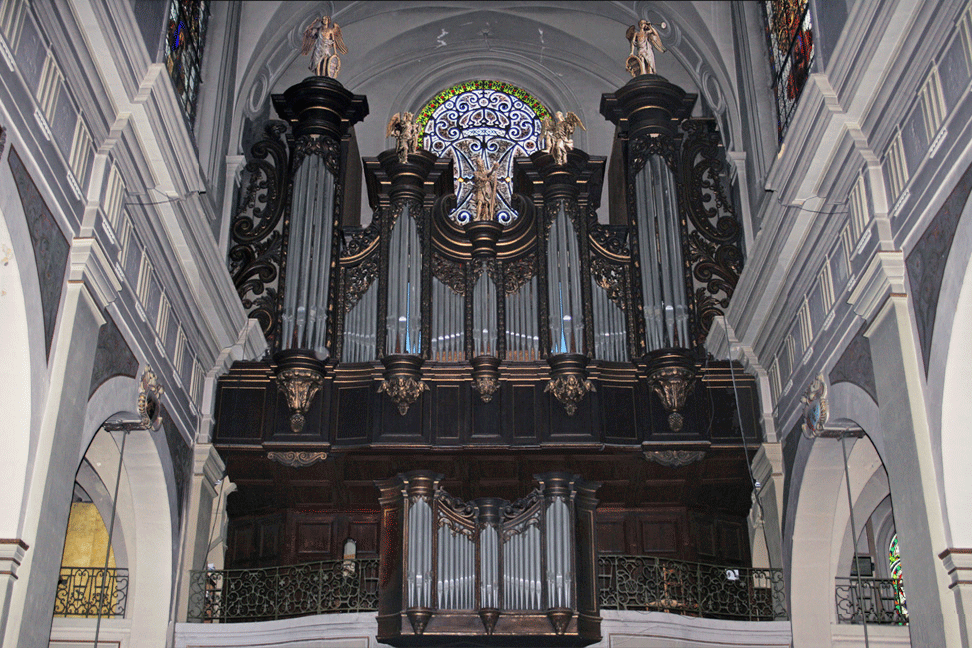
Cavaillé-Coll organ, Notre Dame de Metz
Both vocally and instrumentally, there were several other moments of interest in Jakob Lehmann’s interpretation, one being the widespread use of portamento (sliding from note to note) from both. In my usual reviewing, that is an absolute no-no, so it took a while to get used to it. Vibrato was another issue that I would usually argue against in an earlier repertoire, but on this occasion, once I had attuned my ears and brain to it, the strong vibrato of the four soloists and the choir sopranos seemed to fit the quaisi-operatic nature of much of the music. It was, however, noticeable that the strings used minimal or no vibrato – an interest contrast in musical texture. I am not an expert of timpani, but the simple ‘bowl on sticks’ pair used here looked a little old-fashioned by Rossini’s time, but produced a wonderfully precise tone. It is rare for me to mention an ophicleide or the player of one, but Marc Girardot deserves a special mention, as does the ophicleide, for the important role it had in this performance. Its direct and clear sound provided an intensly solid bass line in several of the movements.
The vocal soloists, Robyn Allegra Parton and Natalie Lewis, Petr Nekoranec, and Bogdan Talos were obviously well versed in operatic-style singing, their powerful voices projecting above the sound of the large orchestra. Tenor Petr Nekoranec was the first soloist with his Domine Deus his voice floating, seemingly effotlessly, into his upper register. It was here that the frequent use of rubato (a flexible approach to the notated rhythm) was first fully evident, a feature of Jakob Lehmann interpretation. Robyn Allegra Parton and Natalie Lewis joined forces for the following Qui tollis featuring the antiphonal harps mentioned about. Bass Bogdan Talos made the first of many powerful intejections with the Quoniam before the choir burst in with the Cum Sanctus Spititu and Amen. Robyn Allegra Parton had the key vocal solo with the O salutaris hostia, which, along with the Preludio religioso was added to the score for the orchestral version. The wide range of dynamics was noticable throughout, with rapid and extreem contrasts of dynamics, often on a single note or in very short phrases, and several incidents of dramatic sforzandos.
Jakob Lehmann‘s principal role was in the background work on interpretation, bringing many musical traditions of Rossini’s time to musicians that were probably unfamiliar. The Monteverdi Choir members rose to occasion magnificently, singing with conviction and dedication. His actual conducting and direction was most impressive, with clear indications as to what he wanted, and no unneccesary fluff or posturing.
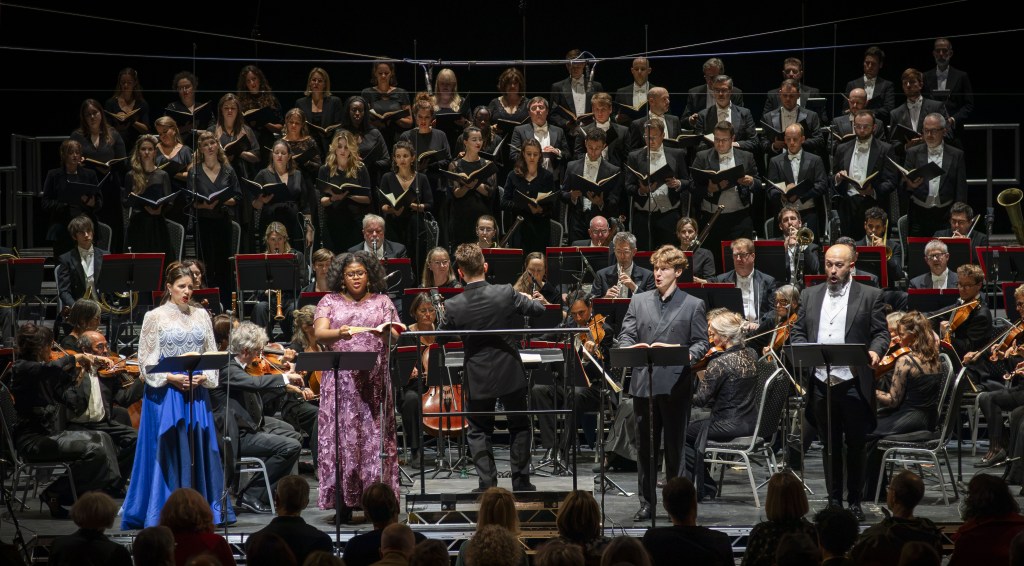
This was a memorable event, which we will one day be able to experience through a recording to be released next year – something to look forward to. Incidentally, there are many more photos on the Monteverdi Choir social media and website.
Performance photos: Paul Marc Mitchell
Theatre decor photo: ABW

