
“In the Belly of the Beast“
Élisabeth Claude Jacquet de La Guerre: Cantates Bibliques
Carolyn Sampson, Mariana Rodrigues
Liam Burne, Lynda Sayce, Alice Earll
Metronome London, 27 June 2026

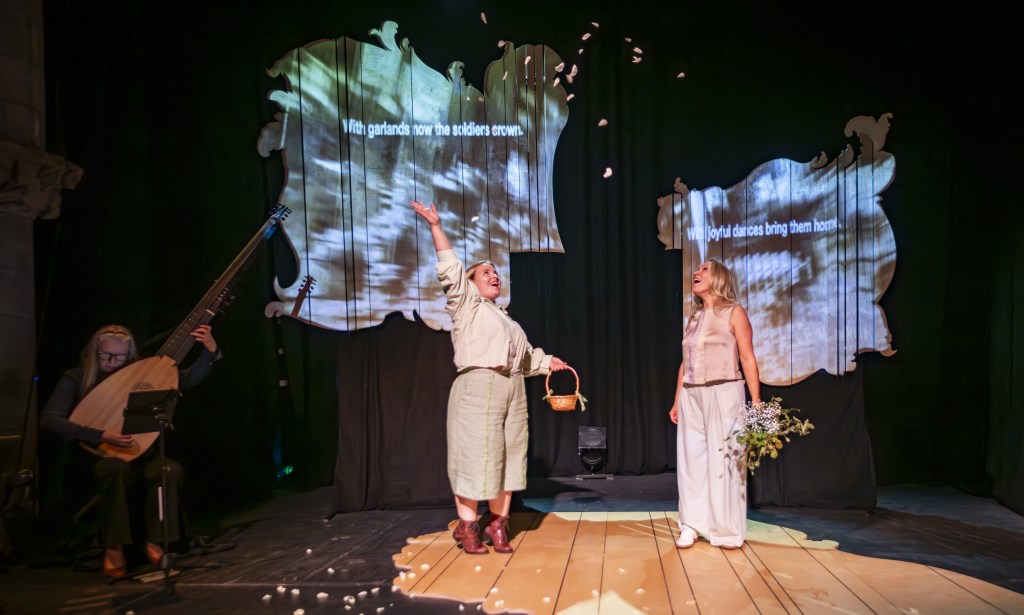
London’s latest record-breaking heatwave, combined with the lack of air conditioning at the previous evening’s venue, turned this into the opening event of this year’s Spitalfields Festival. The air conditioning at this event in Metronome London (a small black-box venue forming part of a new building that seems to house elements of various out-of-London universities) certainly made itself felt, to the bizarre extent that the organisers emailed attendees to warn them to bring additional clothing, something that was apparently easier than anybody actually turning the air conditioning down! The concert featured a staging of three of Élisabeth Claude Jacquet de La Guerre’s Cantates françoises sur des sujets tirez de l’Écriture à voix seule, et basse-continue, published in two volumes in 1708 and 1711, sometimes referred to as Cantates Bibliques.
Élisabeth Claude Jacquet de La Guerre (1665-1729) was a key musician in Paris during the years of the Sun King, Louis XIV and the environment of Versailles, where she was first noticed by Louis XIV while performing there aged five. She soon became a regular member of the king’s inner mucial circle. She came from a family of musicians and instrument makers based on the Île Saint-Louis. She was taught the harpsichord from an early age, and went on to compose a wide variety of music, including operas, trio sonatas, harpsichord pieces, sacred and secular cantatas, a Te Deum and various songs.
This event included three of her Cantates Bibliques, Adam and Jephté from book 2 and Jonas from book 1. The singers were sopranos Carolyn Sampson and Mariana Rodrigues, the former a very well-established singer I have reviewed many times over the years, the latter a recent graduate. It was interesting to compare approach the two singers to the music and style of singing. Both with commendably expressive in their delivery but, as is so often the case, age can make a more pronounced vibrato inevitable. This was very evident in Carolyn Sampson’s singing but barely noticeable in Mariana Rodrigues. In terms of the ability to negotiate the complexities of French Baroque ornamentation and vocal style, Carolyn Sampson’s agile and flexible voice was a masterclass in interpretation. Both coped well with the acting required in this staged interpretation of the music.
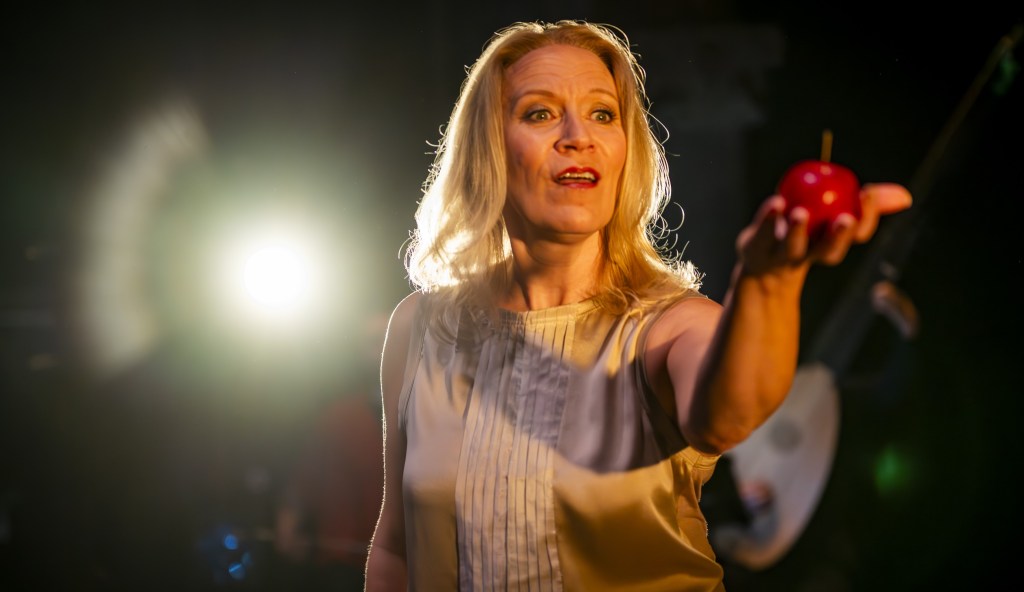
Carolyn Samson with Adam’s apple
The instrumentalists were Liam Burne, viola da gamba, Lynda Sayce, theorbo, with Alice Earll, violin, joining for the central Jonas cantata, the technical complexities of which can be seen and heard from this recording with the score. All the cantatas involved virtuoso and dramatic playing from the viola da gamba, with the theorbo possibly replacing the harmonies of an original harpsichord. The pair produced a well-balanced sound that suited the small venue from their position on the left side of the stage. The staging was rather contrived, with two large panels on the walls which had the English words projected onto them, to varying degrees of success, and one floor panel which seems to have begun to come apart during the first cantata, something that presumably bypassed the risk analysis.
One of the promotional ads described the cantatas as “a thrilling examination of the human condition, individuals brought together in their attempts to confront the unfairness of the world humanity finds itself in, and uncover the true cruelty and arbitrariness of the powers that be“. The “powers that be” are the God of the Old Testament, then apparently a mere ‘duality’ rather than the New Testament ‘Trinity’ they were to become. And what a deeply unpleasant chap he clearly was. The rather cluncky contemporary English reworking of the text gave him phrases like “Don’t forget who gave you your freedom … As payment, I want something from you … The heavenly Father giveth and taketh away” – a truly Trumpian litany of self-aggrandizement, greed, self-importance and appalling lack of respect for what seems to have been his own creation. This performance must surely have turned any lingering agnostics into adamant atheists. Frankly, I would have much preferred the whole thing to have been sung in its original French, without knowing the nonsense of the text.
Apart from the unwelcome blast of very cold air, the thing that really put me off from the start of this event was the programme. Of the four A4 sides, one promoted the Spitalfields festival, one the details of the two singers and the names of everybody involved, the latter amounting to an extraordinary list of 12 individuals or organisations in addition to the two singers and three instrumentalists. What really got my goat was the fact that the programme gave no information at all about the three instrumentalists – merely their names! The central two A4 sides were taken up with lengthy CVs of some of the others involved. There was also no information about Élisabeth Claude Jacquet de La Guerre, or the cantatas being performed. This was an unforgivable slight on the composer and musicians involved in the event. As the individuals or organisations have given themselves quite enough publicity through the programme, I have concentrated on what to me were by far the most important people involved.
Production photos (from a performance in Edinburgh): Andy Catlin

