Handel: Theodora
Monteverdi Choir, English Baroque Soloists, Christophe Rousset
St Martin in the Fields, 19 November 2026
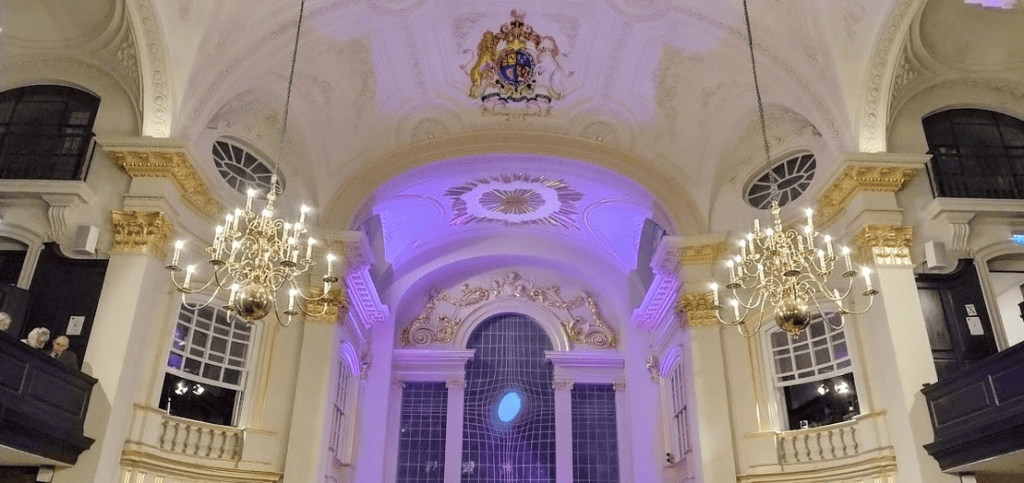
The Monteverdi Choir and English Baroque Soloists with Christophe Rousset completed their tour of Handel’s Theodora covering four concerts in South America followed by Paris, Rome, Oxford and this performance in London St Martin in the Fields. Staging restrictions in both the UK venues meant that we saw a reduced version of the otherwise semi-staged event enjoyed in the other venues, photographs of which reveal a very different and more extravagant visual style, notably from the Monteverdi Choir. On this occasion, the performing style was relatively ‘straight’ with only a few of stage director Thomas Guthrie’s elements apparent, although the prominent one at the end was wonderfully evocative. That said, I found the performance absolutely gripping and emotionally intense, not least by allowing Handel’s music to do the talking, so to speak.
The role of the choir is critical in this oratorio, particularly when performed in concert rather than in the full-stage opera versions. One of the most notorious of those was Peter Sellars particularly gruesome 1996 Glyndebourne staging with William Christie and the Orchestra of the Age of Enlightenment, the final scene of which is still etched my mind. On this occasion, unless you knew the oratorio or were following the text, you may not have realised that the imprisoned Theodora and Didymus had actually been executed, as the only textural reference is Irene’s “Ere Thiis their Doom is past and they are gone”.
On this occasion, the most powerful of Thomas Guthrie’s directorial interventions came during the final scenes as Theodora and Didymus await their end. The entire choir, previously uniformly dressed as white-topped waiters or hospital orderlies, left the stage to then reappear in an array of casual clothes to sing the chorus How strange their Ends in surround-sound from the auditorium’s aisles and galleries. Perhaps I’m just a softie, but I found it really moving to be sitting a few feet away from a young soprano singing in the central aisle as part of a four-voice group. The choir then returned to the stage, this time in random voice order for the final chorus.
Vocally the cast were strong. I particularly liked Marie Lys as Theodora, with her clear and focussed voice and her gentle and well-controlled use of vibrato. In contrast, I found Iestyn Davies’s (as Didymus) continual and rather strong vibrato disturbing, particularly when set against Marie Lys in duets. John Chest was a powerful Valens while Guy Cutting was a richly-voiced Septimius. Jonathan Hanley sang the Messenger role from within the choir. Alice Coote stole the show as far as character involvement was concerned, as she visibly felt the emotion of the texts, although such was the layout of venue that only those close to the front would have been able to easily witness this.
That brings me to one of the problems with performances in St Martin in the Fields. The orchestra and the soloists are at floor level with the choir on a low staging behind the orchestra. Unless you are sitting close to the front and without anybody tall in front, you are unlikely to see much of the soloists or any of the instrumentalists. On this occasion, the soloists were almost entirely in the narrow space between the orchestra and the front stalls, with several moments of singing away from the centre. I do wonder if greater use could be made of the wide central aisles for semi-staged performances like this. I realise this is particularly relavent to me as a reviewer as knowing who is doing what is pretty important.