Haydn in London
English Baroque Soloists
Peter Whelan, Christophe Coin
St Martin-in-the-Fields, 18 June 2026
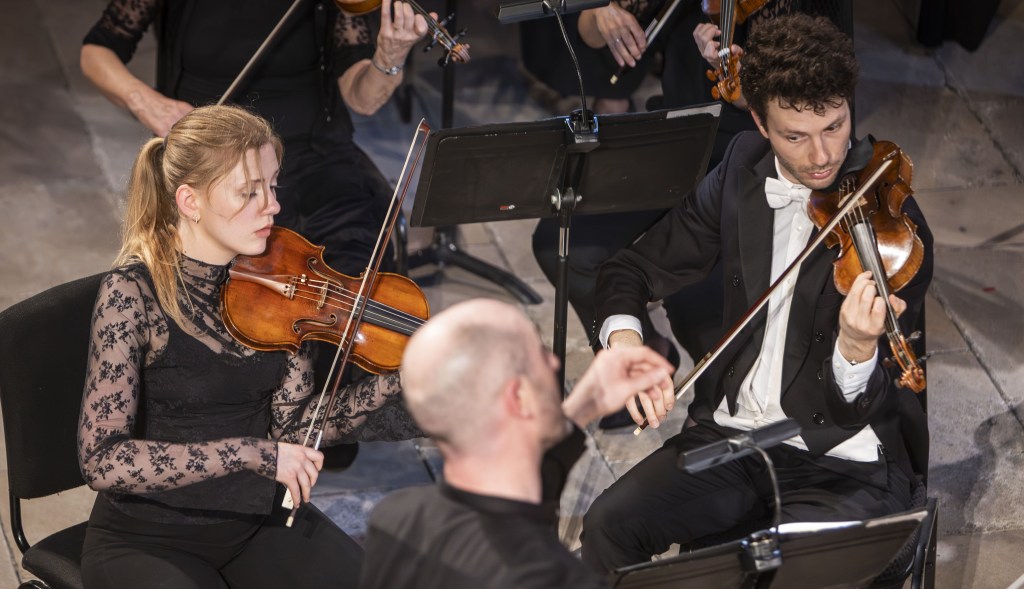
Charlotte Spruit, leader of the English Baroque Soloists
Haydn: Symphony No. 100 in G major (Military)
Haydn: Cello Concerto No. 2 in D major
J.C. Bach: Symphony in G minor
Haydn: Symphony No. 104 in D major (London)
Haydn is a little outside my usual early music reviewing radar, apart from the occasional Creation, which I’m afraid always gives me the giggles. So an evening with three major Haydn pieces was a bit of an eye and ear opener for me. Part of the 300th anniversary celebrations of St Martin-in-the-Fields, this concert from the English Baroque Soloists featured music written and first performed within a stone’s throw of the church. A pre-concert talk by historian Katherine Alcock set the historic scene, with conductor Peter Whelan joining for a discussion on the evening’s music.
Although well-known in London musical circles before his first arrival in London, notably through performances of his music at the Hanover Square Rooms in the period following the early death of Johann Christian Bach (the ‘London Bach’, and youngest son of Johann Sebastian), whose Symphony in G minor opened the concert’s second half. The death of Prince Nikolaus Esterházy in 1790 gave Haydn the freedom he needed to travel. The musical promoter, Salomon, took advantage of this newfound freedom to invite Haydn to London in 1791/2 and again in 1794/5.
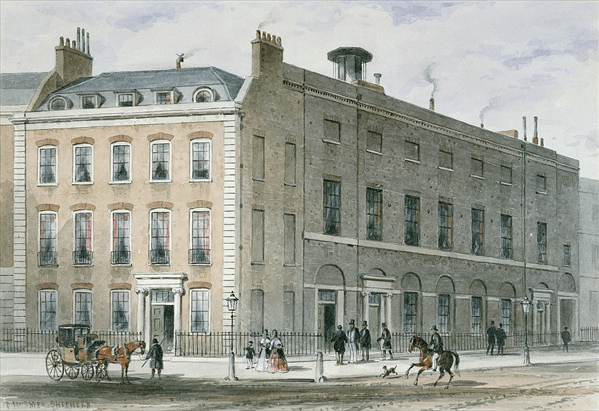
Hanover Square Rooms
After a rather anarchically cacophonous tuning-up session, the concert opened with Haydn’s ‘Military’ Symphony (No. 100). This was the eighth of twelve London symphonies written by Joseph Haydn in 1793/94, and was first performed at the Hanover Square Rooms in March 1794, with Haydn directing from the fortepiano. I am not sure if there are any contemporary references as to how Haydn would have directed from the fortepiano, but I doubt it was anything like Peter Whelan’s approach. He barely touched the fortepiano, instead standing in front of it, only occasionally leaning down to just above knee level to play a note or two. The performance was gutsy, making the most of the volume contrasts hinted at in the score with three percussionists making the most of the Turkish instruments, notably the military Turkish Crescent, a bizarre-looking pole with various bells attached, giving it the alternative name of Jingling Johnny.
Haydn’s Cello Concerto No. 2 was given a more restrained reading, although the subtle sounds of Christophe Coin’s solo cello were still occasionally overpowered by the reduced orchestral forces. It had been premiered at the Hanover Square Rooms in 1784, before Haydn’s London visits. Despite Christophe Coin’s generally subdued performance, he seemed to relish the virtuosic nature of much of the passagework, particularly in the final Rondo movement.
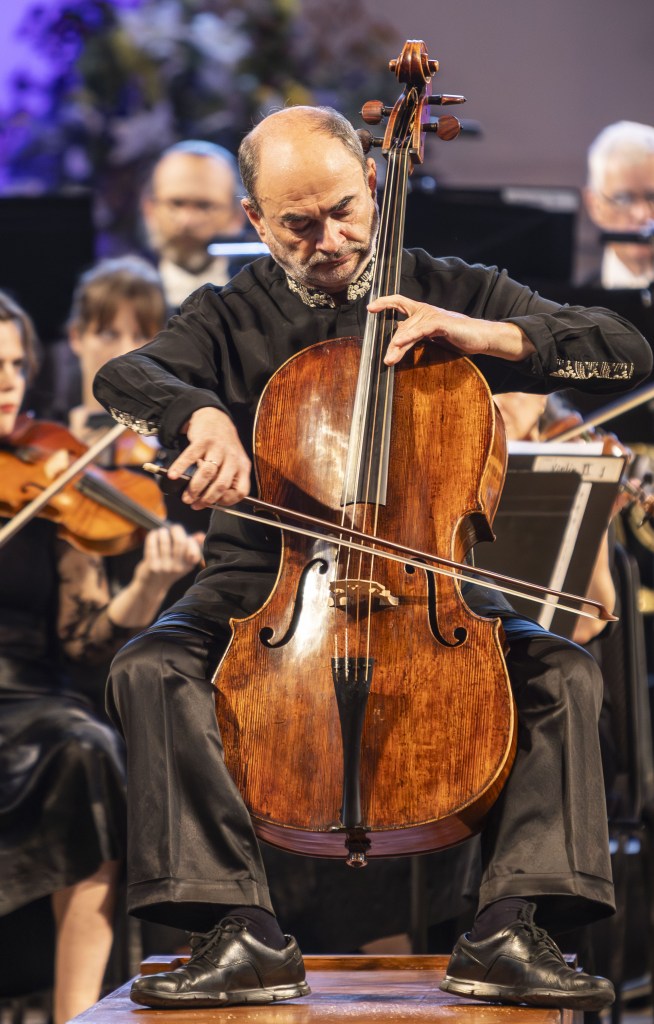
Christophe Coin
Johann Christian Bach’s Symphony in G minor was composed around 1770, a different era and style from that of Haydn – indeed, it is arguably in a different style to much of Bach’s mature keyboard music. Set firmly in the dramatic and often unpredictable Sturm und Drang style, it seems likely that it was never performed in London, but may date from his time in Berlin. This time, Peter Whelan actually sat at the fortepiano and played it for most of the time, only stopping, as many directors do, when he needed both hands to conduct. Was that really what keyboard directors did? The other director option was from the first violin, who I don’t suppose ever stopped playing to conduct.
The concert ended with Haydn’s ‘London’ Symphony (No. 104), his last composition and the last of his London Symphonies, although the only one of the 12 to be given that specific title. It was composed in London in 1795 and premiered at the King’s Theatre. The strident opening unisons on the tonic and dominant notes give no indication as to whether the piece will be in the major or minor key, although the following introductory sequence is firmly in the minor key. The theme reverts to D major and, unusually, returns as the second theme but in A rather than D major. The Andante and Menuetto further emphasise major keys, despite key wanderings, as does the whirlygig finale, one of Haydn’s best-known movements.
The instrumentalists of the English Baroque Soloists were perhaps not always on their top form, but particularly impressive solo contributions came from Elizabeth Walker, flute, Rachel Chaplin, oboe, and Catriona McDermid, bassoon, pictured below. Peter Whelen has a distinctive conducting style, which I found quite obtrusive at times.
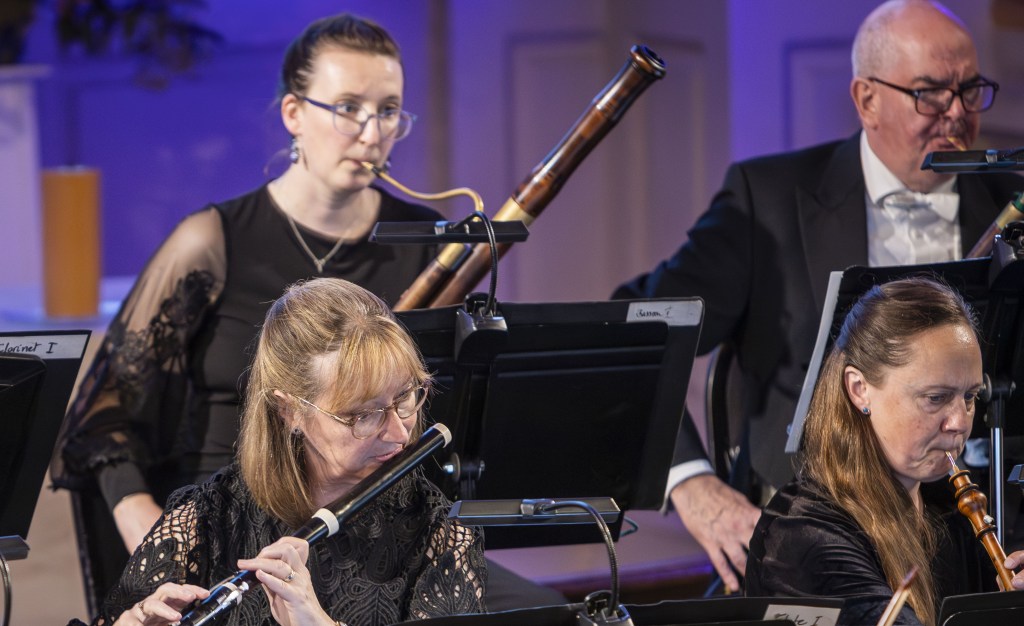
Woodwind soloists, Elizabeth Walker, flute, Rachel Chaplin, oboe, and Catriona McDermid, bassoon.
Performance photos: Paul Marc Mitchell
 Andrew Benson-Wilson : Early Music Reviews +