Monteverdi: L’incoronazione di Poppea
Academy of Ancient Music
Laurence Cummings, Anna Dennis, Ed Lyon
Barbican Hall. 17 November 2026
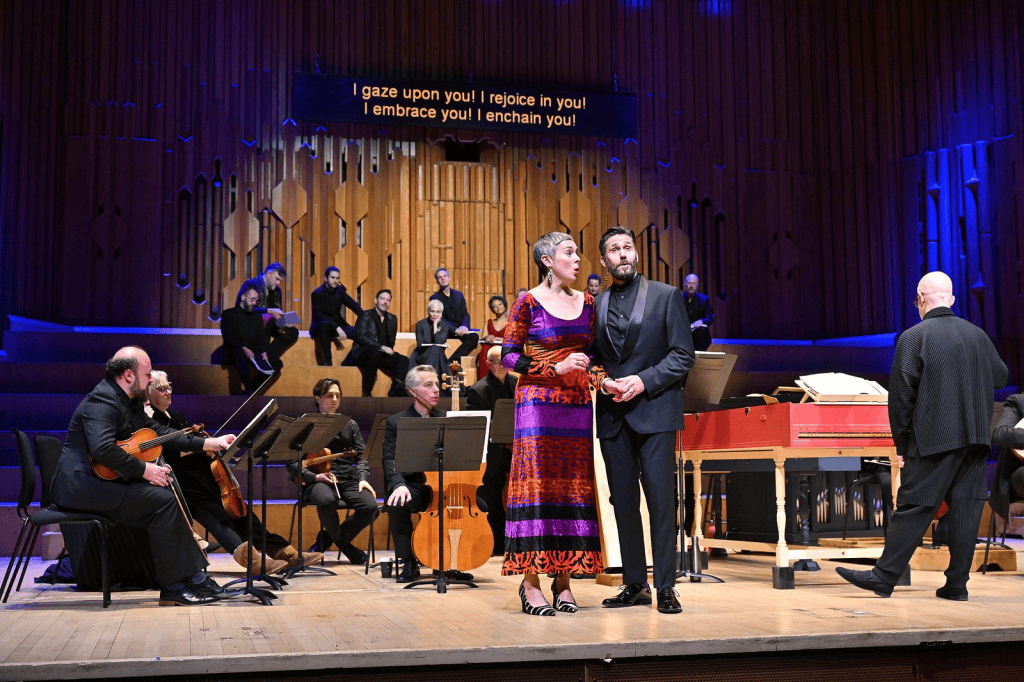
It took me a while to appreciate opera, something I put down to being sent (not taken) in my teens to Parsifal at the Royal Opera House in my teens. If I recall, it started around 5 and ended well after my bedtime. One of my memories is coming round after a 15 minutes period of repose to find that they were singing the same music, but up a minor third. Sometime later I told an opera loving friend that I would rather go to the theatre one evening and an orchestral concert the next, rather than combining the two. Over several decades of reviewing (mostly) early music, I have now experienced opera in its many forms, for student productions to Glyndebourne. One thing I have learnt is that I generally prefer concert performances than the full shebang, not least because I get the chance to actually concentrate on the music and the emotions of the texts without the distraction of a director’s often bizarre take on the story and all the other goings-on of full-scale opera. And this inspiring performance of Monteverdi’s L’incoronazione di Poppea from the Academy of Ancient Music and their exceptional director Laurence Cummings was a fine example of this.
The opening was impressive in a number of ways. I liked the way that all the instrumentalists and Laurence Cummings came on stage one-by-one, casually taking up their positions, meaning that the music started from silence rather from the usual dying applause. Apart from anything else, this tuned our ears to the modest instrumental forces in the large Barbican space. The Prologue opened with La Fortuna and La Virtù striding down one of the aisles in mid-row, which was continued musically once they arrived on stage. This was one of many clever bits of staging that, I assume, were sorted out by Laurence Cummings or the singers themselves as there was no theatrical director acknowledged. Others included Mercurio’s godly warning to Seneca that he was about to die, boomed out from the top back corner of the audience.
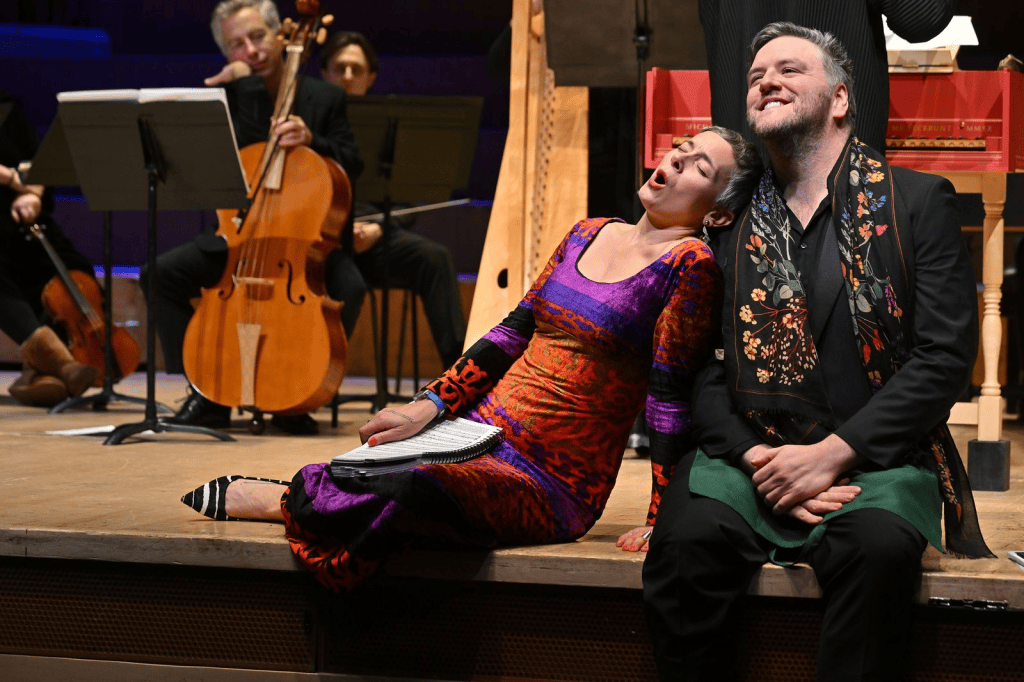
There were a few clothing concessions, one being Arnalta, Poppea’s nurse, sung by a tenor in whatever the opposite of a trouser role is, with a flamboyant scarf and the front half of a skirt. The female leads were colour-coded with a brightly coloured Poppea and a black-clad vengeful Ottavia. The transfer of clothing from Drusilla to Ottone aided by her wearing a detachable robe over her dress. The singer’s use of the very wide Barbican stage was well thought out – it is not an easy stage to present these events on.
The instrumentalists were gathered in a small group centre stage, with the continuo group (2 theorbos, viola da gamba) to the right, the other instrumental contributions (2 violin, 2 violas, bass violin and violone) to the right, and the two harpsichords, organ and harp in the middle. Key amongst the instrumentalists were Reiko Ichise, viola da gamba, Joseph Crouch, bass violin, Joy Smith, harp, and Bojan Čičić, violin and AAM leader. The 2 harpsichords and organ were played by Laurence Cummings and Ashok Gupta.
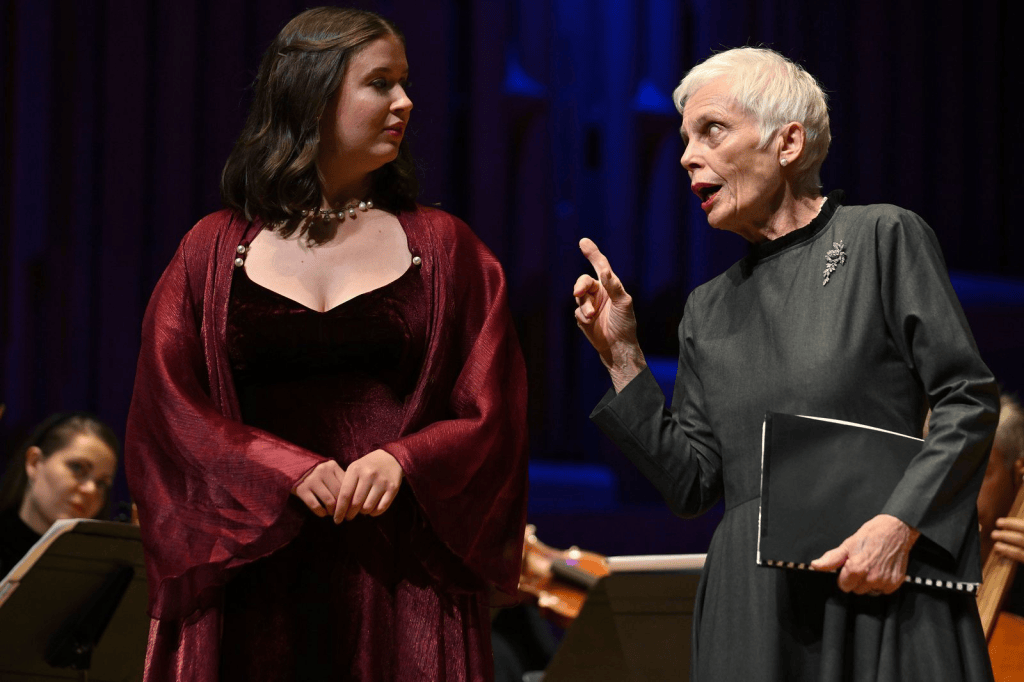
The 14 singers covered around 28 different characters together with some consort groups. I was impressed with all of them, although as is so often the case, I found the vibrato a little excessive. The principal roles were Anna Dennis, Poppea, Ed Lyon, Nerone, Katie Bray, Ottavia, Christopher Lowrey, Ottone, Nahuel di Pierro, Seneca, Stuart Jackson, Arnalta, and Maryam Wocial, Drusilla, with the other singers were Rachel Redmond, Fiona Kimm, Thomas Walker, Rory Carver, Valletto, Richard Latham, Danni O’Neill, and Rob Macdonald. About half sang from scores, the rest from tablets of varying sizes, most taking some effort to hid the glare of the screens from the audience.
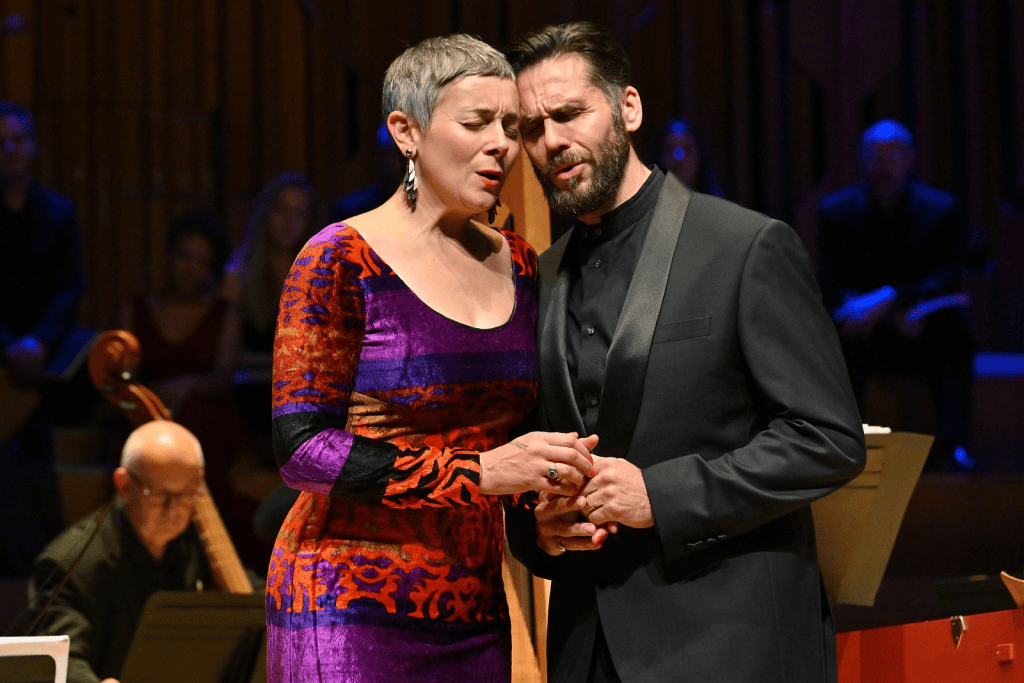
The musical direction was outstanding, with a nice flow between sections and spot-on tempos between the various time markings, something of a minefield in this era of music, notably with the frequently encountered 3:2 sesquialtera relationship. The interpretations of the various moods of the piece were well judged, the comedic and cameo elements being particularly successful. I liked the relaxed style of the translations shown at the back of the stage, one being the word “empurple”.
Photo credits: Mark Allen

