London Festival of Baroque Music
The Mad Lover
Théotime Langlois de Swarte & Thomas Dunford
Smith Square Hall. 28 October 2026
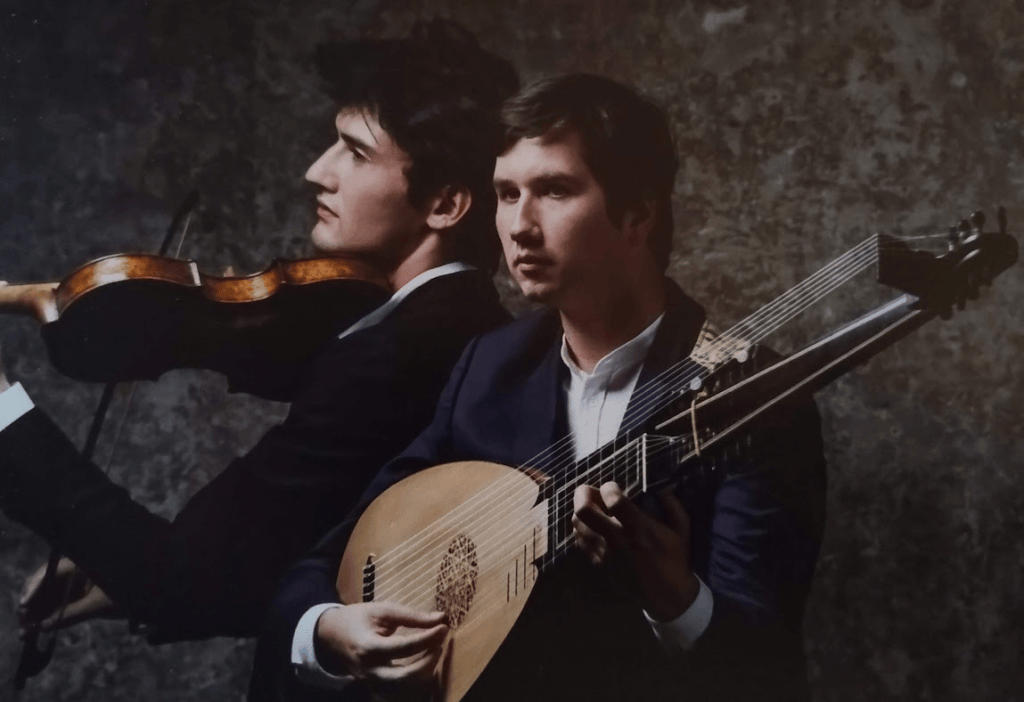
Photo: Julien Benhamou (copied from the programme)
This concert, part of the week-long London Festival of Baroque Music, attracted a large and enthusiastic audience, helped, no doubt, by much advertising and media activity by the two French performers, violinist Théotime Langlois de Swarte and theorbo-player, Thomas Dunford and the fact that the concert was a live performance of their popular 2020 CD of the same name. I am not sure if they were forewarned, but the in-the-round performing space did them, or the audience, no favours at all. Both instruments are directional, so for most of the evening only those who sitting in one of the eight blocks directly in front of the two performers were able to hear them as intended. They did eventually attempt a rather awkward sort of 360 degree show, but it was a bit random and clearly unrehearsed. Quite what inspired the organisers to arrange the seating in such an awkard configuration is beyond me, as was the bizarre arrangements of rows and seat numbers, which meant that most people had to be escorted to their seats by staff.
The programme was rather loosely based on a 1695 revival of a 1616 play for which John Eccles wrote a Suite, whose Ground on a four note descending bass and wide-spaced violin line opened the programme as the players slowly wandered through the audience to their centre stage. The composers represented were said John Eccles along with his younger brother, Henry Eccles, the father and son Nicola Mattais’s, Daniel and Henry Purcell and, for some reason, Joan Ambrosio Dalza, an early 16th century Italian composer whose Calata ala Spagnola seemed to have no relevance to the programme’s theme of English composers of the later 17th century.
This was, at least to me, a curious and gleefully informal event, combining virtuosic playing with playing to the audience, lots of intimate chat and interaction between the two performers and some rather ramshackle improvisations from Dunford’s lute. It ended in a rather awkward singalong as the audience were inveigled into providing four-part harmonies to the concluding piece and a bizarre rendition of Blackbird from The Beatles’ White Album. That said, the audience seemed to relish it, not least the elderly lady sitting right behind me who screamed her approval like a pubescent girl at a rock concert.

