London Festival of Baroque Music
The Mad Lover
Théotime Langlois de Swarte & Thomas Dunford
Smith Square Hall. 28 October 2026
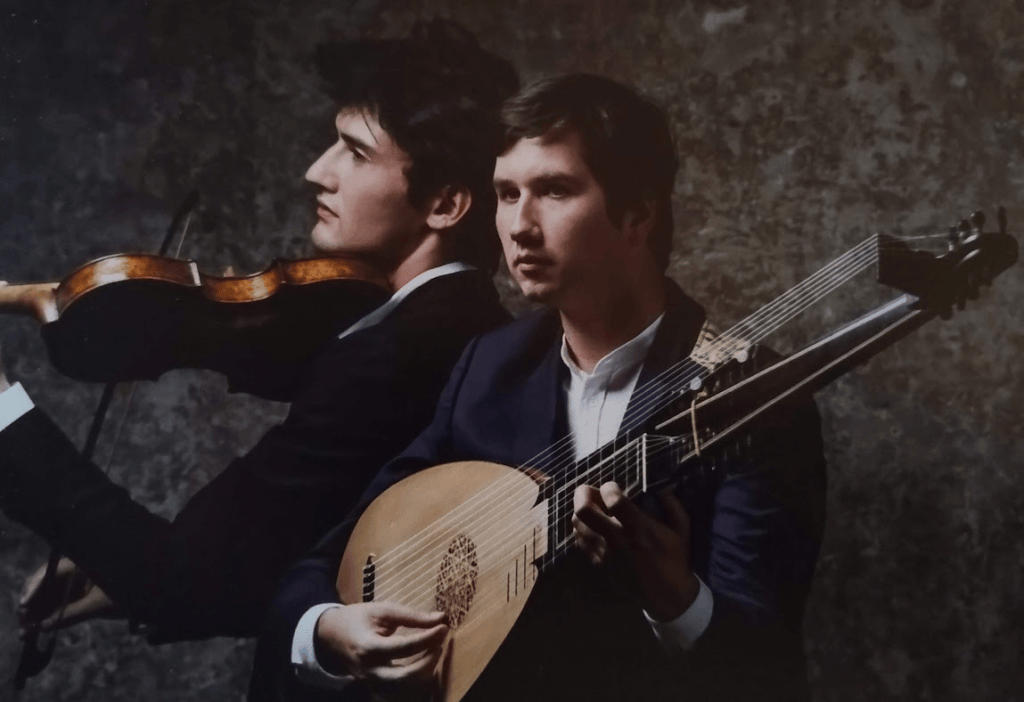
Photo: Julien Benhamou (copied from the programme)
This concert, part of the week-long London Festival of Baroque Music, attracted a large and enthusiastic audience, helped, no doubt, by much advertising and media activity by the two French performers, violinist Théotime Langlois de Swarte and theorbo-player, Thomas Dunford and the fact that the concert was a live performance of their popular 2020 CD of the same name. I am not sure if they were forewarned, but the in-the-round performing space did them, or the audience, no favours at all. Both instruments are directional, so for most of the evening only those who sitting in one of the eight blocks directly in front of the two performers were able to hear them as intended. They did eventually attempt a rather awkward sort of 360 degree show, but it was a bit random and clearly unrehearsed. Quite what inspired the organisers to arrange the seating in such an awkard configuration is beyond me, as was the bizarre arrangements of rows and seat numbers, which meant that most people had to be escorted to their seats by staff.
Continue reading
 I first reviewed Anna Prohaska in 2012 Wigmore Hall concert (broadcast live on Radio 3) and noted that “… If I had read Anna Prohaska’s CV (full of names like the Berliner Philharmoniker, Weiner Philharmoniker, Deutsche Staatoper Berlin) before I heard her sing, I would have wondered why on earth the Academy of Ancient Music had booked her”. But, for the ‘early music’ vocal scene, she was a real find. I don’t know what, or how, she sings with these orchestral big boys, but her beautifully eloquent and pure voice is just the thing for this repertoire, as was her presentation. She is of impeccable musical stock – her father and mother were an opera director and singer, her grandfather and great-grandfather a conductor and composer respectively. She has a very attractively un-diva like and engaging stage manner, giving the impression of singing with us, rather that at us, and involving us in the emotional turmoil of the various pieces. She has an exquisitely warm timbre with a slightly mezzo-ish tinge and demonstrated a thorough understanding of her chosen repertoire (and its wide range of emotions), with fine da capo elaborations and the rare ability to trill properly. Her use of rhetoric to accent emotive moments was spot on, as was her heart-wrenching cries of “Gabriel” in Purcell’s ‘Tell me, some pitying angel’ – one of those moments when silence can be more intense than music.

