Ensemble Théodora
Concert: Wanderlust
London Festival of Baroque Music
Smith Square Hall. 28 October 2026
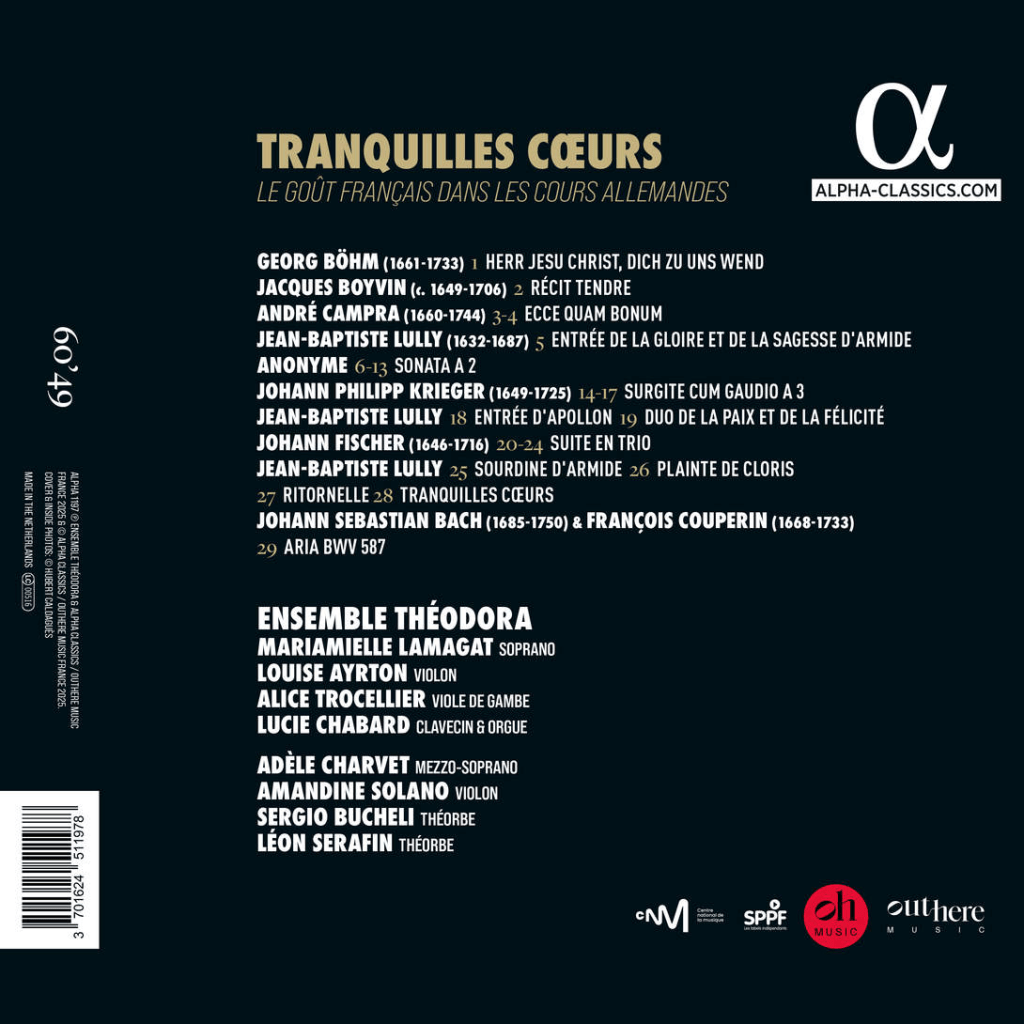
CD: Tranquilles Cœurs
Alpha. ALPHA1197. 60’49
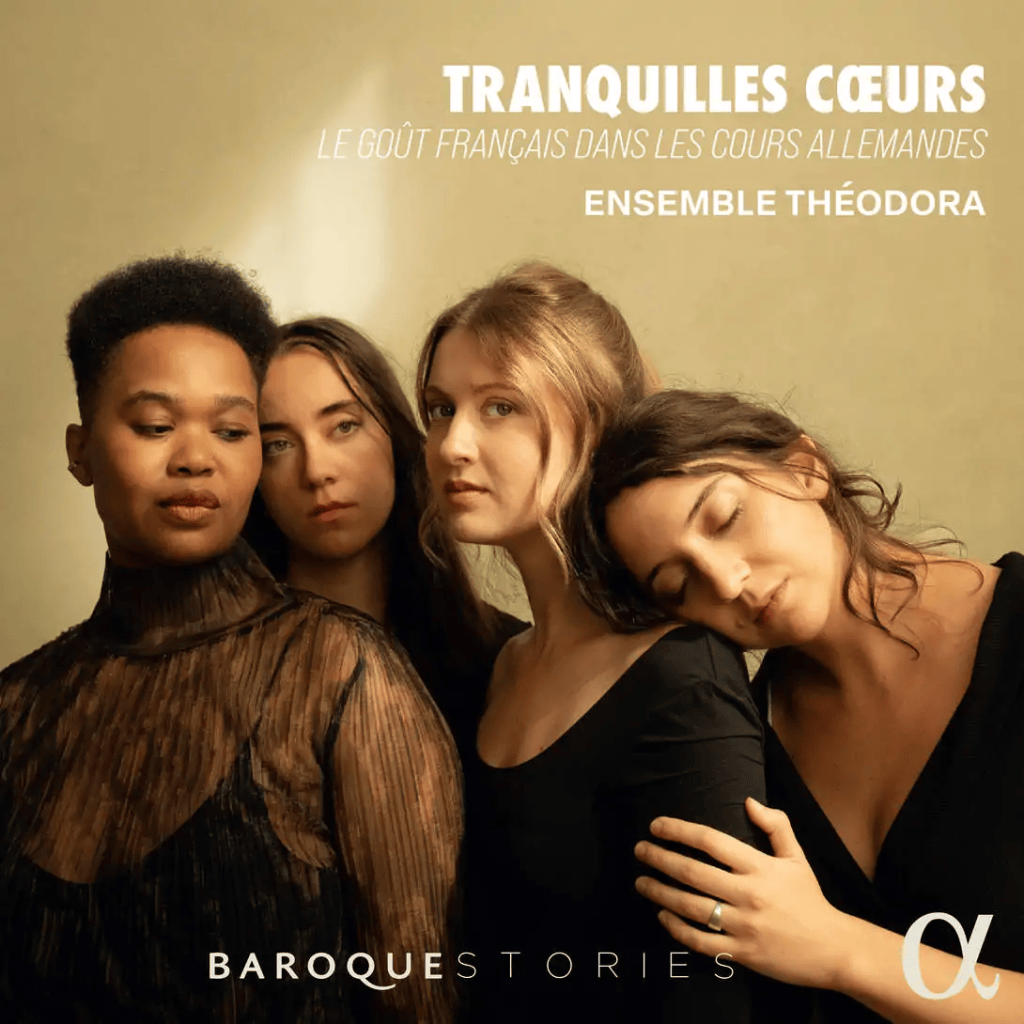
The four Paris-based musicians of Ensemble Théodora (Mariamielle Lamagat, soprano, Louise Ayrton, violin, Alice Trocellier, viola da gamba, and Lucie Chabard, harpsichord) met as international students at London’s Royal Academy of Music. They returned to London for a concert as part of the London Festival of Baroque Music with their programme Wanderlust. Based on the music of Louis XIV’s French court and its influence of the music of the rest of Europe, the well-planned programme explored a musical dialogue between nations that reflected their own international origins. The concert was a slightly reduced version of their recent CD Tranquilles Cœurs with the subtitle “French Taste in German Courts”. This review covers the concert and the CD.
Their concert programme and CD introduced us to works from Uppsala, Dresden, Berlin, and the German court libraries of Kassel and Schwerin, with music by George Böhm, Johann Philipp Krieger, and Johann Fischer, as well as France, with pieces from Jean-Baptiste Lully and André Campra, the latter introducing the Italian influence on the music of Europe. Several pieces were transcribed versions of larger-scale pieces, giving an intimate chamber music feel to the event. For the CD, they enhanced their resources by adding mezzo-soprano Adèle Charvet, Amandine Solano, violin, Sergio Bucheli, archlute, and Leon Serafin, theorbo. The CD also has the benefit of having an organ and a far more substantial viola da gamba, both missing from the London concert, presumably for obvious travel-related reasons. The CD has well-
For the London concert, the stage was rather awkwardly positioned in the middle of the audience, meaning that most of the audience only saw the backs of at least two of the four performers, who then, as in the early evening London Festival of Baroque Music event, had to try to bow in four directions. They made a far better job of this than the two performers at the earlier concert. This central position also meant that the harpsichord had to lose its angled lid, so essential for sound transfer, making it sound underpowered.
Their programme successfully profiled all four of the musicians, each having distinctive roles, either solo, in pairs, or in consort. Their individual performing was impeccable, as were their roles in consort. Not surprisingly, given their background, they all showed a deep understanding of the French musical idiom of the period, with its distinctive use of ornaments and rhythmic flexibility, including the distinctive lilt of notes inégales. I liked Mariamielle Lamagat’s control of vibrato, using it, quite correctly, as an occasional ornamental device at the end of a long-held note, rather than an ever-present irritant. Louise Ayrton’s violin playing was beautifully sensitive, notably in Lully’s opening Tranquilles Cœurs, while Alice Trocellier, viola da gamba, and Lucie Chabard, harpsichord, excelled in their continuo and solo roles. As a group, I liked the way that they took control of applause.
There are a number of online videos available, including this informal introduction to their CD by members of the group. You can also watch an impressive live TV recording here of the four-strong group playing the whole of this programme in the splendid surroundings of Fondation Singer-Polignac, where they have been artists in residence since 2023.