Music for a Grand Exhibition Organ
Andrew Benson-Wilson
St Anne’s, Limehouse. Friday 2 October, 7:30
Johann Sebastian Bach (1685-1750)
Alle Menschen müssen sterben BWV 643
Wenn wir in höchsten Nöten sein BWV 641
Ich ruf’ zu dir, Herr Jesu Christ BWV 639
Wer nur den lieben Gott läßt walten BWV 642
‘Cathedral’ Prelude and Fugue in E minor, BWV 533
Alexandre Pierre-François Boëly (1785–1858)
Quatour
Offertoire pour le Jour de Paques
Dialogue
Fantasia pour le verset Judex Crederis au Te Deum
Louis-James Alfred Lefébure-Wély (1817-1869)
Scène pastorale avec orage pour une inauguration d’orgue
J S Bach
‘St Anne’ Fugue in E flat, BWV 552
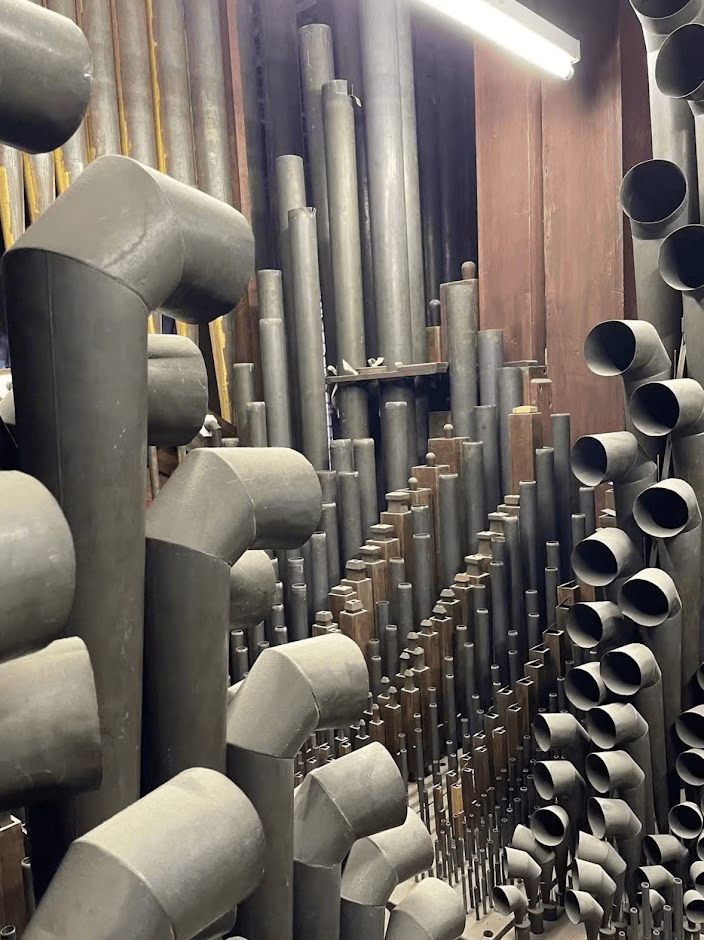
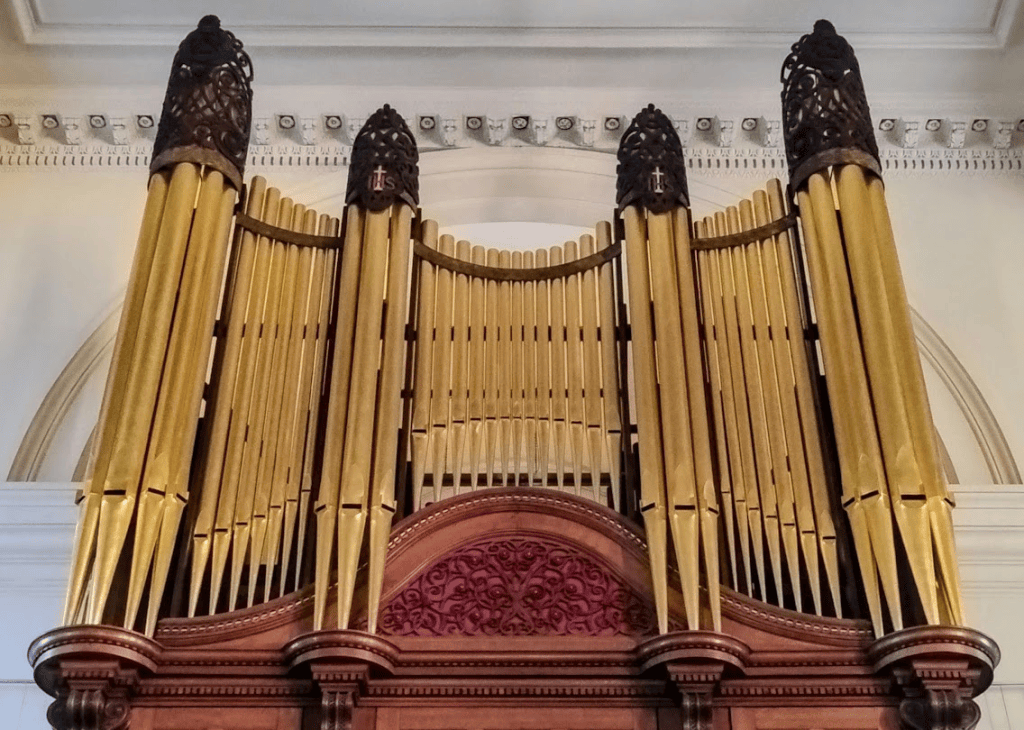
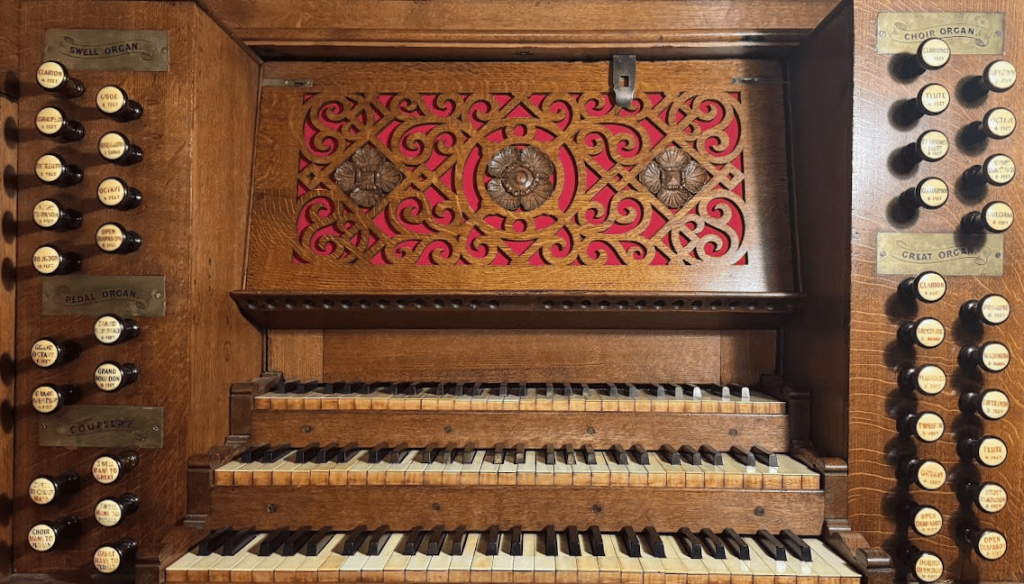
Welcome to a rare opportunity to hear the magnificent 1850 Gray & Davison organ in Nicholas Hawksmoor’s stunning 1730 church of St Anne’s, Limehouse – the “Cathedral of the East End”. The organ won first prize at the 1851 ‘Crystal Palace‘ Great Exhibition in Hyde Park. The organ features several gentle stops as well as some astonishingly powerful reeds. Around the late 1980s, I gave some annual recitals here, around the time a book was published that described the organ as “decrepit but still magnificent”. The idea of those recitals was to let people hear this important organ, whatever state it was in, before it became unplayable and forgotten. Following the 2006 William Drake restoration, I am delighted to be invited back for this recital.
All the proceeds from the retiring collection will go towards the continuing maintenance of this important organ.
All the music played this evening was published around the time of the organ, the Bach pieces as part of the early 19th-century Bach revival led by Mendelssohn.
We start with quieter sounds for four of Bach’s Orgelbüchlein chorale preludes, composed between 1708/17. The prelude to the funeral chorale Alle Menschen müssen sterben (All mankind must die) has been described as one of the most perfect examples of the Orgelbüchlein style, with its use of short musical motifs to set a mood, in this case, one described as “tender melancholy”. For example, the pedals repeat a 6-note motif in the bass throughout. In Wenn wir in höchsten Nöten sein (When in the hour of utmost need), the supporting voices are based on the first four notes of the ornamented chorale. Ich ruf’ zu dir, Herr Jesu Christ (I call to you, Lord Jesus Christ) is one of Bach’s popular chorale preludes, its trio form unique in the Orgelbüchlein. In Wer nur den lieben Gott läßt walten (He who calls dear God to lead him) the choral melody is supported by two inner voices and a walking bass, expressing musical symbols of confidence and joy.
Bach’s Prelude and Fugue in E minor is nicknamed ‘Cathedral’, and was chosen to reflect St Anne’s nickname of the ‘Cathedral of East London’. It is a grand piece, composed when Bach was a young man and strongly influenced by the North German organ school that culminated in Buxtehude. Bach famously walked 200 miles to hear and meet Buxtehude in Lübeck.
Alexandre Boëly was born to a family of musicians based in Versailles and Sainte-Chapelle in Paris. His early training included studying music of Haydn and Bach, whose organ music was considered unplayable at the time. He rejected the increasingly secular and populist music of the post Revolution era. His organ recitals at Saint-Germain l’Auxerrois included music by Frescobaldi, Couperin and Bach, something that eventually led to his dismissal for playing such “austere” music. Nonetheless he was admired by the then young César Franck and Saint-Saëns, later to become key composers of the Romantic era. Saint-Saëns played the organ at Boëly’s funeral. All of his pieces played today follow the musical forms of French Baroque organ tradition.
The Quatour is a gentle piece using the Oboe and Clarinet stops of the organ. Some Baroque examples of the Quatour (four-part) required the organist to play two melodies with one hand playing on two keyboards at the same time. The majestic Offertoire pour le Jour de Paques was composed for Easter Day. It was chosen to remind us that it was the 1850 Easter Day fire in St Anne’s Limehouse that led to the reconstruction of the interior and this organ being installed. After a dramatic opening on full organ, we hear variations on the popular Easter hymn O filii et filiae, finishing with a jubilant fugue.
The Dialogue is a reflective piece contrasting different sounds of the organ, and is typical of earlier examples from the 17th and 18th centuries. The extraordinary Fantasia pour le verset Judex Crederis au Te Deum was probably first performed at the church of Saint-Gervais in Paris, the church of the famous earlier Couperin dynasty. It is based on a verse in the Te Deum that depicts the Day of Judgement and the end of the world. It starts innocently, but signs of things to come soon appear with increasingly chromatic passages. The sound of what seems to be a cock crowing repeatedly leads to the unleashing of the organs reeds stops and the musical horrors of the apocalypse. Guillaume Lasceux, an earlier Parisian organist, wrote that such music should reflect “… the abomination and desolation caused by the terrifying catastrophe of the final day. It must express nature’s astonishment and stupefaction, its annihilation, and the awakening of the dead as they rise from their tombs at the piercing sound of the trumpet. It must give voice to the cries, the lamentations, and the despair of the damned, the falling of the stars, the turmoil of the elements, and universal chaos”. Boëly’s example concludes with a flurry of ascending and descending passagework and the depressing of the bottom octave of notes of the organ, followed by an emphatic two note fanfare.
Alfred Lefébure-Wély studied with his father, organist of Sainte-Roch in Paris, playing his first Mass aged eight. Two years later he started to deputise after his father’s stroke, becoming official organist aged 14. He became organist at the Madeleine (where he played for Chopin’s funeral) and later Saint-Sulpice, which then housed the largest organ built by Cavaillé-Coll, whose symphonic-style organs Lefébure-Wély enthusiastically supported. He gave inaugural recitals on many of Cavaillé-Coll’s most famous organs. César Franck and Saint-Saëns, earlier youthful supporters of Boëly, both later supported Lefébure-Wély, and dedicated some of their own music to him. In contrast to Boëly, his compositions were unashamedly operatic and popular. It has been suggested that the powerful reeds stops in the St Anne’s organ were influenced by Cavaillé-Coll.
Lefébure-Wély’s extended Scène pastorale avec orage pour une inauguration d’orgue ou une messe de minuit is, in effect, a mini opera for the organ. The story starts with a gently pastorale countryside scene, enlivened with folk dances. The rumbling of an approaching thunderstorm begins to disrupt things before building to a dramatic climax. A quiet prayer begins to calm the storm which eventually subsides as the dances return. A nightingale heralds the quiet conclusion.
Bach’s famous Fugue in E flat is known In England as the ‘St Anne’ because of the similarity with the St Anne hymn tune. It is the conclusion of Bach’s Clavierübung III, arguably his most important work for organ, composed ‘for music lovers and connoisseurs’. It includes chorale movements in a variety of musical styles, enclosed by a Prelude and this Fugue. It is marked in the score as ‘a 5 voci per organo pleno’ (with five voices for full organ) and includes musical symbols of the Trinity, including the key signature of three flats, being in three contrasting sections, with three fugue subjects which combine (three-in-one) at the end.
Andrew Benson-Wilson specialises in the performance of early music, ranging from early 14th and 15th century manuscripts to late Classical composers. His playing is informed by experience of historic organs, an understanding of period performance techniques and several internationally renowned teachers. One of his CDs of Thomas Tallis was Gramophone’s ‘Record of the Month’. The Organists’ Review commented that his “understanding of the historic organ is thorough, and the beautifully articulated, contoured result here is sufficient reason for hearing this disk. He is a player of authority in this period of keyboard music.”
Andrew’s recitals have included the enormous 1642 Festorgel in Klosterneuburg Abbey, the famous 1562 Ebert organ in the Innsbruck Hofkirche, a tiny 1668 chamber organ in a medieval castle in Croatia and the 1723 ‘Bach’ organ in Störmthal, Leipzig. One reviewer wrote that a St John’s, Smith Square recital in was “one of the most rewarding organ recitals heard in London in years”. Other recent London recitals have included Christ Church Spitalfields, St George’s, Hanover Square, Grosvenor Chapel, The Chapel of Christ, Dulwich College, and St Lawrence, Whitchurch.
Andrew’s little book, The Performance of Early Organ Music (a gentle introduction to performance techniques), is a required text in a number of Universities. He is also a reviewer, formerly for Early Music Review magazine, and now on his website http://www.andrewbensonwilson.org. He had been elected to The Royal Society of Musicians of Great Britain and the Council of the National Early Music Association.
Specification of the St Anne’s organ, from the
British Institute of Organ Studies’ (BIOS) National Pipe Organ Register (NPOR)
https://npor.org.uk/survey/N167
| GREAT Dble Open Diap. 16 Open Diapason 8 Open Diapason 8 Stopd. Diapason 8 Octave 4 Flute 4 Twelfth 3 Fifteenth 2 Flageolet 2 Sesquialtra III Mixture II Posaune 8 Clarion 4 | SWELL (TC) Bourdon 16 Open Diapason 8 Stopd. Diapason 8 Octave 4 Fifteenth 2 Sesquialtra III Cornopean 8 Oboe 8 Clarion 4 | CHOIR Dulciana 8 Keraulophon 8 TC Stopd. Diapn. Bass 8 Clarionet Flute 8 TC Octave 4 Flute 4 Fifteenth 2 Clarionet 8 TG PEDAL Grand Open Diap. 16 Grand Bourdon 16 Grand Octave 8 Grand Bombard 16 |