The Image of Melancholy
Barokksolistene
Sam Wanamaker Playhouse, 20 September 2015
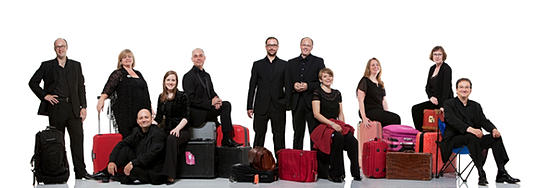
The Norwegian group Barokksolistene make a point of ‘pushing boundaries’ with their occasionally curious mixture of Norwegian folk music, early music and electronic jiggery-pokery, played on period string instruments. They brought this combination to the Globe’s Sam Wanamaker Playhouse for a programme based on their recent CD, The Image of Melancholy. The electronic jiggery-pokery opened the show with ambient background sounds whilst two of the Globe’s candle-lighters slowly lit the 48 candles on the six central candelabra, seemingly designed specifically to drip molten wax on to the performers below. As the background electronics began to merge with an off-stage violin sound, the eight musicians (an enlarged string quartet, plus archlute and what was described as an organ) entered the stage one by one and sat in a circle, as if waiting for a group therapy session. It was clear from the title that this evening was unlikely to be a bundle of fun, but I wasn’t quite prepared for it actually turned out to be.
The thing that was ‘described as an organ’ turned out to be one of those little hand-pumped squeeze-box reed organs usually to be found in Indian ashrams, with what looked like a tiny midi keyboard sitting on top, linked to a laptop. I originally wondered if all the electronic sounds were coming via the latter combination, but it turned out that there was somebody sitting in the gallery producing ‘soundscapes’. By and large, these consisted of the ambience background sounds we had already heard, reminiscent of Brian Eno’s early pieces, plus some very electronic-sounding organ tones of the type used in late 1960’s alternative rock groups. Very few of the pieces we heard were without some sort of background sound like this, whether by the likes of Holborne, Dowland, Gibbons or Byrd or obscure (at least to me) Norwegian folk melodies.
Staging is key to Barokksolistene’s performances, and much thought had gone into this, with on and off stage comings and goings including, at one stage, a bizarre dance given by the group’s leader Bjarte Eike, out of sight of most of the audience behind the central door at the back of the stage. His rocking back and forth on his own in the dark reminded me of scenes from The Wicker Man. This came as the culmination of an extended passage of what I initially thought was tuning up (and still might have been), but which then morphed into this rather ritualistic scene. Eike sees himself as very much the centre of attention, visually and aurally, and despite the mood of a particular piece, was often to be found standing in the middle of the sitting circle. Not surprisingly, the concert ended with an extended violin solo with Eike standing at the front of the gallery to the accompaniment of phase-shifting ambient sound and the archlute while the candelabra rose and fell, seemingly randomly. There was a large and enthusiastic crowd of friends and family whose whooping and yelling at the end of the concert seemed slightly out of keeping given the subject matter of the evening’s concert and, particularly, the last piece, a lament on the death of the composer’s wife. But perhaps they do things differently in Norway – judging by the encores, Norwegian weddings have more than a touch of melancholia to them.
 The highlight was the singing of soprano Berit Norbakken Solset (left), both in the folk songs and the early pieces, notably in Buxtehude’s bittersweet lament for his father, the Klag-Lied, and in the equally expressive Byrd ‘Ye sacred muses’, a lament on the death of Tallis with the mournful phrase “Tallis is dead, and music dies”. Instrumentally the finest sounds came from strings in the early pieces, producing a muted tone quite close to that of the viol consort which would have almost certainly been the preferred accompaniment to singers of the time. I am not sure what the likes of Dowland or Holborn would have made of the frequent foot-tapping from one of the players, but it seemed more of a performance tic than relating to any sense of rhythmic enhancement. The foot-tapping turned into foot-stomping from Bjarte Eike during some of the livelier Norwegian contributions and early English dance pieces.
Barokksolistene’s describe their take on early music as treating it as “just old pop music”. I did wonder whether the rather new-age sonic background to much of this music gave it the feel of ‘old pop music’, but from around 50 years ago.
 The English Concert was reduced to one of its smallest formations with just four instrumentalists plus tenor Mark Padmore for their Wanamaker Playhouse concert, based on Charles Burney’s writings on music. In 1770 and 1772, Burney (painting by
 g some 30,000 people a year. Their latest Winter Festival opened (in Shoreditch parish church) with a very apt programme based on the early 17th century vogue for composing music based on the hubbub of London’s street sellers and criers, reflecting a tradition of loudly publicising wares that exists to this day in placed like the nearby Petticoat Market.
 The city of Toulouse has nine historic organs on the national protected listed monuments schedule, together with many other instruments in the surrounding Midi-Pyrénéés region. It is something of a pilgrimage site for organ lovers; an appropriate description, as much of its early importance came from the Basilica of St. Sernin and its key position on the Santiago de Compostela pilgrimage route. The Toulouse les Orgues organisation has a year-round responsibility for the maintenance of most of the organs in the city, as well as a thriving educational and outreach remit. In addition, they organise the annual international festival and the occasional International Xavier Darasse Organ Competition. This year was the 20th anniversary of the festival. It’s motto ‘The organ: fabulous musical machine” was reflected in a vast array of musical events and presentations, featuring not just the organ in its various incarnations, but also an impressive breadth of other musical activity.
 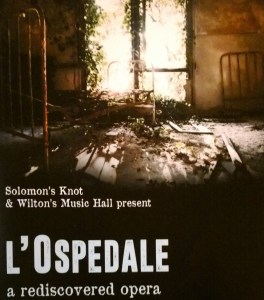 There are many operas that would appear to be taking place in a mental asylum, but the setting of the 17th-century ‘dramma burlesco’, l’Ospedale really is just that. It is based on a libretto by Antonio Abati and is set to music by an unknown seventeenth-century composer. As Naomi Matsumoto (who researched and prepared the score) explains in her programme essay, there are possible connections to the Hapsburg Court of the Holy Roman Emperor where an entertainment called l’Hospitale de’Pazzi is known to have been performed in 1667. Given its later history and famed inhabitants, Vienna does seem a rather apt location for the first performance – as was the delightful and historic surroundings of Wilton’s Music Hall for this, the first staged performance for centuries.
  Concert: Steven Devine, fortepiano, Jane Booth, basset horn, Anneke Scott, natural horn;
 Composed in 1647 (to a libretto by fellow Italian Francesco Buti), Rossi’s Orpheus is generally acknowledged to be the first opera specifically commissioned for France – one outcome of the appointment of an Italian Cardinal as the Prime Minister to Queen Anne of Austria, the Regent to the young Louis XIV, and his attempts to introduce Italian culture to the French Court. Buti’s libretto is a curious affair, adding a bewildering array of miscellaneous characters to the story together with extended
  The European Union Baroque Orchestra was formed in 1985, and has recently successfully negotiated its way through a difficult period of financial uncertainty. It celebrated its renewed, if short term security with the first short series of concerts for the newly formed orchestra of young musicians. They are selected anew each year through combined educational and selection courses and then usually meet five or six times a year to rehearse and then tour a new programme. One of the key features of EUBO is giving the musicians the chance to experience life as a touring orchestral musician, evidenced on this occasion by
  returned to Dresden where he became more involved in composing for the Court Church(left), which had taken on a new significance after the closure of the city opera house in 1720. His career path didn’t go quite to plan. Having been temporary Kapellmeister for a short period of time, he was pipped to the post of Senior Kapellmeister by JA Hasse in 1733. He was then appointed as a church composer. A few years later JS Bach, who knew and admired Zelnka’s compositions, was appointed as an (honorary) Royal Court Composer as a result of his well-known petition accompanying his 1733 ‘Dresden Mass’ – the Kyrie and Gloria of what later part of the Mass in B minor (See PS below). On his death, his compositions were purchased by the Saxon Court as valuable objects rather than performing scores, and remained hidden away in their archives until the 1950s.


 of some Mozart examples, a relatively unknown repertoire. The Harmonie usually described an ensemble of up to fifteen players, generally with pairs of oboes, clarinets, horns and bassoons, sometimes supplemented by a wide range of other instruments. With its roots in Viennese saloon and Imperial music, a parallel tradition was growing in France through military and revolutionary bands. Apparently there are some 12,000 works for the Harmonie band.
  Pergolesi is often seen as one-horse-wonder, rather unfairly as he died aged just 26, composing his famous Stabat mater just before his death. His other works, including several operas, are usually ignored. He was one of the first composers (of around 70) to write an opera based on Metastasio’s take on Adriano in Siria (Hadrian in Syria), two years after the libretto was written, and two years before his death. The plot is based on the story of Hadrian in his days as Governor of Syria in Antioch (where he first became Emperor), and his love for his prisoner (and daughter of the Parthian King Osroa) Emirena who, in turn, is betrothed to Farnaspe, a Parthian prince. As these things inevitably go in opera seria, Adriano is married to Sabina, who, in turn, is loved by Aquilio. Rather bizarrely, Osroa tries to rescue his daughter by setting fire to the palace that she lives in. Of course, it all ends up well – the condemned Osroa is forgiven, Farnaspe marries Emirena, and Adriano stays with his wife Sabina.
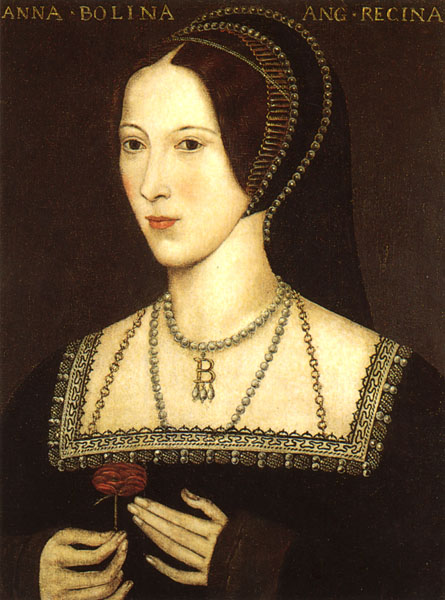 Having recently dusted off ‘The Spy’s Choirbook’, a manuscript by Alamire in the British Library, David Skinner and Alamire have now turned their attention to a manuscript that (arguably) belonged to Anne Boleyn, currently in the Royal College of Music (MS1070). The inscription ‘Mistres ABolleyne nowe this’ indicates the link to Anne, the ‘Mistres’ suggesting that the songbook was started before she became Queen in 1533 – and, I suggest, also before she became Marquess of Pembroke in 1532, and possibly before 1525 when her father was elevated to the peerage as a Viscount, or 1529 when he was created an Earl, both ranks giving Anne a courtesy title. ‘Nowe thus’ is her father’s motto.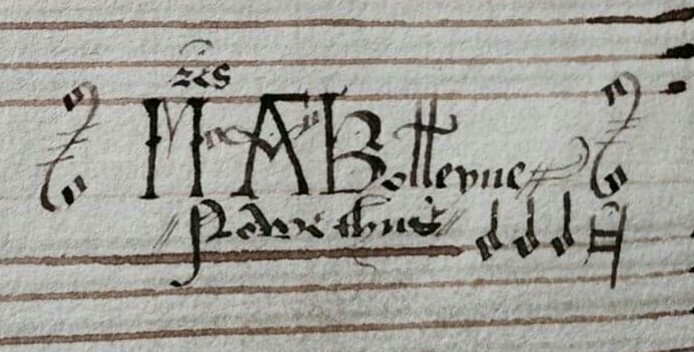
 Guerrero: Duo seraphim clamabant, Gloria (Missa Surge propera), Laudate Dominum, Maria Magdalene, Credo (Missa de la batalla escoutez), Vexilla Regis, Agnus Dei (Missa Congratulamini mihi);
 The annual visit to the Proms of one of the current series of Glyndebourne Festival Opera productions is always a highlight. Transferring from the relatively intimate space of Glyndebourne’s opera house to the vast Royal Albert Hall obviously has its problems, but the more-than-semi-staging (in this case, with full costumes and props, but no scenery) brings a welcome chance to focus on the music. There were several surprises for those not used to the work, not least that it is a Singspiel, with a lot of spoken text, much of which is usually omitted – but not here. This gave the chance to experience Mozart’s music in its original context of incidental music to a play. The fact that the music is of the utmost complexity only heightens the suspense of waiting for the next bit to start.
  The Tête à Tête Opera Festival at Kings Place included the premiere of a fascinating new one-hour long opera, The Electrictionary, with music by Alexis Bennett, words by Timothy Knapman, and direction by Dominic Gerrard It was performed by four solo singers and the instrumentalists of The Early Music Experiment & guests. The Electrictionary was conceived by the composer to explore the power of language and the issue of new words. It is intended “to confront progress, pedantry, class, slang and neologisms, in search of the ultimate dictionary with a riotously eclectic score mixing jazz-funk, classical and the avant-garde”. The use of various styles of music aims “to draw parallels between the deep history of words and the similarly complex origins of the multitude of musical styles that surround us every day”. The orchestra featured baroque specialists (albeit playing modern instruments) alongside jazz/funk musicians, and the wide-ranging structure of the piece included a combination of baroque recitative and aria, the spoken elements of Singspiel, and present-day music theatre and film music.

