Beethoven transformed

Beethoven TransformedVolume 1
Chamber Music for Harmonie
Boxwood & Brass
Resonus Classics RES10249, 61’40


Beethoven arr. Czerny: Septet Op.20
Beethoven: Sextet Op.71

Beethoven Transformed is a two-year project by Boxwood & Brass exploring wind music in early 19th-century Vienna and, in particular, the rearrangement of Beethoven’s music by other composers for Harmonie (wind band). What are today considered as venerated ‘masterpieces’ were treated with considerable liberty in such arrangements. This recording also throws some welcome light on the world of Harmonie, the wind bands so popular in central Europe, notably in Vienna, but little known today outside that area. Just listening to the first few moments of Beethoven’s Op.20 Septet opens up a world of exotic instrumental colour and texture that relies on the use of period instruments. Continue reading

Purcell: King Arthur (1691)

Purcell: King Arthur (1691)
Gabrieli Consort & Players, Paul McCreesh
Concert: St John’s Smith Square, 30 October 2019
CD: Signum/Winged Lion SIGCD589. 2CD. 97’38

Purcell King Arthur 1691

The new recording by the Gabrieli Consort & Players of Purcell’s King Arthur was launched at an impressive concert performance at St John’s, Smith Square. Lacking the two biggest-name singers from the recording (Carolyn Sampson and Roderick Williams), the concert was otherwise the same as the CD apart from the late replacement bass Robert Davies, standing in for Marcus Farnsworth and a smaller orchestra. Omitting all the spoken text of the original play, the music of King Arthur makes for a musically excellent, but texturally confusing, listen. None of the main characters of the King Arthur story appears. The music occurred at intervals during the play, generally as little masques, only occasionally as one-off songs responding to moments in the play. Continue reading

Salvatore Lanzetti: Sonatas for Violoncello and Basso Continuo Op.1

Salvatore Lanzetti
Sonatas for Violoncello and Basso Continuo Op.1 (Vol 1)
Agnieszka Oszanca, cello
Challenge Classics CC72794. 68’55

Salvatore Lanzetti (c1710-1780) was a virtuoso Italian cellist and composer who introduced many new innovations in cello performance. He was born in Naples around 1710 and studied cello and composition there. After early employment in Lucca and Turin, he started touring around Europe, spending many years in London. Charles Burney noted Lanzetti’s role in popularizing the cello in England. His Opus 1 XII Sonate à Violoncello Solo e Baffo Continuo was published in Amsterdam in 1736 and was dedicated to Federico di Brunswick, known in England as Frederick, Prince of Wales. This magnificent recording from cellist Agnieszka Oszanca is an important contribution to recognizing the importance of Lanzetti to the cello world, and to the musical life of England. He was one of the many generations of musicians from the continent of Europe that have enlivened the musical life of England, then and now. Continue reading

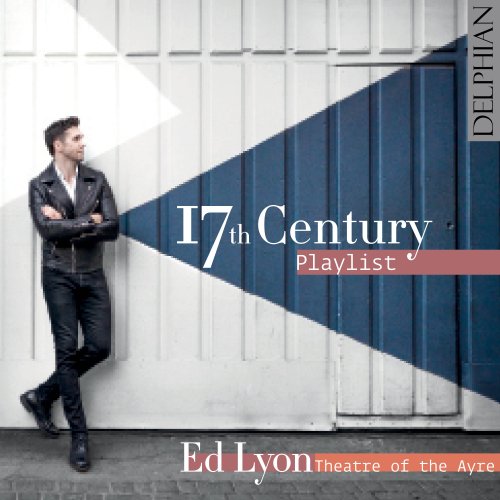
17th-Century Playlist

17th-Century Playlist
Ed Lyon, Theatre of the Ayre
Delphian DCD34220. 61’30

This debut recording from tenor Ed Lyon reflects his own playlist of music from the 17th-century. Many of them have that catchy ear-worm tendency to provide an immediate hook, although hearing 15 such pieces one after the other might help to reduce that effect.The recital opens with Alessandro’s exquisite Misero, Cosi va, a reflection on the pain of true love and, in the opera Eliigsbalo, a welcome relief from the sheer awfulness if the titular tyrannical teenage Roman Emperor Heliogabalus. The delicately sensitive opening instrumentalist realisation of the four repeated bass notes sets the scene for a recording of vocal and instrumental brilliance.

Continue reading

Weiss in Nostalgia

Weiss in Nostalgia
Sylvius Leopold Weiss: Suites from the London Manuscript
Alex McCartney, Baroque lute
Veterum Musica VM019. 48’41

Sylvius Leopold Weiss (1687-1750) is the go-to composer for all lute and early guitar performers. He was born, and started his professional life, in Breslau Silesia (now Wroclaw, Poland) before moving to a number of the German-speaking courts, culminating in a post at the Dresden Court of Augustus II (der Starke: the Strong), where he was the most highly paid musician. The London manuscript GB-Lbl30387 contains about half of Weiss’s known music, including the two Suites recorded here (in F & d). It was purchased by the British Library in 1877, and was probably put together in Prague some time after 1730

Continue reading

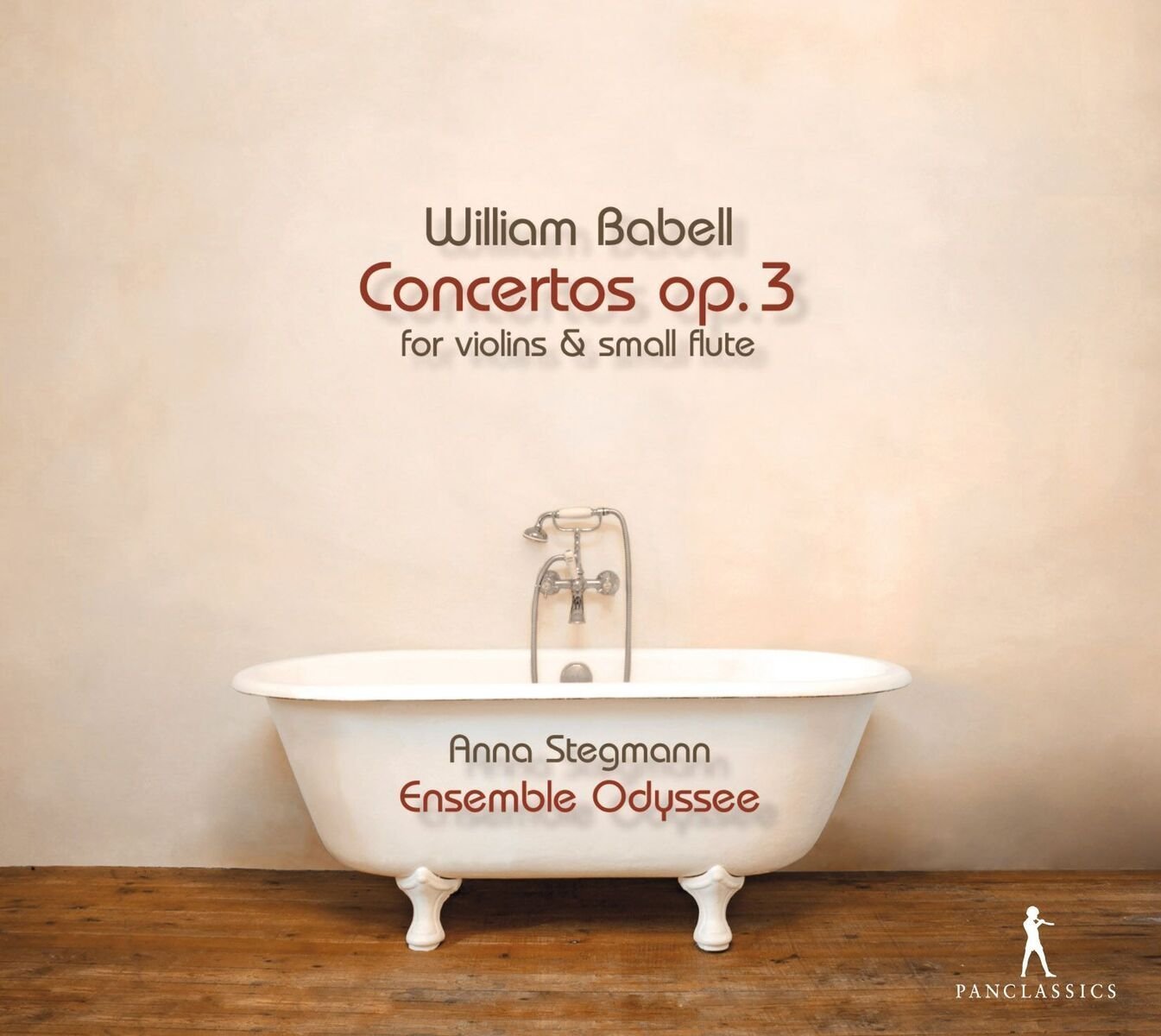
Babell: Concertos Op.3

William Babell: Concertos Op.3
for violins & small flute
Ensemble Odyssee, Anna Stegmann, Andrea Friggi
Pan Classics PC10348. 75’02

William Babell: Concertos op. 3

William Babell (c16901723) is best known today (if at all) for his technically demanding harpsichord transcriptions of Handel pieces, giving a fascinating insight into the sort of improvisatory ornaments and additions to the musical text that Handel himself was famed for. He came from a musical family, his father playing bassoon in the Drury Lane Theatre orchestra. Babell started out as a violinist in the Court Orchestra of George I, before becoming known as a harpsichordist and organist, preceding the famed John Stanley as organist at All Hallows, Bread Street, London. This excellent recording by the Amsterdam-based Ensemble Odyssee throws some light on other aspects of Babell’s short-lived musical career. His Opus 3 Concertos were collected together, in a rather random form, by Walsh three years after Babell’s death, aged just 33, apparently from “intemperate habits”. This recording uses on a new edition by Andrea Friggi (the Ensemble Odyssee harpsichordist) based on the confusing Walsh print. Continue reading

Anamorfosi

Anamorfosi
Allegri, Monteverdi
Le Poème Harmonique, Vincent Dumestre
Alpha 438. 73’10

Gregorio Allegri: Miserere mei, Deus
Luigi Rossi: Un allato messagier
Claudio Monteverdi: Si dolce è ‘l martire
Anon: Domine, ne in furore tuo
Domenicho Mazzocchi: Breve è la vita nostra
Antonio Maria Abbatini: Sinfonia La comica del cielo
Marco Marazzoli: Chi fà, Un sonno ohimè
Claudio Monteverdi: Maria, quid ploras, Pascha concelebranda

The word “Anamorphosis” is described by Wikipedia as “a distorted projection or perspective requiring the viewer to occupy a specific vantage point, use special devices or both to view a recognizable image”. In the UK it is perhaps best known through its use Holbein’s famous 1533 painting The Ambassadors where what seems to be an elongated smudge across the bottom of the painting turns out to be a skull (a memento mori) when viewed sideways from the right-hand corner of the picture. It is that notion of artistic distortion that Vincent Dumestre and his Le Poème Harmonique explore in musical terms in this recording of music from the early Baroque era, a period when the structures of the Renaissance were successively deconstructed, and viewed from a different perspective through a lens of ornamentation and elaboration.

Continue reading

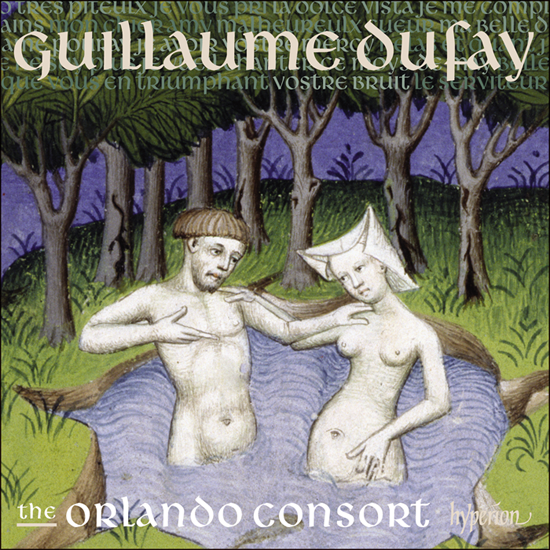
Dufay: Lament for Constantinople

Guillaume Dufay
Lament for Constantinople & other songs
The Orlando Consort
Hyperion CDA68236. 70’48

Music, and indeed most art forms, that comes on the cusp of a change in style can be amongst the most fascinating as composers, artists, and architects search out new approaches to their art. The music of Guillaume Dufay represents one such boundary, in his case, that between the Medieval and Renaissance periods. Although substantially Medieval in style, with its complex rhythmic structures and the curious Medieval habit of combining several texts in the same piece, often in different languages, there are clear elements of the forthcoming Renaissance style in Dufay’s music. This impressive recording by The Orlando Consort demonstrates this aspect of his music well in a sequence of 18 tracks, 12 in Rondeau form, 3 Ballades, 2 multi-texted Motets and a single Virelai. Continue reading

Carbonelli: Sonate da Camera 7-12

Giovanni Stefano Carbonelli: Sonate da Camera 7-12
Bojan Čičić & The Illyria Consort
Delphian DCD34214. 78’18

Following their 2017 debut recording of the first six of Giovanni Stefano Carbonelli’s Sonate de Camera (my enthusiastic review is here), Bojan Čičić & The Illyria Consort return to complete the set with the final six concertos. Four of the six are premier recordings. Sadly that completes the only known compositions surviving from this fascinating composer, Italian born, but settling and making a success of a career in England. My earlier review sets out the background to Carbonelli and these pieces, so I will not repeat them here. Continue reading

Lully: Dies Iræ, De Profundis, Te Deum

Jean-Baptiste Lully
Dies Iræ, De Profundis, Te Deum
Choeur de Chambre de Namur, Millenium Orchestra, Cappella Mediterranea, Leonardo García Alarcón
Outhere Music: Alpha 444. 82’50

The complex rituals of the ceremonial music of the French Court of Louis XIV, with its divided Music re Roi, are perhaps summed up in these three Lully pieces – the grand motets Dies Iræ, De Profundis and Te Drum. Although Lully never held any formal posts within the Chapelle du Roi, court tradition dictated that for royal funerals, although the Mass itself was directed by the Sous-maîtres de la Chapelle, for the Prose and Aspersion of the Coffin, the music (Dies Iræ & De Profundis) was the responsibility of the Superintendant de la Musique de la Chambre – Lully. He took this opportunity to develop the genre of the grand ceremonial motet using the combined forces of the two choirs and a rich orchestration.

Continue reading

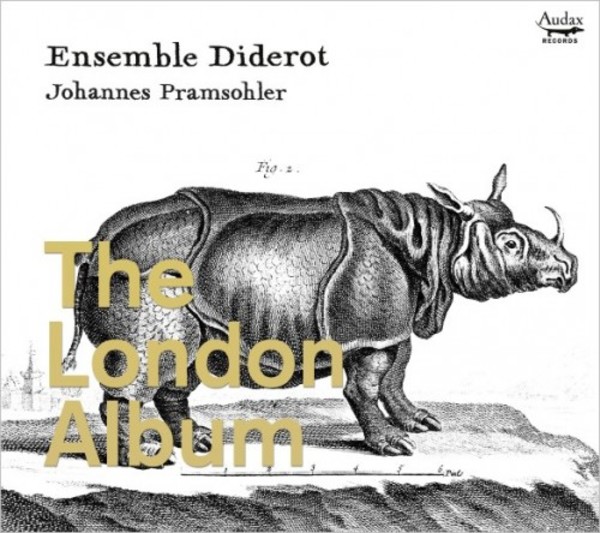
Ensemble Diderot: The London & Paris Albums

The London & Paris Albums
Ensemble Diderot, Johannes Pramsohler
London: Audax ADX13718. 66’10
Paris: Audax ADX13717. 65’13

Ensemble Diderot: The London Album | Audax ADX13718

Ensemble Diderot: The Paris Album | Audax ADX13717

ADX13718: The Trio Sonata in England before 1680
ADX13717: The Trio Sonata in France before 1700

The impressively energetic Ensemble Diderot continue their series of recordings (on their own label) with these two offerings, comparing and contrasting Trio Sonatas from London and Paris in the latter part of the 17th-century. There are several premiere recordings, some fine examples of the early history of the Trio Sonata, and a few oddities that are nonetheless worth recording, and listening to.

Continue reading

Henri-Jacques de Croes: La Sonate Égarée

Henri-Jacques de Croes: La Sonate Égarée
BarrocoTout
Linn Records CKD 597. 62’19

CKD 597 Cover

BarrocoTout (Carlota Garcia, flute, Izana Soria, violin, Edouard Catalan, cello, and Ganael Schneider, harpsichord) are named after a sketch in a Spanish comedy show: Barroco Tú (= Baroque yourself). They got together during their studies at the Royal Conservatoires, Brussels in 2013. They were selected for the EEEmerging (Emerging European Ensembles) project in 2015 and in 2016 won awards at the Utrecht Early Music Festival. This debut recording by Linn Records is one of their prizes for winning the 2017 York Early Music International Young Artists Competition. It is appropriate for them to choose a little known composer, in this case, the Antwerp born Henri-Jacques de Croes (1705-86).

Continue reading

Conti: Missa Sancti Pauli

Francesco Bartolomeo Conti: Missa Sancti Pauli
Purcell Choir, Orfeo Orchestra, György Vashegyi
Glossa, GCD924004. 67’25

György Vashegyi and his Purcell Choir and Orfeo Orchestra take time out from their impressive series of recordings of music of the French Baroque for this CD of the grand 1715 Missa Sancti Pauli by the Italian Francesco Bartolomeo Conti (c1681-1732). Conti was born in Florence and worked for most of his life in the Hapsburg court in Vienna, initially as a theorbist and mandolin player, and then as court composer and vice-Kapellmeister. Despite his comparatively low profile nowadays, he was well respected in his time, not least by Bach and Zelenka. He does, however, seem to have got into trouble for beating up a priest (see here). A composer of operas as well as sacred music, it was the latter that kept his name alive after his death, deservedly if this attractive Mass setting is anything to go by.

Continue reading

La Morte Della Ragione

La Morte Della Ragione ‘The Death of Reason’
Il Giardino Armonico, Giovanni Antonini
Outhere Music. ALPHA 450. CD Book. 73’07

La Morte della Ragione (The Death of Reason) (CD + Book) | Alpha ALPHA450

La Morte della Ragione (The Death of Reason) is the sort of recording that may require you to put on a seat belt before listening. Under the banner of Petrarch’s comment that “Senses reign, and Reason is dead” Il Giardino Armonico take us on a whistlestop tour through a sizeable chunk of early music history. The choice of descriptor is deliberate, as it is also very obviously a showcase for the virtuoso recorder playing of director Giovanni Antonini, which dominates much of the programme and comes vey close to be too clever by half.

Continue reading

Johannes de Lymburgia: Gaude Felix Padua

Johannes de Lymburgia: Gaude Felix Padua
Le Miroir de Musique, Baptiste Romain
Ricercar RIC402. 65’39


Johannes de Limburgia was born around 1380 in the Duchy (or city) of Limburg. He seems to have worked in Liège between 1408–19, and then in Italy. Somebody of the same name was in Vicenza from 1431 to 1436. There was a canon with the same name in Liège in 1436. His music survives principally in the manuscript Bologna Q15, dating from the first half of the fifteenth century. It includes 46 of his pieces, all liturgical. An indication of his importance, at least to the compiler of the manuscript, is that only Dufay has more pieces than Limburgia. Despite that, he is very little known today, so this recording from the excellent Le Miroir de Musique and their director Baptiste Romain is very welcome. The four/five singers and three/four instrumentalists (one does both) perform a selection of liturgical pieces and Latin strophic songs in the manner of Italian Lauri.

Continue reading

Barlaam & Josaphat

Barlaam & Josaphat
Buddha – a Christian Saint?
Dialogos, Katarina Livljanić
Outhere Music: ARCANA A458. 65’41

This recording (released on 5 October) by Katarina Livljanic and Dialogos tells an astonishing story that was completely unknown to me and, I suspect, to many other people. It is a musical reflection on the story of the Christian saints Barlaam and Josaphat, a tale that replicates, in a Christian setting, the story of the life of the Buddha. The story was known in at least four religions and was passed down in most of the medieval languages. It tells of Prince Josaphat (from the Sanskrit word Bodhisattva), the son of the Indian King Abenner who was persecuting Christians. Astrologers predicted that Josaphat would become Christian, so the king imprisoned him. But he met the hermit Saint Barlaam and converted to Christianity. Eventually his father, the King, also became Christian, and became a hermit, passing his throne to Josaphat, who also later abdicated and retired into seclusion and contemplation with his teacher Barlaam. The story comes from a 2nd to 4th century Sanskrit Buddhist text, passing into Christian mythology via Baghdad and the 8th century Arabic Book of Bilawhar and Yudasaf) and Middle Eastern Christian sources. In medieval times, the two saints were honoured (although not actually sainted) by both the Slavic Eastern Orthodox and the Roman church. There is even an illusion to it in Shakespeare’s Merchant of Venice.

Continue reading

Amadio Freddi: Vespers (1616)

Amadio Freddi: Vespers (1616)
The Gonzaga Band, Jamie Savan
Resonus RES10245. 58’10

We know very little about Amadio Freddi (c1580-1643). His death is known to be in 1634, but his age at death is reported to be either c1570 or c1580. The latter date seems more likely, as in 1592 he was in paid employment at the Basilica of S. Antonio in Padua as a boy soprano, followed in 1598 with a doubling of salary as a countertenor. He seems to have come from humble background, his father having worked as a sword polisher. The payment from S. Antonio, unique for a boy soprano at the time, may have been a reflection of his families straightened circumstances. This important recording by The Gonzaga Band is the world premiere recording of his 1616 Vespers, from his Messa, vespro et compieta, composed while he was maestro di cappella at Treviso Cathedral between 1615 and 1627. In 1627 he moved to Vicenza before returning to Padua in 1634.

Continue reading

Croce: Notetti & Sacrae Cantiones

Giovanni Croce: Motetti & Sacrae Cantiones
Voces Suaves & Concerto Scirocco
Outhere Music: Arcana A439. 52’19

Giovanni Croce (1557-1609) was a boy chorister in St Mark’s, Venice, becoming maestro di cappella there in 1603, a few years before his death. He was born in Chioggia on the Adriatic near Venice. He took holy orders in 1585, and appears to have been a priest, and possibly director of music, at Santa Maria Formosa while singing at St. Mark’s. His compositions provide a link between the Venetian Renaissance and the musical advances of Monteverdi. His music is constructionally and harmonically simpler than many other Venetian composers of his time, but includes examples of double chorus and echo effects within his rather conservative late Renaissance polyphony.

Continue reading

Gypsy Baroque

Gypsy Baroque
Il Suonar Parlante Orchestra, Vittorio Ghielmi
Outthere Music: Alpha ALPHA392. 58’58

For those educated in the Western European countries, the history and music of Central and Eastern Europe can be something of a mystery. This recording sheds some very welcome light on some of the roots of the musical tradition of the Hapsburg and Ottoman empires, much of it inspired by the travelling musicians and peoples known variously as Roma or Gypsies. Based on research by director Vittorio Ghielmi on Gypsy melodies found in the the Sepsiszentgyõrgy manuscript, the wide ranging programme include anonymous folk arrangements together with adaptions of such melodies by composers such as Telemann, Benda, Tartini, Vivaldi and Kirnberger.

Continue reading

Anime Amanti

Anime Amanti
Roberta Mameli, Luca Pianca
Alpha Classics ALPHA291. 68’16

Anime Amanti

Songs by Monteverdi, Caccini, Strozzi, d’India, Merula. Pianca

The opening Lamento di Arianna, the only surviving part of Monteverdi’s opera L’Arianna. sets the scene for a beautifully performed programme of music from the earliest days of opera. Roberta Mameli’s evocative and rich vocal timbre is an ideal vehicle to display the extraordinary range of emotions depicted in this sensuous music. Her coherence of tone over a very wide range aligns with effective control of her natural vibrato, notably on long-held notes where she uses gentle vibrato as an ornament. She is very well supported by the impressively restrained theorbo playing of Luca Pianca.

Continue reading

Tröstlicher Lieb stets ich mich üb

 Tröstlicher Lieb stets ich mich üb
Lieder und Tänze der Renaissance
Intavolaturen und Originalsätze für 2 Lauten, Cembalo, Orgel, Flötenquartett
Cornetto COR 10051. 46’09

This very short (46’09) CD of Songs and Dances from the Renaissance focusses on the practice of intabulating (transcribing) vocal pieces for instruments, a common practice in the 15th and 16th-centuries. In many examples, the addition of divisions (additional notes added to the original slow-moving vocal lines) gave more of a musical flow to pieces. Many early organ and keyboard treatises are based on the practice of adding divisions to intabulations, making it, arguably, the foundation of all later keyboard music.  Continue reading

Vox Luminis: Kantaten der Bach Familie

Kantaten der Bach Familie 
HeinrichJohann ChristophJohann Michael & Johann Sebastian Bach
Vox Luminis, Lionel Meunier
Ricercar  RIC 401. 66’30

Since Vox Luminis was formed around 15 years ago, they have established themselves as one of the leading performers of early music, usually just with choir and continuo, but also appearing with up to a full orchestra. Under their director, Lionel Meunier, their many award-winning CDs have highlighted fascinating areas of the repertoire, as does this one with its exploration of the sacred cantatas of Bach’s earlier family. Although we have long given up the notion that Bach sprung in the musical world from nowhere, our knowledge of the pre-Bach Bach’s and the musical world in Thuringia and Saxony that nurtured the Bach brood over many generations is still rather limited. This recording reveals just some of the extraordinary riches that await exploration from the 17th century Bachs. The focus is on three pre-JS Bach’s, Heinrich (1615-92), first cousin of JA BAch’s father, and his two sons Johann Christoph (1642-1703), and Johann Michael (1648-94), whose daughter, Maria Barbara married her cousin JS Bach. 

Continue reading

Henry Purcell: Symphony while the swans come forward

Henry Purcell
Symphony while the swans come forward
Le Sfera Armonioso, Mike Fentross, Johannette Zomer
Challenge Classics CC 72783. 78’57

In this live recording, Le Sfera Armonioso present extracts from Purcell’s History of DioclesianThe Indian QueenKing Arthur and The Fairy Queen. So far, so good. But this is a curious recording, raising questions about early music vocal and instrumental performance practice. To start with the positive: Le Sfera Armonioso clearly takes the period instrument issue seriously, to the extent that for this project they commissioned two new trumpets from Graham Nicholson, who also plays on the recording. They are replicas of the c1700 William Bull silver trumpet, owned by Purcell’s principal trumpeter, John Shore and housed in the Museum of Warwick. These trumpets have no finger holes, relying solely on the players’ lips to produce the notes, with the inevitable distinctive tunings, obvious from the start with the opening Symphony for trumpets and violins from Purcell’s History of Dioclesian. More information about the trumpets, and some extracts from the recording can be found hereContinue reading

Favourites: Telemann and his Subscribers

‘Favourites’
Telemann and his Subscribers
Tabea Debus, recorder
TYXart TXA18107. 66’34

Recorder player Tabea Debus is one of the most impressive young musicians of her generation. She has already featured many times in this review website for her CDs and concert performances (see here). Her latest recording is a clever combination of two genuine Telemann pieces for recorder (the Sonata in C, TWV 41:C2 and Concerto in F, TWV 51:F1) forming a sandwich with a filling of four suites of pieces collated and arranged by Tabea Debus from Telemann and three of the composers who subscribed to Telemann’s music publications. Telemann was one of the pioneers of music publishing funded by inviting pre-publication subscriptions – an early form of crowd-funding. Amongst those subscribers were Bach, Handel and Blavet, the three composers whose pieces are collected into suites on this recording. Continue reading

A Fancy: Fantasy on English Airs & Tune

A Fancy: Fantasy on English Airs & Tune
Rachel Redmond, Le Caravansérail, Bertrand Cuiller
Harmonia Mundi. HMM 902296. 66’04

Rachel Redmond - A Fancy: Fantasy on English Airs & Tunes

This recording was released in September 2017, but I have only become aware of it, having heard a concert performance during the 2019 Tage Alter Musik Regensburg (reviewed here). As well as being a musically outstanding recording, with excellent singing from soprano Rachel Redmond and playing from Le Caravansérail, directed by Bertrand Cuiller, this is an intelligent way of presenting the music of the English Baroque era. Much of the music of the post-Restoration period (from the mid-17th century) was written for the theatre, where plays included lots of music to set the scene and provide interludes. The resulting pieces are often short, and can be difficult to programme into a concert setting. In this recording, Le Caravansérail has concocted what is, in effect, a five-act mini-opera taking samples of music for the theatre by composers such as Matthew Locke, Henry Purcell, John Blow to make a coherent and well-balanced whole. Continue reading

Hieronymus Praetorius: Motets in 8-20 Parts

Hieronymus Praetorius: Motets in 8, 10, 12, 16 & 20 Parts
Alamire, His Majestys Sagbutts and Cornetts
David Skinner, Stephen Farr
Resonus: Inventa Records. INV001. 2 CDs: 57’46 + 42’39 

I have waited years for a comprehensive recording of Hieronymus Praetorius and this one ticks all the boxes. I first got to know his organ music many years ago, finding in him a very rare example of a North German organ composer from before the generation of Sweelinck students that dominated Hamburg and North German musical life in the 17th century (of which his sons were a key part). That progression eventually led to the peak of the North German Baroque, Dieterich Buxtehude. Although there were indications of the post-Sweelinck style, his musical language was distinct, if occasionally rather impenetrable, and clearly represented an important late Renaissance style of organ composition and performance. The joy of this double CD set is that several organ pieces are included, along with some of the magnificent multi-part motets, with up to 20 independent voices. Continue reading

Welcome home, Mr Dubourg

Welcome home, Mr Dubourg
Irish Baroque Orchestra, Peter Whelan
Linn CKD 532. 60’58

Welcome home, Mr Dubourg | Linn CKD532

If the compositions of Matthew Dubourg (1703-1767) are not familiar to you (and they certainly weren’t to me), this recording will remedy that, as well as taking a fascinating peek at musical life in Dublin in the 18th century. Dubourg was born in London, the son of a dancing master. He seems to have had a youthful talent, apparently playing a Corelli Violin Sonata in one of Thomas Britton’s house concerts, aged 9, and standing on a stool. He then studied with the celebrated violinist, Francesco Geminiani. From 1728 to 1764 he was based at Dublin Castle as “His Majesty’s Chief Composer and Master of the Music in Ireland”. He was a major force the musical life of Dublin, together with Geminiani, who was his friend and teacher for many years. He is probably best known for a comment that Handel made while conducting Dubourg when, after a more-than-usually extensive cadenza when, according to Charles Burney, Dubourg “wandered about in different keys a great while, and seemed indeed a little bewildered, and uncertain of the original key”, he was heard to remark as the cadential trill was played – “Welcome home, Mr Dubourg”. After the first performance of Messiah in Dublin, Handel wrote that “as for the instruments they are really excellent, Mr Dubourg being at the head of them”. Continue reading
Leonardo da Vinci: La Musique Secrète

Leonardo da Vinci: La Musique Secrète
Doulce Mémoire, Denis Raisin-Dadre

Alpha ALPHA456. CD & book. 78’05

This is the second recording I have been sent linked to this year’s 500th-anniversary celebrations of Leonardo da Vinci. I Fagiolini included a wide range of music, including newly composed pieces in their reflection, but very little music of Leonardo’s own time. This release from Doulce Mémoire makes up for that by focussing on music of the time and, notably, on Leonardo’s own instrument, the lira da braccio, here played with commendable sensitivity by Baptiste Romain. The CD is accompanied by a sumptuous 127-page book, with excellent reproductions of 15 paintings, including close-ups of many of them. In his choice of music, Denis Raisin-Dadre aims to seek out the ‘hidden music’ within these paintings. Continue reading

Bach: Das Wohltemperierte Klavier I

Bach: Das Wohltemperierte Klavier I
Steven Devine, harpsichord
Resonus Classics RES10239. 2 CDs. 55’06+56.13

This is the first of two double-CD volumes of Bach’s Das Wohltemperierte Klavier (The Well-Tempered Clavier), and covers the Preludes and Fugues 1 to 24 (BWV846-869) that form Book 1 of ‘The 48’. This musically intelligent and absorbing recording by Steven Devine demonstrates that performing Bach (or any music, for that matter) is far more the merely playing all the notes in the right order. His subtle use of articulation and rhetoric and his understanding of the Baroque idea of building up musical ideas from small motifs make for an absorbing recording that will invite repeated listening. He manages to negotiate that fine line between presenting a personal interpretation and those over-mannered performances that might be fine for a live recital but is usually off-putting on the repeat listening that a recording allows. With obvious respect to Bach and these extraordinary miniatures of musical craft, Devine brings a wide range of interpretations, matching the underlying mood of each Prelude and Fugue perfectly. Continue reading

The Duarte Circle: Antwerp 1640

The Duarte Circle: Antwerp 1640
Transports Publics, Korneel Bernolet, Thomas Baeté

Musica Ficta MF8028. 68’02

What a delightful recording! Even without reading any of the notes, or knowing nothing of the backstory, the music on this disc will enchant you. The fact that it has such a fascinating background just adds to the magic. The music is based on concerts given in Antwerp in the years around 1640 in the household of the Duarte family, a wealthy Portuguese/Jewish family who lived as Catholics whilst maintaining their own Jewish heritage and faith. Amongst their number was the composer Leonora Duarte (1610-1678), whose seven surviving Sinfonias for five viols form the backbone of the recording. Information about the instruments and the pieces the family played comes from a letter from somebody who was at one of those concerts.

The Duart family left Portugal to escape the Inquisition, setting in Antwerp and becoming wealthy jewellery and diamond merchants. Leonora’s parents were trained as musicians and, amongst others, knew the famed harpsichord Antwerp maker, Ruckers. They mixed comfortably with the artistic and influential circles of Antwerp, counting Vermeer, Rubens, Huygens, and the influential English aristocrat, William Cavendish, Duke of Newcastle.  Leonora was around 30 in 1640, one of six children, all well trained in music, although Leonora is the only one with any surviving pieces. Continue reading