
This is the listing of some of my forthcoming organ recitals from the very last issue of the now defunct Early Music Review diary, for many years put together by Helen Shabetai every month.

 The recital in Worcester on 31 July will mostly be played on the ‘Wetheringsett’ organ, a reconstruction of a medieval English organ based on a fragment of an East Anglian organ dating from around 1525. Thomas Tomkins was organist at Worcester Cathedral. He was also an avid collector of earlier music, dating from around the time of the Wetheringsett organ. I will be playing music by Tomkins and from the earlier manuscripts that Tomkins owned and commented on – “A daynty fine verse” being just one of his comments. I will also play an Organ Concerto by William Hayes, an 18th century Worcester Cathedral organist, on the 1795 Gray organ. Continue reading
 It’s not often that I find myself standing in a long queue outside a venue controlled by bouncers. But this was, after all, an I Fagiolini event (commissioned by the Barbican), and the little beans had come up with yet another of their spectaculars. The venue was Village Underground, a performance and arts venue created out of a derelict railway viaduct and adjoining warehouse. The bouncers eventually let us in, after we had shown the ‘Crime Scene Inspection Permit’ we had been told to bring with us. We were immediately shrouded in thick smoke, the little blue-light torches were had been given not being a great deal of help. In the murk, we managed to find a series of display boards showing an enigmatic sequence of photos and poetic texts, all linked by lines. Several chalked body outlines could be seen on the floor, close to various seemingly random objects that had been grouped near the display boards. The investigation permit began to make sense. As the gloomy room filled up with people it became harder to move about, an issue that became more serious when the singers and dancers joined the scene.

 five female composers, the music ranged from the very beginning of the Baroque up to the end of the 17th century. The earliest composer was Francesca Caccini (1587-1641), daughter of Giulio Caccini (represented here by Peter Philips’ harpsichord transcription of his Amarillo, mia Bella). Francesca Caccini made her debut aged 13 at the Medici Court, singing at the wedding of Henri IV of France to a Medici bride. After time in France she returned to become the leading female singer in Florence. Apart from one opera (the earliest known one by a woman) her only surviving music was published in 1618. The three pieces demonstrated the early recitativo style of

 Baroque. But Stevie Wishart is a composer with roots in early and contemporary music. So rather than highlighting the melodic aspects of the instruments that are usually key to Baroque music, Wishart focused on the “resonance, overtones and sympathetic vibration” of the string orchestra, commenting that “the entire orchestra play only open strings and harmonics so that melodies only surface through a barrage of ‘sound clouds’ and gentle noise.”
  This CD would be attractive enough to listen to without knowing any of the back-story. But it is a fascinating one. William Bird was part of the musical life of the British community in Calcutta in the late 18th century. His Oriental Miscellany (“being a collection of the most favourite Airs of Hindoostan, compiled and adapted for the Harpsichord”), was first published in 1789. It was the first Western attempt to notate traditional Indian music, and contains 30 songs written in a straightforward and approachable style, appropriate for gentle amusement. The list of subscribers
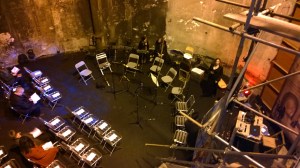 railway system, and the shaft has been re-opened with a concrete floor inserted to separate it from the trains below. It is currently only accessible by wriggling through a 1.3m high entrance and clambering about 12m down on some rickety scaffolding stairs.

