Hymne à la Vierge
A Weekend of Excessively Good Taste. Music of the French Baroque – 2
Orchestra of the Age Enlightenment, Eamonn Dougan
Kings Place, 26 November 2016
Charpentier: Ave Regina H. 45, Litanies a la Vierge H. 90, Pro omnibus festis BVM H.333, Pulchra es a3 H.52, Regina Caeli H.46, Alma Redemptoris H.44, Litanies a la Vierge H.83;
F. Couperin: Concerto Royale No. 1
Monsieur de Saint-Colombe: Les Pleurs;
Marin Marais: Pieces de viole, Livre III: Suite No. 7 in G, Allemande le Magnifique
Robert de Visée: Prélude, Allemande, Les Sylvains de Mr Couprin, par Mr de Viseé
As the title suggested, this concert focussed on vocal music for Marian devotion, and in particular, that written by Marc-Antoine Charpentier. There is an unproven suggestion that he travelled to Rome to study painting, although he certainly built the foundations of his future musical career whilst studying with Carissimi. On his return, he joined the household of Marie of Lorraine, the Duchess of Guise in the privileged role of house composer. The musical bond between the Duchess and Charpentier was clearly strong, not least in their mutual admiration for Italian music and in devotion to the Virgin Mary. For around 17 years, until Marie’s death, Charpentier wrote for the musicians of her household, producing some of the most beautiful music from the whole French Baroque era, most of it in praise of the BVM. He later moved to posts at the Jesuit St Paul-St Louis and eventually to the Royal chapel of Sainte-Chapelle.
 Composers with an eye for future recognition should ideally aim to die around the age of either 25 or 75, thereby gaining an anniversary every 25 years or so. Johann Jakob Froberger (1616-67) died aged 51, which means that he has anniversaries this year and next year, but not again for another 49 years. Hopefully the burst of interest in these two years will carry his name forward, as he is an often overlooked composer. But he was an enormous influence on keyboard composers from the 17th to early 19th century, not least for spreading the Italian style of his teacher Frescobaldi around Europe, and assimilating various European musical styles into his own compositions, notably from France.
 largest church in Christendom. Well before the completion of the Basilica, a musical foundation had been established (in 1436), and in 1476 a magnificent organ was built on one side of the choir. This was enlarged, and a corresponding organ added to the gallery on the other side of the choir, in 1596. Both organs survive to this day, in more-or-less original condition, and are amongst the most important surviving historic organs in the world.
 The London Bach Society was founded 70 years ago by Dr Paul Steinitz under the rather unambitious title of the ‘South London Bach Society’, but soon lost the ‘South’ part of the name. 1946 might not seem to be the ideal time to concentrate on things musical (and, indeed, devoted to a German composer), but they were not alone: The Arts Council and BBC Third Programme were launched around then, as were a number of orchestras. From the start, the focus of the LBS was to ‘get back to Bach in its original form’ at a time when Bach performance was very far from what we could no consider as being in any way ‘authentic’ with enormous choirs and orchestras, and a funereal approach to tempo and romantic notions of instrumentation, phrasing and articulation. To this end, the Steinitz Bach Players was founded, in 1968, bringing together a small group of professional musicians interested in period performance techniques on period instruments.
 The Dunedin Consort under their director (and noted Bach scholar) John Butt are amongst the most prominent exponents of Bach’s music around. So this timely release of their take on the Christmas Oratorio is particularly welcome. With a distinguished group of period instrumentalists, and some outstanding vocal soloists, this is one of the most impressive interpretations I have heard. Whatever your religious beliefs, or lack of them, this music digs deep. John Butt’s scholarly interpretations are an integral part of the Dunedin story and, for this recording, his study of the performing conditions of the first performances in Leipzig in 1734 led to decisions about the vocal forces for the recording.
 You can imagine the headlines in today’s gutter press. “Woman seduces man, gets him drunk, then beheads him. Claims God told her to do it”. She would probably spend the rest of her life in a institution for the criminally insane. But in the Bible (or, at least, in the Bible of the Catholics and Orthodox Christians, but not the Protestants, who count the Book of Judith as apocryphal, or the Jews), she was hailed as a national heroine who lived to the age of 105. Musically her story inspired Tallis’s Spem in alium, and works by Scarlatti, Mozart and Parry. In art, she inspired the likes of Cranach, Donatello, Caravaggio, Botticelli, Michelangelo, Goya and Klimpt (pictured). She is also the subject matter for Vivaldi’s only surviving oratorio Juditha triumphans devicta Holofernis barbarie, written exactly 300 years ago, in 1716. The story of Judith’s ‘triumph over the barbarians of Holofernes’ would have had a strong contemporary reference to Venetians, whose army had just defeated the Ottoman invaders in Corfu. Judith clearly represents Venice, and the Assyrian general Holofernes, the Ottomans.
 I didn’t see the 2010 production of Don Giovanni, or this summer’s Festival revival, so for me this was a new show. Set in a post-Mussolini Italy, the broody set, designed by Paul Brown, is focused on a massive central cube that presents all four of its sides, plus different incarnations of the central space, to the audience. It is a powerful image, but not without potential issues. Its overpowering presence centre stage pushes most of the action to the front or the side of the stage: no bad thing in itself, but giving a rather cramped feeling
 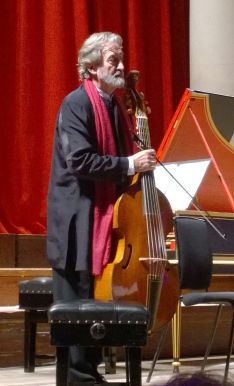 As part of the Southbank Centre’s International Chamber Music Series (currently taking place in St John’s, Smith Square while the Queen Elizabeth Hall is being refurbished), Jordi Savall and Le Concert des Nations presented a sell-out concert of music from the 1991 film Tous les matins du monde. Savall’s pre-concert chat with Radio 3’s Sara Mohr-Pietsch revealed some of the differences between the film’s portrayal and the actual life of Sainte-Colombe and Marais, but confirmed that Marais did crawl beneath Sainte-Colombe’s garden shed to listen to him practicing, that Sainte-Colombe developed a new style of fingering, and added a 7th string to the viol. He also explained how they achieved the voices of the two young girls singing in the film, by speeding up two adult female singers.
  English Touring Opera (ETO) has built a solid reputation for their two annual opera tours around England. In their most recent season, they visited 91 venues, with two groups of fully-staged operas (sung in English) plus various wider educational and community projects. It is a remarkable organisational undertaking and a tough call for the singers in each tour, with many singing in two operas and covering a role in the third. Usually touring two or three operas in the spring and autumn, they open with one-off autumnal London showings before hitting the road. Their choice of operas usually has a theme, or is otherwise related in style and period. This year’s autumn focus is on early operas written in, or inspired by, Venice, with Handel’s 1738 Xerxes, Cavailli’s 1651 La Calisto, and Monteverdi’s 1639 “Ulysses’ Homecoming” (Il ritorno d’Ulisse in patria), performed in reverse order to the dates of composition, and premièring in the magnificent surroundings of the Edwardian Hackney Empire.
  As part of the Kings Place ‘Baroque Unwrapped’ season, the Newcastle-based Avison Ensemble explored the world of the 18th century concerto, and the equally interesting world of English provincial musical life. Charles Avison (pictured) was a Newcastle born organist and composer who absorbed the musical style of Geminiani and Scarlatti during a short period in London before being enticed back to Newcastle with the promise of prestigious organist post complete with a new organ. He made a handsome living through teaching and arranging subscription concerts. He was also a fierce reviewer of other composers, including Handel.
 One of the most important musical events in London in 2015 was the long-awaited opening of the 1735 Richard Bridge organ (restored by William Drake) in the Hawksmoor designed Christ Church, Spitalfields. For many decades it was the largest organ in the UK, and its musical importance is immeasurable. My review of the gala opening recital, given by (the now sadly, late) John Scott, and information about the restoration and an organ specification can be found
 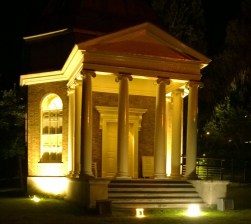 One of the most delightful of London’s music venues is Garrick’s Temple to Shakespeare
 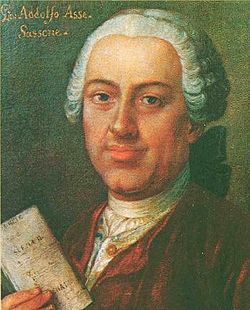 Johann Adolph Hasse (1699-1783) is one of those historically unfortunate composers who achieved great fame during their lifetimes but have since been more-or-less forgotten. A prolific composer of opera, he was hailed by Charles Burney as being superior to all other lyric composers. Married to the famed soprano Faustina Bordoni, the couple became the Posh and Becks of their day. Usually based in Dresden in the Court of the Saxon Elector Frederick III, Hasse had special dispensation that avoided the need to travel annually to the Polish Court, where Frederick was also the elected King. He also maintained a post in Venice at the Ospedale degli Incurabili. He lived long enough to have performed in front of Bach and the young Mozart.
 The Innsbruck Festival of Early Music celebrated its 40th anniversary this year, although its roots go back a further 14 years or so. After some preliminary events, the festival proper ran for the last two weeks in August. It usually features three fully staged operas, although this year the third of them was reduced to a one-night concert performance of the Ruhrtriennale festival’s production of Gluck’s Alceste, conducted by René Jacobs who until 2009 was artistic director of the Innsbrucker Festwochen and, incidentally, the singer at the first concert of the first festival on 24 August 1976.
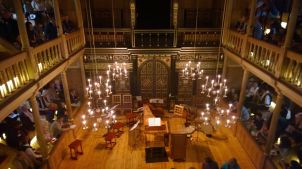 the new Globe management, those events seems to have ground to a halt, with only one listed in the current season – and that a hang-over booking from the previous management. So it was fortuitous that the BBC Proms chose the theatre for one of its ‘BBC at …’ events (alongside such venues as a multi-story car park in Peckham), not least because it enabled people to see the inside of this fabulous, but very uncomfortable, theatre for just £14, rather than the up to £62 the Globe are asking for their own next concert there.
 Since 1996, the cloister has been home to summer opera productions, presented by Iford Arts. Their latest season concluded with ‘A Fairy Queen’ presented by Iford Arts and their regular orchestra from Christian Curnyn’s Early Opera Company.
