St. Anne’s International Bach Festival

Music-at-Hill Golden Jubilee
24th St. Anne’s International Bach Festival

St. Mary-at-Hill, Lovat Lane, City of London
19 & 26 July 2019

The Music-at-Hill Concert Society was founded 50 years ago as the St Anne’s Music Society based in the church of St Anne & Agnes Church in Gresham Street, then the home of London’s Lutheran congregation. The church and the music society moved to St Mary-at-Hill in 2013. Music-at-Hill arranges weekly Friday lunchtime concerts, often of early music. During the four weeks in July leading up to the date of Bach’s death, they present the annual St. Anne’s International Bach Festival now in its 24th year, run in conjunction with its partner organisation, the City Bach Collective, who run regular Bach Cantatas for the St Anne’s Lutheran congregation in St Mary-at-Hill. The final two Fridays of the four-week festival featured two lunchtime recitals and a Gala Bach Concerto Finale from the City Bach Collective.

Continue reading

Andrew Benson-Wilson plays Bach: influenced by Reincken

Mayfair Organ Concerts
The Grosvenor Chapel
South Audley Street, Mayfair, London W1K 2PA
Tuesday 13 August 2019, 1:10

Andrew Benson-Wilson
plays music by
J S Bach
influenced by Johann Adam Reincken

WP_20150721_15_17_12_Pro.jpg

Johann Adam Reincken (1643-1722) was organist of Hamburg’s famous Katharinenkirche and a close friend of Buxtehude.  This recital is linked to a recital of his music given earlier this year at St George’s, Hanover Square. That recital included his monumental chorale fantasia on An Wasserflüssen Babylon composed around 1650. At around 20 minutes long, it the longest known piece of its type in the whole 17th century North German repertoire. It was known by Bach who, while at school in Luneburg, aged around 15 copied the entire piece out from a copy owned by Georg Böhm. It is believed that he also travelled to Hamburg to hear Reincken play. In 1720, shortly before Reincken’s death, Bach visited Hamburg and improvised a lengthy fantasia on the same chorale in homage to Reincken, who commented: “I thought that this art was dead, but I see that it lives in you”. Bach also transcribed several of Reincken’s instrumental pieces for keyboard.

This recital includes one of Bach’s Reincken transcriptions, a Toccata that is clearly influenced by Reincken’s dramatic style, and Bach’s chorale prelude on An Wasserflüssen Babylon, which includes a very obvious reference to Reincken’s chorale fantasia. It ends with Bach’s giant Fantasia in G minor, which may have been played during Bach’s 1720 visit to Hamburg. The accompanying Fugue is based on a popular Dutch tune and might have been Bach’s homage to Reincken, who was born in The Netherlands. 

Toccata in D minor  BWV 913
An Wasserflüssen Babylon BWV 653
Sonata in A minor (after Reincken
Hortus musicus) BWV 965
Fantasia in G minor BWV 542i

The organ is by William Drake
Admission is free, with a retiring collection

York Early Music Festival

York Early Music Festival
Innovation: the Shock of the New!
10-12 July

My principal reason for going to York was to review the biennial York Early Music International Young Artists Competition which took place over the last three days of the annual York Early Music Festival. The Festival lasted from 5 to 13 July and was given under the banner of Innovation: the Shock of the New! taking inspiration from the 500th anniversary of Leonardo da Vinci. Alongside talks and community events were a range of concerts, mostly from York-connected and UK ensembles, but with welcome continental visitors including Concerto de Margherita, one of the EEEmerging groups, fortepianist Andreas Staier, the Italian/Jewish Ensemble Lucidarium, and the distinguished Belgian consort Vox Luminis. I was able to attend the last four of the Festival concerts, together with the three days of the Competition.

Continue reading

Favourites: Telemann and his Subscribers

‘Favourites’
Telemann and his Subscribers
Tabea Debus, recorder
TYXart TXA18107. 66’34

Recorder player Tabea Debus is one of the most impressive young musicians of her generation. She has already featured many times in this review website for her CDs and concert performances (see here). Her latest recording is a clever combination of two genuine Telemann pieces for recorder (the Sonata in C, TWV 41:C2 and Concerto in F, TWV 51:F1) forming a sandwich with a filling of four suites of pieces collated and arranged by Tabea Debus from Telemann and three of the composers who subscribed to Telemann’s music publications. Telemann was one of the pioneers of music publishing funded by inviting pre-publication subscriptions – an early form of crowd-funding. Amongst those subscribers were Bach, Handel and Blavet, the three composers whose pieces are collected into suites on this recording. Continue reading

Art of Moog: Bach and beats

Art of Moog: Bach & beats
Waterloo Festival
The Cello Factory, Waterloo, 18 June 2019

Bach was influenced by a wide range of musical styles of his time, travelling to learn about other musical traditions and copying manuscripts of other composers. If he had been around, not in the 1700s, but in the 1960s, when the likes of Pink Floyd, Keith Emmerson, and Rick Wakeman were active; when Wendy Carlos’s ‘Switched-On Bach’ was released and, a few years later, when Kraftwerk highlighted their genre of electronic synth-pop, then he would surely have appreciated the world of synthesised music. Indeed, his own instrument, the organ, is a giant wind-blown synthesiser, with the names and sounds of most of its stops replicating Renaissance instruments. The four-strong group Art of Moog base their music on Bach, Wendy Carlos and Kraftwerk under the banner of ’21st-century Hyper-Bach on Synthesizers’.

Their concert for the Waterloo Festival was given in the delightful Cello Factory, an art gallery in the streets close to London’s Waterloo Station. Three distinguished early-music harpsichord players (Robin Bigwood, Steven Devine & Marin Perkins) gathered around a collection of keyboards, synthesisers, vocoders and other complicated looking little boxes, together with the equally distinguished recorder player Annabel Knight, who clipped an EWI5000 (an Electronic Wind Instrument) onto a lanyard around her neck. This was not going to be a ‘normal’ period instrument early music event – indeed, we were told that what we were about to hear was “absolutely bonkers”. Continue reading

Bach: Das Wohltemperierte Klavier I

Bach: Das Wohltemperierte Klavier I
Steven Devine, harpsichord
Resonus Classics RES10239. 2 CDs. 55’06+56.13

This is the first of two double-CD volumes of Bach’s Das Wohltemperierte Klavier (The Well-Tempered Clavier), and covers the Preludes and Fugues 1 to 24 (BWV846-869) that form Book 1 of ‘The 48’. This musically intelligent and absorbing recording by Steven Devine demonstrates that performing Bach (or any music, for that matter) is far more the merely playing all the notes in the right order. His subtle use of articulation and rhetoric and his understanding of the Baroque idea of building up musical ideas from small motifs make for an absorbing recording that will invite repeated listening. He manages to negotiate that fine line between presenting a personal interpretation and those over-mannered performances that might be fine for a live recital but is usually off-putting on the repeat listening that a recording allows. With obvious respect to Bach and these extraordinary miniatures of musical craft, Devine brings a wide range of interpretations, matching the underlying mood of each Prelude and Fugue perfectly. Continue reading

Bach: St John & Matthew Passions

JS Bach: St John Passion
 The Choir of Westminster Abbey, St James’ Baroque, James O’Donnell
Westminster Abbey. 16 April 2019

JS Bach: St Matthew Passion
Ex Cathedra, Jeffrey Skidmore
St John’s, Smith Square. 17 April 2019

Hearing Bach’s two best-known Passions on successive evenings in two nearby venues, and with contrasting performers, gave me a chance to compare aspects of the two Passions and performing styles. One was given by a choir with a 600-year history, the other by a choir approaching its 50th anniversary.  Both used period instrument orchestras. They were given in very different conditions to the performances of Bach’s day, and to very different groups of people – Bach to an involved congregation with a reasonable unified belief system, us as a passive audience with a variety of beliefs. However much a present-day believer might know the story that Bach sets to music, few will understand the context of early 18th-century Lutheran theological thought in Saxony. Non-believers or doubters will find the text at best puzzling, and at worse an illogical fabrication based on generations of earlier and equally illogical myth-makers. Continue reading

Andrew Benson-Wilson plays Reincken

Mayfair Organ Concerts
Andrew Benson-Wilson plays 
Johann Adam Reincken (1643-1722)
St George’s, Hanover Square, London W1S 1FX
30 April 2019 @ 1:10pm 

Toccata in G (Andreas Bach Book)
Toccata in A (Anon?)
Chorale Fantasia: An Wasserflüssen Babylon

Johann Adam Reincken was one of the most important and influential 17th-century North German organist-composers. He forms a unique link between the Sweelinck influenced organists of the earlier part of the century and JS Bach. Little is known about his life, and very few of his organ compositions survive. He was born to North German parents in Deventer in The Netherlands around 1643. An earlier supposed birthdate of 1623 is now accepted as incorrect. He moved to Hamburg in 1654, aged just 11, to study with the famed organist of the Katharinenkirche, Heinrich Scheidemann, a pupil of Sweelinck. After a brief return to Deventer, he came back to Hamburg in 1659 as Scheidemann’s assistant, replacing him as organist in 1663 on Scheidemann’s death. As was the custom of the time, he married one of Scheidemann’s daughters in 1665. He remained there for 60 years until his death in 1722. As well as his church duties, he co-founded the Hamburg Opera and was involved in the city’s musical life. He is known from two pictures dating from around 1674; the portrait painting and the now well-known ‘Musical Company’ painting by Johannes Voorhout.

Reincken. Kniller, c1674.jpg

Continue reading

Bach: Partitas

J S Bach: Partitas Clavier-Übung I
Menno van Delft, clavichord
Resonus Classics. RES10212. 2 CDs: 59’21+73.49

Clavier-Übung I – Partitas BWV 825-830

Bach’s Six Partitas were published in 1731 under the title of  Clavier-Übung, the first of four publications under that name, culminating in the monumental third and fourth publications, the ‘German Organ Mass’ and the Goldberg Variations, Clavier-Übung VI. Each Partita had been published separately between the years of 1726 and 1730 but seem to have been intended as a combined set of six, as was the pattern of many such musical collections of the time, including Bach’s own preceding English and French Suites. They are the only one of the four Clavier-Übung set that does not specify a particular keyboard instrument, but Menno van Delft makes a convincing argument for the use of a clavichord, the domestic instrument of choice, particularly for organists, rather than a harpsichord. Continue reading

Bach: Chorale Partitas

J S Bach
Chorale Partitas, BWV 766-768 & 770

Stephen Farr, organ
Resonus Classics RES10120. 55’46

Ach, was soll ich Sünder machen BWV 770
Christ, der du bist der helle Tag BWV 766
O Gott, du frommer Gott BWV 767
Sei gegrüßet, Jesu gütig BWV 768

Stephen Farr continues his series of Bach organ recordings with the four Chorale Partitas – variations sets of Lutheran chorales. None of them exists in autograph, so dating is problematical. They are almost certainly early works, possibly composed around the time Bach was at Arnstadt, or perhaps even earlier while Bach was under the influence of Georg Böhm, who Bach knew, and probably studied with while he was at school in Lüneburg. Böhm wrote many variation sets (as did Pachbel), a compositional style that goes back the Sweelinck, the Amsterdam instigator of the North German/Hamburg school of the early to mid-17th-century. It is not clear whether Bach’s examples were intended for performance during church services or, indeed, on the organ. Most are equally suitable for clavichord or harpsichord in a domestic setting. Continue reading

Wednesdays at 5.55

Wednesdays at 5.55
Organ Recitals at the Royal Festival Hall
W Harry Hoyle
Clontarf Press 2018
Hardback. 230 pages, 235x156mm, ISBN 978-1-999685706

Wednesdays at 5.55.png
For many organ music lovers, the phrase Wednesdays at 5.55 will have a particular resonance. Between 1954 and 1989, London’s Royal Festival Hall held early evening organ recitals on the influential and controversial Harrison & Harrison organ, inaugurated in 1954. During those years there were a total of 545 organ recitals given by nearly 200 international organists attracting at its peak audiences of around 1500. This record of these recitals, and the music and performers involved, is very clearly a labour of love for the author, W Harry Hoyle. The publicity blurb sums up the book well – “Drawing on the Southbank Centre archive, private paper collections and the memories of many performers, in this comprehensive and engaging book he tells the story of how the series was planned, which organists performed, the repertoire they played and how the recitals were received by the press and by the public. He also reviews the social changes that led to the ending of ‘Wednesdays at 5.55’ and the search for the best way to present the highlights of the organ repertoire on this unique instrument“. And that is exactly what it does, in an absorbing and informative read. Continue reading

Baroque at the Edge

Baroque at the Edge
Saint James, Clerkenwell, St Luke’s Old Street
Saturday 6 January 2019

Imagine.jpg

With a headline of “Imagine if Bach was a jazzman, Purcell a folk-fiddler, or Monteverdi a minimalist…”, the second annual Baroque at the Edge festival made a fitting opening to the 2019 London musical calendar. Founded in 2018 by Lindsay Kemp and Lucy Bending, the team behind the London Festival of Baroque Music and the earlier Lufthansa Festival, the festival invites musicians with a classical, jazz, or folk background to “take the music of the Baroque and see where it leads them” with the promise of “No rules, no programme notes, no lectures: all you need to know is how to listen”. The festival was spread over a three day weekend, with most of the events taking place on Saturday, 6 January, after a Friday night piano recital and before a Sunday family folksinging workshop and linked lunchtime concert. Continue reading

Bach: Christmas Oratorio

Bach: Christmas Oratorio
Choir of Trinity College Cambridge, Stephen Layton

Orchestra of the Age of Enlightenment
St John’s, Smith Square, 22 December 2018

Whatever joys the St John’s Smith Square Christmas Festival comes up with year after year (this is the 33rd), the climax comes with the final two (always sold-out) concerts conducted by the festival director, Stephen Layton, firstly with his own Trinity College Cambridge choir, and then with his professional choir, Polyphony. In recent years both concerts have been accompanied by the Orchestra of the Age of Enlightenment (OAE). The first of the two concerts is usually Bach’s Christmas Oratorio (Parts 1, 2, 3 & 6), sung by the student choir of Trinity College, the second, Messiah, sung by Polyphony.

No automatic alt text available.

Continue reading

Gesualdo Six: There is no rose

There is no rose
The Gesualdo Six, Owain Park
St John’s, Smith Square, 14 December 2018

Although only formed four years ago, The Gesualdo Six have gained an impressive following, not least at St John’s, Smith Square where they were one of the four members of the second Young Artists Scheme in 2015/16. They used that residency to launch their Composition Competition at SJSS, with the second following in 2019. For their concert in this year’s SJSS Christmas Festival, they gave a mixed programme of Christmas music ranging from plainchant and the early 15th century Trinity Carol Roll and music by Taverner and Tallis, through to living composers, including their own director Owain Park. Continue reading

Il Santissimo Natale

Il Santissimo Natale
The English Concert & Choir, Laurence Cummings
St John’s, Smith Square, 12 December 2018

The 33rd St John’s, Smith Square Christmas Festival continued with a very welcome first-half performance (by The English Concert and Choir, directed by Laurence Cummings) of Alessandro Scarlatti’s Missa per il Santíssimo Natale. Scarlatti is usually overlooked in comparison with other composers, both in his many operas and his few compositions for the church. His il Santíssimo Natal Mass was composed in 1707, during Scarlatti’s brief time as maestro di cappella at the Basilica of S Maria Maggiore in Rome. The two jubilant Kyries contrasted with a reflective central Christe. The gentle mood continued into the opening of the Gloria, before the bouncy rhythms returned. As in the later parts of the Mass, frequent changes of mood were a compositional feature, dissolving from one to the other with delightful ease, helped by some well-judged directed from conductor Laurence Cummings. The final Agnus sequence is a gently expansive movement, providing a suitably reflective conclusion to an impressive composition, Scarlatti’s operatic experience never far from the surface, without imposing. Continue reading

Bach: St Matthew Passion

Bach: St Matthew Passion
English Touring Opera
Temple Church, London. 18 October 2018

English Touring Opera (ETO) is an ambitious organisation that run extensive annual tours of staged operas around the UK, alongside one-off projects like their current adaptation of Bach’s St Matthew Passion. They start their tours in London, usually at the Hackney Empire, where they have just staged Radamisto and a triple-bill of Dido and Aeneas, Carissimi’s Jonas, and Gesualdo madrigals. Details of their current tour can be found here. For the Matthew Passion, as in previous such projects, they enrol local amateur choirs, community groups, and schools. For their London performance, these were the Collegium Musicum of London Chamber Choir (whose musical director is assistant organist at The Temple Church) and an almost exclusively female flock of children from the Holy Trinity and Saint Silas Church of England Primary School in Camden. The orchestra was the professional period instrument Old Street Band. Continue reading

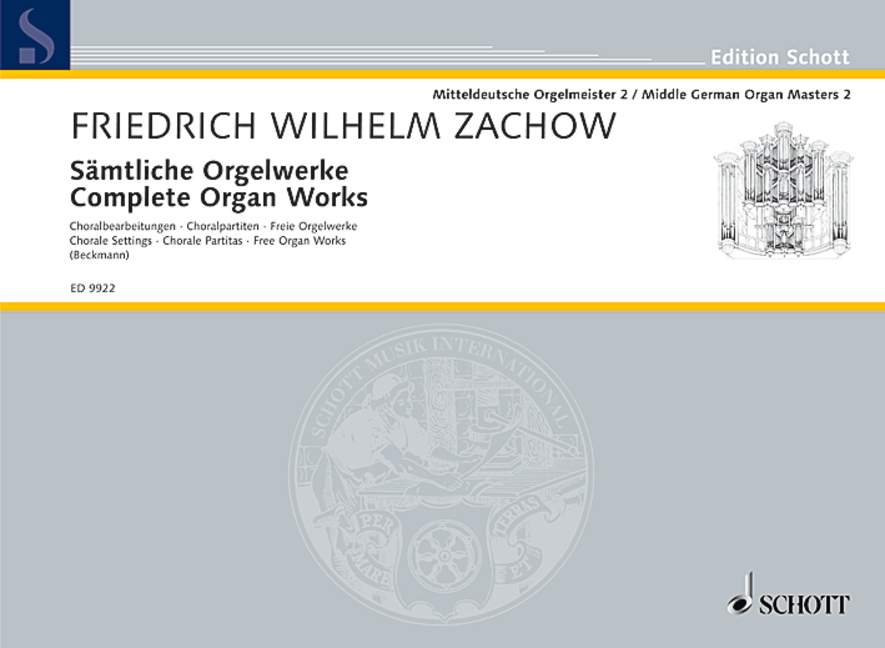
Zachow: Complete Organ Works

Friedrich Wilhelm Zachow: Complete Organ Works
Chorale Settings • Chorale Partitas • Free Organ Works
144 pages  • ISMN: 979-0-001-14049-2 • Softbound
Edition Schott ED 9922

Friedrich Wilhelm Zachow (1663-1712) is best known as the teacher of the young Handel in their hometown of Halle. He was organist of the principal city church, the Marienkirche, also known as the Marktkirche Unser Lieben Frauen and Liebfrauenkirche, a post held earlier in the 17th century by Samuel Scheidt.  The little 1664 organ on a gallery above the altar that Zachow and Handel certainly knew still exists. JS Bach was offered the post in succession to Zachow, but turned it down, leaving it until 1746 for his son WF Bach to eventually become the organist. Zachow’s father was from nearby Leipzig where he was town piper. His church music was criticised as being too long and complicated by the pietest clergy, who preferred something more approachable. He taught Handel violin, oboe organ, and harpsichord along with music theory. He teaching was clearly successful, as Handel became organist of the Halle Cathedral aged just 17. His later compositions show several influences from Zachow, as well as borrowings.

Continue reading

RFH International Organ Series: Renée Anne Louprette

Renée Anne Louprette, organ
Royal Festival Hall, 19 September 2018

JS Bach: Prelude and Fugue in G
Marin Marais: Suite from Alcyone (arr. Louprette)
Jehan Alain: Variations sur un thème de Clément Jannequin
Ad Wammes: Mytò
Nadia Boulanger: Improvisation from 3 Pièces
Duruflé: Suite, Op.5

The Royal Festival Hall’s ‘International Organ Series‘, most of which is made up of UK, rather than international organists, made up for that fact by replacing an indisposed UK performer with Renée Anne Louprette, an American organist who spent some of her student days in London. She has held posts in several important New York churches, alongside academic posts, and is now University Organist and Coordinator of the Organ Department at the Rutgers University Mason Gross School of the Arts in New Jersey.

Her largely French programme opened with Bach’s flamboyant Prelude and Fugue in G (BWV 541), a distinctly non-French piece. From the very first few notes, it was clear that Renée Anne Louprette is an outstanding Bach interpreter. Her sense of touch, rhetoric and the way she sensitively articulated the opening flourish and the repeated notes in both Prelude and Fugue showed a real (and sadly rather rare) understanding of Baroque concepts such as the hierarchy of the bar. Her choice of registration was spot-on. Continue reading

Prom 29/30: The Brandenburg Project

Prom 29/30: Brandenburg Concertos Project
Swedish Chamber Orchestra, Thomas Dausgaard
Royal Albert Hall, 5 August 2018

One of the more unusual of this year’s BBC Proms were two related concerts given by the Swedish Chamber Orchestra under their conductor Thomas Dausgaard. Over an afternoon and evening Prom, they performed all six Bach Brandenburg Concertos, each accompanied by companion pieces, commissioned by the orchestra, to partner each of the Brandenburgs. An ambitious project, that got close to working, but ultimately, from my point of view, didn’t. As an early music specialist, I do find modern instrument performances of Bach problematical. Although they certainly didn’t over-romanticize their interpretations, the sound world was one I wasn’t used to, at least, not since my youth. And with so many composers eager to write for period instruments, I think a real opportunity has been missed, from the Proms point of view, although the project has certainly done the Swedish Chamber Orchestra no harm.

Continue reading

Itinéraire Baroque: 2018

Itinéraire Baroque en Périgord Vert
26-29 July 2018

IMG_20180728_115913327.jpg

The annual Itinéraire Baroque en Périgord Vert festival is now in its 17th year. It is based around the towns of Ribérac and Verteillac in the northern part of the Dordogne-Périgord region of western France. It was founded by Robert Huet and Ton Koopman, the former a local resident and director of the organising committee, the latter the artistic director and occasional import from The Netherlands, along with musical friends and family. It started as the one-day event that gave the festival its name – the Itineraire Baroque, a musical tour of some of the little-known Romanesque churches of the region. It was intended as much to draw attention to these often locked churches as for any musical intent. It has now expanded to cover four days over the last weekend in July. The theme for this year’s festival was ‘Looking towards Spain’, although only a few concerts made more than a casual nod in that direction. In fact, as a weekend dominated by Netherlanders, it was no surprise that several of the concerts focussed on the historic battles between the Dutch and the Spanish, viewed from a Dutch point of view – perhaps ‘Trying to get rid of Spain’ would have been a more accurate title. The programme for this year’s festival can be found here.

Continue reading

Peter Williams Memorial Recital

Peter Williams Memorial Recital
David Ponsford & Ghislaine Reece-Trapp
St George’s, Hanover Square. 24 May 2018

Peter Williams (1937–2016) was a renowned Bach scholar, organist, harpsichordist, music and publications editor, and writer. His notable publications include seminal works on Bach, Bach’s organ music, and historic organs. One of his most important books was his 1966 ‘European Organ 1450-1850’. a key introduction to the different styles of the wider European organ culture, published at a time when most UK organists had little experience of continental organs. This was followed in 1993 by ‘The Organ in Western Culture, 750-1250’. His three-volume ‘Organ Music of J. S. Bach’ (Cambridge University Press 1980, revised as a single volume in 2003) is still essential reading for anybody wanting to understand the complex background of Bach’s most famous repertoire. His most recent book, ‘Bach: A Musical Biography‘ was published posthumously in 2016, a few months after his death.  Some of the obituaries can be found here and here and here.

Peter Williams.jpg

Continue reading

Bach: B Minor Mass

JS Bach: B Minor Mass
Gabrieli Consort and Players, Paul McCreesh
St John’s, Smith Square. 1 April 2018

The St John’s, Smith Square Holy Week Festival concluded with an Easter Sunday performance of the B Minor Mass. it is a piece not normally associated with Holy Week, but it reflects in glorious musical form the belief system of the Christian believer. It is one of Bach’s last works and one that he clearly wanted posterity to hear, even though he never heard it performed himself. In fact, it wasn’t performed complete until a 100 years after Bach’s death. Its compositional background is complex, with versions of some individual movements dating back to 1714 (the Crucifixus) and the Kyrie and Gloria (the Missa) completed in 1733 and presented to the new Saxon Elector with a view to getting the title of Composer to the Electoral Saxon Court, which he eventually got three years later. In the last few years of his life, Bach extended the Missa to include the full Latin Ordinary of the Catholic Mass by adding the Credo (the Symbolum Nicenum), Sanctus, Agnus Dei, and the concluding Dona nobis pacem, the latter a repeat of an earlier Gloria movement. Even its current title is misleading, not least because only a few of the movements are actually in B minor. Continue reading

Bach: Matthew Passion

Bach: St Matthew Passion
Orchestra & Choir of the Age of Enlightenment, Mark Padmore
The Anvil, Basingstoke. 31 March 2018

During Easter Saturday, I watched a broadcast from Berlin of the powerful Simon Rattle/Peter Sellars staging of the St Matthew Passion that I had reviewed back in 2014 at the Proms. And in the evening, an unstaged, but equally powerful Orchestra of the Age of Enlightenment performance in Basingstoke’s Anvil. The common factor was Mark Padmore, appearing as the Evangelist and, in the case of the OAE, as director. I don’t object in principle to stagings of the Bach Passions. Sellar’s use of the space in and around the orchestras was very effective, and I also liked Jonathan Miller’s inspiringly human reading in the mid-1990s, and Deborah Warner’s 2000 ENO staging of the St John Passion, which drew the audience directly into the unfolding drama. But sometimes just being presented with the music itself, without additional layering, is the way to focus on the complex human emotions that Bach portrays.  Continue reading

Concerto

Concerto
Works for one & two harpsichords
Guillermo Brachetta, Menno van Delft
Resonus RES10189. 56’24

I have reviewed harpsichordist Guillermo Brachetta recordings on Resonus favourably several times before (here) but was almost immediately put off this CD by the overly mannered playing of Bach’s opening Italian Concerto (BWV 971), particularly the first two movements. Lingering on notes to this extent not only disrupts the flow of the music and the underlying pulse but, in my view, is alien to the Baroque concept of performance style as I understand it. That said, I am glad that I continued listening to the CD as this aspect of performance is not as apparent in the later pieces, even in the pieces by WF Bach and Graun where, arguably, such flexibility of rhythm and articulation might be considered rather more appropriate. Interestingly there is also no recurrence in the other JS Bach piece, the Concerto a due Cembali in C major (BWV 1061a) performed with Menno van Delft. This is the assumed original version, from around the same time as the Italian Concerto, which was later turned into a concerto with added string accompaniment. For me, this performance is the highlight of the CD,  Continue reading

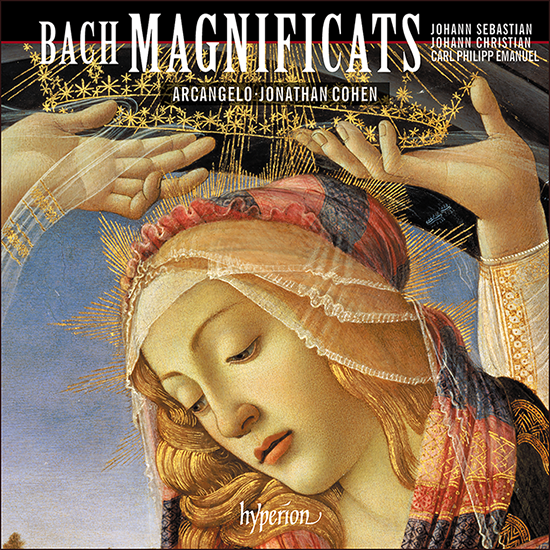
JS Bach/JC Bach/CEP Bach: Magnificats

JS Bach, JC Bach & CPE Bach: Magnificats
Arcangelo, Jonathan Cohen
Hyperion CDA68157. 76’48

This recording has the same programme as the concert in St John’s, Smith Square in October 2015. The CD was recorded a few days after the concert, in the church of St Mary the Virgin and St Mary Magdalen in Tetbury, Gloucestershire, but has only recently been released. The acoustics of this large Gothic church (with its wide nave and tiny side aisles) are more generous than St John’s, Smith Square, giving an added bloom to the sound, although the spacing of the musical forces sometimes gives more of a sense of distance that the more compact London stage avoided. Unlike the concert performance, the CD opens with JS Bach’s 1733 reworking of his earlier E flat version, written for his first Christmas in Lübeck in 1723. It is given a forthright performance without the irritating gaps between movements that I mentioned in the concert review.  Continue reading

Bach and Handel: Great Balls of Fire

Bach and Handel: Great Balls of Fire
Orchestra of the Age of Enlightenment, Steven Devine
Kings Place. 1 March 2018

Handel: Organ Concerto Op. 4 no. 1
Handel: 
Organ Concerto Op. 7 no. 5
Bach:
 Brandenburg Concerto no. 5

Under the banner of the Kings Place ‘Turning Points’ series (which aims to explore the hidden secrets of the great composers) and a very silly concert title (‘Great Balls of Fire’), the OAE presented three examples of the 18th-century keyboard concerto, contrasting two of Handel’s Organ Concertos with Bach’s 5th Brandenburg Concerto. Composed for entirely different audiences and occasions, the Bach and Handel pieces reflect key moments in the development of music. A pre-concert talk by the chief executive of the OAE, given in the rather booming style of a schoolmaster (I use the gender-specific term deliberately) lecturing a lower-sixth general studies course, gave some background to the concert and the three pieces were to hear. The concert itself lasted just one hour, without interval. It was followed by a Q&A session with the performers and an encore, voted for by the audience from a list of three.  Continue reading

Bach: Organ Chorales

JS Bach
Organ Chorales of the Leipzig manuscript/Schübler Chorales
Vincent van Laar
Aliud ACDBN 103-2. 2CDs 60’32+52’34

There are many recordings of these pieces, so a new one needs to be judged by what it can offer that others cannot. One question is about the nature of performing in recital and for a recording. It is generally accepted that performers can be much freer in their interpretation when playing live than in recording. An interpretational flourish in a recital is a take-it-or-leave event, which may well not repay repeated listening. So recordings tend to be ‘safer’ interpretations. Some recordings are, in effect, ‘live’, in that they are either taken from a live recital, or are performed as if live, without editing or re-takes. On this recording, Vincent van Laar generally plays in the ‘safe’ zone, but there are a few occasions when he steps into a more personal mode. And it is these moments that make this recording worth considering.  Continue reading

Bach: Du treuer Gott

J S Bach: Du treuer Gott
Leipzig Cantatas BWV 101 – 103 – 115

Collegium Vocale Gent, Philippe Herreweghe
Outhere music LPH027.62’26
Nimm von uns, Herr, du treuer Gott BWV 101
Mache dich, mein Geist, bereit BWV 115
Ihr werdet weinen und heulen BWV 103

Following two earlier CDs (LPH006 and LPH012) that focussed on cantatas written during Bach’s first year in Leipzig, this recording looks at the second cycle of cantatas, composed in 1724/5. Nimm von uns, Herr, du treuer is based on the chorale melody better known as Vater unser im Himmelreich, the Lutheran version of the Lord’s Prayer. Apart from the first aria (with its delightfully jovial flute solo), this well-known melody is heard in all movements. The two recitatives are interesting, with both alternating the chorale melody with recitative passages, the first in a particularly dramatic mood, the second with some evocative harmonic sequences. The central bass aria also switches between chorale and aria. Bach uses a strong orchestration, with three trombones, three oboes, an oboe da caccia, and a cornett – an unusual use of an instrument that would have been seen as distinctly old-fashioned at the time. The final aria, a reflective duet for soprano and alto, combines flute and oboe da caccia.  Continue reading

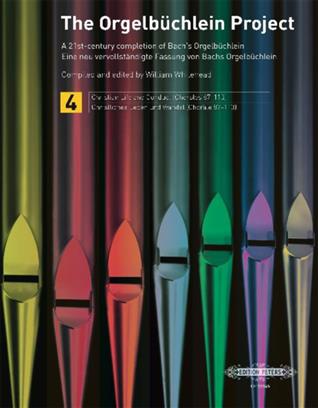
The Orgelbüchlein Project

The Orgelbüchlein Project
A 21st-century completion of Bach’s Orgelbüchlein
Compiled and edited by William Whitehead
Volume 4: Christian Life and Conduct (Chorales 87–113)

152 pages  • ISMN 979-0-57701-498-2  • Softbound
Edition Peters EP73145

OB.jpg

The Orgelbüchlein Project is one of the most exciting and ambitious musical projects of recent years. Bach’s Orgelbüchlein was intended to be a set of 164 chorale preludes covering the whole liturgical year. It was started during Bach’s time in Weimar (1708-17) with a few additions after he arrived in Leipzig. In a tiny manuscript book, Bach wrote the titles of all 164 Lutheran chorales at the top of the pages, but only managed to complete settings of 46 of them. Most titles were allocated a single page, with some given more space. When he came to write out the chorale preludes, he occasionally ran out of space and packed in a few more bars at the bottom of the pages in the more compact (but old-fashioned) German tablature letter notation. The title page of the autograph copy (pictured below) notes Bach’s intention for the collection that “a beginning organist receives given instruction on performing a chorale in a multitude of ways while achieving mastery in the study of the pedal, since the chorales contained herein the pedal is treated entirely obbligato . . . that my fellow man may hone his skill.” The Orgelbüchlein Project is an international project, founded and curated by organist William Whitehead, to complete the Orgelbüchlein by commissioning composers to write settings for the 118 missing chorale preludes.

Continue reading

Bach in Advent: Clavier-Übung III

Bach in Advent
David Titterington, Siglo de Oro, Patrick Allies
Bach Clavier-Übung III ‘German Organ Mass’
St John’s, Smith Square. 21 December 2017

During the three-week run-up to Christmas, St John’s, Smith Sq has been running a series of free early evening organ recital, given by the curator of the SJSS Klais organ, David Titterington, and focussed on the music of JS Bach. The two I had intended to hear before evening concerts were both cancelled, but I did catch the evening concert that concluded the series. This was a performance of the major pieces from Bach’s Clavier-Übung III, occasionally referred to this Bach’s monumental work, the largest single collection of his organ music. It was published in 1739 and includes a wide range of musical style, in the form of chorale preludes (in pairs, with larger pedaliter and smaller manualiter arrangement) based on the German Lutheran Mass, together with four duets, the whole enclosed with a large-scale Praeludium and Fugue – the latter known in the UK as the ‘St Anne Fugue’ after the hymn tune which the theme resembles.  Continue reading