Recital on the ‘Wetheringsett’ organ, c1525
St Swithun’s, Church Street, Worcester WR1 2RH
Friday 23 June, 2017. 1.10
Andrew Benson-Wilson
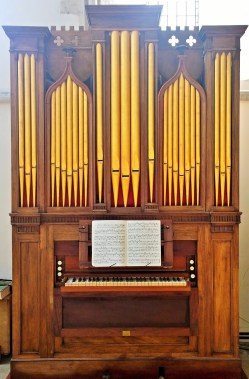
 The ‘Wetheringsett’ organ is a reconstruction of a Tudor organ based on the soundboard of an organ that was found during alterations to a farmhouse in the village of that name in Suffolk. Until it was hidden away within the walls of the farmhouse, is seems to have been used as a dairy door. The many holes in the wood were initially thought to indicate some sort of protection from the evil eye, until a local organ builder recognised it as the soundboard of an organ – the bit hidden away inside the instruments where the feet of the pipes sit, and through which the air is channelled from the windchest to the pipes. Analysis of the number and size of the holes can give a pretty accurate account of the size, range and number of stops of the organ. Tree-ring dating suggests that the wood dates from around 1525, leading to suggestions that this could be the organ known to have been purchased by a large parish church in Debenham in that year.
Under the aegis of the Early English Organ Project this organ, along with a smaller instrument based on another soundboard found in Wingfield Church, Suffolk, was reconstructed by organ builders Goetze & Gwynne in 2002. Under the management of the Royal College of Organists, the Wetheringsett organ is now resident in the church of St Swithun’s in the centre of Worcester, a delightful Georgian church with box pews and a later 18th century organ.
For this recital, I will be playing English music from before, during, and just after the 1520s, with pieces from c1360 to one of Thomas Tallis’s two extraordinarily monumental Felix Namques, dating from around 1560. In contrast I will play a Voluntary by Samuel Wesley on the 1795 Grey organ, published just a few years after the date of the organ.
Robertsbridge Codex, c1360
Adesto / Firmissime / Alleluya Benedictus
John Dunstaple (Buxheimer Orgelbuch, c1460)
Sub Tuam Protectionem
Anon, c1530 (Roy 56)
Felix Namque (in 5/4)
Anon / Thomas Preston (d1563)
Uppon la mi re
Hugh Aston (c1485-1556)
A hornepype
Samuel Wesley (1766-1837)
Voluntary in B flat. Op 6/9 8’
Thomas Tallis (c1505-1585)
Felix Namque I (1562)
Admission is free, with a retiring collection.
 This release combines the re-release of a 2005 recording of Joby Talbot’s Path of Miracles with Footsteps, a companion work composed by Owain Park, recorded in 2016. Both are commissions by Tenebrae, the Park piece apparently in answer to requests from amateur singers for a less complex piece than the Talbot. Continue reading
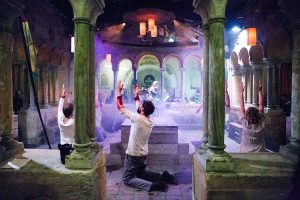 Contraband. It was set in recent times in a fundamentalist (and militaristic) Christian community of cult-like weirdness, led by the controlling Zebel (Frederick Long), with behaviours frequently bordering on what might have been found in a lunatic asylum of Handel’s day. As it happened, on my drive down to Iford, I listened to a Radio 4 broadcast of an account of the 1993 siege of a fundamentalist sect at Waco in Texas. The comparisons were chilling.
  l tower were added. Internally, the Romanesque triple-aisled basilica was altered, rather inelegantly, by inserting two enormous domed cupolas into the original external walls, resulting in a bit of an architectural mess. After two major fires in the 17th century (which destroyed the cupolas), the church was restored, and impressive new convent buildings were added, with cells for 45 nuns. During the Revolution, the Abbey first became a prison (1792), and then a barracks (1808). In the 1920s, the Abbey complex was purchased by the town of Saintes. In the 1970s, restoration of the monastic
  buildings (abandoned since the war) was started and, in 1972, an annual Festival of Ancient Music was created, later becoming the Festival de Saintes. In 1988 the Abbey was launched as a cultural centre by President François Mitterrand, and in 2013 it became la cité musicale, housing a Conservatoire of Music and a range of year-round musical activities, including many for young people. The former nun’s cells now sleep visitors and guests of the Festival.
 LunchBreak Opera is a new venture, launched earlier this year. Its first production was Puccini’s one-act opera Suor Angelica, given in nine fully staged and costumed lunchtime and early evening performances (10-14 July) in St Botolph’s Church, Bishopsgate, London – a prime position, next to Liverpool Street Station. Lasting just 50 minutes it is ideal for lunchtime and post-work entertainment.
  The five-strong group Ceruleo (two sopranos, cello, theorbo, and harpsichord) got together at the Guildhall School of Music and Drama in 2014. They have just completed a one year Artist Fellowship there, the first time a this has been awarded to a group. During their year, they gave several performances of their programme ‘Deplorable Fire’ commemorating the 350th anniversary of the Great Fire of London, including a live performance on BBC Radio 3. They presented their Paradise Lost programme, based on John Milton’s poem (published 350 years ago in 1667) as their final recital of their Fellowship year. The music was interspersed by extracts from Paradise Lost.
  The entire centre of the historic Danube city of Regensburg has been declared a World Heritage site, and all the venues for the festival are in important historic buildings. These range from extreme Baroque and Rococo to austere Gothic churches, and the historic Reichssaal, part of the Altes Rathaus, and for centuries the permanent seat of the Parliament of the Holy Roman Empire. This was the 33rd festival and featured groups from 12 countries, and musicians from a great many more. The Tage Alter Musik website can be see
  converted into a small concert room, and there is also a larger lakeside amphitheatre and stage. As well as small-scale professional productions, it has also recently started week-long academies for young opera singers, culminating in public performances. When they invited me to review Rameau’s Hippolyte et Aricie , I was warned that ‘it isn’t Glyndebourne’, but even Glyndebourne singers have to start somewhere and this seemed a pretty attractive venue for a week of music making and learning. Ten singers were accepted onto the academy, led by music direct Marco de Silva and harpsichordist Stephanie Gurga. Three of the roles had dual casting on the Saturday and Sunday performances.
  This short recording is of two pieces by composer Freya Waley-Cohen, written for her older sister, the violinist Tamsin Waley-Cohen. The key work, Permutations (c18′), is described as a “roaming performance artwork”. It has a fascinating compositional background. It was commissioned as part of Aldeburgh Festival’s 2017 season and composed during a residency at Aldeburgh and is intended as an exploration of the relationship between architecture and music.
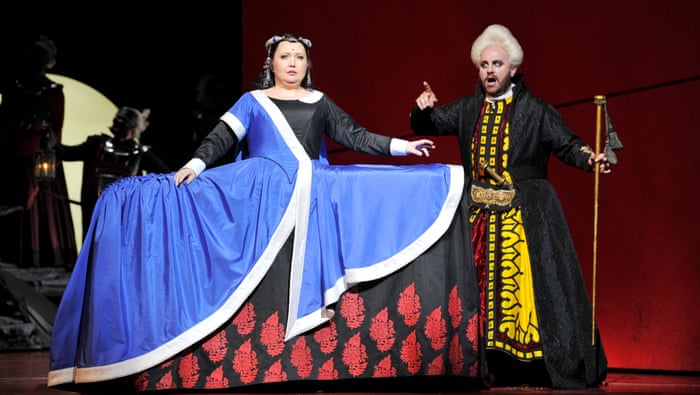 for Aspasia to walk through without turning sideways. She later appeared as though sitting behind a large bedecked dinner table, as pictured. Indeed the striking costume design was one of the main features of this production, which included a number of impressively choreograph set-piece dances, at one stage complete with a lot of foot-stomping, stick-banging and skirt-twirling, the whole more in Japanese than Anatolian (or 18th century European) style.
 For the past year La Serenissima have been performing a series of concerts based on music from different cities in Italy. This CD, recorded in St John’s, Smith Square after one such concert, forms a summary of the extraordinary music from that concert series. the cities, and composers, represented are Venice (Albinoni, Caldara, Vivaldi), Bologna (Torelli), Padua (Tartini) and Rome (Corelli). Apart from some glorious music, one of the features of this recording is the instrumental colour, with prominent roles for oboes, bassoons, trumpets, trombone, timpani and strings.
  account of its appearance and landscape importance, and placed into the guardianship of
  can vividly remember the first time I heard Matthew Wadsworth playing, in 1999, in the bowels of the Royal Academy of Music, during the debut of what was then a student group, all four of whom (Kati Debretzeni, Alison McGillivray, Matthew Wadsworth, and Robert Howarth) have gone on to achieve prominence in the world of music. This CD stems from an overheard comment at a late night gathering of friends, when somebody searching through CDs commented “I need lute, late night lute”. In the intervening years, the frequency of invitations to present late night lute concerts reinforced the feeling that there was indeed something of the night about lute music.
 For a British musician, now is a very good time to be reminded of the extraordinary contribution that immigrant musicians have made to our musical history, from at least the early 1500s. This CD reflects that in at least two ways. Giovanni Stefano Carbonelli was born in Liverno in 1694. Although supposition that he studied with Corelli seems ill-founded, he certainly absorbed and developed Corelli’s style. He moved to England in, or just before 1719, possibly at the invitation of John Manners (then Marquess of Granby, and soon to become the 3rd Duke of Rutland), who was to be his only known patron in England. Almost immediately on his arrival Carbonelli became leader of the Drury Lane Theatre orchestra, a post which also involved performing concertos and sonatas. In 1735, like many of his fellow Italian immigrant musicians, he anglicised his name, in his case to John Stephen Carbonell.
  This recording features the music I heard in the second half of the concert reviewed
  Harpsichordist Catalina Vicens’ new CD ticks a lot of boxes. Firstly, it is recorded on the world’s oldest playable harpsichord, built in Naples c1525, and now housed in the National Music Museum of Vermillion, South Dakota, USA, where it has been recently restored. Secondly, her programme of 24 pieces represents the wide range of musical styles of the period of the instrument, played with a compelling sense of musical and period style. And, thirdly, it comes with the bonus of an imaginative story (downloadable as an audiobook) by Catalina Vicens, based on the instrument and “inspired by music, history and legends”.
  During this 450th Monteverdi anniversary year there will be many performances and recordings of the 1610 Vespers. But for this ‘not the 1610’ recording, I Fagiolini have reconstructed a Vespers service inspired by a Dutch tourist’s 1620 record of hearing Monteverdi direct a Vespers on the Feast of the Nativity of John the Baptist. The psalms and the plainchant on this recording are from that feast, using music by Monteverdi and his contemporaries. The Monteverdi contribution comes from his Selva morale e spirituale, published in 1641, but containing music written much earlier. Whereas the 1610 Vespers are intended for feasts of the Virgin or other female saints, the 1641 collection contains psalms for feasts of male saints.
  This recording is based on the fact that Sir Francis Drake is known to have taken four viol players with him on his 1577-80 circumnavigation of the world, using the musicians for prayers and entertainment on board, and for diplomatic uses with the people they met. He also had trumpeters and drummers, but they are excluded from this recording, which takes as its premise the sort of music that the musicians might have played to the people they met, and also to their friends on their return to England, using their memory of the native music that they heard during their travels. Alongside music of the period by the likes of Parsons, Taverner, White, and Picforth, the principal musical contribution comes from Orlando Gough (b 1953) who was commissioned by Fretwork to compose a sequence of 13 pieces for viol consort based on the local music that Drake and friends might have heard.
