Academy of Ancient Music: Dido and Aeneas

Dido and Aeneas
Academy of Ancient Music, Richard Egarr, Thomas Guthrie
The Barbican, 2 October 2018

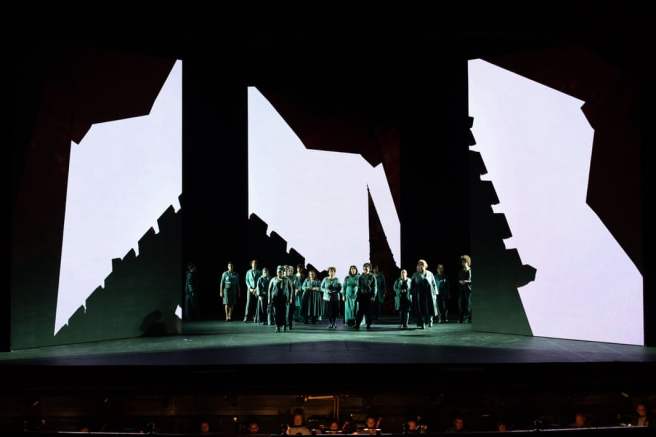
For anybody who was not already familiar with the story of Purcell’s Dido and Aeneas, the Academy of Ancient Music’s semi-staged performance (directed by Thomas Guthrie) at The Barbican opened with something of a plot-spoiler. The first half was a 40-minute exploration of the funeral rites of the dead Dido, albeit a couple of hours or more before she was ‘laid in earth’. Actually, laid in earth she wasn’t, instead lying on a funeral catafalque over which Belinda, Aeneas and assorted mourners (the AAM chorus, who opened the show with some rhythmic drum bashing) acted out their reaction to her death as they remembered her. And when I write ‘she’ in fact it was a half-size puppet of the upper half of Dido who represented her throughout the evening. The full panoply of puppets came to the fore in the second half performance of Dido and Aeneas itself where the entire cast of soloists and chorus sported puppets – torsos for Dido and Aeneas, heads and gauze cloths for the rest. Continue reading

A Courtly Garland for Baroque Trumpet

A Courtly Garland for Baroque Trumpet
Orpheus Britannicus, Robert Farley, Andrew Arthur
Resonance Classics RES10220. 79’57

The 17th-century was a time of dramatic musical invention, both compositionally, and instrumentally, with several now mainstream instruments going through their birth pangs, or re-birth pangs. One such was the trumpet, hitherto a largely military or ceremonial instrument, with little, if any, music of real significance composed for it. It was the development of the clarino style of playing in the higher registers that freed the trumpet from its lower register, only capable of playing restricted arpeggio-like notes. The more melodic notes in the upper reaches of the harmonic series allowed for more tuneful writing. Girolamo Fantini (1600–1675) was one of the first known trumpet virtuosos, described as “the monarch of the trumpet on earth!” After five years in the service of Cardinal Scipio Borghese in Rome he was appointed principal Court trumpeter to the Grand Duke of Tuscany. In 1634, played in a concert with the famous organist/composer Frescobaldi (1583–1643), organist of St Peter’s Basilica in Rome. This seems to have been the first known recital of music for trumpet and organ, a popular combination to this day. Fanni is represented on this CD by four short pieces.  Continue reading

In Convertendo

In Convertendo
Sacred Music From The Düben Collection

Abendmusiken Basel, Jörg Andreas Böttiche
Coviello Classics, COV 91733.  63’25

Abendmusiken Basel group takes its name from the monthly Abendmusik concerts in the Predigerkirche, Basel: in turn, based on the famous series of concerts in Lübeck’s Marienkirche, initiated by Franz Tunder in 1646 and continued under his successor Dieterich Buxtehude. These Lübeck concerts took place on the five Sundays preceding Christmas, but the present day Basel version is on the second Sunday of the month throughout the year. As in Lübeck, the music focusses on the 17th-century, as does this impressive CD, which draws on music from the Düben Collection, now part of the library of Uppsala University. It is one of the most important sources of 17th-century German music, not least because it contains the only known copies of many works by Buxtehude. Appropriately, this recording focusses on some of the many lesser-known composers of the time, with six of the eleven pieces being world premiere recordings.  Continue reading

RFH International Organ Series: Renée Anne Louprette

Renée Anne Louprette, organ
Royal Festival Hall, 19 September 2018

JS Bach: Prelude and Fugue in G
Marin Marais: Suite from Alcyone (arr. Louprette)
Jehan Alain: Variations sur un thème de Clément Jannequin
Ad Wammes: Mytò
Nadia Boulanger: Improvisation from 3 Pièces
Duruflé: Suite, Op.5

The Royal Festival Hall’s ‘International Organ Series‘, most of which is made up of UK, rather than international organists, made up for that fact by replacing an indisposed UK performer with Renée Anne Louprette, an American organist who spent some of her student days in London. She has held posts in several important New York churches, alongside academic posts, and is now University Organist and Coordinator of the Organ Department at the Rutgers University Mason Gross School of the Arts in New Jersey.

Her largely French programme opened with Bach’s flamboyant Prelude and Fugue in G (BWV 541), a distinctly non-French piece. From the very first few notes, it was clear that Renée Anne Louprette is an outstanding Bach interpreter. Her sense of touch, rhetoric and the way she sensitively articulated the opening flourish and the repeated notes in both Prelude and Fugue showed a real (and sadly rather rare) understanding of Baroque concepts such as the hierarchy of the bar. Her choice of registration was spot-on. Continue reading

Rameau: Naïs

Rameau: Naïs
Purcell Choir, Orfeo Orchestra, György Vashegyi
Glossa GCD924003. 2CDs 72’44 + 72’26

I have been looking forward to this CD ever since I heard this performance of Naïs in concert in the Béla Bartók National Concert Hall in Budapest’s Müpa arts centre on 4 March 2017 during a short early music festival. The recording dates for the CD are given as 4-6 March 2017 and, although there is nothing on the sleeve notes (or evidence on the recording) to suggest that it is a ‘live’ recording, I think it is probably based on a recording of that 4 March concert, presumably with two days of patching afterwards.

Rameau’s Naïs, a Pastorale heroïque, was written in 1749 the aftermath of Treaty of Aix-la-Chapelle. This concluded the War of the Austrian Succession between Hapsburg Austria and Hungary, Saxony, the Dutch Republic and Great Britain against France and Prussia, and confirmed Marie Theresa’s succession to the Hapsburg thrones of Hungary and Austria. Rameau gave it the subtitle of Opéra pour La Paix (Opera for Peace), its original title of Le triomphe de la paix being amended after concerns about just how triumphant the treaty had actually been for France. Before the story of Naïs starts, the dramatic opening Prologue depicts the tussle for supremacy between Jupiter and Neptune, clearly reflecting the agreement between Louis XV of France and Britain’s George II that concluded the war. Continue reading

Scheidt: Tabulatur-Buch, Görlitz 1650

Samuel Scheidt: Tabulatur-Buch, Görlitz 1650
111 four-part Chorale Settings for Organ or Keyboard
116 pages  • ISMN: 979-0-001-13600-6 • Softbound
Edition Schott ED 22325

Samuel Scheidt is one of the finest of the North German school of organist-composers that stemmed from the teaching of Sweelinck in Amsterdam. Born in Halle in 1587, he became assistant organist the Moritzkirche in 1603, before studying in Amsterdam between 1607 and 1609. He returned as Court organist to the Margrave of Brandenburg in Halle, where he was soon joined by Michael Praetorius. The Thirty Years War disrupted musical life in Germany. The Margrave fled, and the music of the Court ceased. Scheidt took to private teaching before eventually becoming director of music for the major Halle city churches (Marketkirche, Moritzkirche, and St Ulrich).

In 1624 Scheidt wrote his monumental three-volume Tabulatura Nova, an important collection of works for organ, harpsichord, or clavichord. Scheidt never recovered his earlier financial security and died in some financial trouble. His last publication was this 1650 Görlitzer Tabulaturbuchnamed after the city that commissioned the collection of four-part harmonisations of Lutheran chorales. Although there are a few simple harmonised settings, many of them are adventurous little pieces demonstrating Scheidt’s advanced keyboard technique and musical thinking as the early Baroque style of composition developed. Whether or not you would ever use them in a liturgical setting (as seems to have been intended, judging from Scheidt’s introduction where he mentions that the pieces are for “gentlemen organists to play with the Christian community”), they are worth exploring.

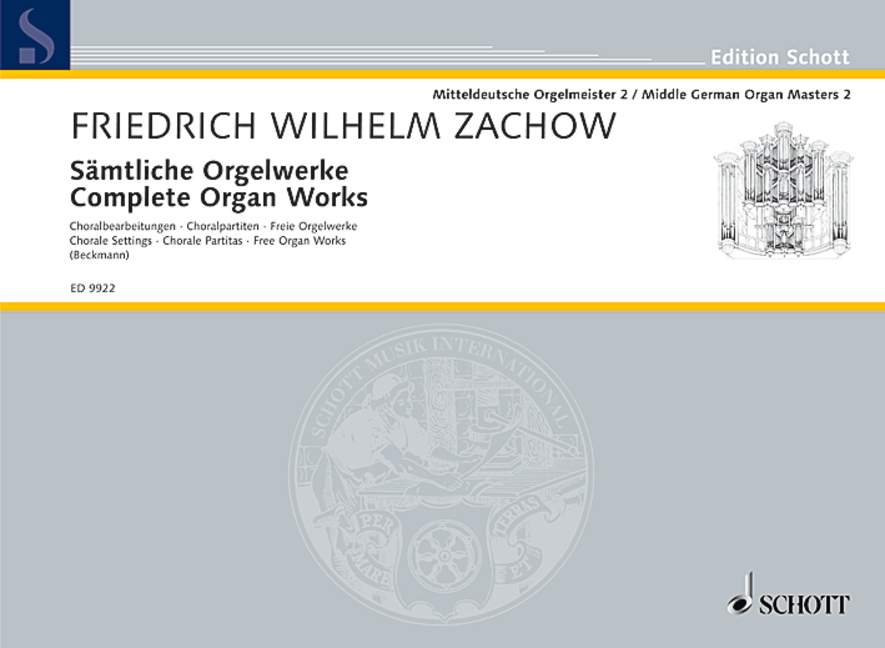
This Schott edition is clearly printed, in landscape format. The introduction by editor Klaus Beckmann (in German and English) gives background to the pieces and the editorial process. The critical commentary is, as usual, only in German. Preview pages can be view here. This is apparently the last in the Schott series ‘Masters of the North German Organ School‘, although I hope that is rethought as scholarship on this important repertoire continues to evolve and there must be more composers and pieces to be discovered and edited.
Andrew Benson-Wilson – Organ recital: ‘From England’

Andrew Benson-Wilson
plays organ music
‘From England’

Biel organ 4.jpg

Stadtkirche (Temple Allemand)
Biel/Bienne, Switzerland
21 September 2018, 12:30

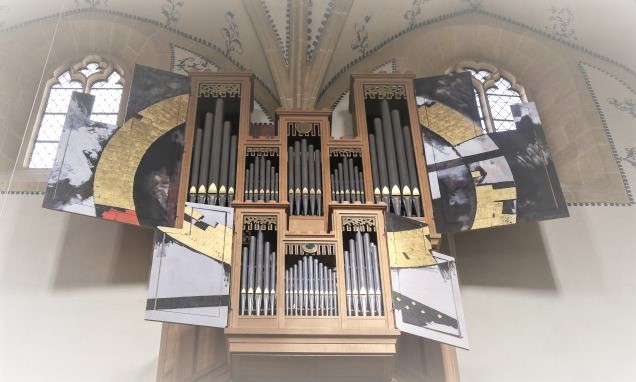
A recital on the reconstruction of the original 1517 ‘Swallow’s nest’ organ (Hochwandorgel) in the Stadtkirche (Temple Allemand) Biel/Bienne. Music by Anon, Dunstable, Preston, Tallis, Byrd, and Bull, the latter played on the Hauptorgel.

Anon: Robertsbridge Codex (c1360) Estampie
John Dunstable (c1390-1453) Sub Tuam Protectionem
Anon (c1530) Felix Namque
Thomas Preston (c1500-1563) Uppon la mi re
Thomas Tallis (c1505-1585) Alleluia Per te Dei genitrix
William Byrd (1538-1623) Callino Casturame
John Bull (1562-1628) Salve Regina (5 verses) Continue reading

Le Cœur & l’Oreille: Manuscript Bauyn

Le Cœur & l’Oreille
Manuscript Bauyn
Giulia Nuti (harpsichord)
ARCANA A434. 74’24

Music by Louis Couperin, Jacques Champion de Chambonnières, Jacques Hardel, Jean Henry D’Angelbert, René Mesangeau, Germain Pinel, and Johann Jacob Froberger

Le Cœur & l’Oreille (The Heart & the Ear) ticks all the musical boxes in a wonderful combination of a historic instrument, fascinating repertoire, inspired playing, and intriguing performance practice and musicological insights. The music performed is found in the famous Bauyn Manuscript, dating from around 1690, but containing music probably composed several decades earlier. It looks as though the manuscript was intended as a wedding gift, although analysis of the coat of arms on the cover has yet to determine who the lucky recipient was. More important is the fact that such a collection was made in the first place. When ‘old music’ was usually considered to be anything written just a few years earlier, the idea of collecting together music from a couple of generations earlier was something of a revolution, not least at a time when very little harpsichord music had been published at all. Continue reading

BBC Prom 74: Handel – Theodora

Handel: Theodora
Arcangelo, Jonathan Cohen
Royal Albert Hall, 7 September 2018

Of all Handel oratorios, the one that is probably most likely to put you off Christianity (or put you even further off Christianity) is Theodora. Set during the reign of the Emperor Diocletian, the story is of two love-struck Christians who refuse to honour the Roman gods, and then vie with each other as to which of them is to be put to death as a result, each insisting on taking the place of the other until the exasperated Valens, President of Antioch, has them both sent to their heaven. It was unusual for an opera or oratorio to end badly for the leading lights, which perhaps explains its lack of success at the time. The text doesn’t bear much scrutiny either, the earlier arias of the Christian contingent and their confidence that the Lord would provide protection ‘here and everywhere’,  and the chorus’s response that the Everlasting One was ‘Mighty to save in perils, storm and death’, seemed a little ill-judged in the forthcoming circumstances.   But, setting aside the silly plot, the text and music express aspects of love, religious freedom, bloody-mindedness, and the assumptions that Christians are far more musically intelligent than ‘heathens’. The latter is a particular feature of Handel’s music, with the choir switching between Heathen and Christian to distinctly different music, the former generally rather four-square, clumpy, and harmonically unadventurous, the latter tuneful and svelte.  Continue reading

BBC Prom 73: Tallis Scholars

Before the Ending of the Day
Tallis Scholars, Peter Phillips
Royal Albert Hall, 6 September 2018

The late-night concert on 6 September, following the Britten War Requiem, was a quasi-liturgical performance of the service of Compline, the concluding service of the daily eight canonical hours in Catholic liturgy. After the concluding litany of the War Requiem: “Let us sleep now” it was an appropriate add-on. Traditionally followed in monastic settings by the ‘Great Silence’ that lasted until the first service of the morning, its roots go back to St Benedict at the beginning of the sixth century. The name of the service comes from the word ‘complete’ reflecting the completion of the working day – or, in this case, for most of us, the end of a musical day.  Continue reading

BBC Prom 72: War Requiem

Benjamin Britten: War Requiem
Royal Scottish National Orchestra, Peter Oundjian
Huddersfield Choral Society, RSNO Chorus, RSNO Junior Chorus
Erin Wall, Allan Clayton, Russell Braun
Royal Albert Hall, 5 September 2018

As we approach the centenary of The Armistice that ended the First World War, it was an appropriate moment for The Proms to programme Benjamin Britten’s War Requiem. It is a piece that has had fluctuating enthusiasm over the years since its first performance in May 1962 in the new Coventry Cathedral, designed by Basil Spence, and built alongside the ruins of the medieval cathedral building, destroyed during the 1940 Battle of Britain. A committed pacifist and almost certainly agnostic or atheist, Britten was perhaps not the most obvious choice to compose a requiem, but this combination of personal beliefs led to one of the most powerful of all compositions related to war. Combining the traditional Catholic Latin Requiem Mass with the poems of the war poet Wilfred Owen, resulting in an often heart-wrenching combination of pleas for peace with reflections on the horrors of war.  Continue reading

Innsbrucker Festwochen der Alten Musik 2018

Innsbrucker Festwochen der Alten Musik 2018
Innsbruck, 23-25 August 2017

The Innsbruck Festival of Early Music runs annually for about three weeks during August. It was founded in 1976 and has traditionally focussed on Baroque opera. In recent years it has included three each season, including the Barockoper:Jung. This uses singers chosen from the finalists of the previous year’s International Singing Competition for Baroque Opera Pietro Antonio Cesti, named after Antonio Cesti, a 17th-century Italian singer and composer who served at the Innsbruck court of Archduke Ferdinand Charles of Austria. Unfortunately, I was only able to attend for three days but those included two of the operas and the Cesti final.

IMG_20180823_212452154.jpg Continue reading

Salterio Italiano

Salterio Italiano
Franziska Fleischanderl, Il Dolce Conforto, Romina Basso
Christophorus CHR77426. 62’16

Sonatas for Salterio by Fulgenzio Perotti, Florido Ubaldi and Vito Ugolino
Cantatas by Giovanni Battista Martini and Girolamo Rossi

One of the most impressive concerts that I heard during July’s Itineraire Baroque (reviewed here) was given by Austrian musicologist and performer Franziska Fleischanderl, demonstrating and playing the Salterio, a delightful little instrument related to the psaltery or dulcimer.  Playing her own restored original instrument, dating from 1725, she explored the many different sounds of the instrument, created by playing battuto (using wooden or leather-covered little mallets) or pizzicato (plucked by the fingers). The Salterio was very popular in Italy during the 18th-century, principally amongst aristocratic players. Her own researches into the instrument and repertoire have revealed a wealth of information and many surviving original instruments. For example, in her excellent liner notes, Fleischanderl mentions a college in Bologna where forty young aristocrats studied the instrument, her researches discovering a change in playing style (from battuto to pizzicato) around 1735, based on the students’ purchasing records. You can read more about the instrument, and Franziska Fleischanderl’s research here. Continue reading

Antwerp: Laus Polyphoniae 2018

Laus Polyphoniae 2018
1618 / BEFORE
Antwerp, Belgium. 16-20 August.

This year’s Laus Polyphoniae festival (part of the Festival van Vlaanderen / Flanders Festival) celebrated two anniversaries. It is 25 years since the festival first started, and 400 years since the opening of the former St. Augustine’s Church (in 1618), now the home of AMUZ (Augustinus Muziekcentrum), the hosts of Laus Polyphoniae. The festival lasted from 16 – 26 August, and I was invited for the first four days, from the opening concert on Thursday 16 August to the lunchtime concert on Monday 20 August. Taking the date of 1618 as the hinge, the Laus Polyponiae festival ‘1618 / Before’, was the prelude to a further series of concerts under the title ‘1618 / Beyond’, the English names being original, not translations.

Focussing on music from the Middle Ages and Renaissance, the programme covered repertoire from the year 800 up to the early 17th century, when the early Baroque style began to emerge from the tradition of Renaissance polyphony. It featured musicians from Flanders and beyond, with a wide-ranging programme of concerts and events, the International Young Artist’s Presentation, and various associated events included a study day exploring the recently discovered Leuven Chansonnier and other educational activities. Unless otherwise noted, all the concerts took place in AMUZ.

IMG_20180819_215308901_LL.jpg

Continue reading

Mozart: Chamber Music Vol. 2

Mozart: Chamber Music Vol. 2
Ensemble DeNOTE
Devine Music DMCD008. 67’27

Duo no.1 for Violin and Viola in G, K.423
C. F. G. Schwencke: Grand Quintetto (1805)
an arrangement of Mozart’s Gran’ Partita for 13 Winds, K.361

I reviewed the 2017 first volume of this series here. It grew out of Ensemble DeNOTE’s 2016 staged performances of Mozart, part of their Mozart Project Live! It is followed by this similarly imaginative programme of music, with two very different and little-known pieces. The Duo for Violin and Viola in G has an interesting backstory. It is one of two Duos composed in 1783 at the request of Michael Haydn as he didn’t have time to complete a commission for six such Duos. Originally passed off as Haydn’s work, Mozart eventually reclaimed and issued manuscript copies of them in 1788. The G major Duo is a delightful conversation piece between the two equally important instruments. Continue reading

Larmes de Résurrection

Larmes de Résurrection
La Tempête, Simon-Pierre Bestion
Alpha Classics ALPHA 394. 77’18

Schütz: Historia der Auferstehung Jesu Christi
Schein: Israelsbrünnlein

If you are a confirmed authenticist, this recording is probably one to miss. But what it lacks is HIP (historically informed performance), is gains in inventiveness and imagination plus several curiosities. The music is Heinrich Schütz’s Historia der Auferstehung Jesu Christi  and Johann Schein’s Israelsbrünnlein, both works dating from 1623 and both influenced by Italian music. Simon-Pierre Bestion intersperces sections of the two works with each other, segueing from the ‘Story of the Resurrection’ to ‘Fountains of Israel‘ with surprising musical, if not historical or literary, ease. It was recorded in the sumptuous surroundings and acoustics of the Chapelle Royale at Versailles; a deal that includes some promotional puff in the liner notes. The acoustic is a little too generous for some of the pieces using smaller forces, although it responds to the more powerful moments. Continue reading

Andrew Benson-Wilson plays Scheidt: Tabulatura Nova III – A Lutheran Vespers

Andrew Benson-Wilson
plays
Samuel Scheidt (1587-1654)
Tabulatura Nova III
A Lutheran organ Vespers

Queen's organ photo.jpg

The Queen’s College Chapel, Oxford
Wednesday 24 October, 1:10

Andrew’s series of concerts featuring the North German pupils of Sweelinck (the ‘Orpheus of Amsterdam’) continues with this, the second of two recitals of music by one of Sweelinck’s most distinguished pupils, Samuel Scheidt. His influential three-volume Tabulatura Nova was published in 1624 and is one of the most important of all the many collections of organ music. Its 58 pieces are a comprehensive demonstration of compositional styles. Whereas the first two volumes included a variety of sacred and secular pieces in different styles, Volume III consists entirely of Lutheran liturgical music. It opens with settings for the Ordinary of the Mass, followed by the settings of the hymns and Magnificat for a Lutheran Vespers. It ends with one of the most extraordinary pieces of the whole 17th century North German organ repertoire: the powerful Modus pleno Organo pedaliter: Benedicamus à  6 Voc, its six voices divided between four on the manuals and two on the pedals.

Kyrie Dominicale 4. Toni
Gloria Canit Pastor: Et in terra pax 
Credo in unum Deum

Hymnus: Veni Creator Spiritus

Magnificat 9 Toni

Psalmus sub Comminione: Jesus Christus, unser Heiland

Modus pleno Organo pedaliter: Benedicamus à 6 Voc

Played on the influential Frobenius organ. More information here.
Admission free – retiring collection.

Mysterien-Kantaten

Mysterien-Kantaten
Ensemble Les Surprises
Ambronay Editions AMY051. 58’16

Mysterien Kantaten

Music by Pachelbel, Buxtehude, Bruhns, Bernhard, Scheidemann, Reincken

Taking its title from Biber’s Mystery Sonatas (although not actually including any of those pieces), this recording from Les Surprises delves into the mysteries of life and death with an exploration of late 17th-century North German sacred cantatas of Buxtehude, Bruhns and Bernhard. What was particularly interesting for me to listen to, as an organist, were the arrangements of two well-known ground bass organ pieces for instruments. The CD opens with a version of Pachelbel’s Ciaconna in F minor, based on a repeated descending four-note bass line. We are then plunged straight into the world of death, with the Klag Lied, Buxtehude’s extraordinarily moving reflection on the death of his own father, whose last days were spent in his son’s home in Lübeck. It is followed by Nicolaus Bruhns’ cantata for bass voice meditation on death, De profundis clamavi and the second of the instrumental arrangements of organ pieces, Buxtehude’s Passacaglia in D minor. The programme notes (perhaps rather too unquestionably) the admittedly rather good theory that this is based on the lunar month and the phases of the moon, with its 28 variations and four sections, each with a distinctively different mood.  Continue reading

Gonzaga Band: Venice 1629

Venice 1629
The Gonzaga Band
Resonus RES10218. 68’27

Music by Castello, Monteverdi, Marini, Schütz, Grandi, Pesenti,
Tarditi, Carrone, Donati, and Rè

The Gonzaga Band, as the name suggests, was founded to explore the
music of late Renaissance Italy, their name inspired by the Mantua seat of the Gonzaga family, where Claudio Monteverdi had been their maestro della musica. However, this recording is centred in Venice, around 150km east of Mantua. The year 1629 is when Schütz, then  Hofkapellmeister of the Saxon court in Dresden, made a second visit to Venice to learn more about the music of Monteverdi and his contemporaries. Monteverdi had been maestro di cappella at St Mark’s since 1613, and the style of Giovanni Gabrielli, under whom Schütz studied in Venice a couple of decades earlier, was beginning to be superceded by the new style of the early Baroque.  Whilst there, Schütz published the first volume of his Symphoniae Sacrae. The same year also saw the publication of music by Dario Castello, Alessandro Grandi, Biagio Marini and others. This recording explores the extraordinarily productive musical life of Venice during that single year of 1629, with pieces from the musical greats of the city, as well as lesser-known composers.  Continue reading

BBC Prom 33: Thea Musgrave & Brahms

Thea Musgrave: Phoenix Rising
Brahms: A German Requiem
BBC Symphony Orchestra & Chorus, Richard Farnes
Royal Albert Hall, 7 August 2018

I was surprised to find that, despite being composed 21 years ago, this was the first time that Thea Musgrave’s Phoenix Rising (a BBC commission) had been performed at the Proms. It made for a fascinating pairing with Brahm’s German Requiem in this performance by the BBC Symphony Orchestra & Chorus conducted by Richard Farnes, making his Proms debut. Phoenix Rising represents the conflict between the forces of evil and good, darkness and light. The title came during composition and is taken from a sign outside a coffee shop in Virginia. At its core, it is a double concerto for horn and timpani, set within a dramatic kaleidoscope of symphonic colour and texture. The horn player, Martin Owen, is supposed to be offstage, but at the Royal Albert Hall there is always the risk that he would never be seen again, and was therefore positioned high up on the far left of the stage, behind timpanist Antoine Bedewi, and in front of one of the four percussionists spread out across the rear stage.

Thea Musgrave.jpgThea Musgrave. © BBC | Chris Christodoulou
Continue reading

Prom 29/30: The Brandenburg Project

Prom 29/30: Brandenburg Concertos Project
Swedish Chamber Orchestra, Thomas Dausgaard
Royal Albert Hall, 5 August 2018

One of the more unusual of this year’s BBC Proms were two related concerts given by the Swedish Chamber Orchestra under their conductor Thomas Dausgaard. Over an afternoon and evening Prom, they performed all six Bach Brandenburg Concertos, each accompanied by companion pieces, commissioned by the orchestra, to partner each of the Brandenburgs. An ambitious project, that got close to working, but ultimately, from my point of view, didn’t. As an early music specialist, I do find modern instrument performances of Bach problematical. Although they certainly didn’t over-romanticize their interpretations, the sound world was one I wasn’t used to, at least, not since my youth. And with so many composers eager to write for period instruments, I think a real opportunity has been missed, from the Proms point of view, although the project has certainly done the Swedish Chamber Orchestra no harm.

Continue reading

Andrew Benson-Wilson plays Scheidt: Tabulatura Nova I

The Grosvenor Chapel
South Audley Street, Mayfair, London W1K 2PA
Tuesday 11 September, 1:10

WP_20150721_15_17_12_Pro.jpg

Andrew Benson-Wilson
plays
Samuel Scheidt (1587-1654)
Tabulatura Nova I

Andrew’s series of concerts featuring the North German pupils of Sweelinck, the ‘Orpheus of Amsterdam’, continues with two recitals of music by one of his most distinguished pupils, Samuel Scheidt. His influential three-volume Tabulatura Nova was published in 1624. It is one of the most important of all collections of organ music. Its 58 pieces are a comprehensive demonstration of compositional styles. This recital, played on the William Drake organ in the Grosvenor Chapel, features three large-scale pieces from Volume 1 of the Tabulatura Nova.

Cantio Sacra: Wie gleuben all an einen Gott
Fantasia: Io son ferito lasso 
Cantio Belgica: Ach du feiner Reuter

The next Scheidt recital will be on the famous Frobenius organ in the chapel of The Queen’s College Oxford, on Wednesday 24 October 2018, starting at 1:10. It will be of pieces from Volume 3 of the Tabulatura Nova, in the form of Lutheran Organ Vespers.

Both concerts are free admission, with retiring donations welcomed.

Itinéraire Baroque: 2018

Itinéraire Baroque en Périgord Vert
26-29 July 2018

IMG_20180728_115913327.jpg

The annual Itinéraire Baroque en Périgord Vert festival is now in its 17th year. It is based around the towns of Ribérac and Verteillac in the northern part of the Dordogne-Périgord region of western France. It was founded by Robert Huet and Ton Koopman, the former a local resident and director of the organising committee, the latter the artistic director and occasional import from The Netherlands, along with musical friends and family. It started as the one-day event that gave the festival its name – the Itineraire Baroque, a musical tour of some of the little-known Romanesque churches of the region. It was intended as much to draw attention to these often locked churches as for any musical intent. It has now expanded to cover four days over the last weekend in July. The theme for this year’s festival was ‘Looking towards Spain’, although only a few concerts made more than a casual nod in that direction. In fact, as a weekend dominated by Netherlanders, it was no surprise that several of the concerts focussed on the historic battles between the Dutch and the Spanish, viewed from a Dutch point of view – perhaps ‘Trying to get rid of Spain’ would have been a more accurate title. The programme for this year’s festival can be found here.

Continue reading

BBC Prom 26: Serpent and Fire

Serpent and Fire
Il Giardino Armonico, Anna Prohaska
Royal Albert Hall. 2 August 2018 

Serpent and Fire is probably a better concert title that ‘Two Suicidal African Queens’, but Anna Prohaska’s exploration of the musical characters of Dido and Cleopatra certainly delved the emotional issues that caused both Queen’s demise. Despite her plea to ‘forget my fate’, Dido’s end is etched in all music-lovers minds, and it closed this late-night BBC Prom. Purcell’s Ah! Belinda providing the opening, introducing the Anna Prohaska’s beautifully clear and pure voice, and her use of the gentlest of vocal inflexions, quite correctly, as an ornament, for which I will readily forgive her the occasional tendency to slightly slur notes together. She later joined the very rare catalogue of early music singers who can produce a proper trill, rather than just relying on vibrato. The curious pauses in Ah! Belinda were the first of a number of directorial oddities provided by conductor Giovanni Antonini.

Anna Prohaska.jpg

Continue reading

Gottlieb Muffat: Ricercatas & Canzonas

Gottlieb Muffat
32 Ricercatas & 19 Canzonas (Ed. Erich Benedikt)
Vol  1: Ricercatas I-XIX
52 pages • ISMN: 979-0-012-19074-5 • Softbound
Doblinger DM 1336

Muffat DM-01336_.jpg

Gottlieb Muffat is one of those unfortunate composers who is overshadowed by his father, in his case, Georg Muffat. The latter was one of the key instigators of an international keyboard style, infusing the Italian keyboard influence of Frescobaldi with musical influence from France. Gottlieb is generally known, if at all, through his connections with Handel, who ‘borrowed’ an extraordinary amount of his music, notably in the Ode to St. Cecilia’s Day, Samson, Joshua, and Judas Maccabeus. mostly from the six Suites in the 1736 Componimenti Musicali. 

This edition of Gottlieb Muffat’s 32 Ricercares and 19 Canzonas (Die 32 Ricercaten und 19 Canzonen) was first published by Doblinger in 2003 but has now been reissued in a smart new cover. Volume I (of three) includes the first 19 Ricercatas, plus an additional variant of Ricercata VII. The first three Ricercatas of this volume set are highly ornamented, in the manner of Georg Muffat, but there are few, if any, ornaments in the other Ricercatas. Muffat’s own table of ornaments from the Componimenti Musicali are included in this volume and are essential reading if you are to grasp the musical style of the period. As complex as they may seem (for example, there are 9 different types of trill), understanding them is essential in performance. Incidentally, knowledge of ornaments like this will also help to make sense of some of John Blow’s music, such was the international influence of the Frescobaldi/Froberger ‘school’. Having grasped the concept from the first three Ricercare, adding ornaments to the other pieces would be entirely appropriate.  Continue reading

Glyndebourne: Saul

Handel: Saul
Orchestra of the Age of Enlightenment, Laurence Cummings
Glyndebourne Festival Opera. 22 July 2018

Glyndebourne’s new production of Handel’s Saul was one of the highlights of the 2015 season, gaining rave reviews from, amongst others, me – see here, which also gives more background to the oratorio and the production. Glyndebourne has a long tradition of staging Handel oratorios, and I have no problem at all with that, subject to my normal reservations about what some some opera directors get up to with their productions. This was not entirely devoid of some concern on those grounds, but the sheer spectacle of Barrie Kosky’s direction and the musical integrity of Ivor Bolton’s direction allayed most of my concerns. The same applies to this revival, at least musically, on this occasion conducted by the equally distinguished Laurence Cummings, directing the same Orchestra of the Age of Enlightenment, Glyndebourne’s resident period instrument orchestra.

Continue reading

West Green Opera: Candide

Bernstein: Candide
West Green Opera, 21 July 2018

According to the pre-event announcement from somebody at the front of the stalls, West Green Opera are one of only three permitted staged productions of Candide in the UK during this ‘Bernstein 100’ anniversary year. If so, that is quite an achievement for one of the lesser known summer opera venues. But West Green Opera are already looking forward and upward, this year featuring the first appearence of a smart new, albeit commercially loaned, opera house construction trialling a possible site for a more permanent addition to West Green House, a few miles east of Basingstoke. Leased from the National Trust, the gardens and the summer opera season have both blossemed in recent years, and their ambitions are clearly not yet satisfied. The earlier opera venue was in a tent blocking the view of the house elevation pictured below.

IMG_20180721_185110136.jpg

The new opera house is beyond the ha-ha in the corner of an adjoining field. It is much larger than its earlier incarnation, and they have yet to build an audience large enough to fill it completely, at least for this performance of Candide. But this new accommodation is certainly an improvement on the previous tent, although one of the hottest days of the year did test audience, and presumably, cast stamina somewhat. The back-stage provision is a vast improvement on the earlier Heath Robinson affair, and the stage and orchestra area is much larger.

IMG_20180721_185318962.jpg
Continue reading

Garsington Opera: The Skating Rink

The Skating Rink
David Sawer & Rory Mullarkey
Garsington Opera, Wormsley. 14 July 2018

Just days after the world premiere of a new opera (at Grange Park Opera, reviewed here), here is another one, this time The Skating Rink, performed at Garsington Opera, now firmly established as a feature in the spectacular landscape of Wormsley Park. Their new commission was written by David Sawer to a libretto by Rory Mullarkey, based on the novel by Chilean author Roberto Bolaño. Set in a small seaside town on the Costa Brava in the late 1990s, the story is based around the beautiful young ice skating champion, Nuria, and her relationships first with Remo Moran and then with the obsessive and much older Enrico. Political machinations during the run-up to a local election year provide background intrigue, including such lines, presumably aimed at the well-heeled Garsington audience, as “I’m not a monster / I’m a Socialist” and the repeated refrain of “Fuck this Country/ Fuck the Government”. Getting rid of illegal immigrants runs through the storyline, focussed on an opera singer, Carmen, who has fallen hard times and the young girl Caradad, attractive beneath the shabbiness of her clothes. A large community cast provided further ‘vagrants’ and scene-shifters.

Gaspar, a local poet and an illegal immigrant himself, is at the bottom of a food chain hierarchy and is tasked with evicted Carmen and Caradad from the campsite at which he is the night watchman. He quickly falls for Caradad (pictured below), but she soon goes missing, running off through the audience. His search for her brings him into the murky world of what turns out to be a murder plot, combined with embezzlement, deception, lust for power, and obsession.

8Garsington Opera 2018 Susan Bickley (Carmen), Claire Wild (Caridad), Sam Furness (Gaspar) credit Johan Persson_0.jpg

Continue reading

Pushkin – the opera

Pushkin – the opera
Konstantin Boyarsky & Marita Phillips
Orchestra and Chorus of Novaya Opera, Jan Latham-Koenig
Grange Park Opera, West Horsley Place, 12 July 2018

We all have a great many great-great-great grandparents, but few of us are able to write an opera about two of them. Marita Phillips is one such, a descendent of the scandalous elopement and 1891 marriage between the grandson of Tsar Nicholas I and the granddaughter of Pushkin. Pushkin and Nicholas were born within 3 years of each other in 1796 and 1799 respectively. While exiled by Nicholas’s father, Tsar Alexander I, for writing the poem Ode to Liberty, Pushkin wrote Boris Godunov and Eugene Onegin. Ode to Liberty was seen as influencing the 1825 Decembrist Uprising that followed Nicholas’s unexpected appointment as Tsar, creating an uneasy relationship between the two men, at the core of this opera, which opens with the gruesome nooses that followed the Decembrist Uprising.

Written over an astonishing 15 years period, the story covers key aspects of Pushkin’s life in and around the court of Nicolas I, with an emphasis on the complex relationship with his wife Natalia Goncharova. She was around 13 years younger than him. They met when she was just 16, and already a renown beauty. She attracted the attention of the sumptuously monikered Georges-Charles de Heeckeren d’Anthès, the adopted son of the Dutch Ambassador. The relationship between the two was open to some discussion, leading in Phillips’ text to the accusatory question of “buggery or incest”. Perhaps unfortunately, this question was reinforced by the fact that Georges d’Anthès looked remarkably like outrageously camp Mr Humphries from the 1970s television sitcom Are you Being Served, making his later attraction to Natalia a bit of a surprise. He pursued Natalia to the extent that a duel between him and Pushkin, leading to Pushkin’s death, his depiction as the ‘white wolf’ predicted by the exotic character of the gypsy.  Continue reading

Vivaldi: Le Quatro Stagioni

Vivaldi: Le Quatro Stagioni
Il Riposo, L’Amoroso, and Il Grosso Mogul
Rachel Podger, Brecon Baroque
Channel Classics CCS SA 403318. 75’24

Although the Four Seasons sounds much better in Italian, it doesn’t hide the fact that this is yet another recording of the inevitable old favourite. Despite there being squillions of other recordings available, a new one will probably guarantee good sales, not least because people do seem to like what they know. And they do know the Four Seasons, even if the CD title of Le Quatro Stagioni might confuse them a little. Vivaldi wrote more than 200 concertos for violin and orchestra, For the more discerning listener, there has to be something distinctive to separate any new recording out from the competition. And, boy, haven’t some people tried something distinctive. Rachel Podger and her Brecon Baroque avoid the ‘distinctive’ route and instead focus on intelligent music-making, aided by sensitive articulation, sensible speeds and appropriate accompaniments.  Continue reading