ENO: Don Giovanni
English National Opera
Coliseum. 4 October 2016
It would take a brave barrister to defend a serial rapist with the argument that “his gigantic passion beautifies and develops its object, who flushes in enhanced beauty by its reflection”. But that was one of the many attempts by 19th century commentators to interpret Mozart’s Don Giovanni in the light of their yearnings for the romantic hero, in this case from, the Swedish philosopher, Søren Keirkegaard in his discussion of aesthetic and ethics in the pseudonymous Either/Or. He goes on to refer to the Don as “the very incarnation of sensuous passion and desire” and a “simple, exuberant, uncomplicated, unreflective man”. Nowadays we are more likely to be reminded of The Archers’ Rob Titchener, Donald Trump, and the likes of Jimmy Savile and that ilk. In that vein, it is usually overlooked that the full title of the opera is Il dissoluto punito ossia il Don Giovanni – The Libertine (or Rake) Punished, namely Don Giovanni. Continue reading
 As part of the Kings Place ‘Baroque Unwrapped’ season, the Newcastle-based Avison Ensemble explored the world of the 18th century concerto, and the equally interesting world of English provincial musical life. Charles Avison (pictured) was a Newcastle born organist and composer who absorbed the musical style of Geminiani and Scarlatti during a short period in London before being enticed back to Newcastle with the promise of prestigious organist post complete with a new organ. He made a handsome living through teaching and arranging subscription concerts. He was also a fierce reviewer of other composers, including Handel.
 One of the most important musical events in London in 2015 was the long-awaited opening of the 1735 Richard Bridge organ (restored by William Drake) in the Hawksmoor designed Christ Church, Spitalfields. For many decades it was the largest organ in the UK, and its musical importance is immeasurable. My review of the gala opening recital, given by (the now sadly, late) John Scott, and information about the restoration and an organ specification can be found
 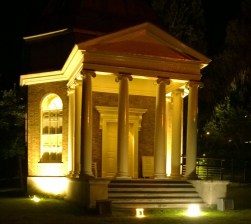 One of the most delightful of London’s music venues is Garrick’s Temple to Shakespeare
 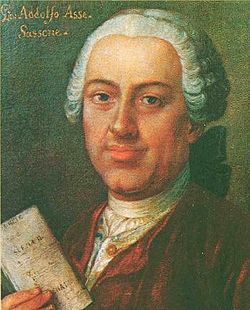 Johann Adolph Hasse (1699-1783) is one of those historically unfortunate composers who achieved great fame during their lifetimes but have since been more-or-less forgotten. A prolific composer of opera, he was hailed by Charles Burney as being superior to all other lyric composers. Married to the famed soprano Faustina Bordoni, the couple became the Posh and Becks of their day. Usually based in Dresden in the Court of the Saxon Elector Frederick III, Hasse had special dispensation that avoided the need to travel annually to the Polish Court, where Frederick was also the elected King. He also maintained a post in Venice at the Ospedale degli Incurabili. He lived long enough to have performed in front of Bach and the young Mozart.
 The Innsbruck Festival of Early Music celebrated its 40th anniversary this year, although its roots go back a further 14 years or so. After some preliminary events, the festival proper ran for the last two weeks in August. It usually features three fully staged operas, although this year the third of them was reduced to a one-night concert performance of the Ruhrtriennale festival’s production of Gluck’s Alceste, conducted by René Jacobs who until 2009 was artistic director of the Innsbrucker Festwochen and, incidentally, the singer at the first concert of the first festival on 24 August 1976.
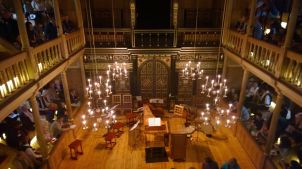 the new Globe management, those events seems to have ground to a halt, with only one listed in the current season – and that a hang-over booking from the previous management. So it was fortuitous that the BBC Proms chose the theatre for one of its ‘BBC at …’ events (alongside such venues as a multi-story car park in Peckham), not least because it enabled people to see the inside of this fabulous, but very uncomfortable, theatre for just £14, rather than the up to £62 the Globe are asking for their own next concert there.
 Since 1996, the cloister has been home to summer opera productions, presented by Iford Arts. Their latest season concluded with ‘A Fairy Queen’ presented by Iford Arts and their regular orchestra from Christian Curnyn’s Early Opera Company.
 this distinguished orchestra has built an enormous international reputation, not least during the years from 1998 to 2011 when Sir Roger Norrington was their chief conductor, bringing his noted ‘historically informed’ performance practice to this modern instrument orchestra, producing a distinctive style – the ‘Stuttgart sound’. The two merging orchestras are both under the auspices of Südwestrundfunk (South West Radio), the public broadcaster for Baden-Württemberg and Rhineland-Palatinate, and have very different repertoires and styles. It was entirely appropriate that Roger Norrington, now their Conductor Emeritus, was the conductor for their final concert.
 Grange Park Opera has been one of the UK’s musical successes since it first set up shop in 1998 in the derelict shell of The Grange, a country house in the centre of Hampshire. Owned by the Baring banking family, The Grange dates from the early nineteenth century when William Wilkins, architect of the British Museum, transformed an earlier 17th century brick building into Britain’s most important example of the Greek revival architecture, notable for its imposing temple-style portico. It was saved from demolition in 1975 after a public outcry and the intervention of the Government, who spot-listed the exterior shell of the building, in recognition of its important as a landscape feature. English Heritage took over custodianship of the building, although the ownership remained with the Baring family.
 Jeremy Summerly’s comprehensive programme note opens with the suggestions that “Early Tudor England was insular and the attitude of its people xenophobic”, quoting an Italian visitor in 1497 that “they have a antipathy to foreigners”, an unfortunate habit that sadly still seems to be the case, at least for around 52% of the population. John Taverner was very clearly an exception to this view, at least musically, for he relished the music coming from the continent. This CD indicates two particular influences, with the complex polyphony and imitative writing of the likes of Josquin featuring in the Missa Mater Christi sanctissima and, in the Western Wynde Mass, as Summerly puts it “a Lutheran dexterity in his use of a secular model for a piece of sacred music”.
 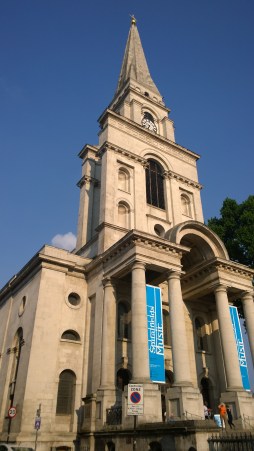 Spitalfields Music has been an extraordinary musical and community success since its foundation 40 years ago. Starting life with a 1966 concert to help save Nicholas Hawksmoor’s architecturally important Christ Church Spitalfields (which was then, unbelievably, under threat of demolition) it soon grew into a ‘Summer Festival of Music’ led by Richard Hickox. Initially under the auspices of the Friends of Christ Church, it became an independent organisation and charity in 1989, setting up their continuing community and education programme two years later. Under the artistic and managerial leadership of the likes of Judith Serota, Michael Berkely, Judith Weir, Jonathan Dove, Diana Burrel, Abigail Pogson and the current Chief Executive, Eleanor Gussman, it has grown into an major musical and community force in London, sharing their passion for music with nearly half and million people, attracting more than 325,000 audience members to events in more than 70 venues in the Spitalfields and Tower Hamlets area. Alongside their Summer and Winter Festivals, they run an enormous Learning & Participation programme involved more than 125,000 people.
 The Orchestra of the Age of Enlightenment have been celebrating their 30th anniversary year with a remarkably wide range of music, culminating with this Birthday Concert performance of Weber’s Der Freischütz. Perhaps most noted for their exploration of Baroque and Classical music, it can be forgotten that the OAE have also performed many pieces from the Romantic era, with remarkable success – indeed, their second concert, 30 years ago, under Roger Norrington, was devoted entirely to Weber. And so it was with this powerful semi-dramatised performance.
 Awaiting the construction of their new concert hall, the Royal Academy of Music have been trying out different venues in the past year. For their final opera of the season, Monteverdi’s L’incoronazione di Poppea, they chose Shoreditch Town Hall (a space new to me) in the middle of a very lively and cosmopolitan part of London. There was some awkwardness in the staging arrangement as the audience enter past what would normally be back-stage, but they coped with this well. The staging was simple, a three-sided box with three entrances on either side, and five in the rear wall. There were very few props, with much depending on Jake Wiltshire’s excellent lighting to provide mood, most prominently at the end of Act 1 when Seneca’s death is depicting by a flood of red light.
 The weekend traditionally opens on Friday evening with the famous Regensburg cathedral boys’ choir, the Regensburger Domspatzen,
  Andrew Benson-Wilson : Early Music Reviews +