
Rameau: Dardanus
English Touring Opera, The Old Street Band, Jonathan Williams
Hackney Empire, 6 October 2017
I have been a little lukewarm about some previous English Touring Opera productions, but this staging of Rameau’s Dardanus ticked all the boxes. The first box tick comes for performing this work in the first place, an example of the adventurous approach to programming of the English Touring Opera and their first venture into the complex world of French Baroque opera. It formed part of their Hackney Empire opening to their autumn tour of the country, with Dardanus visiting Oxford, Buxton, Snape, Saffron Walden and Exeter. Its companion opera, Handel’s Giulio Cesare has a much larger tour, calling additionally at Portsmouth, Norwich, Durham, Bath, Keswick, and Great Malvern. Giulio Cesare, rather curiously, divided into two separate and overlapping, parts, under the titles of The Death of Pompey and Cleopatra’s Needle, with the last half hour of the first repeated at the start of the second, to the chagrin of some reviewers. Continue reading


 Edward Armitage: The Remorse of Judas, 1866. Tate Britain
 In sharp contrast to the situation in, of all places, the Musicians’ Church, Heath Street Baptist Church in Hamstead is one of many London churches that have actively embraced music and musicians, running a regular series of lunchtime concerts as well as occasional musical festivals, the latter recently under the title of Baroquestock in food-related weekend festivals. Their latest Baroquestock weekend includes concerts by Spiritato and Istante Classical, the latter including Haydn’s La Poule Symphony to the accompaniment of BBQ chicken. Their opening event was a performance of Schoenberg’s Verklärte Nacht, to the culinary accompaniment of, you’ve guessed – Schoenbergers!
  As the deliberately chosen name suggests, Grimeborn is not Glyndebourne, its location in the Arcola Theatre, a converted textile factory in Dalston, East London, being just one of the differences. Founded in 2007, the Grimborn opera festival focuses on new operas and experimental productions of more established repertoire. The limited space and budget in comparison to its more glamorous inspiration is one of its main strengths, as it forces directors, singers and instrumentalists to rethink basic opera practice. One key factor for the singers is that, rather like the more glamorous Iford Opera season, the singers are performing within a few feet of the audience, sitting on three sides of the central stage area.
  The annual
 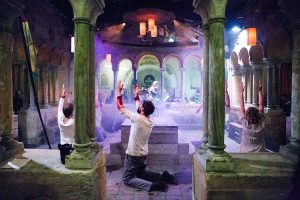 Contraband. It was set in recent times in a fundamentalist (and militaristic) Christian community of cult-like weirdness, led by the controlling Zebel (Frederick Long), with behaviours frequently bordering on what might have been found in a lunatic asylum of Handel’s day. As it happened, on my drive down to Iford, I listened to a Radio 4 broadcast of an account of the 1993 siege of a fundamentalist sect at Waco in Texas. The comparisons were chilling.
  l tower were added. Internally, the Romanesque triple-aisled basilica was altered, rather inelegantly, by inserting two enormous domed cupolas into the original external walls, resulting in a bit of an architectural mess. After two major fires in the 17th century (which destroyed the cupolas), the church was restored, and impressive new convent buildings were added, with cells for 45 nuns. During the Revolution, the Abbey first became a prison (1792), and then a barracks (1808). In the 1920s, the Abbey complex was purchased by the town of Saintes. In the 1970s, restoration of the monastic
  buildings (abandoned since the war) was started and, in 1972, an annual Festival of Ancient Music was created, later becoming the Festival de Saintes. In 1988 the Abbey was launched as a cultural centre by President François Mitterrand, and in 2013 it became la cité musicale, housing a Conservatoire of Music and a range of year-round musical activities, including many for young people. The former nun’s cells now sleep visitors and guests of the Festival.
 LunchBreak Opera is a new venture, launched earlier this year. Its first production was Puccini’s one-act opera Suor Angelica, given in nine fully staged and costumed lunchtime and early evening performances (10-14 July) in St Botolph’s Church, Bishopsgate, London – a prime position, next to Liverpool Street Station. Lasting just 50 minutes it is ideal for lunchtime and post-work entertainment.
  The five-strong group Ceruleo (two sopranos, cello, theorbo, and harpsichord) got together at the Guildhall School of Music and Drama in 2014. They have just completed a one year Artist Fellowship there, the first time a this has been awarded to a group. During their year, they gave several performances of their programme ‘Deplorable Fire’ commemorating the 350th anniversary of the Great Fire of London, including a live performance on BBC Radio 3. They presented their Paradise Lost programme, based on John Milton’s poem (published 350 years ago in 1667) as their final recital of their Fellowship year. The music was interspersed by extracts from Paradise Lost.
  The entire centre of the historic Danube city of Regensburg has been declared a World Heritage site, and all the venues for the festival are in important historic buildings. These range from extreme Baroque and Rococo to austere Gothic churches, and the historic Reichssaal, part of the Altes Rathaus, and for centuries the permanent seat of the Parliament of the Holy Roman Empire. This was the 33rd festival and featured groups from 12 countries, and musicians from a great many more. The Tage Alter Musik website can be see
  converted into a small concert room, and there is also a larger lakeside amphitheatre and stage. As well as small-scale professional productions, it has also recently started week-long academies for young opera singers, culminating in public performances. When they invited me to review Rameau’s Hippolyte et Aricie , I was warned that ‘it isn’t Glyndebourne’, but even Glyndebourne singers have to start somewhere and this seemed a pretty attractive venue for a week of music making and learning. Ten singers were accepted onto the academy, led by music direct Marco de Silva and harpsichordist Stephanie Gurga. Three of the roles had dual casting on the Saturday and Sunday performances.
 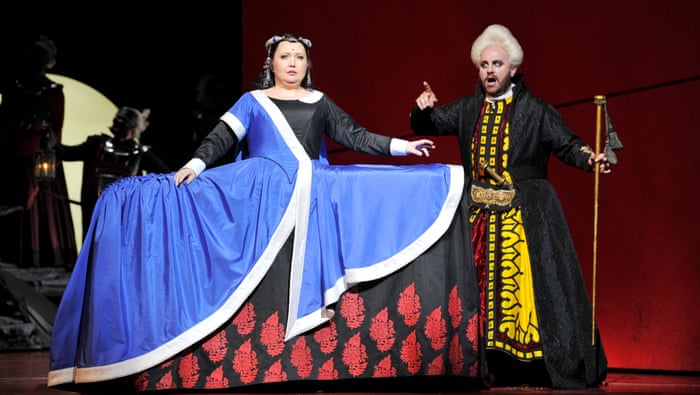 for Aspasia to walk through without turning sideways. She later appeared as though sitting behind a large bedecked dinner table, as pictured. Indeed the striking costume design was one of the main features of this production, which included a number of impressively choreograph set-piece dances, at one stage complete with a lot of foot-stomping, stick-banging and skirt-twirling, the whole more in Japanese than Anatolian (or 18th century European) style.
 account of its appearance and landscape importance, and placed into the guardianship of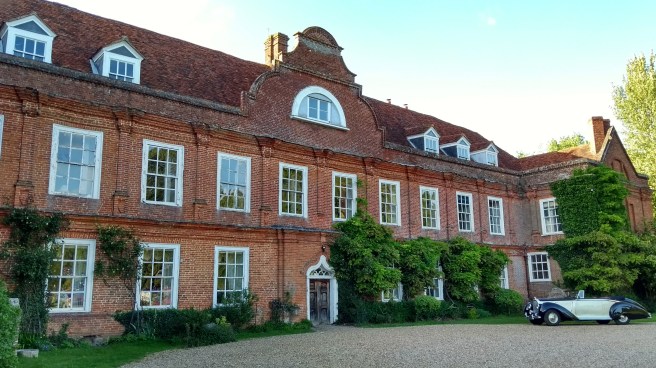
 Andrew Benson-Wilson : Early Music Reviews +