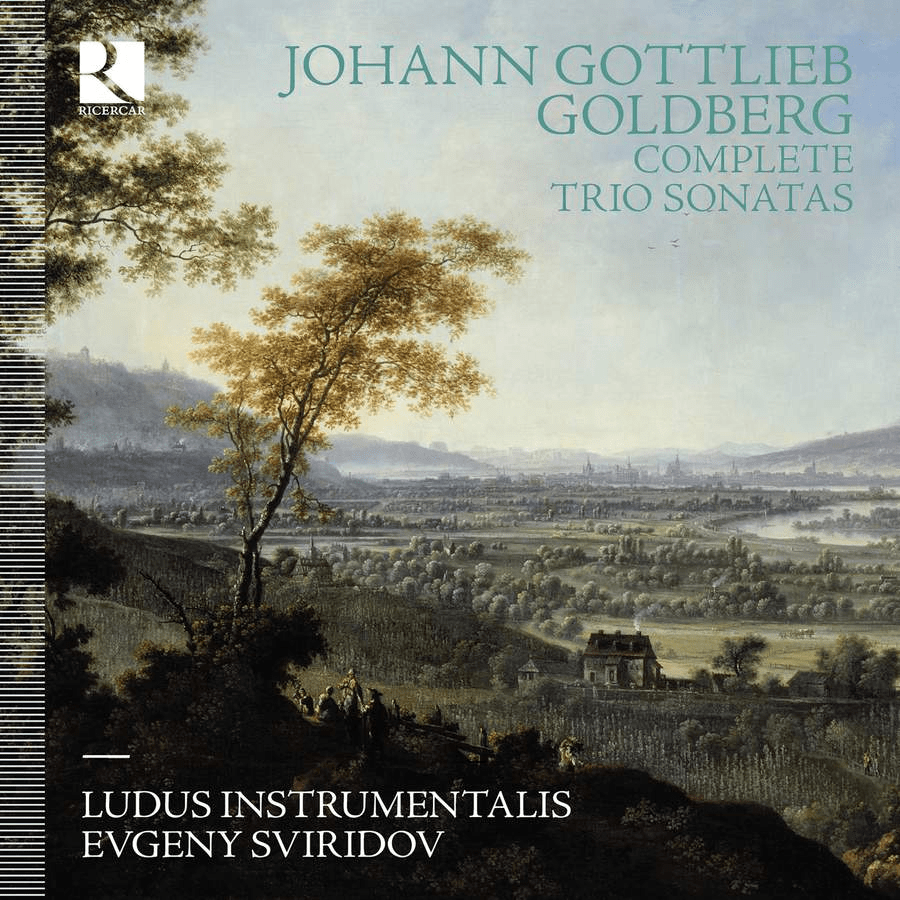
Johann Gottlieb Goldberg: Complete Trio Sonatas
Ludus Instrumentalis, Evgeny Sviridov
Ricercar RIC 426. 69’57
Trio Sonata in C, DürG 13 (was BWV 1037)
Trio Sonata in A minor, DürG 11
Trio Sonata in G minor, DürG 12
Trio Sonata in B flat, DürG 10
Prelude and Fugue in g, arranged from Dür G 5
Sonata for 2 violins, viola & continuo in C minor, DürG 14
Johann Gottlieb Goldberg (1727-56) has been overlooked as little more than the name attached to the famous JS Bach variations, rather than a respected composer in his own right. This excellent recording from Ludus Instrumentalis should help to set the record straight. Goldberg was born near Danzig. In 1737 he met Wilhelm Friedemann Bach in Dresden, a trip instigated by the art-loving Count von Keyserlingk who was impressed with the 10-year old’s musical skills. After initial studies with WFB in Dresden, he moved to Leipzig in 1746, perhaps to study with JS Bach. The Bach variations were later composed for Goldberg to play for the insomniac Keyserlingk. Goldberg died aged 29 of consumption but, despite his young age, was described by a writer at the end of the 18th century as being on the same level as Bach and Handel.





 If you can listen to the first two tracks of this recording without being smitten by the extraordinary musical and emotional power, you are probably on a different musical planet to me. The richly sonorous and harmonically intense opening chorus (a Responsory for Holy Week) segues straight into the opening section of the Passio Secundum Johannem. The orchestral introduction is a glorious harmonic construction, leading to the evocative voice of mezzo-soprano Giuseppina Bridelli, singing the role of Testo (the Evanglelist).
  Girolamo Frescobaldi is one of the most important composers of the transitional period between the late Renaissance and the early Baroque. His keyboard music and his written performing instructions form the bedrock of the 17th century Baroque style, in particular the Stylus phantasticus that dominated the musical style in Italy and Germany. Through pupils like Froberger and other disciples, his music spread throughout Europe and influenced composer, including Bach and his North German organ composer predecessors like Weckmann, Tunder and Buxtehude and English composers like John Blow.
  Andrew Benson-Wilson : Early Music Reviews +