A Renaissance Christmas

A Renaissance Christmas
The Sixteen, Harry Christophers

Coro, COR16167. 67’11

A Renaissance Christmas

The publicity blurb that came with this CD refers to it as “a perfect alternative to traditional carols”, and it certainly is. Perhaps trying to seek forgiveness for their 2015 release, The Complete Traditional Christmas Carols Collection (recorded in 1991), The Sixteen here concentrate on music from the Renaissance era. They bring their particular brand of highly professional choral singing to a well-balanced sequence of pieces from composers born between 1505 and 1580, a period when the Renaissance reached its zenith as religion in Europe reached one of its periodic nadirs. Continue reading

Gesualdo Six: There is no rose

There is no rose
The Gesualdo Six, Owain Park
St John’s, Smith Square, 14 December 2018

Although only formed four years ago, The Gesualdo Six have gained an impressive following, not least at St John’s, Smith Square where they were one of the four members of the second Young Artists Scheme in 2015/16. They used that residency to launch their Composition Competition at SJSS, with the second following in 2019. For their concert in this year’s SJSS Christmas Festival, they gave a mixed programme of Christmas music ranging from plainchant and the early 15th century Trinity Carol Roll and music by Taverner and Tallis, through to living composers, including their own director Owain Park. Continue reading

Il Santissimo Natale

Il Santissimo Natale
The English Concert & Choir, Laurence Cummings
St John’s, Smith Square, 12 December 2018

The 33rd St John’s, Smith Square Christmas Festival continued with a very welcome first-half performance (by The English Concert and Choir, directed by Laurence Cummings) of Alessandro Scarlatti’s Missa per il Santíssimo Natale. Scarlatti is usually overlooked in comparison with other composers, both in his many operas and his few compositions for the church. His il Santíssimo Natal Mass was composed in 1707, during Scarlatti’s brief time as maestro di cappella at the Basilica of S Maria Maggiore in Rome. The two jubilant Kyries contrasted with a reflective central Christe. The gentle mood continued into the opening of the Gloria, before the bouncy rhythms returned. As in the later parts of the Mass, frequent changes of mood were a compositional feature, dissolving from one to the other with delightful ease, helped by some well-judged directed from conductor Laurence Cummings. The final Agnus sequence is a gently expansive movement, providing a suitably reflective conclusion to an impressive composition, Scarlatti’s operatic experience never far from the surface, without imposing. Continue reading

Mater Inviolata

Mater Inviolata
European music for the Christ-Child and His Mother
The Brabant Ensemble, Stephen Rice
St John’s, Smith Square, 11 December 2018

The 33rd St John’s, Smith Square Christmas Festival has taken a slightly more eclectic approach to the traditional seasonal offerings, although its roots in early music remain, as exemplified by this concert by The Brabant Ensemble, directed by Stephen Rice. Their programme focussed on Mary, the focus for devotion in the late Renaissance era. The geographical focus was, as the group’s name suggests, the old Duchy of Brabant, covering present-day parts of Belgium and the Netherlands. The Franco-Flemish composers included Josquin, Lassus, and Josquin’s contemporary Pierre de la Rue in the 500th year of his death together with the latter composers, Clemens non Papa, Crecquillon, and Mouton, with his well-known Nesciens mater. Continue reading

Star of Heaven: The Eton Choirbook

Star of Heaven: The Eton Choirbook Legacy
The Sixteen, Harry Christophers
CORO. COR16166. 66’37

Star of Heaven: The Eton Choirbook Legacy

You need to read the title of this recording carefully – The Eton Choirbook Legacy, the key word being ‘Legacy’. Alongside pieces by Walter Lambe, William Cornysh and Robert Wylkynson from the famous c1500 Eton College Choirbook are compositions by five contemporary composers, commissioned by the Sixteen’s Genesis Foundation to contrast with and compliment the Eton pieces. Four are direct responses to Eton Choirbook pieces, the fifth is Stephen Hough’s four-movement Hallowed, composed for the British Museum’s recent ‘Living with Gods’ exhibition. Continue reading

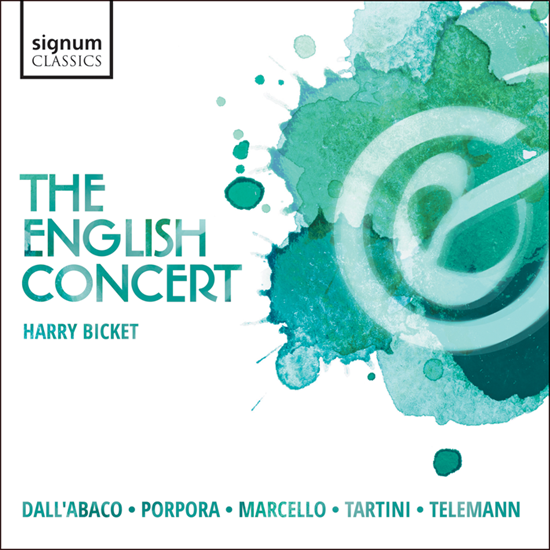
English Concert

Instrumental Concertos
by Dall’Abaco, Porpora, Marcello, Tartini & Telemann
The English Concert, Harry Bicket
Signum Classics SIGCD549. 68’43
Dall’Abaco (1675-1742) Concerto a piu instrumenti in D major Op.5 No.5
Porpora (1686-1768) Cello Concerto in G major
Marcello (1673-1747) Oboe Concerto in D minor
Tartini (1692-1770) Violin Concerto in B minor D.125
Telemann (1681-1767) Viola Concerto in G major TWV 51.69.

At first sight, this appears to be a blatant promotional effort on behalf of The English Concert (who are celebrating their 45th birthday), one clue being calling it after themselves, rather than the composers or music it contains. I think that image is unfortunate, as the music and the instrumental soloists are of the highest order. It is based on the composers and performers connected with the many early 18th-century European court orchestras, several of which proved to be pioneering musical hothouses, albeit depending on the whims of the current princely ruler. The featured soloists are Nadja Zwiener (violin), Tuomo Suni (violin), Joseph Crouch (cello), Katharina Spreckelsen (oboe), Alfonso Leal del Ojo (viola), all regular members of The English Concert rather than bought-in soloists. Continue reading
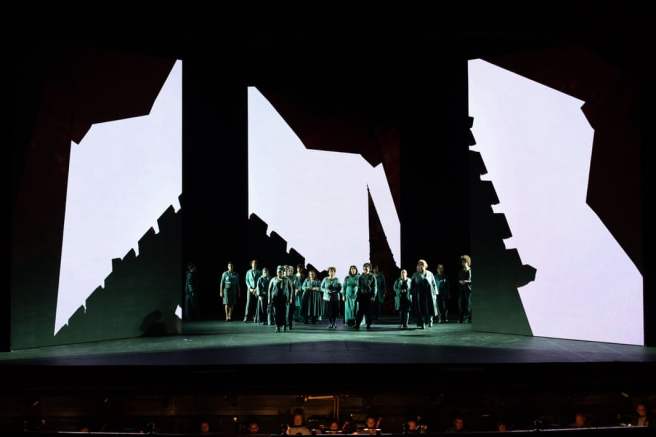
ENO: Britten War Requiem

Britten: War Requiem
English National Opera
The Coliseum, 16 November 2018

English National Opera has a record of performing Benjamin Britten operas, as well as creating operas from the Bach Passions and other choral works, so it was no surprise that they would turn to Benjamin Britten’s famed War Requiem. As with the Bach Passions, when I first saw them staged, I was a little apprehensive as to what I was to see. Just how would they stage a work with such vastly contrasting moods and scenes, combining the heart-wrenching poems of Wilfred Owen and the words of a traditional Latin Requiem Mass? Britten himself accented this contrast by giving the two male soloists who sing the Owen poems their own chamber orchestra, to be positioned closest to the audience and with its own conductor. The Requiem settings are for a large chorus and orchestra and a soprano soloist, together with boys choir and accompanying organ which are to be situated some distance away from the main orchestras.

Tillmans 3.jpg Continue reading

London International Exhibition of Early Music

London International Exhibition of Early Music
Early Music Young Ensemble Competition Finals
Blackheath, 8-10 November 2018

The London International Exhibition of Early Music is the latest incarnation of an annual event organised over many years by the Early Music Shop. It has had a number of names over the years, the most recent one being the Royal Greenwich International Early Music Festival, although it had been resident in Blackheath for a couple of years. My review of last year’s festival can be found here. Concerts have always been an important addition to the musical instrument exhibition, ranging from demonstration recitals on behalf of instrument makers, Performers Platforms, competition winner’s recitals and, this year, for the first time, the Early Music Young Ensemble Competition Finals, alongside more formal evening concerts by some leading names in the early music world. This year’s complete events diary can be seen here. The instrument exhibition itself takes place in the newly restored Blackheath Halls, with the concerts taking place in nearby churches. Continue reading

Le cor mélodique

Le cor mélodique
Mélodies, Vocalises & Chants by Gounod, Meifred & Gallay
Anneke Scott & Steven Devine
Resonus Classics RES10228. 75’57

The horn must have a claim to have one of the longest and most complex histories of all musical instruments, with the exception of the flute and the human voice. From the Scandinavian Lur (dating back some 12,000 years, and surviving today in the form of the crest on packs of butter), ancient animal horns (surviving today as the Jewish Shofar), via the Byzantine Oliphant, the Roman Cornu, and hunting and military horns came the gradual absorption into art music during the 17th century. Initially, these were valveless instruments only capable of playing very restricted notes but time and the addition of plumbing and valves gave the orchestral instrument a much greater range, but at some cost to the distinctive sound of the naturally produced notes of the harmonic scale, modified only by the mouth and hand of the player. In this recording, horn specialist Anneke Scott explores one of the developmental stages of the horn: the mid-19th-century transition from the natural to the piston horn, using three horns and three playing techniques, each related to the specific ideas of the composers. Continue reading

Steinitz Bach Players 50th

London Bach Society’s Bachfest 2018
Steinitz Bach Players, Rodolfo Richter
St John’s, Smith Square, 6 November 2918

For the fourth and final day of their 2018 Bachfest, the London Bach Society (LBS) celebrated the 50th anniversary of their own orchestra, the Steinitz Bach Players, with this St John’s, Smith Square concert. The orchestra was founded, along with the London Bach Society, by Paul Steinitz (1909-88), one of the pioneers of the British Bach revival. Made up of leading freelance period instrumentalists, the orchestra performs under different directors during the annual Bachfest. On this occasion, they performed without a conductor, but with direction from the violin by Rodolfo Richter, a practice that I am sure Bach himself would have approved of.   Continue reading

Partimenti Napoletani

Partimenti Napoletani
Music for Keyboard Instruments by Paisiello, Durante & Dol
Nicoleta Paraschivescu
with Katharina Heutjer, violin
Deutsche Harmonia Mundi 19075896222. 54’06

Partimenti Napoletani. Music for Keyboard Instruments by Paisiello, Durante & Dol

Although this recording would make a very acceptable recital of music for harpsichord and organ (and occasional violin) there is far more to it than that. In fact, unless you already know what a partimento is, I suggest you have a listen before you read any more, because what I am about to reveal might surprise you, given the nature of the music you will hear. You can find extracts of all the pieces here, but I particularly recommend the first and the fifth one on the list – Paisiello’s Partimento in D and Durante’s Intavolatura in A minor. Continue reading

Purcell: The Fairy Queen

Purcell: The Fairy Queen
Gabrieli Consort and Players, Paul McCreesh

St John’s, Smith Square. 1 November 2018

The Gabrieli Consort and Players could probably perform The Fairy Queen in their sleep, such is their experience of Purcell’s music, and this particular work, over many years. They have performed it at the BBC Proms, the Barbican, the Spitalfields Festival and many other venues around the world. They now plan to record it, along with King Arthur, early in the New Year, with the same forces as appeared in this St John’s, Smith Square performance. Their crowdfunding campaign page can be found here.

One of the continuing successes of the Gabrieli’s and their director Paul McCreesh is their ability to reinvent themselves and to continually question and push boundaries in their approach to their music making. For this particular recording (and this concert) they stress that “Gabrieli also brings a forensic understanding of contemporaneous performance techniques to this repertoire, including a new bow hold for string players which transforms articulation and influences tempi; wind instruments using more basic, coarser reeds, for a more martial sound; and natural trumpets performing on instruments without holes, playing entirely through the adjustment of embouchure – a high wire act!“. This was also the premiere of a new performing edition, prepared by McCreesh and Christopher Suckling, their principal bass violinist. It was performed at the low ‘French’ pitch of 392Hz and the violins played using French bow holds.  If this suggests an academic approach to music making, the experience of this concert proved to be anything but. It was a compelling and exuberant performance, semi-staged, albeit with only one ‘prop’ – in the shape of an enormous bleached-white wig for Mopsa, aka Charles Daniels. Continue reading

Other Worlds

”Other Worlds’
London Contemporary Orchestra and Choir
Robert Ames, conductor
Barbican 31 October 2018

Giacinto Scelsi: Uaxuctum
John Luther Adams: Become Ocean

It was an achievement that this concert took place at all. Giacinto Scelsi’s Uaxuctum is one of the most complicated orchestral works to perform. Although composed in 1969, nobody attempted to perform in until 1987. This was its UK premiere. The score includes four amplified solo singers and a chorus singing the most complex microtonal music in up to twelve parts. The large orchestra includes a solo ondes-martenot, vibraphone, clarinets, horns, trumpets, trombones, bass and double bass tubas, and timpani. A battery of other percussionists play instruments such as a two-hundred litre. The subtitle of Uaxuctum is ‘The Legend of the Maya City, destroyed by themselves for religious reasons’, and the music evokes that atmosphere of despair that led to the apparent self-destruction, around 900 CE, of this Mayan city (in what is now Guatemala) after a few centuries of varying fortunes since their conquest in the 4th century, . Its five movements move from evocative mysticism to violent outbursts in an arch form, the final movement reflective of the first. It last just over 20 minutes.  Continue reading

Echoes of Venice/NCEM Young Composers

‘Echoes of Venice’
The English Cornett & Sackbut Ensemble
Turner Sims, University of Southampton. 30 October 2018

As part of their 25th-anniversary celebrations (which also included the release of this excellent CD), The English Cornett & Sackbut Ensemble (ECSE) joined with the National Centre for Early Music (NCEM) in the 2018 NCEM Young Composers Award. UK composers aged 25 and under were invited to compose a piece to be performed by The English Cornett & Sackbut Ensemble. Composers were”encouraged to “look to Venice for inspiration, and to treat the cornetts and sackbuts as ‘wordless voices’, closer in spirit to a vocal ensemble than to a modern brass ensemble“. They were offered this brief outline of Venetian art and writing. During the final of the award in May, the ECSE performed the six shortlisted pieces and helped to select two prizewinners, one for those 18 and under, and one for 19 to 25 year-olds. All the finalist’s pieces can be heard on the NCEM Young Composers Award website here. The two winning pieces were performed during this Turner Sims concert: ‘Bridge of Sighs’ by Lilly Vadaneaux (18 years and under) and ‘Isole’ by Andrew Blair (19-25 years). Extracts from the concert will be broadcast on BBC Radio 3’s Early Music Show at 2pm on Sunday 18 November and will be available for a few weeks after that. Continue reading

Weiss & Hasse: Lute Sonatas

Weiss & Hasse: Lute Sonatas
Jadran Duncumb
Audax ADX13713. 57’19

Hasse: Sonata in A; Sonata in E flat major
Weiss: Sonata in D minor; Prelude in C minor; Passacaglia in D major

Rather like the mythical dying swan, the lute went through something of a peak as it approached its ultimate decline, along with the Baroque era that had provided it with so much music. The pieces here recorded by Silvius Leopold Weiss and Johann Adolph Hasse, close colleagues in the Dresden court orchestra, are amongst the last gasps of a centuries-old genre and represent a final flowering – until, of course, the last few decades. The two Hasse Sonatas were originally composed for harpsichord, but survive in a simplified transcription for lute, although for this premiere recording Jadran Duncomb has reinstated some of the original keyboard notes of the opening Sonata in A. This, and the Sonata in E flat (which is far from simplified in the lute arrangement), represent the move towards the Gallant style. They are from a set of four Sonatas dedicated to the wife of French Dauphin, the daughter of the Saxon Elector.  Continue reading

Une Voix Française: 20th-Century Organ Masterworks

Une Voix Française
A French Voice: 20th-Century Organ Masterworks
Renée Anne Louprette
Acis APL01609. 69’58

Jeanne Demessieux (1921-1968) Te Deum
Nadia Boulanger (1887-1979) Improvisation 
Jacques Ibert (1890-1962) Fugue
Jehan Alain (1911-1940) Variations on a Theme by Clément Jannequin
André Isoir (1935-2016) Six Variations on a Huguenot Psalm
Louis Vierne (1870-1937) Fantasy Pieces, Second Suite

This recording is an excellent reflection a small part of the important contribution to the history of organ composition by France, a powerhouse of organ design and composition with a tradition going back to the early 17th century. Since then, France has produced some of the best-known organ composers, with names such as Titelouze, Couperin, De Grigny, Widor, Vierne, and Messiaen among others. Focussing on the first half of the 20th century, Renée Anne Louprette‘s well-chosen programme includes a few well-known pieces, but there are some really interesting lesser-known works that sets this recording apart. Jeanne Demessieux’s dramatic opening Te Deum, is one example. It was composed for a recital she gave in 1958 in the Cathedral of St John the Divine in New York, so it is an appropriate start for a recording made on the important 1993 NP Mander organ in nearby St. Ignatius Loyola church. Renée Anne Louprette was Associate Director of Music at this church from 2005 to 2011, and clearly knows and understands the instrument very well. The thundering opening soon subsides into a sequence of more rhapsodic passages, before the power of the opening and full resources of the organ returns. Continue reading

Festival d’Ambronay/Festival eemerging: 2018

Vibrations: Cosmos
Festival d’Ambronay/Festival eeemerging
Centre culterel de recontre d’Ambronay
28-30 September 2018

The 39th Festival d’Ambronay saw the conclusion of an annual triptych devoted to the theme of Vibrations, in this case with the subtext of ‘Cosmos’. Spread over four weekends, it was described as “An evocation in music of a cosmos alternately spiritual or material, intimate or grandiose, in-depth or elevation … An evocation of the stars, elements and spirituality, a look at the harmony of man and the universe“. As well as hosting the annual festival, the Centre culterel de recontre d’Ambronay is also the base for the eeemerging project (Emerging European Ensembles), a European Union-wide cooperation project dedicated to the selection, training and promotion of young early music ensembles. It brings together partners from the UK, Latvia, Romania, Slovenia, Italy and Germany in a four-year cooperation project. Alongside festival events, the third weekend of the four-weekend festival was devoted to the ensembles selected for the 2018 eeemerging round, with six young groups of musicians performing, alongside one of the previous eeemerging ensembles and one of the most established groups in recent history. The comparison between the young musicians and some of the more established performers in the festival was of particular interest, leaving me with the view that the latter, with few exceptions, have a lot to learn from the former.

IMG_20181002_155857192.jpg Continue reading

French Baroque music meets Indian Classical Dance

French Baroque music meets Indian Classical Dance
BBC Singers, Academy of Ancient Music, Sofi Jeannin
Sanskriti UK & Ankh Dance
Milton Court, 19 October 2018

Lully: Te Deum 
Rameau: In convertendo Dominus;
extracts from 
Les Indes galantes, Les fêtes d’Hébé Castor et Pollux 

In what was a rather brave bit of programming for a live BBC Radio 3 broadcast, the BBC Singers and the Academy of Music, directed by Sofi Jeannin, the new Chief Conductor of the BBC Singers, presented an evening of French Baroque music, the second half of which was accompanied by two contrasting forms of Indian dance. The first half was of liturgical pieces, starting with Lully’s jubilant 1677 setting of the Te Deum. This was first heard at Fontainebleau and later became the piece that led to Lully’s death after he stabbed himself in the foot with his conducting baton during Chapel Royal celebrations for the Sun King’s recovery from surgery – surgery that Lully decided, fatally, to refuse. No such calamity occurred here as Sofi Jeannin demonstrated her commendably straightforward style of conducting, her focus clearly on the music itself rather than on any sense of self-aggrandisement. She coped well with the complications of this particular occasion, which included a late start after an overrun of the previous Radio 3 show, and complicated coordination between dances, singers, instrumentalists, a BBC announcer and the paraphernalia of a live BBC broadcast.  Continue reading

Bach: St Matthew Passion

Bach: St Matthew Passion
English Touring Opera
Temple Church, London. 18 October 2018

English Touring Opera (ETO) is an ambitious organisation that run extensive annual tours of staged operas around the UK, alongside one-off projects like their current adaptation of Bach’s St Matthew Passion. They start their tours in London, usually at the Hackney Empire, where they have just staged Radamisto and a triple-bill of Dido and Aeneas, Carissimi’s Jonas, and Gesualdo madrigals. Details of their current tour can be found here. For the Matthew Passion, as in previous such projects, they enrol local amateur choirs, community groups, and schools. For their London performance, these were the Collegium Musicum of London Chamber Choir (whose musical director is assistant organist at The Temple Church) and an almost exclusively female flock of children from the Holy Trinity and Saint Silas Church of England Primary School in Camden. The orchestra was the professional period instrument Old Street Band. Continue reading

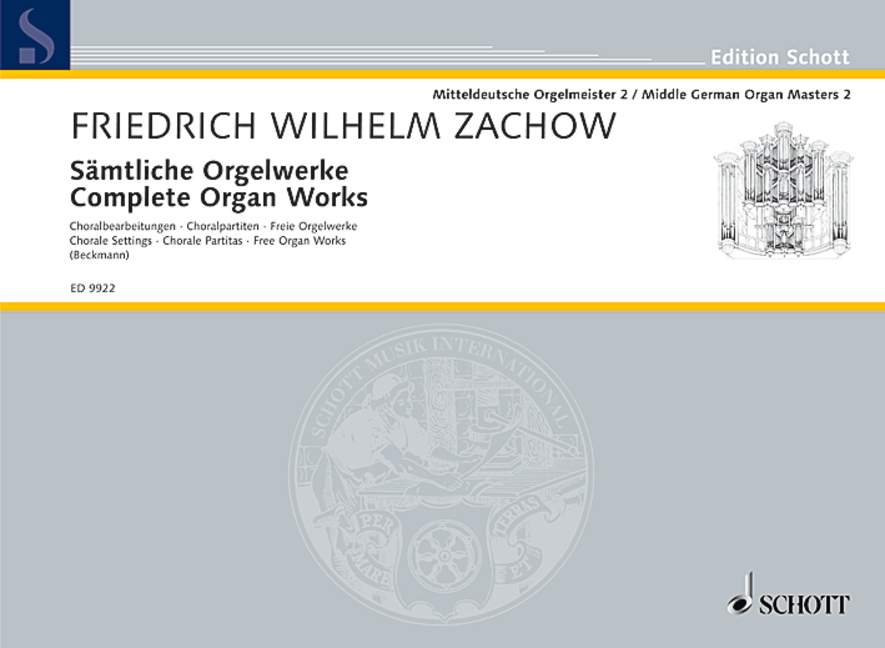
Zachow: Complete Organ Works

Friedrich Wilhelm Zachow: Complete Organ Works
Chorale Settings • Chorale Partitas • Free Organ Works
144 pages  • ISMN: 979-0-001-14049-2 • Softbound
Edition Schott ED 9922

Friedrich Wilhelm Zachow (1663-1712) is best known as the teacher of the young Handel in their hometown of Halle. He was organist of the principal city church, the Marienkirche, also known as the Marktkirche Unser Lieben Frauen and Liebfrauenkirche, a post held earlier in the 17th century by Samuel Scheidt.  The little 1664 organ on a gallery above the altar that Zachow and Handel certainly knew still exists. JS Bach was offered the post in succession to Zachow, but turned it down, leaving it until 1746 for his son WF Bach to eventually become the organist. Zachow’s father was from nearby Leipzig where he was town piper. His church music was criticised as being too long and complicated by the pietest clergy, who preferred something more approachable. He taught Handel violin, oboe organ, and harpsichord along with music theory. He teaching was clearly successful, as Handel became organist of the Halle Cathedral aged just 17. His later compositions show several influences from Zachow, as well as borrowings.

Continue reading

Music for Windy Instruments

Music for Windy Instruments: Sounds from the Court of James I
The English Cornett & Sackbut Ensemble
Resonus RES10225. 59’50

In celebration of their 25th anniversary, The English Cornett & Sackbut Ensemble present this enticing recording of some of the Royal Music performed at the Court of James I. The music comes from a set of manuscript part-books, now housed in Cambridge’s Fitzwilliam Museum (Mu. MS 734). The chosen pieces are from the first layer, which was copied around 1615. Further recordings are clearly planned. Only five of the six part-books survive, the missing part reconstructed, often from other examples of the pieces, most of which are instrumental arrangements of sacred and secular vocal music by Continental composers, including the likes of Orlando de Lassus, Peter Philips, Alfonso Ferrabosco I & II, plus many lesser-known composers. Continue reading

ENO: Salome

Richard Strauss: Salome
English National Opera, Martyn Brabbins, Adena Jacobs
The Coliseum, 3 October 2018

In a production that veered from My Little Pony, via Lolita, to the Texans Chainsaw Massacre, there were two clear winners: the music of Richard Strauss, given a superb reading by Martyn Brabbins and the Orchestra of English National Opera, and mezzo Allison Cook in her strangely compelling and insightful interpretation of the complex role of Salome – a role and ENO debut. Usually depicted as the archetypical seductive femme fatale, for most of this production, directed by Adena Jacobs in an ENO debut, she seemed far more like a confused, hormone-ridden teenage girl, becoming increasingly fragile, delicate, and in need of protection. Perhaps I was viewing it through the mind of a father, rather than a voyeur, but it was an incredibly powerful image. Her first appearance was as a black-clad, demanding and confident long-haired princess arguing to see the imprisoned Jokanaan. As events unfolded, she mutated into a slight and vulnerable bare-breasted child-woman in minuscule schoolgirl gym knickers and with makeup smeared all over her face.

Salome 5.jpg Continue reading

Academy of Ancient Music: Dido and Aeneas

Dido and Aeneas
Academy of Ancient Music, Richard Egarr, Thomas Guthrie
The Barbican, 2 October 2018

For anybody who was not already familiar with the story of Purcell’s Dido and Aeneas, the Academy of Ancient Music’s semi-staged performance (directed by Thomas Guthrie) at The Barbican opened with something of a plot-spoiler. The first half was a 40-minute exploration of the funeral rites of the dead Dido, albeit a couple of hours or more before she was ‘laid in earth’. Actually, laid in earth she wasn’t, instead lying on a funeral catafalque over which Belinda, Aeneas and assorted mourners (the AAM chorus, who opened the show with some rhythmic drum bashing) acted out their reaction to her death as they remembered her. And when I write ‘she’ in fact it was a half-size puppet of the upper half of Dido who represented her throughout the evening. The full panoply of puppets came to the fore in the second half performance of Dido and Aeneas itself where the entire cast of soloists and chorus sported puppets – torsos for Dido and Aeneas, heads and gauze cloths for the rest. Continue reading

A Courtly Garland for Baroque Trumpet

A Courtly Garland for Baroque Trumpet
Orpheus Britannicus, Robert Farley, Andrew Arthur
Resonance Classics RES10220. 79’57

The 17th-century was a time of dramatic musical invention, both compositionally, and instrumentally, with several now mainstream instruments going through their birth pangs, or re-birth pangs. One such was the trumpet, hitherto a largely military or ceremonial instrument, with little, if any, music of real significance composed for it. It was the development of the clarino style of playing in the higher registers that freed the trumpet from its lower register, only capable of playing restricted arpeggio-like notes. The more melodic notes in the upper reaches of the harmonic series allowed for more tuneful writing. Girolamo Fantini (1600–1675) was one of the first known trumpet virtuosos, described as “the monarch of the trumpet on earth!” After five years in the service of Cardinal Scipio Borghese in Rome he was appointed principal Court trumpeter to the Grand Duke of Tuscany. In 1634, played in a concert with the famous organist/composer Frescobaldi (1583–1643), organist of St Peter’s Basilica in Rome. This seems to have been the first known recital of music for trumpet and organ, a popular combination to this day. Fanni is represented on this CD by four short pieces.  Continue reading

In Convertendo

In Convertendo
Sacred Music From The Düben Collection

Abendmusiken Basel, Jörg Andreas Böttiche
Coviello Classics, COV 91733.  63’25

Abendmusiken Basel group takes its name from the monthly Abendmusik concerts in the Predigerkirche, Basel: in turn, based on the famous series of concerts in Lübeck’s Marienkirche, initiated by Franz Tunder in 1646 and continued under his successor Dieterich Buxtehude. These Lübeck concerts took place on the five Sundays preceding Christmas, but the present day Basel version is on the second Sunday of the month throughout the year. As in Lübeck, the music focusses on the 17th-century, as does this impressive CD, which draws on music from the Düben Collection, now part of the library of Uppsala University. It is one of the most important sources of 17th-century German music, not least because it contains the only known copies of many works by Buxtehude. Appropriately, this recording focusses on some of the many lesser-known composers of the time, with six of the eleven pieces being world premiere recordings.  Continue reading

RFH International Organ Series: Renée Anne Louprette

Renée Anne Louprette, organ
Royal Festival Hall, 19 September 2018

JS Bach: Prelude and Fugue in G
Marin Marais: Suite from Alcyone (arr. Louprette)
Jehan Alain: Variations sur un thème de Clément Jannequin
Ad Wammes: Mytò
Nadia Boulanger: Improvisation from 3 Pièces
Duruflé: Suite, Op.5

The Royal Festival Hall’s ‘International Organ Series‘, most of which is made up of UK, rather than international organists, made up for that fact by replacing an indisposed UK performer with Renée Anne Louprette, an American organist who spent some of her student days in London. She has held posts in several important New York churches, alongside academic posts, and is now University Organist and Coordinator of the Organ Department at the Rutgers University Mason Gross School of the Arts in New Jersey.

Her largely French programme opened with Bach’s flamboyant Prelude and Fugue in G (BWV 541), a distinctly non-French piece. From the very first few notes, it was clear that Renée Anne Louprette is an outstanding Bach interpreter. Her sense of touch, rhetoric and the way she sensitively articulated the opening flourish and the repeated notes in both Prelude and Fugue showed a real (and sadly rather rare) understanding of Baroque concepts such as the hierarchy of the bar. Her choice of registration was spot-on. Continue reading

Rameau: Naïs

Rameau: Naïs
Purcell Choir, Orfeo Orchestra, György Vashegyi
Glossa GCD924003. 2CDs 72’44 + 72’26

I have been looking forward to this CD ever since I heard this performance of Naïs in concert in the Béla Bartók National Concert Hall in Budapest’s Müpa arts centre on 4 March 2017 during a short early music festival. The recording dates for the CD are given as 4-6 March 2017 and, although there is nothing on the sleeve notes (or evidence on the recording) to suggest that it is a ‘live’ recording, I think it is probably based on a recording of that 4 March concert, presumably with two days of patching afterwards.

Rameau’s Naïs, a Pastorale heroïque, was written in 1749 the aftermath of Treaty of Aix-la-Chapelle. This concluded the War of the Austrian Succession between Hapsburg Austria and Hungary, Saxony, the Dutch Republic and Great Britain against France and Prussia, and confirmed Marie Theresa’s succession to the Hapsburg thrones of Hungary and Austria. Rameau gave it the subtitle of Opéra pour La Paix (Opera for Peace), its original title of Le triomphe de la paix being amended after concerns about just how triumphant the treaty had actually been for France. Before the story of Naïs starts, the dramatic opening Prologue depicts the tussle for supremacy between Jupiter and Neptune, clearly reflecting the agreement between Louis XV of France and Britain’s George II that concluded the war. Continue reading

Scheidt: Tabulatur-Buch, Görlitz 1650

Samuel Scheidt: Tabulatur-Buch, Görlitz 1650
111 four-part Chorale Settings for Organ or Keyboard
116 pages  • ISMN: 979-0-001-13600-6 • Softbound
Edition Schott ED 22325

Samuel Scheidt is one of the finest of the North German school of organist-composers that stemmed from the teaching of Sweelinck in Amsterdam. Born in Halle in 1587, he became assistant organist the Moritzkirche in 1603, before studying in Amsterdam between 1607 and 1609. He returned as Court organist to the Margrave of Brandenburg in Halle, where he was soon joined by Michael Praetorius. The Thirty Years War disrupted musical life in Germany. The Margrave fled, and the music of the Court ceased. Scheidt took to private teaching before eventually becoming director of music for the major Halle city churches (Marketkirche, Moritzkirche, and St Ulrich).

In 1624 Scheidt wrote his monumental three-volume Tabulatura Nova, an important collection of works for organ, harpsichord, or clavichord. Scheidt never recovered his earlier financial security and died in some financial trouble. His last publication was this 1650 Görlitzer Tabulaturbuchnamed after the city that commissioned the collection of four-part harmonisations of Lutheran chorales. Although there are a few simple harmonised settings, many of them are adventurous little pieces demonstrating Scheidt’s advanced keyboard technique and musical thinking as the early Baroque style of composition developed. Whether or not you would ever use them in a liturgical setting (as seems to have been intended, judging from Scheidt’s introduction where he mentions that the pieces are for “gentlemen organists to play with the Christian community”), they are worth exploring.

This Schott edition is clearly printed, in landscape format. The introduction by editor Klaus Beckmann (in German and English) gives background to the pieces and the editorial process. The critical commentary is, as usual, only in German. Preview pages can be view here. This is apparently the last in the Schott series ‘Masters of the North German Organ School‘, although I hope that is rethought as scholarship on this important repertoire continues to evolve and there must be more composers and pieces to be discovered and edited.

Andrew Benson-Wilson – Organ recital: ‘From England’

Andrew Benson-Wilson
plays organ music
‘From England’

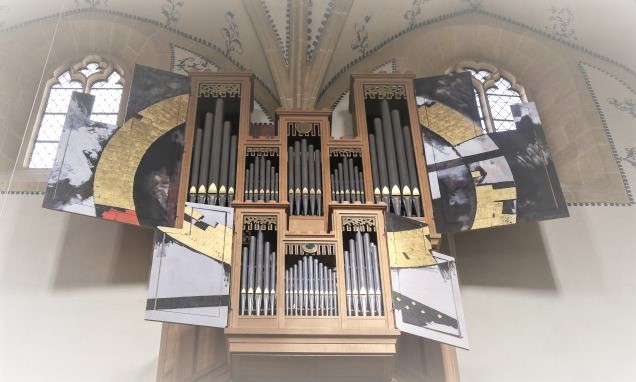
Biel organ 4.jpg

Stadtkirche (Temple Allemand)
Biel/Bienne, Switzerland
21 September 2018, 12:30

A recital on the reconstruction of the original 1517 ‘Swallow’s nest’ organ (Hochwandorgel) in the Stadtkirche (Temple Allemand) Biel/Bienne. Music by Anon, Dunstable, Preston, Tallis, Byrd, and Bull, the latter played on the Hauptorgel.

Anon: Robertsbridge Codex (c1360) Estampie
John Dunstable (c1390-1453) Sub Tuam Protectionem
Anon (c1530) Felix Namque
Thomas Preston (c1500-1563) Uppon la mi re
Thomas Tallis (c1505-1585) Alleluia Per te Dei genitrix
William Byrd (1538-1623) Callino Casturame
John Bull (1562-1628) Salve Regina (5 verses) Continue reading

Le Cœur & l’Oreille: Manuscript Bauyn

Le Cœur & l’Oreille
Manuscript Bauyn
Giulia Nuti (harpsichord)
ARCANA A434. 74’24

Music by Louis Couperin, Jacques Champion de Chambonnières, Jacques Hardel, Jean Henry D’Angelbert, René Mesangeau, Germain Pinel, and Johann Jacob Froberger

Le Cœur & l’Oreille (The Heart & the Ear) ticks all the musical boxes in a wonderful combination of a historic instrument, fascinating repertoire, inspired playing, and intriguing performance practice and musicological insights. The music performed is found in the famous Bauyn Manuscript, dating from around 1690, but containing music probably composed several decades earlier. It looks as though the manuscript was intended as a wedding gift, although analysis of the coat of arms on the cover has yet to determine who the lucky recipient was. More important is the fact that such a collection was made in the first place. When ‘old music’ was usually considered to be anything written just a few years earlier, the idea of collecting together music from a couple of generations earlier was something of a revolution, not least at a time when very little harpsichord music had been published at all. Continue reading