Forgotten Vienna 2: Amadè Players
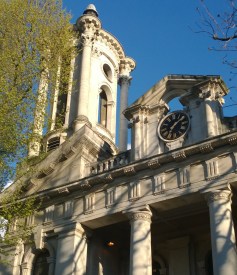
St John’s, Smith Square. 1 July 2015
Carl Ordonez Sinfonia in C; CPE Bach Cello Concerto in g; Georg Mathias Monn Cello Concerto in G Minor; Alessandro Rolla Violin Concerto in G BI 520
Poppy Walshaw, cello, George Clifford, violin, Nicholas Newland, director.
 The Amadé Players returned to St John’s, Smith Square for the second in their Forgotten Vienna series. The title is a bit misleading – it is not Vienna that has been forgotten, but the wealth of composers from central and eastern European lands that flocked there in the 18th century. On this occasion the composers represent Moravia, Germany, Vienna itself, and Italy.
As with their last concert, names were an issue – the first composer (from Moravia), was listed as Carl Ordonez, but is also known as Karl von Ordoñez, Carlo or Carl d’Ordonetz, Ordonnetz, d’Ordóñez, d’Ordonez and Ordoniz. Such was social life in 18th century Vienna that his ranking in the lower nobility prevented him from working as a musician, instead having a career in the civil service. His rather conservative Sinfonia in C (Brown C1), with its delightfully delicate opening Adagio, demonstrated a tentative move from the Baroque to the Classical era. There followed the first of two cello concertos, played by Poppy Walshaw. The conductor, Nicholas Newland, explained that the addition of a second concerto was to replace the originally advertised Waňhal’s Concerto for 2 Bassoons, omitted because of the lack of the requisite number of bassoons.
 The first cello concerto to be played was the more advanced in style of the two. CPE Bach’s Concerto in a opening in typical Empfindsamer Stil with an orchestral unison, immediately challenged by contrary-motion scales and a yearning melody for the solo cello followed by a motif built on rapidly repeated notes – a typical CPE Bach mix of colours and textures. The first movement ended with the first of Poppy Walshaw’s excellent cadenzas, all kept well within the bounds and style of the piece. In the slow movement, the sound of the solo cello was allowed to grow delicately out of the orchestral texture. The skittish final movement saw the cello finally break free from its former collaborative role with a virtuoso series of flourishes.
The second cello concerto, after the interval, was the little known Concerto in g by Georg Matthias Monn (aka. Johann Georg Mann). In the pre-classical Galant style, his slightly formulaic compositional style was balanced by some very tricky passages for the solo cellist, with wide-spaced melodic lines and leaps using the whole gamut of the cello. Poppy Walshaw dealt with all these challenges with apparent ease, relishing the technical complexities and flourishes. Her playing in both these concertos (a big ask for any soloist) demonstrated a natural and sensitive understanding of the music, and the importance of working with the orchestra, rather than challenging it. The stifling heat of the hottest July day since records began no doubt added to the intonation woes of the violins, but a tuning pause after the first movement might have helped.
 The evening ended with the Violin Concerto in G (B1:520) by Allessandro Rolla, an Italian composer better known today as the teacher or Paganini than for his own compositions. Clearly in a later genre that the other works on the programme, this was very obviously a work written by a violin virtuoso to demonstrate his own skills. In contrast to the earlier composers, the solo moments were accompanied by the full orchestra, rather than a Baroque-style continuo group. As with Poppy Walshaw earlier, George Clifford produced a superb extended cadenza towards the end of the first movement, building on the advanced techniques already demonstrated. Switching between arco and pizzicato (and on one occasion, both at the same time) and taking the melodic line well towards the top of the violin fingerboard, Rolla would have approved.
 The 6th incarnation of the rather convolutedely-worded ‘International Singing Competition for Baroque Opera: Pietro Antonio Cesti’ took place during the last few days of the Innsbruck Festival of Early Music, with preliminary rounds on 21-23 August and the final on 25 August. A total of 67 singers from 26 countries entered for the competition, a considerable reduction from last year’s entry of 97 singers from 32 countries. They have to fund their own travel and accommodation during the competition, so this is a very big investment for young singers, with monetary prizes only going to four of them. As well as the prizes (1st 2nd and 3rd prizes of €4,000, €3,000 & €2,000, together with an audience prize of €1,000), there is the opportunity to appear in next year’s BarockOper:Jung production of Pietro Antonio Cesti’s Le nozze il Sognio by as part of the 2016 Innsbruck Festival of Early Music. There is also the possibility of being selected to appear in other music festivals, many connected to members of the jury, most of whom represent opera venues. Continue reading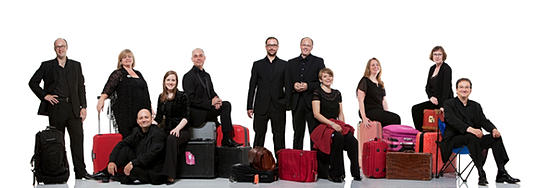
 The highlight was the singing of soprano Berit Norbakken Solset (left), both in the folk songs and the early pieces, notably in Buxtehude’s bittersweet lament for his father, the Klag-Lied, and in the equally expressive Byrd ‘Ye sacred muses’, a lament on the death of Tallis with the mournful phrase “Tallis is dead, and music dies”. Instrumentally the finest sounds came from strings in the early pieces, producing a muted tone quite close to that of the viol consort which would have almost certainly been the preferred accompaniment to singers of the time. I am not sure what the likes of Dowland or Holborn would have made of the frequent foot-tapping from one of the players, but it seemed more of a performance tic than relating to any sense of rhythmic enhancement. The foot-tapping turned into foot-stomping from Bjarte Eike during some of the livelier Norwegian contributions and early English dance pieces.
 of some Mozart examples, a relatively unknown repertoire. The Harmonie usually described an ensemble of up to fifteen players, generally with pairs of oboes, clarinets, horns and bassoons, sometimes supplemented by a wide range of other instruments. With its roots in Viennese saloon and Imperial music, a parallel tradition was growing in France through military and revolutionary bands. Apparently there are some 12,000 works for the Harmonie band.
  Pergolesi is often seen as one-horse-wonder, rather unfairly as he died aged just 26, composing his famous Stabat mater just before his death. His other works, including several operas, are usually ignored. He was one of the first composers (of around 70) to write an opera based on Metastasio’s take on Adriano in Siria (Hadrian in Syria), two years after the libretto was written, and two years before his death. The plot is based on the story of Hadrian in his days as Governor of Syria in Antioch (where he first became Emperor), and his love for his prisoner (and daughter of the Parthian King Osroa) Emirena who, in turn, is betrothed to Farnaspe, a Parthian prince. As these things inevitably go in opera seria, Adriano is married to Sabina, who, in turn, is loved by Aquilio. Rather bizarrely, Osroa tries to rescue his daughter by setting fire to the palace that she lives in. Of course, it all ends up well – the condemned Osroa is forgiven, Farnaspe marries Emirena, and Adriano stays with his wife Sabina.
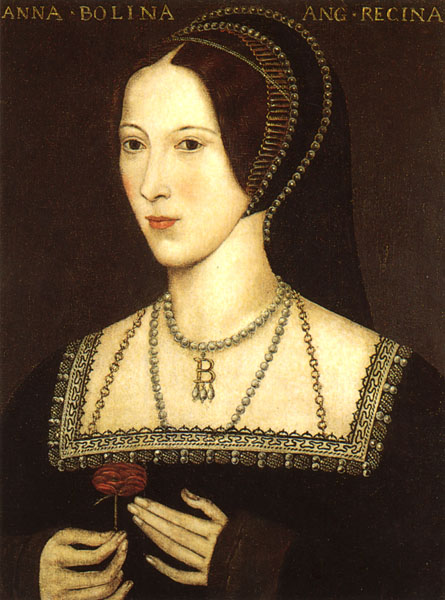 Having recently dusted off ‘The Spy’s Choirbook’, a manuscript by Alamire in the British Library, David Skinner and Alamire have now turned their attention to a manuscript that (arguably) belonged to Anne Boleyn, currently in the Royal College of Music (MS1070). The inscription ‘Mistres ABolleyne nowe this’ indicates the link to Anne, the ‘Mistres’ suggesting that the songbook was started before she became Queen in 1533 – and, I suggest, also before she became Marquess of Pembroke in 1532, and possibly before 1525 when her father was elevated to the peerage as a Viscount, or 1529 when he was created an Earl, both ranks giving Anne a courtesy title. ‘Nowe thus’ is her father’s motto.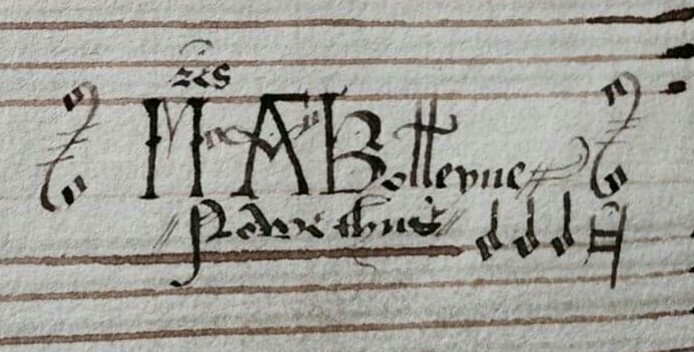
 Guerrero: Duo seraphim clamabant, Gloria (Missa Surge propera), Laudate Dominum, Maria Magdalene, Credo (Missa de la batalla escoutez), Vexilla Regis, Agnus Dei (Missa Congratulamini mihi);
 The annual visit to the Proms of one of the current series of Glyndebourne Festival Opera productions is always a highlight. Transferring from the relatively intimate space of Glyndebourne’s opera house to the vast Royal Albert Hall obviously has its problems, but the more-than-semi-staging (in this case, with full costumes and props, but no scenery) brings a welcome chance to focus on the music. There were several surprises for those not used to the work, not least that it is a Singspiel, with a lot of spoken text, much of which is usually omitted – but not here. This gave the chance to experience Mozart’s music in its original context of incidental music to a play. The fact that the music is of the utmost complexity only heightens the suspense of waiting for the next bit to start.
  The Tête à Tête Opera Festival at Kings Place included the premiere of a fascinating new one-hour long opera, The Electrictionary, with music by Alexis Bennett, words by Timothy Knapman, and direction by Dominic Gerrard It was performed by four solo singers and the instrumentalists of The Early Music Experiment & guests. The Electrictionary was conceived by the composer to explore the power of language and the issue of new words. It is intended “to confront progress, pedantry, class, slang and neologisms, in search of the ultimate dictionary with a riotously eclectic score mixing jazz-funk, classical and the avant-garde”. The use of various styles of music aims “to draw parallels between the deep history of words and the similarly complex origins of the multitude of musical styles that surround us every day”. The orchestra featured baroque specialists (albeit playing modern instruments) alongside jazz/funk musicians, and the wide-ranging structure of the piece included a combination of baroque recitative and aria, the spoken elements of Singspiel, and present-day music theatre and film music.
 I first reviewed Anna Prohaska in 2012 Wigmore Hall concert (broadcast live on Radio 3) and noted that “… If I had read Anna Prohaska’s CV (full of names like the Berliner Philharmoniker, Weiner Philharmoniker, Deutsche Staatoper Berlin) before I heard her sing, I would have wondered why on earth the Academy of Ancient Music had booked her”. But, for the ‘early music’ vocal scene, she was a real find. I don’t know what, or how, she sings with these orchestral big boys, but her beautifully eloquent and pure voice is just the thing for this repertoire, as was her presentation. She is of impeccable musical stock – her father and mother were an opera director and singer, her grandfather and great-grandfather a conductor and composer respectively. She has a very attractively un-diva like and engaging stage manner, giving the impression of singing with us, rather that at us, and involving us in the emotional turmoil of the various pieces. She has an exquisitely warm timbre with a slightly mezzo-ish tinge and demonstrated a thorough understanding of her chosen repertoire (and its wide range of emotions), with fine da capo elaborations and the rare ability to trill properly. Her use of rhetoric to accent emotive moments was spot on, as was her heart-wrenching cries of “Gabriel” in Purcell’s ‘Tell me, some pitying angel’ – one of those moments when silence can be more intense than music.
  For the second time this year, London sees Monteverdi’s Orfeo performed in a large circular space. After the Royal Opera House / Early Opera Company production in the Roundhouse early this year (
 and Shepherds (men in casual black, women in bright block colours) bounced around to the merciless thump of the drum and rattle of a tambourine. The two very professional-looking dancers who took over the front stage turned out to be the key soloists Mariana Flores and Francesca Aspromonte (Eurydice and Musica who, in a nice twist, also sang the role of the Messenger).
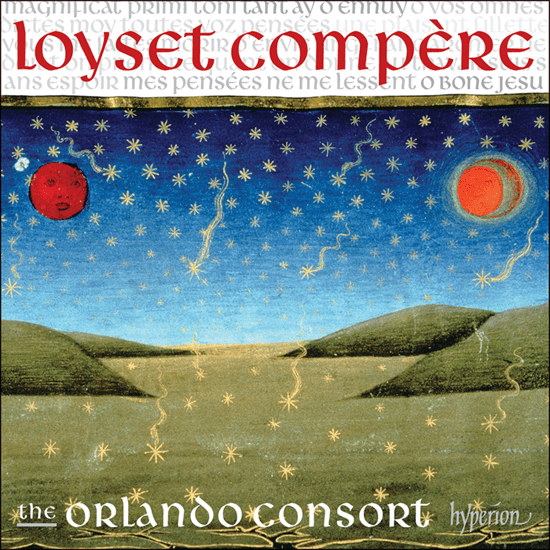 Loyset Compère is not as well-known as he deserves to be, and this recording could be the means by which his (recently re-assessed) place in musical history is acknowledged. The key to the re-assessment is the slightly embarrassing realisation that the Josquin that musicologists assumed to have been born in 1440 was not, in fact, Josquin des Prez, but another Josquin altogether. That makes Josquin des Prez around 10 years younger than thought. Similar birth date realignment concerning Obrecht and Agricola also make them younger than first thought. As David Fallows explains in his comprehensive programme notes, this leaves Loyset Compère as one of the earliest composers in the imitative style, now known to be later developed, rather than instigated, by Josquin and others.
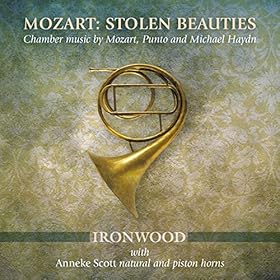 A CD launch concert in Handel’s own parish church of St George, Hanover Square featured the programme from the CD ‘Mozart: Stolen Beauties’. Ironwood is an Australian period instrument ensemble formed in 2006. They were joined by the distinguished horn player Anneke Scott, here playing both natural (or ‘hand’) and piston horn.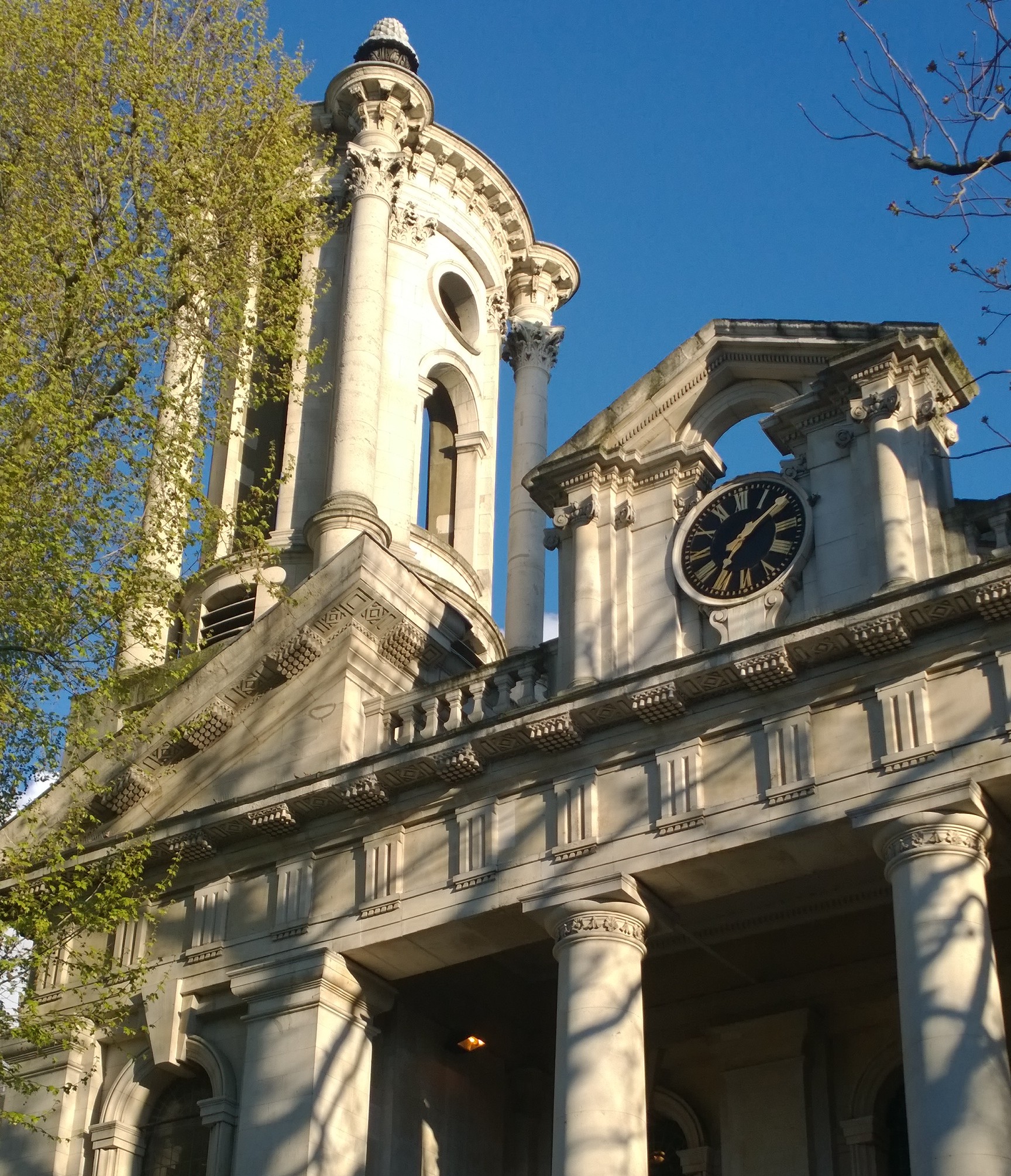
 The Sam Wanamaker Playhouse, part of the Shakespeare Globe on London’s South Bank, has come up with an enterprising series of candlelit musical events and, increasingly, theatrical events using music as an integral part of the production. The latest of the latter genre is ‘All the Angels: Handel and the first Messiah, a play by Nick Drake that explores Handel’s visit to Dublin where the first performance of Messiah took place on 13 April 1742.


 (the 5th in their spectacular new home on the Wormsley estate) saw them spreading their wings with more educational projects and partnerships with the Royal Shakespeare Company and, in future years, Rambert and the Philharmonia Orchestra. As usual, they presented a mixed programme of popular operas, including the regularly returning Mozart, in this case with Così fan tutte.
 least given the nature of Armonico Consort’s rather staid production. It was also singularly unwise of director Christopher Monks to tell us all in his introductory talk that we would have “never seen a performance like this before”. I am still not quite sure what he meant by that remark, but it kept me waiting for something special or unusual to happen – which it didn’t. His comment did turn out to be true, in a way, but not in the way that I think he intended.
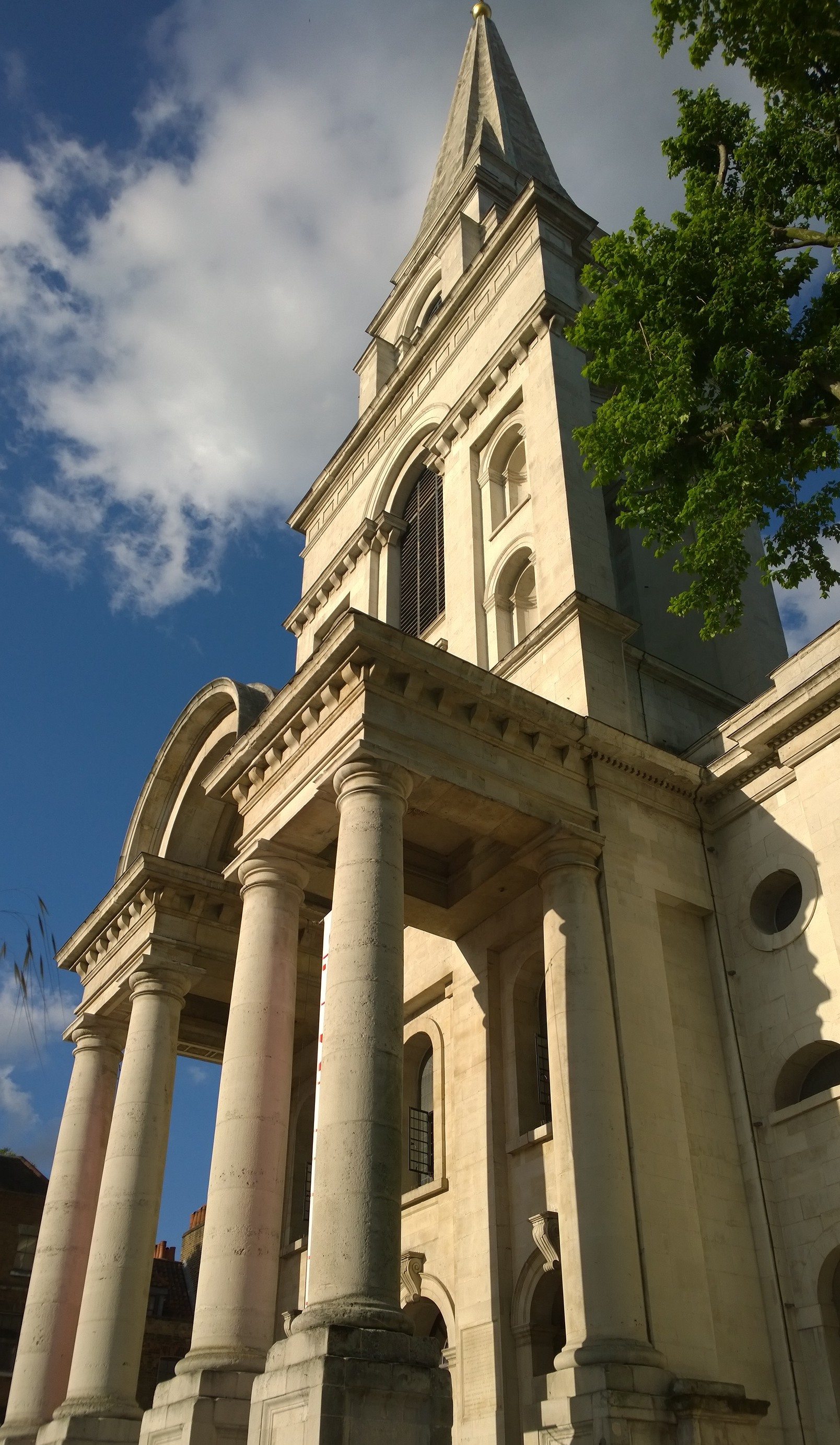
 new heights of curiosity. With wholesale ‘borrowing’ from his own, and around seven other composers’ music, this doesn’t seem to be Handel at his most sincere. Amongst other oddities, he turned a wedding cantata by Stradella into a chorus about plagues. It was performed in the almost ideal acoustic of Christ Church Spitalfields (as part of the Spitalfields Festival) by La Nuova Musica, directed by their flamboyant conductor David Bates.
 Andrew Benson-Wilson : Early Music Reviews +