‘Cello Unwrapped’ – Bach Through Time
Christophe Coin, cello & piccolo cello
Kings Place. 11 January 2017
Domenico Gabrielli: Ricercar No. 3 in D
JS Bach: Cello Suite No. 2 in D minor, BWV 1008
Dall’Abaco: Capriccio No. 8 in G; Capriccio No. 6 in E minor (collage)
Bernhard Romberg: Praeludium in C minor
Félix Battanchon: Pièce caractéristique (Enterrement de Carnaval c1850)
JS Bach: Cello Suite No. 6 in D, BWV 1012 (performed on cello piccolo)
Following on from last years’ Baroque Unwrapped series of concerts, the latest in the Kings Place ‘Unwrapped’ series is devoted to the cello (see here). Included within that series are thre e concerts under the title of Bach Through Time, the first of which featured Christophe Coin playing solo cello – or, in this case, two solo cellos with three different bows. He opened with one of the very first compositions for solo cello, the third of Domenico Gabrielli’s Ricercars, a lively piece in the trumpet key of D major which included many triad fanfare motifs. This Gabrielli (no relation) was part of the rich musical foundation of the Basilica of San Petronio in Bologna and also worked for the d’Este family in Moderna. Continue reading

 Over the years, William Christie has done much to introduce French baroque music to British ears, and has opened our ears to Purcell. But I had not heard his take on Messiah live before. It was bound to be rather different from the usual variety of British interpretations, and it was. We are increasingly used to lightly scored performances with moderately sized choirs, in contrast to the cast of thousands of yesteryear, but this very Gallic interpretation added a layer of delicacy and dance-like joie de vivre to Handel’s music, all done in the best possible Bon Goût. Les Arts Florissants fielded a choir of 24 (quite large, by some standards today, and in Handel’s time) and an orchestra with 6, 6, 4, 4, 2 strings, together with five soloists. Both instrumentalists and the chorus were encouraged to keep the volume down, usually by a finger on the Christie lips. This seems to be in line with Handel’s intentions, as indicated by his scoring and, for example, his very limited use of the trumpets. When things did let rip, there was still a sense of restraint amongst the power.
 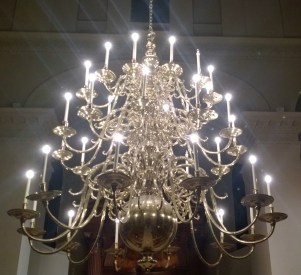 The Renaissance Singers have a history that goes back to 1944. They played an important part in the revival of interest in Renaissance sacred polyphony as the early music movement grew and developed. Their 2017 Christmas concert, in the architecturally important Hawksmoor church of St George’s Bloomsbury, sensibly avoided carols and concentrated on what they do best: singing Renaissance music. Under the inspired direction of their musical director, David Allinson, they presented a programme of seasonal music centered on the composer Clemens non Papa and his Missa Pastores quidnam vidistis, together with music by Josquin, Verdelot, Gombert and Willaert.
 The 31st St John’s, Smith Square Christmas Festival features most of the usual suspects, including regulars, The Cardinall’s Musick. As is typical of their concerts, the focus was on Catholic liturgical music from the Renaissance, on this occasion in honour of the Virgin Mary. In a ‘greatest hits’ line-up of Renaissance composers, the first half was built around Lassus’s Missa Osculeter me osculo oris sui alternating with motets by Victoria; the second centered on Byrd’s Propers for the Nativity of the Virgin Mary and concluded with Palestrina’s Magnificat primi toni a 8.
  The
The 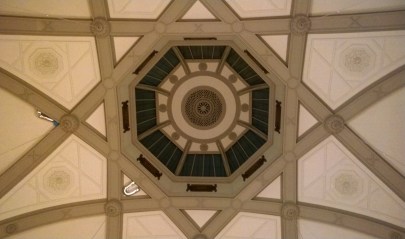 For many years now, Spitalfields Music has been spreading its wings way beyond its original home in Spitalfields, both for its major programme of community work and for venues for its musical and other performances. It is now a major arts and community organisation covering the whole of the East End of London. Among the venues for this year’s winter festival (which included a hidden Masonic Temple) was The Octagon, built in 1887 as part of the grand premises of the People’s Palace, described in The Times on its opening as a “happy experiment in practical Socialism”. It is now the home of Queen Mary University of London. The architect, ER Robson (best known for his influential school designs), used the British Museum Reading Room for inspiration in designing the octagonal library.
 More ‘happy experiments’ were in evidence in the programme ‘Sound House’ given by The Society of Strange and Ancient Instruments (SSAI). It was based on the 17th century scientific writings and acoustic experiments of Francis Bacon, as described in his posthumously published Sylva Sylcarum and New Atlantis. In the latter vision of a new society, Bacon promoted the idea of Sound Houses where his acoustic experiments could be continued and better appreciated by the populace. Bacon’s musical ideas might seem commonplace today, not least through the medium of electronics and manipulated sound, and his experimental approach to sound is a key feature of many musicians today.
 The Spitalfields Music Winter Festival is one of the highlights of the London musical calendar, sensibly positioned in early December just before the Christmas musical silliness takes hold. Founded in 1976, initially to raise interest and money for the restoration of the fabulous Nicholas Hawksmoor Christ Church Spitalfields, Spitalfields Music has grown to became a major arts and community organisation working throughout the year in the East End of London. It’s 40th year included 15 new commissions, programming more than 65 performances across East London, enabling some 5000 local people to take part in free musical activities, and working with communities ranging from 1500 local school children to care home residents. The week-long festival ranged from contemporary jazz, a Bollywood show with ‘a tuba the size of Belgium’, a show for toddlers, musical dinners in a hidden Masonic Temple together with the usual array of top-notch classical music events, with the usual focus on early and contemporary music.
 Composers with an eye for future recognition should ideally aim to die around the age of either 25 or 75, thereby gaining an anniversary every 25 years or so. Johann Jakob Froberger (1616-67) died aged 51, which means that he has anniversaries this year and next year, but not again for another 49 years. Hopefully the burst of interest in these two years will carry his name forward, as he is an often overlooked composer. But he was an enormous influence on keyboard composers from the 17th to early 19th century, not least for spreading the Italian style of his teacher Frescobaldi around Europe, and assimilating various European musical styles into his own compositions, notably from France.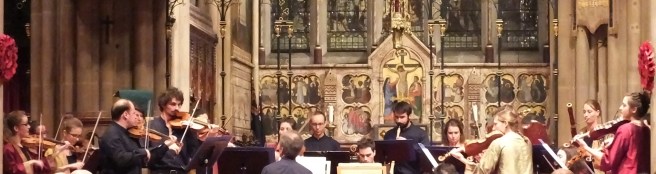
 largest church in Christendom. Well before the completion of the Basilica, a musical foundation had been established (in 1436), and in 1476 a magnificent organ was built on one side of the choir. This was enlarged, and a corresponding organ added to the gallery on the other side of the choir, in 1596. Both organs survive to this day, in more-or-less original condition, and are amongst the most important surviving historic organs in the world.
 The London Bach Society was founded 70 years ago by Dr Paul Steinitz under the rather unambitious title of the ‘South London Bach Society’, but soon lost the ‘South’ part of the name. 1946 might not seem to be the ideal time to concentrate on things musical (and, indeed, devoted to a German composer), but they were not alone: The Arts Council and BBC Third Programme were launched around then, as were a number of orchestras. From the start, the focus of the LBS was to ‘get back to Bach in its original form’ at a time when Bach performance was very far from what we could no consider as being in any way ‘authentic’ with enormous choirs and orchestras, and a funereal approach to tempo and romantic notions of instrumentation, phrasing and articulation. To this end, the Steinitz Bach Players was founded, in 1968, bringing together a small group of professional musicians interested in period performance techniques on period instruments.
 The Dunedin Consort under their director (and noted Bach scholar) John Butt are amongst the most prominent exponents of Bach’s music around. So this timely release of their take on the Christmas Oratorio is particularly welcome. With a distinguished group of period instrumentalists, and some outstanding vocal soloists, this is one of the most impressive interpretations I have heard. Whatever your religious beliefs, or lack of them, this music digs deep. John Butt’s scholarly interpretations are an integral part of the Dunedin story and, for this recording, his study of the performing conditions of the first performances in Leipzig in 1734 led to decisions about the vocal forces for the recording.
 You can imagine the headlines in today’s gutter press. “Woman seduces man, gets him drunk, then beheads him. Claims God told her to do it”. She would probably spend the rest of her life in a institution for the criminally insane. But in the Bible (or, at least, in the Bible of the Catholics and Orthodox Christians, but not the Protestants, who count the Book of Judith as apocryphal, or the Jews), she was hailed as a national heroine who lived to the age of 105. Musically her story inspired Tallis’s Spem in alium, and works by Scarlatti, Mozart and Parry. In art, she inspired the likes of Cranach, Donatello, Caravaggio, Botticelli, Michelangelo, Goya and Klimpt (pictured). She is also the subject matter for Vivaldi’s only surviving oratorio Juditha triumphans devicta Holofernis barbarie, written exactly 300 years ago, in 1716. The story of Judith’s ‘triumph over the barbarians of Holofernes’ would have had a strong contemporary reference to Venetians, whose army had just defeated the Ottoman invaders in Corfu. Judith clearly represents Venice, and the Assyrian general Holofernes, the Ottomans.
 I didn’t see the 2010 production of Don Giovanni, or this summer’s Festival revival, so for me this was a new show. Set in a post-Mussolini Italy, the broody set, designed by Paul Brown, is focused on a massive central cube that presents all four of its sides, plus different incarnations of the central space, to the audience. It is a powerful image, but not without potential issues. Its overpowering presence centre stage pushes most of the action to the front or the side of the stage: no bad thing in itself, but giving a rather cramped feeling
 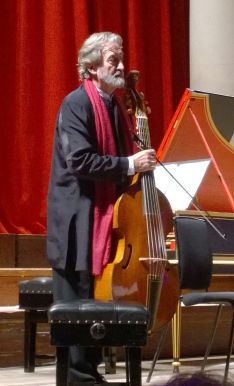 As part of the Southbank Centre’s International Chamber Music Series (currently taking place in St John’s, Smith Square while the Queen Elizabeth Hall is being refurbished), Jordi Savall and Le Concert des Nations presented a sell-out concert of music from the 1991 film Tous les matins du monde. Savall’s pre-concert chat with Radio 3’s Sara Mohr-Pietsch revealed some of the differences between the film’s portrayal and the actual life of Sainte-Colombe and Marais, but confirmed that Marais did crawl beneath Sainte-Colombe’s garden shed to listen to him practicing, that Sainte-Colombe developed a new style of fingering, and added a 7th string to the viol. He also explained how they achieved the voices of the two young girls singing in the film, by speeding up two adult female singers.
 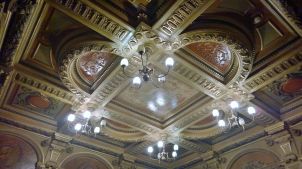 English Touring Opera (ETO) has built a solid reputation for their two annual opera tours around England. In their most recent season, they visited 91 venues, with two groups of fully-staged operas (sung in English) plus various wider educational and community projects. It is a remarkable organisational undertaking and a tough call for the singers in each tour, with many singing in two operas and covering a role in the third. Usually touring two or three operas in the spring and autumn, they open with one-off autumnal London showings before hitting the road. Their choice of operas usually has a theme, or is otherwise related in style and period. This year’s autumn focus is on early operas written in, or inspired by, Venice, with Handel’s 1738 Xerxes, Cavailli’s 1651 La Calisto, and Monteverdi’s 1639 “Ulysses’ Homecoming” (Il ritorno d’Ulisse in patria), performed in reverse order to the dates of composition, and premièring in the magnificent surroundings of the Edwardian Hackney Empire.
  Andrew Benson-Wilson : Early Music Reviews +