
Chorus vel Organa
Music from the Lost Palace of Westminster
Choir of Gonville & Caius College, Cambridge,
Delphian DCD34158. 66’56
Geoffrey Webber, director, Magnus Williamson, organ
Anon c1519: Processional: Sancte Dei pretiose; Ludford: Missa Lapidaverunt Stephanum (Gloria & Agnus Dei), Lady Mass Cycle (Agnus Dei, Alleluia – Salve Virgo, Gloria, Kyrie, Laetabundus); Cornysh Magnificat; Sheppard Hymn: Sancte Dei pretiose; Anon c1530: Offertory: Felix namque.

Anybody who has visited the Houses of Parliament in Westminster will probably have entered by the St Stephen’s entrance and walked through St Stephen’s Hall towards the famous ‘Lobby’, all built around 1850 to the design of Charles Barry. Most will not realise the significance of the St Stephen’s name, or what lies hidden beneath their feet. St Stephen’s Hall is the site of the mediaeval Royal Chapel of St Stephen’s, originally a private chapel for the King and his family and only accessible from the Royal Palace of Westminster. Barry’s sumptuous ceremonial hall was built on top of the surviving undercroft of the Royal Chapel, now known as St Mary Undercroft. The chapel was first mentioned in 1184, and was rebuilt by Edward I around 1292, a project that lasted many years. It was raised to the status of a college by Edward III in 1348, and developed an outstanding tradition of music which lasted until the dissolution in 1548 when it became the first meeting place of the English House of Commons, until 1854. Many of the current parliamentary traditions stem from these Continue reading
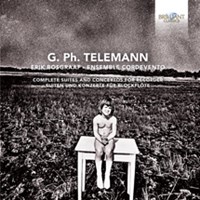 Telemann taught himself to play the recorder, violin and zither before the age of 10, and continued to practice the recorder well into his teens – something very few youngsters do today. He seems to have retained a love for the recorder, judging by the number of pieces he wrote for it, including these Suites and Concertos. Incidentally, the two Suites are both titled Ouverture in their manuscripts, and are examples of Telemann’s so-called concert en ouverture style of composition, which combines elements of the traditional suite with the overture. Apart from the E-flat suite (which is intended for the flute pastorelle, which perhaps means the panpipes), all the music is from the same manuscript surviving in the Hesse Court library in Darmstadt, suggesting that they were composed for Michael Böhm, Telemann’s brother-in-law and a virtuoso woodwind player. They are all written for alto recorder.
 In the last two years of his life, Monteverdi collected a substantial amount of his music for publication (the Madrigali guerrieri et amorisi, 1638, and Salve morale et spirituale, 1641), reflecting his musical output over the previous decades. After his death, one of his publishers had the good sense, or the commercial sense, to put together some unpublished manuscripts to form the 1650 Messa a 4 v. et salmi a 1–8 v. e parte da cappella & con le litanie della B.V. This is the first of two CDs from The Sixteen of music from this posthumous collection: the Mass setting of the title will be on the second volume. This CD includes a selection of liturgical pieces, but not in any specific liturgical context, with several Vespers Psalms, a Litany to the Virgin Mary and a Magnificat by Cavalli who probably assisted in the preparation of the publication.
  Following her first CD, Upon a Ground (reviewed
  The UK seems to breed small-scale a capella male choral groups. The aptly named Queen’s Six are one of a particular branch of that breed, with their matching suits and shirts (and, it seems, overcoats) and carefully posed publicity photographs. They are half of the contingent of lay clerks (adult choir singers) at St George’s Chapel in Windsor Castle, an official residence of the Queen as well as her private weekend home. Living within the castle walls, and performing eight or more services a week in the Royal Chapel; the six male singer’s vocal credentials couldn’t be greater. They were formed in 2008 on the 450th anniversary of Queen Elizabeth I,
 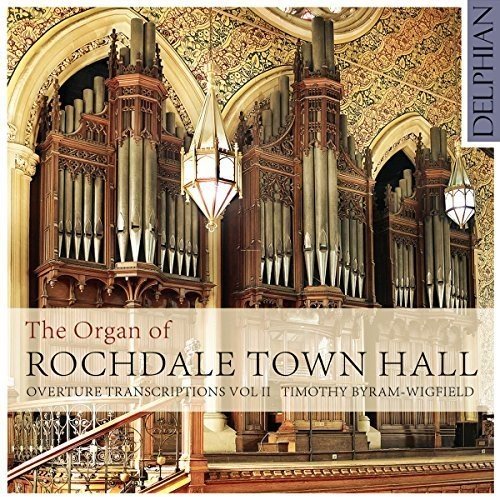 Overtures by: Nicolai, Spohr, Bach, Handel, Verdi, Weber, Tchaikovsky;
 Although the sub-title, ‘Favourite anthems from Merton’, might not be quite accurate for every potential listener, this collection of anthems certainly represents a fascinating insight into Oxbridge choral tradition and its music. It opens with the premiere recording of Jonathan Dove’s Te Deum, a paean of praise with an exciting accompaniment that shows off their new organ. In a very mixed programme, we then have Tallis’s exquisite little If ye love me, before Elgar arrives with Give unto the Lord before giving way to Thomas Morley, a rather dramatic switch of musical styles. And so it continues, with Rutter, Parry, Quilter, Finzi, Harris and Patrick Gowers interweaved between Byrd and more Tallis.
 When I first saw the cover of this CD and the names of the performers, I started looking to see if this was a re-release of an earlier recording. But it is a new recording, made in 2015, featuring the distinguished names of singers Emily Van Evera and Charles Daniels, alongside Andrew Parrott and his Taverner Choir and Players. Most recordings or concerts based on a Mass setting interweave vocal motets around the usual Mass movements in an attempted liturgical reconstruction but, very refreshingly, this CD incorporates a miscellany of instrumental and vocal music related to the Court of Henry VIII alongside The Western Wynde Mass by John Taverner, an almost exact contemporary of the King.
 The Brook Street Band, named after the London street where Handel lived for the last 36 years of his life, celebrate their 20th anniversary this year. As well as his well known Opus 2 and 5 sets of Trio Sonatas, Handel left a number of isolated examples of the genre, three of them normally referred to as the ‘Dresden’ sonatas where the manuscript is housed. To these three (HWV 392-4), are added two other proper trio sonatas (386a and 403) and two other pieces arranged by the Brook Street Band in a trio sonata format, the early Sinfonia and an early version of the overture to Esther, both of which helpfully lack an viola part. Many of the movements are examples of Handel’s re-use of material, and there are a number of familiar melodies that crop up with an otherwise lesser known group of pieces. Notable amongst
  Magnificat vocal ensemble celebrate their 25th anniversary with this CD of extraordinarily powerful large-scale polyphonic works by Renaissance masters, all influenced by the equally extraordinary Italian Dominican friar and prophet, Girolamo Savonarola. His rather alarming prophesies (including declaring Florence to be the ‘New Jerusalem’, the destruction of all things secular, and a biblical flood), his denouncement of the Medicis, clerical corruption, and the exploitation of the poor, together with his extreme puritanical views (resulting in the Bonfire of the Vanities) led, not surprisingly, to his getting himself caught up in Italian and Papal politics.
 The programme notes explain the rational for recording these pieces on clavichord rather than harpsichord, with a convincing argument based on the four-octave compass of the pieces and the didactic nature of their composition, in this case, for his recent (and second) wife Anna Magdalena. This is private, domestic music for home performance or teaching purposes, rather than the more elaborate pieces Bach wrote for public performance, using the larger compass of the harpsichord, for example the three non-organ parts of the Clavierübung. It is also the case that the clavichord was the principal home practice instrument for organists, because the arm to finger weight transfer required is similar for both instruments.
 This is a re-release and re-packaging of a recording made in 2003 (first released in 2008) which stemmed from musicologist Francesco Zimei, the Institute of Musical History of Abruzzo, and a conference in Teramo that aimed to revive the music of the fascinating character, Antonio Zacara da Teramo. Antonio was active around 1400. The rather unkind nickname Zacara (which could mean a small thing, a thing of little value, or a splash of mud) stems from his being rather short in stature, and having a range of physical deformities (possible a result of what later became known as phocomelia) including several missing fingers, as depicted in the Codex Squarcialupi illustration.
  Singer Clara Sanabras arrived in London from her Barcelona home about 20 years ago to study music, despite not speaking a word of English. I first reviewed her shortly after her arrival in one of the many early music groups that she went on to perform with, noting that she has “an evocatively sensual and focussed voice, rich with harmonics . . . her voice is ideal for much of the early repertoire, particularly from the medieval and early renaissance”. She has since built an enviable reputation as an eclectic singer/songwriter with a wide variety of musical styles, notably in the broadly folk/blues tradition. I wrote in a later review that “I hope that Sanabras is not lost to the early music world”. She hasn’t been, and has certainly not lost the clarity, purity and superb intonation of her evocative and sensuous voice. But there aren’t many early music solo singers who could fill The Barbican hall for a concert of her own compositions, complete with over 200 supporting musicians.
 This is re-launch and revision of a 2003 recording of the 13th century Pastourelle, ‘The Game of Robin and Marion’, telling the story of an encounter between the knight Aubert, the shepherdess Marion, and her lover Robin and his attempts to rescue her from his advances. The staged drama was written in 1284 for the Naples Court of the French Charles of Anjou, King of Sicily, shortly after the Sicilian Vespers had ousted him from Sicily itself. It was possibly intended to reflect a longing for their French homeland, but with undertones of Crusading mythology and the massacre of the French forces at Palermo. It is an early example of the genre of musical theatre.
  The Birmingham based choir, Ex Cathedra has long been at the forefront of British choral music, notably through their educational work and concerts and recordings of early music and Baroque music from Central and South America, a particular research interest for their inspirational director, Jeffry Skidmore. But they also venture into more recent repertoire, as evidenced by their latest CD of music by Alex Roth.
 Haydn’s Op.50 (Prussian) String Quartets are amongst his finest musical creations, and yet are relatively unknown, apart from the two given the later nicknames of The Dream and The Frog. Composed in 1787, the set was dedicated to Frederick William II of Prussia (apparently in return for a gold ring sent to Haydn by the King), hence the nickname. The fact that he played the cello might explain the opening of the first quartet, with its solo cello repetition of notes. The six quartets are perhaps less immediately appealing and populist than his earlier Op.33 set, and seem to feature Haydn in a more intense and, perhaps, more intellectual mood. The movements usually only explore one theme, perhaps suggesting that Haydn wanted to concentrate on the developmental possibilities of a single theme. Although each has the same four movement format, they are all very different in style, notably the 4th, in the dark key of F# minor, and with its curiously intensely wrought final fugue.
  This rather unusual CD reflects one of the glories of 19th century domestic music-making (itself reaching its zenith in that period), the repertoire for two voices and piano, in this case represented by Cornelius, Mendelssohn, and Schumann, three of the finest masters of the genre. Generally overlooked nowadays in favour of larger scale performances, this CD reflects a now almost completely forgotten aspect of earlier home life: music making centred on the domestic piano. However, in this case, the venue is more likely to be a saloon, given the recording acoustic of a church and the rather unauthentic use of a modern concert grand piano (given its own billing in the programme note as a Steinway model D, serial number 589064) rather than a period piano – or, indeed, the more likely upright to be found in most 19th century homes.
 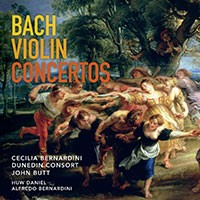 This is a spectacular CD from the ever excellent Dunedin Consort and their leader, violinist Cecilia Bernardini, this time in a solo role. She opens and closes the programme in partnership, first with her father, the distinguished oboist, Alfredo Bernardini, and then with fellow violinist Huw Daniel. Apart from the short central Sinfonia from the cantata Ich hatte viel Bekümmernis, with its exquisite oboe solo, the rest of the nicely symmetrical programme is devoted to the playing of Cecilia Bernardini, with Bach’s E major and A minor violin concertos. And what playing it is. Subtly sensitive, and superbly articulated, she demonstrates a real grasp of Bach’s often complex melodic lines. Her delicacy of tone is matched by her fellow instrumentalists, the chamber-like quality of their playing, and John Butt’s direction and harpsichord continuo playing, being just right for the music, which was almost certainly intended for small-scale performance amongst fellow music lovers.
  Jacques le Polonois (aka Jakub Polak and Jakub/Jacob/Jacques Reys) was born around 1545 in Poland. He was court lutenist to Henry III (briefly the elected King of Poland before returning to France, with Polonois, where he had inherited the throne) and Henri IV of France. As a lute playing composer, his pieces tested the technical abilities of other players. Much later writers wrote (with uncertain evidence) of his ‘good and quick hand’, mentioning that he ‘got the very soul out of the lute’. His extemporisation skills were praised. He left around 60 works for the lute, nearly half of which are included on this recording, many first recordings. Many include the word Polonaise in the title, referring to his county of origin, rather than the national style of his music, which was firmly French. Versions of his names, Jacob and Reys, also appear in several titles.
 The link between early music performance and academic musicological study has always been close, but seems to be becoming even more so with a number of recent projects stemming directly from research backed by the Arts & Humanities Research Council (AHRC). One such is the project ‘Cantum pulcriorem invenire: Thirteenth-Century Music and Poetry’, based at Southampton University, headed by Mark Everist (details
  If you are mathematically minded, this might be the CD for you. Some of the most complex examples of English contrapuntal wizardry from Tallis and Byrd are balanced by more recent, but equally complex and evocative music, from the Estonian composer, Arvo Pärt. As the programme note explains, “Here, Tallis and Byrd meet Pärt on common ground”, although at times, Pärt’s music can sound earlier than that of Tallis and Byrd with its sense of mediaeval structure and texture. This CD will whet your appetite for The Sixteen’s 2016 Choral Pilgrimage, when you can experience this music performed live in some of the most beautiful venues the UK can offer.
 Unless you are a lutenist, or particular fan of lute music, you may not have heard of Vincenzo Galilei. But his eldest son might be more familiar – the physicist and astronomer Galileo Galilei. Another son became a lute virtuoso and composer. Vincenzo was born around 1520 and moved to Pisa where he married into nobility and joined a group of influential humanist intellectuals. This led to Vincenzo Galilei making a range of important discoveries on the nature of sound, acoustics and musical physics together with far-sighted theories on music which hold good to this day, including the role of dissonance and the beginning of the style of recitative.
  As well as the CD demonstrating the 2003 Westenfelder organ in the Abbey of Sankt Lambrecht, Austria (reviewed
  Music by Scheidemann, Bach, Frescobaldi, Boëlly, Arauxo, Ximénez, Brahms, Froberger, Buxtehude.
 Although Bach is something of a God-like figure for me, I think he would be rather scary to actually meet. I have often felt that I would love to have sat at a nearby table where I could overhear Bach, but would rather actually meet and converse with Haydn. The pieces on this CD demonstrate something of those aspects of Haydn’s character that make him appear so approachable. Amongst the first works that Haydn wrote after his 1761 arrival at the Esterházy court were the three symphonies based on the times of the day – Le main, Le midi and Le soir. Many players in the orchestra were already friends of his from Vienna, and these three symphonies were an inspired calling card for their new musical director, with most of the players given key solo moments.
  Benjamin Britten: A Ceremony of Carols, A New Year Carol;
 One of the musical traditions of German Lutheran church music was the sacred cantata or motet addressed directly to God, often in a conversational style, with a response to the plea coming either from God or, more frequently, from Jesus or other believers. This CD explores several examples of this genre, with a focus on the composer Andreas Hammerschmidt, given an overdue bit of exposure. Although he was well known in his day, and composed more than 400 works, his music is not often performed today. It is in a relatively simple style, in comparison with his contemporaries, and shows the gradual development of a true German Baroque style, built on the influence of Italian models. Five of his vocal works are included here, together with an instrumental Pavane.
 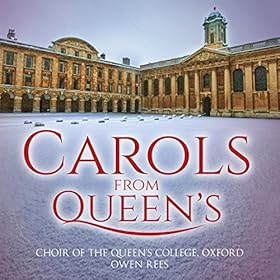 The Queen’s College, Oxford is probably best known in carol singing circles for The Boar’s Head Carol, sung every year as a processional at the start of the centuries-old feast held on the Saturday before Christmas, and known as ‘Gaudy’. But in a delightful mix of well-known and other carols, this CD also reflects other carols and composers connected with The Queen’s College. These include Kenneth Leighton (Lully, lulla, though little tiny child), Herbert Howells (A Spotless Rose, Sing Lullaby), Harold Darke (In the bleak midwinter), Ivor Atkins (The Three Kings), and Reginald Jacques, the latter the compiler (with David Wilcocks) of Carols for Choirs, extracts from which form a key part
  CD 2, the ‘Sorrowful Mysteries’ (Sonatas VI-X), are recorded in Kaltenlengsfeld, next door to Friedelshausen, where CD 1 was recorded, south of the Bach town of Eisenach in Thuringia. The organ dates from 1755 and has, for Thuringian organs, a rather unusual configuration with a Ruckpositive. It is positioned above the altar in what appears to be almost a separate space from the main church volume, beyond a low arch and in a small space – presumably this explains the configuration, which takes up less vertical space. The recording is made fairly close to the organ, but still includes the acoustic bloom from the rest of the space. The violin
  Jacques van Oortmerssen was one of the most influential organists and organ teachers of his generation. His untimely death on Saturday 21 November is a great loss to music. In his memory, I am posting extracts from some of my reviews of his Bach organ CDs.
 Andrew Benson-Wilson : Early Music Reviews +