Handel in Ireland Vol.1
Bridget Cunningham (harpsichord)
Signum Classics SIGCD478. 72’52
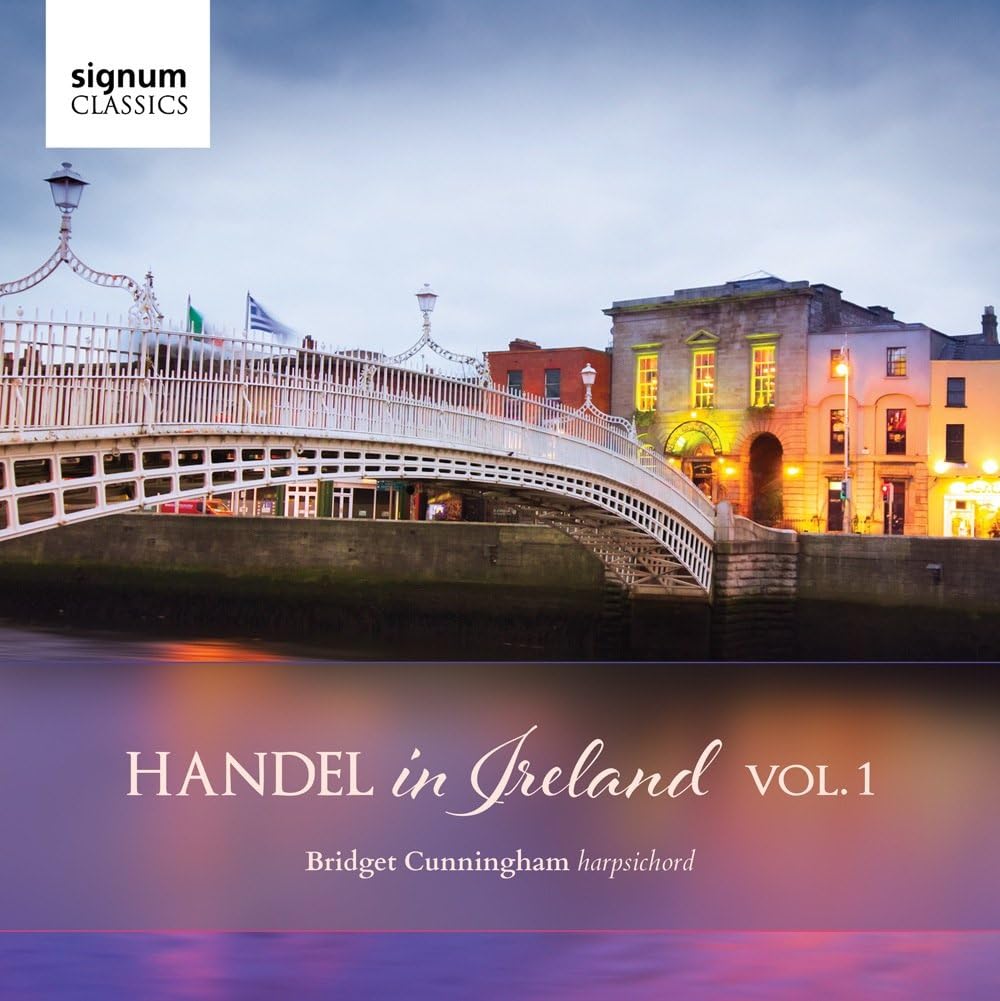
This is a rather delayed review of a CD released in 2017. It is part of an ambitious series of Handel recordings from Bridget Cunningham and her London Early Opera, including Handel in Italy and Handel at Vauxhall, but this one is for solo harpsichord. This recording explores “some of the myths and mysteries surrounding Handel’s visit from London to Dublin in 1741 and reflects on the influences that Handel experienced from being in Dublin and also the inspiration he gave to others through his music and skills of improvisation at the keyboard”. Continue reading


 This release combines the re-release of a 2005 recording of Joby Talbot’s Path of Miracles with Footsteps, a companion work composed by Owain Park, recorded in 2016. Both are commissions by Tenebrae, the Park piece apparently in answer to requests from amateur singers for a less complex piece than the Talbot.
  This short recording is of two pieces by composer Freya Waley-Cohen, written for her older sister, the violinist Tamsin Waley-Cohen. The key work, Permutations (c18′), is described as a “roaming performance artwork”. It has a fascinating compositional background. It was commissioned as part of Aldeburgh Festival’s 2017 season and composed during a residency at Aldeburgh and is intended as an exploration of the relationship between architecture and music.
 This recording is based on the fact that Sir Francis Drake is known to have taken four viol players with him on his 1577-80 circumnavigation of the world, using the musicians for prayers and entertainment on board, and for diplomatic uses with the people they met. He also had trumpeters and drummers, but they are excluded from this recording, which takes as its premise the sort of music that the musicians might have played to the people they met, and also to their friends on their return to England, using their memory of the native music that they heard during their travels. Alongside music of the period by the likes of Parsons, Taverner, White, and Picforth, the principal musical contribution comes from Orlando Gough (b 1953) who was commissioned by Fretwork to compose a sequence of 13 pieces for viol consort based on the local music that Drake and friends might have heard.
  The Baldwin Partbooks were copied in the 1570s and 80s by a member of the choirs of St George’s Windsor and the Chapel Royal, John Baldwin. They included printed pieces as well as Baldwin’s manuscript copies of music, from an earlier age, resulting in one of the most important surviving collections of polyphony from the reigns of Henry VIII and Mary Tudor. This, combined with a focus on music dedicated to the Virgin Mary, is the focus of the music on this volume, the second in the Contrapunctus series on music of the Baldwin Partbooks (the first was In the Midst of Life, SIGCD408).
  The catchy title of this recording (which quotes a 1688 pamphlet) is based a brief, but curious, incident during the turbulent Tudor times when, in April 1555, it was announced that Queen Mary had given birth to a son. The following day this was revealed to be the 16th century version of fake news. The complex history and importance of this event is beyond the scope of this review, but is easily obtainable and is covered in the detailed CD notes. Curiously, no author is credited for these notes, although I think it was Magnus Williamson, whose ‘insight and guidance’ is a credited elsewhere.
  Preceding the two recordings of Handel in Italy (reviewed
  their 1994 reconstruction of a Lutheran Christmas recorded with massed forces in Roskilde Cathedral, the latter chosen because of its important historic organ. In recent years they have built close connections with the National Forum of Music in Wroclaw, Poland. This much heralded recording of the 1801 version of Haydn’s The Seasons is the latest of those collaborations. The opening thunderous wallop on the timpani will warn you that this is a recording of some drama and punch. Using a new performing edition (and English translation) by Paul McCreesh this is the first recording to feature the large orchestral forces that Haydn called for in some of the early performances, with a string section of 60, 10 horns and a choir of 70, using the combined forces of the Gabrieli Consort & Players, Wroclaw Baroque Orchestra and National Forum of Music Choir.
 Some of Handel’s most exciting and dramatic music was composed during the three short years he spent in Italy, starting when he was just 21. Despite offers of financial assistance from a Medici Prince, Handel famously ‘made his way on his own bottom’, as his biographer Mainwearing put it. Mainwearing suggests that prior to his visit, Handel ‘could see nothing’ in Italian music which, if it is true, is rather surprising, as Italian music had been at the forefront of much of the European Baroque, not least because of the developments in opera, oratorio and cantata. Handel very quickly absorbed the taste and style of Italian musicians both from Rome and also from his shorter visits to Venice, Florence and Naples. In his compositions from this period, he often outdid the Italians in writing in their style – as he did in England later in his life.
 This CD would be attractive enough to listen to without knowing any of the back-story. But it is a fascinating one. William Bird was part of the musical life of the British community in Calcutta in the late 18th century. His Oriental Miscellany (“being a collection of the most favourite Airs of Hindoostan, compiled and adapted for the Harpsichord”), was first published in 1789. It was the first Western attempt to notate traditional Indian music, and contains 30 songs written in a straightforward and approachable style, appropriate for gentle amusement. The list of subscribers
  Andrew Benson-Wilson : Early Music Reviews +