Dynamisch
Die Orgeln der Stadtkirche Biel
Pascale Van Coppenolle
Tulip Records. Ture 201521. 2CDs 75’03+ 64’24
CD1. ‘From Hexachord to Chromatiscism’: Scheidt, Byrd, Frescobaldi, Bull, Sweelinck, Bach, Liszt
CD2. ‘Wind organ’ improvisations: Whistle for a While (Hans Koch, bass clarinet), Clusterizing (organ solo), Zebra (Jonas Kocher, accordion), Fusion (Hannah E. Hänni, voice), Sprinkling (Luke Wilkins, violin).
 The city of Biel (official known as Biel/Bienne) in the Swiss canton of Berne lies on the boundary of the German and French speaking areas of Switzerland, hence its bilingual name. Rather appropriately, its town church contains two organs which also speak in two (or more) languages, from ancient to (very) modern, as represented on this fascinating double CD.
The first CD is based on the use by composers of the Hexachord, the first six notes of the major scale, usually written as Ut, re, mi, fa, sol, la. The first three pieces (Scheidt, Byrd, and Frescobaldi) are played on a modern (Metzler, 1994) version of the late Gothic organ of 1517 that briefly survived in the church until the Reformation authorities dismantled it just 10 years later. It has two manuals with pull-down pedals. The compass of the two manuals is the usual Gothic/Renaissance one of C-a” and F-a”, Continue reading
 Giulio Caccini and Jacopo Peri were musical assistants to Emilio de’ Cavalieri for the famed celebrations for the Florentine marriage of Ferdinand de’ Medici and Christine de Lorraine. In the resulting La Pellegrino, they helped to develop a new style of singing, based on earlier concepts of singing in what was thought to be the style of Orpheus. This emphasised the declamatory solo voice in what became known as the stile rappresentativo, accompanied by a simple basso continuo, based on Orfeo’s lyre, here realised by Angélique Mauillon on a triple harp by Somerset luthier Simon Capp, after early 17th century Italian models. This recording explores the later work of the two composers, with an emphasis on the music of Caccini, with 12 examples compared to the five from Peri, together with three instrumental harp interludes by Luzzaschi and Piccinini.
 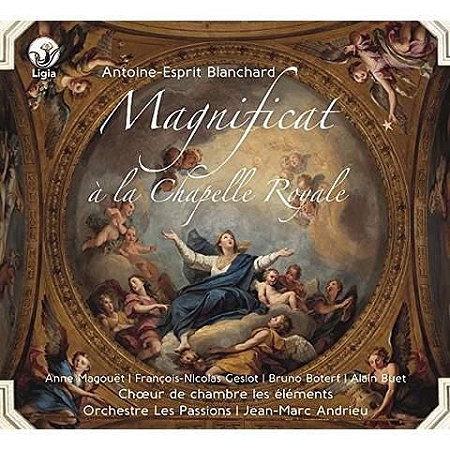 Antoine Blanchard (1696-1770) is a rather shadowy figure in French musical history. There is far more information in Bernadette Lespinard’s detailed CD notes than can be found in other source that I could find on the internet in English. He is sometimes given the additional first names of Esprit-Joseph, although he never used them himself. He was a choirboy in the Saint-Sauveur Cathedral in Aix-en-Provence, and became a cleric from about 18. Transgression of the rules led to his departure from this role after only one year. He then moved to Marseilles as director of music at Saint-Victor, although he spent two years away in Toulon, detained there by the plague. Whilst building up his contacts in Paris, he worked in the choir school at Amiens Cathedral, eventually getting a Royal appointment in the Versailles Musique de la Chapelle in 1738.
 Louis IX of France was crowned aged 12, and remained on the throne until his death some 44 years later. Despite many border disputes and land exchanges, and conflicts with both his own nobles and foreign powers, including his brother in law, Henry III of England, France managed to become one of the most powerful European states. He was an arts enthusiast and a legal reformer. A devote Catholic, he went on two unsuccessful crusades to Egypt (where he allied himself with the Mongolian Khans) and Tunis, where he died. His enduring memorials are Paris’s Sorbonne and Saint-Chapelle, one of the finest Gothic architectural creations of all time. He is the only French King to be canonised as Saint Louis.
 Music by Thomas Ravenscroft, Thomas Robinson, John Johnson, Robert Smith, Nicholas Lanier, Thomas Campion, and Anon.
 The basis for their programme is ‘circular music’, here represented by ‘grounds and rounds’ in the form of instrumental grounds (divisions/variations), lute songs based on grounds, and rounds from Thomas Ravenscroft, here sung four male singers. For the lute songs, they are joined by the excellent soprano, Faye Newton (pictured). The exquisite clarity and focus of her voice fits the musical style perfectly.
  As part of the Kings Place ‘Baroque Unwrapped’ season, the Newcastle-based Avison Ensemble explored the world of the 18th century concerto, and the equally interesting world of English provincial musical life. Charles Avison (pictured) was a Newcastle born organist and composer who absorbed the musical style of Geminiani and Scarlatti during a short period in London before being enticed back to Newcastle with the promise of prestigious organist post complete with a new organ. He made a handsome living through teaching and arranging subscription concerts. He was also a fierce reviewer of other composers, including Handel.
 One of the most important musical events in London in 2015 was the long-awaited opening of the 1735 Richard Bridge organ (restored by William Drake) in the Hawksmoor designed Christ Church, Spitalfields. For many decades it was the largest organ in the UK, and its musical importance is immeasurable. My review of the gala opening recital, given by (the now sadly, late) John Scott, and information about the restoration and an organ specification can be found
  Recorded in 2003, this is presumably a reissue, although I couldn’t anything to confirm that. It is not listed on il Gardellino’s website. Matthessohn seems to have been one of the first to wonder how Telemann managed to compose so much music. This, and the dominance of Bach in the revival of German baroque music, has always been a bit of a problem. The opening Concerto in this CD helps by including several moments that many listeners might recognise. Matthessohn also commented that “Telemann alone is beyond all praise and lauds”, and this CD demonstrates the exceptional quality of his music. Both technically and musically, his compositional skill is self evidence, as is the breadth of his creative imagination.
  With the subtitle of ‘Franz Tausch in Context’, this début recording by Boxwood & Brass explores the music of the clarinettist and composer Tausch as he moved from Mannheim to Munich and then to Berlin. His XIII Pièces en Quatuor for two clarinets, horn and bassoon was his most substantial chamber work, and is performed here complete, in two suites. Published in 1812, the pieces might have been intended for Taush’s own saloon concerts – they are clearly music to be listened to, rather than the mere background music of some of the harmoniemusik repertoire. This is the first time that they have been recorded complete, an important occasion for Tausch and Boxwood & Brass.
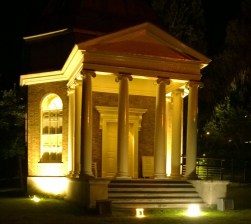 One of the most delightful of London’s music venues is Garrick’s Temple to Shakespeare
 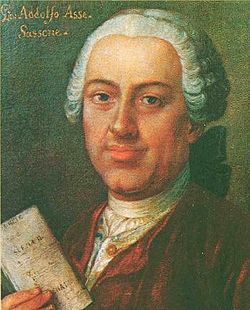 Johann Adolph Hasse (1699-1783) is one of those historically unfortunate composers who achieved great fame during their lifetimes but have since been more-or-less forgotten. A prolific composer of opera, he was hailed by Charles Burney as being superior to all other lyric composers. Married to the famed soprano Faustina Bordoni, the couple became the Posh and Becks of their day. Usually based in Dresden in the Court of the Saxon Elector Frederick III, Hasse had special dispensation that avoided the need to travel annually to the Polish Court, where Frederick was also the elected King. He also maintained a post in Venice at the Ospedale degli Incurabili. He lived long enough to have performed in front of Bach and the young Mozart.
 The Innsbruck Festival of Early Music celebrated its 40th anniversary this year, although its roots go back a further 14 years or so. After some preliminary events, the festival proper ran for the last two weeks in August. It usually features three fully staged operas, although this year the third of them was reduced to a one-night concert performance of the Ruhrtriennale festival’s production of Gluck’s Alceste, conducted by René Jacobs who until 2009 was artistic director of the Innsbrucker Festwochen and, incidentally, the singer at the first concert of the first festival on 24 August 1976.
 Joanne Metcalf: Il nome del bel fior;
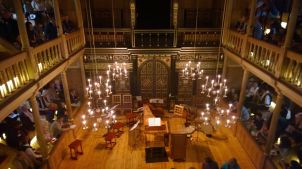 the new Globe management, those events seems to have ground to a halt, with only one listed in the current season – and that a hang-over booking from the previous management. So it was fortuitous that the BBC Proms chose the theatre for one of its ‘BBC at …’ events (alongside such venues as a multi-story car park in Peckham), not least because it enabled people to see the inside of this fabulous, but very uncomfortable, theatre for just £14, rather than the up to £62 the Globe are asking for their own next concert there.
  Nevermind is a rather quirkily named group of four musicians (Anna Besson, flute, Louis Creac’h, violin, Robin Pharo, viola da gamba, Jean Rondeau, harpsichord) who met while studying at the Conservatoire Supérieur National de Paris (CNSM). They share an interest in early music, jazz and traditional music. In 2014, they won the Special Price of the Van Wassenaer Competition in Utrecht. They take their name from a quotation by the 19th
  This CD reflects the tradition of polyphonic singing in the style of Palestrina that developed during the 19th century in the collegiate church of Our Lady of the Old Chapel in Regensburg, a tradition that later extended to the Cathedral and its famous Domspatzen boys choir. The recordings are intended as a tribute to the conductor Josef Kohlhäufl, director of music at the Alte Kappelle from 1984 to 2011, who revived the polyphonic tradition during his tenure.
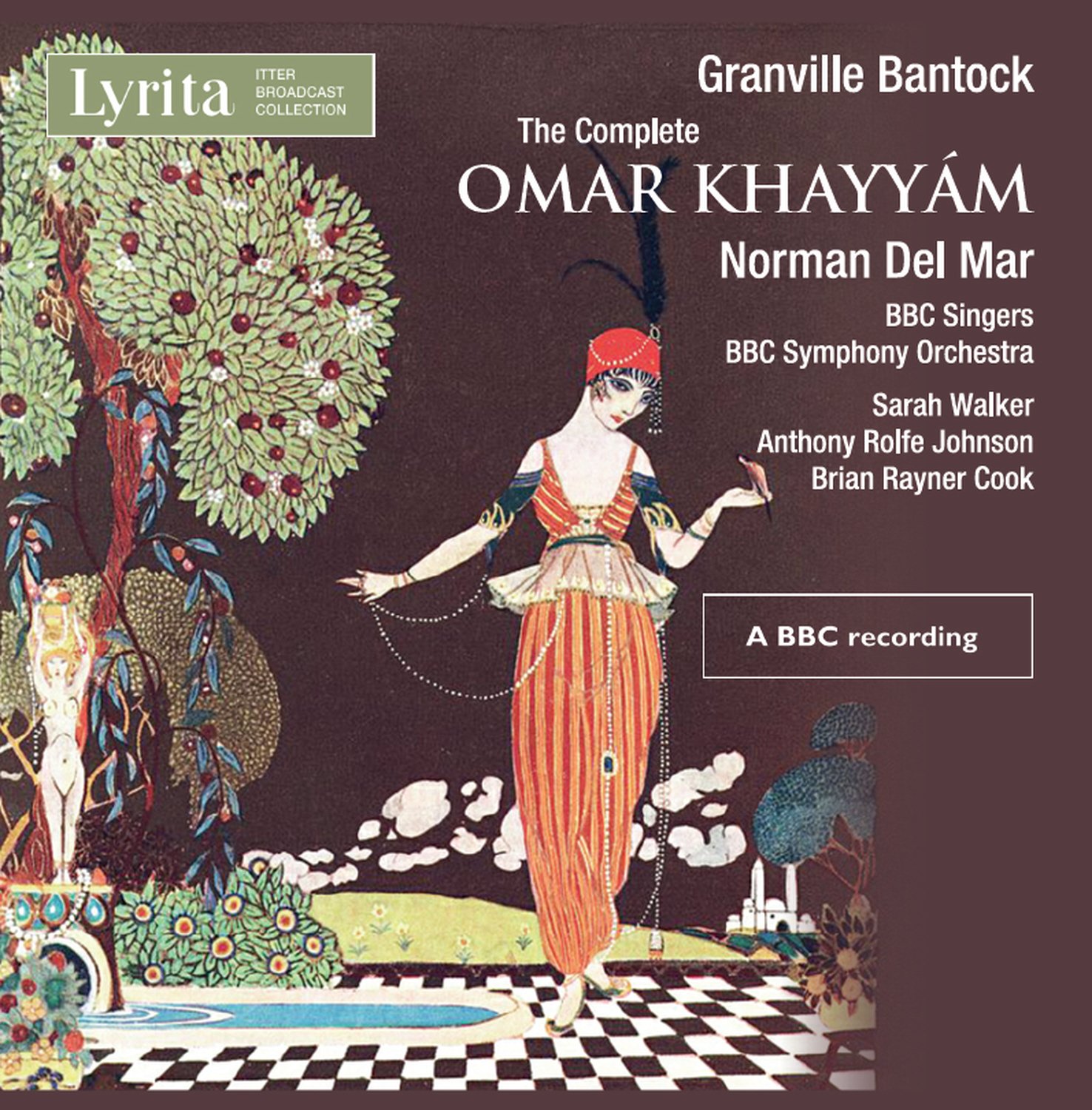 Bantock: Omar Khayyám (172’ 33),
 This is a rather curious CD, subtitled “Ramon Llull – chronicle of a medieval voyage: conversion, study and contemplation”. When I first saw the CD, with its mention of Ramon Llull (Raymond Lully), I wondered if this was a discovery of a previously unknown mediaeval composer. But it turns out the Llull/Lully has nothing to do with the music on the recording. The ‘bouquet of pieces’ on the disc are apparently an offering to the admirers of Llull on the 700th anniversary of his death. A rather curious offering, considering that for most of his life, Llull had little or anything to do with music, and certainly not for the sort of music on this CD.
 Mozart: Sonata in D, K381; Sonata in C, K521; Sonata in B-flat, K358, JC Bach: Sonata in A.
 Despite their name the Elysium Ensemble, at least on this recording, consists of just two people, Greg Dikmans and Lucinda Moon, playing flute and violin respectively. Founded in 1985, the Australia-based Elysium Ensemble has in recent years concentrated on the instrumental duet, with research and concerts exploring the concept of ‘Dialogue: the Art of Elegant Conversation’. The foundation of this is the concept of rhetoric, or “the art of discourse and communication, of speaking with elegance and eloquence.” With roots in Aristotle’s discussions on oratory, and 18th century musicians and writers such as Quantz, they explore the concept of rhetoric in music through Boismortier’s Six Sonatas pour une flute traversiere et un violin par accords, published in Paris in 1734.
 Renaissance period and the start of the Baroque. Born in 1562, he was employed by the city of Amsterdam as organist of the Oude Kerk for 44 years until his death in 1621. Organ music in the Calvanist church was limited to occasional playing of pieces to familiarise the congregation with the choral melodies, before or after the service, but not during. So Sweelinck’s duties as city organist were generally to give concerts for the public and visitors. This have him time to build up an extensive teaching practice, attracting a generation of North German organists who returned to develop the influential Hamburg organ school that dominated the 17th century, culminating in the music Buxtehude in nearby Lübeck. His music was known throughout northern Europe, with two of his pieces includrf within the Fitzwilliam Virginal Book.
 Since 1996, the cloister has been home to summer opera productions, presented by Iford Arts. Their latest season concluded with ‘A Fairy Queen’ presented by Iford Arts and their regular orchestra from Christian Curnyn’s Early Opera Company.
 Andrew Benson-Wilson : Early Music Reviews +