Bach: St Matthew Passion
Monteverdi Choir, English Baroque Soloists, James Gilchrist, Kati Debretzeni,John Eliot Gardiner
Soli Deo Gloria SDG725. 2CDs. 2h40′
 Some 28 years after their famed 1988 Archiv recording (made under studio conditions in Snape Maltings), the Monteverdi Choir and English Baroque Soloists return to the St. Matthew Passion. This extraordinary piece can evoke enormous emotional responses, regardless of the religious views of the listener. I vividly remember taking my young daughter to a performance of their 1988 Matthew, sitting in the front row, and watching the bass player just a few yards away gently shedding tears as she played. For this version, on their own label, they opt for a live recording, made in Pisa Cathedral during the Anima Mundi Festival as the culmination of a six-month tour. Continue reading
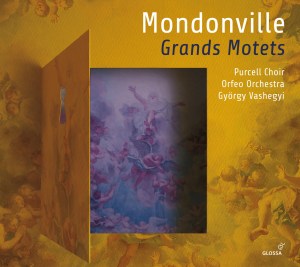 Jean-Joseph Cassanéa de Mondonville (1711-1772) was born in Narbonne in the south-west of France. He moved to Paris in 1733 and almost immediately came under the patronage of Madame de Pompadour, joining the Concert Spirituel and the Chapelle Royale as a violinist. Although continuing is career as a violinist, he soon rose through the musical ranks (becoming director of the Concert Spirituel and Maître de musique de la Chapelle) and also became famed as a composer of opera and sacred music. Although never quite reaching the musical heights of his predecessors Lully and Rameau, his compositions reflect the changing mood in the middle third of 18th century France.
  Jean-Joseph Cassanéa de Mondonville (1711-1772) was born in the south-west of France to an aristocratic family whose fortune was in decline. He moved to Paris in 1733 and almost immediately published a volume of violin Sonatas. He initially came under the patronage of Madame de Pompadour and also joined the Concert Spirituel and, later, the Chapelle royale. The first of his 17 grands motets was performed at around the same time. In 1734, this Opus 2 set of six Trio Sonatas was published. The quality and technical virtuosity of the writing for the two violins says a lot about his own abilities as a violinist. Extensive use of double stops for both players are just the start of it.
 their 1994 reconstruction of a Lutheran Christmas recorded with massed forces in Roskilde Cathedral, the latter chosen because of its important historic organ. In recent years they have built close connections with the National Forum of Music in Wroclaw, Poland. This much heralded recording of the 1801 version of Haydn’s The Seasons is the latest of those collaborations. The opening thunderous wallop on the timpani will warn you that this is a recording of some drama and punch. Using a new performing edition (and English translation) by Paul McCreesh this is the first recording to feature the large orchestral forces that Haydn called for in some of the early performances, with a string section of 60, 10 horns and a choir of 70, using the combined forces of the Gabrieli Consort & Players, Wroclaw Baroque Orchestra and National Forum of Music Choir.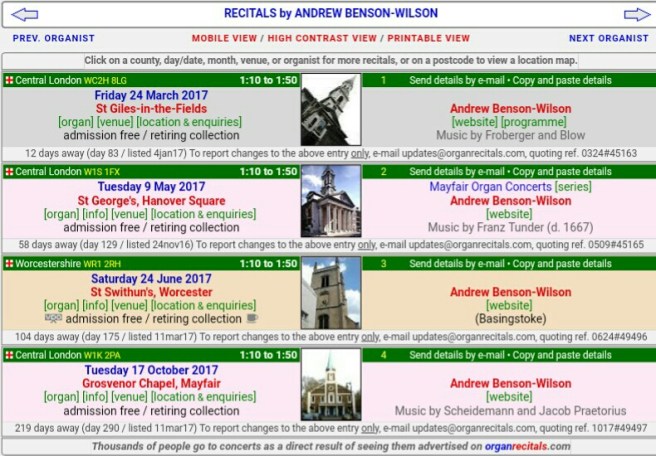
 As the subtitle suggests, In Nomine explores how the concepts of heaven and hell were portrayed in Europe during the transition between the Renaissance and Baroque period. Its publicity suggests that it “plunges into a demonic world of evanescent dreams and telluric rumblings and then, as a counterpoint, whisks us up to the celestial heights of hope, salvation and the sublime…“. The result is something of a musical pot pourri, jumping from track to track and style to style with little sense of linking cohesion and with some alarming pitch and key changes between tracks. It jumps from music clearly intended for performance in church, and pieces that equally clearly were not.
 Museum, best known for its Vienna contemporary art gallery. The centre hosts an enormous range of activities throughout the year and, for the past three years, has been running a short early music festival, this year consisting of six events. I was invited to review five of them, between 27 February to 4 March, featuring performers based in Italy, Austria, Germany, Switzerland and Budapest.
 ook place in the
  If you can listen to the first two tracks of this recording without being smitten by the extraordinary musical and emotional power, you are probably on a different musical planet to me. The richly sonorous and harmonically intense opening chorus (a Responsory for Holy Week) segues straight into the opening section of the Passio Secundum Johannem. The orchestral introduction is a glorious harmonic construction, leading to the evocative voice of mezzo-soprano Giuseppina Bridelli, singing the role of Testo (the Evanglelist).
 Girolamo Frescobaldi is one of the most important composers of the transitional period between the late Renaissance and the early Baroque. His keyboard music and his written performing instructions form the bedrock of the 17th century Baroque style, in particular the Stylus phantasticus that dominated the musical style in Italy and Germany. Through pupils like Froberger and other disciples, his music spread throughout Europe and influenced composer, including Bach and his North German organ composer predecessors like Weckmann, Tunder and Buxtehude and English composers like John Blow.
  This recording does exactly what it says on the cover, recreating an imaginary books of vihuela duets in the style and manner of the sole surviving example of such a collection. There are many examples of music for two lutes from the 16th century, but only one for two vihuelas. To make up for that omission, Ariel Abramovich and Jacob Heringman have joined forces to arrange a variety of pieces for two vihuelas in the style of the mid-16th century.
 During the 18th century, Iberian churches often adopted the earlier Italian plan of having two organs, each in (usually) identical architectural cases positioned on balconies and speaking towards each other across the choir. The practice has its roots in St Mark’s Venice in the 16th century. Clérigos Church in Oporto is one such example, its two organs dating from 1779 with major restorations in 1864. Rather like French organs, organ building in the Iberian peninsula reached a technical peak in the 18th century at a time when the music written for the organ was experiencing something of a decline. This CD reflects both those aspects; of organ building and composition.
  osé Luis González Uriol is one of the most influential Iberian organists and teachers, and this recording is a homage to him, and also to the organ in the Monastery of São Vicente de Fora, Lisbon, built by João Fontanes de Maqueira in 1765, and restored in 1994 as part of Lisbon’s European City of Culture celebrations. Unusually for organs, it had survived virtually unaltered since it was built, and retains 98% of its original pipework. The recording was made on 17 October 1994, just after the opening of the restored organ in a recital by González Uriol. A combination of factors, including the death of the recording producer Joaquim Simões de Hora (who was also heavily involved in the restoration project), meant that the recording has never been released until now.
  The St John’s, Smith Square Young Artists scheme gives emerging soloists and ensembles a platform to showcase their talents through three SJSS concerts, a chance to commission new music, and opportunities to develop skills in marketing, education and outreach. The latest batch of six (for the year 2016/17) includes the recorder quartet Palisander. They already seem pretty adept at marketing, and took the opportunity of the first of their three concerts (given under the title Antidotum Arachne) to launch their debut CD, Beware the Spider!.
  The title of Classical Vienna is a bit misleading, and is not perhaps as you know might know it. Firstly the dates of the composers and pieces are rather late for the usual definition of the Classical period of music. Secondly, using an alternative meaning of the word ‘classical’, the combination of guitar and fortepiano is not exactly a mainstream aspect of Vienna’s musical life. For those not familiar with the sound world of period instruments, the notion of music for guitar and piano might seem bizarre. But as demonstrated on this recording, it works perfectly well. Gary Branch’s contribution to the extensive programme notes explains the history of the Viennese fortepiano and why it was suitable to balance with a guitar.
  Following on from their recent issues of Bach and Rachmaninoff, Resonus continue their series of recordings from the Saint Thomas Choir, New York, under their conductor, the late John Scott, with this release of a 2010 recording of Purcell. The well-balanced programme includes major works for choir and orchestra, such as the substantial opening O sing unto the Lord, as well as more intimate pieces such as the Morning and Evening Hymns, here separated by the early anthem O God, thou art my God with its famous Hallelujah, later turned into the hymn Westminster Abbey. This amply demonstrated the extraordinary range of Purcell’s musical style and his harmonic inventiveness.
  The Musicall Compass have undertaken some fascinating projects in the past, combining vocal music with, for example, dance in a memorable performance of Buxtehude’s Memba Jesu Nostri in Christ Church Spitalfields. On this occasion they interspersed the nine five-voice Lamentations of Orlando di Lasso with folk laments from Eastern Europe, sung by Moira Smiley. Written to be performed during the three days leading up to Easter, the Lamentations set verses from Jeremiah’s rather morbid reflections on the decline of Jerusalem: ‘How doth the city sit solitary .. she has become a widow’. Three settings are sung on each day, each finishing with the lament Ierusalem, Ierusalem, convertere ad Dominum Deum tuum (Jerusalem, Jerusalem, return unto the Lord thy God).
  Part of the 2015 expansion of the European Union Baroque Orchestra’s activities has been the EUBO Mobile Baroque Academy (EMBA), a cooperative project aimed at finding new and creative ways of addressing the unequal provision of baroque music education and performance across the European Union. The touring orchestra (EUBO) still forms the core activity of the EMBA, reforming each year with a new intake of talented young period instrumentalists chosen from educational auditions held each spring. For more than 30 years EUBO has provided specialist training and experience, and has encouraged and supported many of the top period instrument specialists around today. One such is the distinguished oboist and director Alfredo Bernardini, a member of the very first EUBO in 1985 and the director of this EUBO tour.
 I reviewed the concert given by Siglo de Oro during the 2016 Spitalfields Winter Festival (
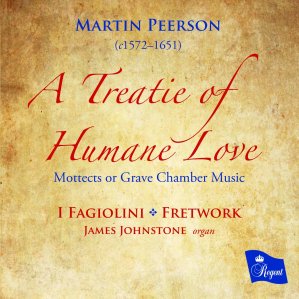 Martin Peerson is one of those composers that can so easily slip under the radar. Little is known of his early life, and records of his adult life are confused by the various ways of spelling his name. It is likely that he was born in March (not the month, but a small market town in Cambridgeshire) around 1572, and became a choirboy at St Paul’s Cathedral. In 1604 a madrigal of his was performed at an ‘entertainment’ in Highgate arranged by Ben Jonson for James I and his Queen Anne of Denmark. This appears to have been his only involvement with the musical life of royalty during his career. He had Catholic sympathies, although managed to pass as sufficiently Protestant to be award a Bachelor of Music from Oxford in 1613. He then held posts at Canterbury and St Paul’s Cathedral and, possibly, Westminster Abbey (a “Martin Pearson” is recorded there in the 1620s).
  Alessandro Scarlatti (pictured) was one of the founders of the Naples opera scene. He first moved there in 1684, aged around 24, as Maestro di Cappella to the Spanish Viceroy, and spent much of his following life there. All the other composers in La Serenissima’s concert were influenced by him. He left little instrumental music alongside his operas, but one such was the Sinfonia di Concerto Grosso II in D (for recorder, trumpet, strings & continuo) that opened this concert. It can be a surprise to those not used to period instruments to realise that the trumpet and recorder can be combined as fellow solo instruments, as Bach demonstrated so well. Scarlatti was less adventurous in his combining of these instruments in this concerto, with the two instruments generally kept apart, and the two melodic Adagio movements only using the recorder.
