Bach: Mass in B Minor
Choir of Trinity College Cambridge, Orchestra of the Age of Enlightenment,
Stephen Layton
St John’s, Smith Sq. 22 December 2015
 The 30th St John’s, Smith Square Christmas Festival ended on 23 December with the traditional Messiah, with Stephen Layton directing Polyphony and the Orchestra of the Age of Enlightenment. The evening before saw what has become another tradition, the appearance of the Choir of Trinity College Cambridge (where Stephen Layton is Director of Music), also with the OAE. I missed their concert last year, but I think it was the same work with the same group of soloists (Katherine Watson soprano, Iestyn Davies countertenor, Gwilym Bowen tenor, Neal Davies, bass). Although it lacks the seasonal element of Messiah, it is an extraordinary and uplifting work, whatever your belief in the words and sentiments might be. It also has an fascinating history, reflecting insights into Bach’s character and emotional response to his own compositions. Part of that complex history is that Bach never called it the B minor Mass, only part of it is actually in B minor, and he never heard it performed. Continue reading
 Returning for their fifth visit to the St John’s, Smith Square Christmas Festival, the Solomon’s Knot Baroque Collective presented a concert based on Advent and Christmas music from Leipzig, with pieces by the three successive Thomaskantor’s. The seating in St John’s was reconfigured from the usual facing-the-stage layout to one where the orchestra and choir were to one side, projecting about two-thirds of the way into the floor space, with the audience arranged on three sides. This was undoubtedly excellent for about one-third of the audience who found themselves sitting directly in front of them, but most of the audience had only a side (or a rear-end view) of the performers.
  After a short tour in The Netherlands, the Tallis Scholars brought their programme of music by Thomas Tallis, Arvo Pärt and John Sheppard to St John’s, Smith Square as part of the SJSS 30th annual Christmas festival. Tallis’s Missa Puer natus est nobis (based on the introit for the Mass of Christmas Day) were threaded through the programme, but it opened with Arvo Pärt’s 1988 Sieben Magnificat Antiphonen and 1989 Magnificat in recognition of Pärt’s 80th anniversary.
  As part of the 30th annual St John’s, Smith Square Christmas Festival, Ensemble Plus Ultra contributed a programme of Advent and Christmas music from Spain, England, and Germany. The rather curious opening had three female singers on stage, while five men approached down the two side aisles, deconstructing the Advent chant Veni, veni Emmanuel by passing it between all three groups. The rest of the first half was a very effective interspersing of Victoria’s 1600 Missa Ave Regina caelorum with Byrd’s 1607 five-part Propers for Lady Mass during Advent. This was preceded by Victoria’s 1581 double choir setting of the Missa Ave Regina caelorum antiphon, upon which the parody mass was based. Although the
 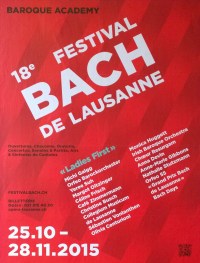 The “Grand Prix Bach de Lausanne” organ competition has taken place every four or five years since 1997, although the actual ‘Grand Prix’ has only been awarded on two of the four previous occasions. The stated intention of the competition is to attract talented organists from all over the world who are passionate about the music of Bach, his predecessors, precursors and his contemporaries. Competitors are told that they need to be able to express the specific language of each style of organ music, and will be judged as to their musicality, choice of registration, technique, quality and order of the programme, style, and originality. Unusually for such competitions, there are no age limits. This is a big investment for the competitors. They are expected to be in Lausanne for up to eight days (arriving three days before the first round), and have to pay their own travel and accommodation costs, as well as a registration fee of 200 Swiss Francs. Unless they live locally, only those winning one of the three main prizes can hope to recover their costs.
 The second of the two festival concerts that I attended was in direct contrast to Messiah: a concert of Bach solo violin music in the intimate surroundings, and attractive acoustic, of the Église de Villamont. Playing the first and third Sonatas and the second Partita, Christine Busch demonstrated a sure grasp of the Bach violin idiom, despite playing what seemed to be a modern violin – or, at least, a violin with what appeared to be a modern set up, complete with tuning aids, chin and shoulder rests, a long finger board, and high bridge.
 When I last visited the Lausanne Bach Festival many years ago, it consisted of nine concerts over a long weekend. In its current incarnation (the eighteenth), it is spread over the period from 25 October to 28 November, with six concerts, three informal ‘Bach Days’, a short conference, and, on this occasion, the 5th International Organ Competition. Although having the events spread out in this way probably attracts more local residents, it makes it a less practical attraction for people from outside Switzerland. I was principally there to review the Organ Competition (reviewed
  For their Spitalfields Festival debut, The Marian Consort brought their programme ‘Christmas with the Shepherds’ (based on last year’s CD release) to St Leonard’s, Shoreditch at the conclusion of a national tour. In a very well conceived and planned programme, they traced the influence of Jean Mouton on composers of the following century, notably Cristóbel de Morales, whose Missa Quaeramus cum pastoribus formed the nucleus of the programme. After the opening motet Alma Redemptoris Mater by Victoria, the latest of the composers represented, we heard Mouton’s motet Quaeramus cum pastoribus, a work that stayed in the repertoire of the Sistine Chapel for more than 100 years and survives in 27 manuscripts and printed sources now to be found as far apart as Aberdeen and Guatemala. It is the best known of a series of ‘Noë’ motets found in the Sistine Chapel archive, the result of the Medici Pope Leo X whose after-dinner entertainment
  The marriage between the Queen Mary Tudor and Philip of Spain only lasted from 1554 to Mary’s death in 1558, but the resulting musical influence lasted for many years, as demonstrated in this concert from the vocal group Chapelle du Roi. Amongst the musicians that Philip brought with him to England was Philippe de Monte, director of the Spanish Chapel Royal. He seems to have met the young William Byrd during his few months in England. Many years later, after the 1583 execution of Mary Queen of Scots and the crushing of a Catholic revolt, de Monte wrote his motet Super flumina Babylonis (‘How shall we sing the Lord’s song in a strange land’) and sent it to Byrd. De Monte set four verses from the Psalm (137), and Byrd’s response was to write his own setting of de Monte’s final verse, adding a further three verses, and sending this motet, Quomodo Cantabimus, to de Monte. These two pieces
  Arvo Pärt provided a link between the earlier B’Rock/Julia Doyle concert and the later evening programme of a capella ‘Songs from the Northern Lands’ given by the Choir of Royal Holloway College. They opened with Pärt’s mesmerising Magnificat, the verse sections evolving around a high and long-held soprano note, and contrasting with fuller-textured passages. A similar drone note was at the core of Rihards Dubra’s ‘A child’s prayer’, again with a soprano solo. Vytautas Miškinis’s Oi šala, šala uses the ‘sh’ sound of ‘šala’ to invoke the sense of shivering in the frost. It is performed with three remote female voices (with noisy shoes!) echoing each other, a soprano solo and an almost inaudible little bell that reinforced the end of phrases.
  Corelli: Concertos grosso Op6/4 and Op6/8 ‘Christmas Concerto’; Handel: Gloria; Arvo Pärt arr Frank Agsteribbe: Fratres; A Scarlatti: Cantata ‘O di Betlemme altera’
 The English Concert was reduced to one of its smallest formations with just four instrumentalists plus tenor Mark Padmore for their Wanamaker Playhouse concert, based on Charles Burney’s writings on music. In 1770 and 1772, Burney (painting by
 g some 30,000 people a year. Their latest Winter Festival opened (in Shoreditch parish church) with a very apt programme based on the early 17th century vogue for composing music based on the hubbub of London’s street sellers and criers, reflecting a tradition of loudly publicising wares that exists to this day in placed like the nearby Petticoat Market.
 The city of Toulouse has nine historic organs on the national protected listed monuments schedule, together with many other instruments in the surrounding Midi-Pyrénéés region. It is something of a pilgrimage site for organ lovers; an appropriate description, as much of its early importance came from the Basilica of St. Sernin and its key position on the Santiago de Compostela pilgrimage route. The Toulouse les Orgues organisation has a year-round responsibility for the maintenance of most of the organs in the city, as well as a thriving educational and outreach remit. In addition, they organise the annual international festival and the occasional International Xavier Darasse Organ Competition. This year was the 20th anniversary of the festival. It’s motto ‘The organ: fabulous musical machine” was reflected in a vast array of musical events and presentations, featuring not just the organ in its various incarnations, but also an impressive breadth of other musical activity.
 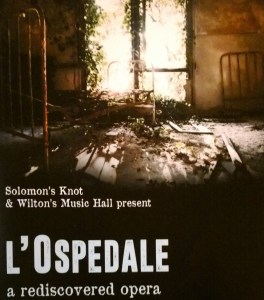 There are many operas that would appear to be taking place in a mental asylum, but the setting of the 17th-century ‘dramma burlesco’, l’Ospedale really is just that. It is based on a libretto by Antonio Abati and is set to music by an unknown seventeenth-century composer. As Naomi Matsumoto (who researched and prepared the score) explains in her programme essay, there are possible connections to the Hapsburg Court of the Holy Roman Emperor where an entertainment called l’Hospitale de’Pazzi is known to have been performed in 1667. Given its later history and famed inhabitants, Vienna does seem a rather apt location for the first performance – as was the delightful and historic surroundings of Wilton’s Music Hall for this, the first staged performance for centuries.
  Concert: Steven Devine, fortepiano, Jane Booth, basset horn, Anneke Scott, natural horn;
 Composed in 1647 (to a libretto by fellow Italian Francesco Buti), Rossi’s Orpheus is generally acknowledged to be the first opera specifically commissioned for France – one outcome of the appointment of an Italian Cardinal as the Prime Minister to Queen Anne of Austria, the Regent to the young Louis XIV, and his attempts to introduce Italian culture to the French Court. Buti’s libretto is a curious affair, adding a bewildering array of miscellaneous characters to the story together with extended
  The European Union Baroque Orchestra was formed in 1985, and has recently successfully negotiated its way through a difficult period of financial uncertainty. It celebrated its renewed, if short term security with the first short series of concerts for the newly formed orchestra of young musicians. They are selected anew each year through combined educational and selection courses and then usually meet five or six times a year to rehearse and then tour a new programme. One of the key features of EUBO is giving the musicians the chance to experience life as a touring orchestral musician, evidenced on this occasion by
  returned to Dresden where he became more involved in composing for the Court Church(left), which had taken on a new significance after the closure of the city opera house in 1720. His career path didn’t go quite to plan. Having been temporary Kapellmeister for a short period of time, he was pipped to the post of Senior Kapellmeister by JA Hasse in 1733. He was then appointed as a church composer. A few years later JS Bach, who knew and admired Zelnka’s compositions, was appointed as an (honorary) Royal Court Composer as a result of his well-known petition accompanying his 1733 ‘Dresden Mass’ – the Kyrie and Gloria of what later part of the Mass in B minor (See PS below). On his death, his compositions were purchased by the Saxon Court as valuable objects rather than performing scores, and remained hidden away in their archives until the 1950s.

 Andrew Benson-Wilson : Early Music Reviews +