
From organrecitals.com/abw.
From organrecitals.com/abw.
Schoenberg: Verklärte Nacht / Brahms: Andante from Sextet Op18/1
Orchestra of the Age of Enlightenment: Night Shift
Baroquestock Summer BBQ weekend special
Heath St Baptist Church, Hampstead. 17 August 2017
This turned out to be a Tale of Two Churches. On my way to Hampstead for the first event of the Baroquestock Summer BBQ weekend at Heath Street Baptist Church in Hamstead, I stopped off at the church of St Sepulchre-without-Newgate in Holborn, known for many years as the Musicians’ Church, and an important venue for rehearsals and concerts for many musicians and choir. There I joined a flashmob drawing attention to the recent decision by the church (now run as a ‘plant’ of the evangelical Holy Trinity Brompton) to stop all rehearsal and concert bookings – an extraordinary decision that has caused a justifiable uproar.
 In sharp contrast to the situation in, of all places, the Musicians’ Church, Heath Street Baptist Church in Hamstead is one of many London churches that have actively embraced music and musicians, running a regular series of lunchtime concerts as well as occasional musical festivals, the latter recently under the title of Baroquestock in food-related weekend festivals. Their latest Baroquestock weekend includes concerts by Spiritato and Istante Classical, the latter including Haydn’s La Poule Symphony to the accompaniment of BBQ chicken. Their opening event was a performance of Schoenberg’s Verklärte Nacht, to the culinary accompaniment of, you’ve guessed – Schoenbergers! Continue reading
Lully: Armide
Les Talens Lyrique, Choeur de chambre de Namur, Christophe Rousset
Aparte AP135. 2CDs. 75’+74′
 In sharp contrast to the pared down version of Lully’s Armide I reviewed here, this CD is the real thing, in a stunning performance by Les Talens Lyrique under Christophe Rousset, with a fine cast of soloists and the Choeur de chambre de Namur in support. It is a live recording of a concert given in the Grande Salle Pierre Boulez of the Philharmonie de Paris in December 2015, although there is no evidence of an audience or other extraneous noises that I could hear. Continue reading
Lully: Armide
Ensemble OrQuesta Baroque
Grimeborn. Arcola Theatre. 9 August 2017
 As the deliberately chosen name suggests, Grimeborn is not Glyndebourne, its location in the Arcola Theatre, a converted textile factory in Dalston, East London, being just one of the differences. Founded in 2007, the Grimborn opera festival focuses on new operas and experimental productions of more established repertoire. The limited space and budget in comparison to its more glamorous inspiration is one of its main strengths, as it forces directors, singers and instrumentalists to rethink basic opera practice. One key factor for the singers is that, rather like the more glamorous Iford Opera season, the singers are performing within a few feet of the audience, sitting on three sides of the central stage area. Continue reading
Berlioz: The Damnation of Faust
Orchestre Révolutionnaire et Romantique
Monteverdi Choir, National Youth Choir of Scotland, Trinity Boys Choir
BBC Prom 31: Royal Albert Hall. 8 August 2017
Whoever thought of turning Berlioz’s Damnation of Faust into a staged opera seems, to me, to be missing the point. Quite apart from the extraordinary challenge of depicting the dramatic scenes on stage, the sheer drama of which would distract from what the music and the libretto is telling us, it is clear that Berlioz intended this as music to be listened to, not watched. That said, there was plenty to see in this Proms performance given by the period instruments of the Orchestre Révolutionnaire et Romantique together with the Monteverdi Choir, the National Youth Choir of Scotland, and Trinity Boys Choir, directed by John Eliot Gardiner. Continue reading
Itinéraire Baroque en Périgord Vert
‘A Telemann Year’
27-30 July 2017
 The annual Itinéraire Baroque en Périgord Vert festival is based in the communes of Ribérac and Verteillac in the northern part of the Dordogne region of south-western France. It was founded by Robert Nicolas Huet and Ton Koopman, the former a local resident and now President and Director of the organising committee, the latter the Artistic Director and an occasional import from The Netherlands, together with his musical friends and family. The festival was initially the one-day event that still gives the now festival its name – the Itineraire Baroque, a musical tour of some of the extraordinary Romanesque churches of the region. But it has now expanded to fill four days over the last weekend in July with a wide range of concerts of Baroque music.
The focus for this year’s festival (the 16th) was Georg Philip Telemann (on the 250th anniversary of his death), a composer now usually overlooked by Bach and Handel (both of whom he knew personally), but who in his time was held in equally high esteem. A self-taught musician, he started to study law in Leipzig, but quickly moved into the city’s musical world. After short spells in princely courts, he moved to Frankfurt and eventually Hamburg where he directed the music in all the city churches. He was the first choice for the Leipzig post that Bach, the third choice, eventually accepted in 1723. He left an enormous amount of music, demonstrating his musical talent and ability to absorb national styles into his own music, notably from France and Poland. Continue reading
Owain Park: Footsteps & Joby Talbot: Path of Miracles
Tenebrae, Nigel Short
Signum Classics. SIGCD471. 79’22
 This release combines the re-release of a 2005 recording of Joby Talbot’s Path of Miracles with Footsteps, a companion work composed by Owain Park, recorded in 2016. Both are commissions by Tenebrae, the Park piece apparently in answer to requests from amateur singers for a less complex piece than the Talbot. Continue reading
Pamber Priory
Pamber End, nr Basingstoke, Hampshire, RG26 5QD
Sunday 24 September 2017, 3pm

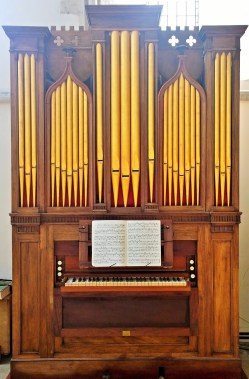
Music from Jane Austen’s own music manuscripts,
played on the 1784 Richard Seede chamber organ by
All proceeds go to the RadCan charity, in support of the Basingstoke Radiotherapy Unit (registered charity 1140906). Tickets £12 (children £6) to include post-concert refreshments, available from Jo Kelly on 01256 328702
Further information – Pamber Priory Poster 2017.
Handel: Israel in Egypt (original 1739 version)
Orchestra & Choir of the Age of Enlightenment, William Christie
BBC Proms, Royal Albert Hall. 1 August 2017
A combination of Handel, the Orchestra of the Age of Enlightenment, and William Christie is bound to sell out the vast auditorium of the Royal Albert Hall, but the first performance of Handel’s Israel in Egypt, in 1739, was not so successful. Many stayed away because of the biblical context of the work, and those that came were not overly impressed. The reasons are complex, but are generally to do with Handel’s move from opera to the new musical form of oratorio. The slightly earlier oratorio Saul, written just before Israel and Egypt, was a great success, no doubt because the musical style included more elements of opera. Israel in Egypt was far more hard-core, not least in the use of choruses. The first part, nearly always omitted in present day performances, is a continuous sequence of 12 choruses. Part Two has 7 and Part Three 8, but these are broken up by a few arias, duets, and recitatives. Handel made many subsequent changes to the score, and it is usually now performed in the 1756 version, with its odd recitative start (which refers back to the non-existent Part One) and no Symphony. It was the inclusion of Part One, and what was supposed to be (but I think was not quite) the original 1739 version, that made this Proms performance so special. Continue reading
Iford Arts: Jephtha
Contraband, Christopher Bucknall
Iford Manor, 25 July 2017
Jephtha was Handel’s last oratorio, composed in 1751 as his sight was failing to the extent that at one point in the autograph score he wrote “unable to go on owing to weakening of the sight of my left eye.” It is rather telling that note occurs at the chorus that concludes Act 2, How dark, O Lord, are thy decrees, All hid from mortal sight. Despite Handel’s personal difficulties at the time, and the frankly bizarre Biblical story upon which it is based, it is one of his finest oratorios, full of the most glorious music for six solo singers and chorus with a succession of attractive and dramatic arias linked by relatively short recitatives.
This Iford Arts production, in the delightfully intimate surroundings of the Italianate cloister at Iford Manor, was directed by Timothy Nelson, with Christopher Bucknall directing the 14 instrumentalists of 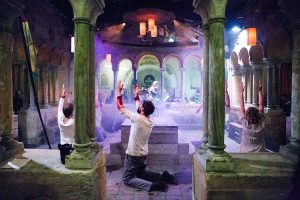 Contraband. It was set in recent times in a fundamentalist (and militaristic) Christian community of cult-like weirdness, led by the controlling Zebel (Frederick Long), with behaviours frequently bordering on what might have been found in a lunatic asylum of Handel’s day. As it happened, on my drive down to Iford, I listened to a Radio 4 broadcast of an account of the 1993 siege of a fundamentalist sect at Waco in Texas. The comparisons were chilling. Continue reading
Festival de Saintes
Abbaye aux Dames: la cité musicale, Saintes
14-22 July 2017
The Abbaye aux Dames was founded in 1047 by the Count of Anjou as a Benedictine abbey for women, usually of aristocratic origin. Around 1120, the Abbey church was altered and the spectacularly carved west end facade and bel l tower were added. Internally, the Romanesque triple-aisled basilica was altered, rather inelegantly, by inserting two enormous domed cupolas into the original external walls, resulting in a bit of an architectural mess. After two major fires in the 17th century (which destroyed the cupolas), the church was restored, and impressive new convent buildings were added, with cells for 45 nuns. During the Revolution, the Abbey first became a prison (1792), and then a barracks (1808). In the 1920s, the Abbey complex was purchased by the town of Saintes. In the 1970s, restoration of the monastic
  buildings (abandoned since the war) was started and, in 1972, an annual Festival of Ancient Music was created, later becoming the Festival de Saintes. In 1988 the Abbey was launched as a cultural centre by President François Mitterrand, and in 2013 it became la cité musicale, housing a Conservatoire of Music and a range of year-round musical activities, including many for young people. The former nun’s cells now sleep visitors and guests of the Festival.
Continue reading
Puccini: Suor Angelica
LunchBreak Opera
St Botolph’s Church, Bishopsgate. 13 July 2017
 LunchBreak Opera is a new venture, launched earlier this year. Its first production was Puccini’s one-act opera Suor Angelica, given in nine fully staged and costumed lunchtime and early evening performances (10-14 July) in St Botolph’s Church, Bishopsgate, London – a prime position, next to Liverpool Street Station. Lasting just 50 minutes it is ideal for lunchtime and post-work entertainment. Continue reading
Nonclassical Club NIght
Freya Waley-Cohen, The Hermes Experiment, Liam Byrne
The Victoria, Dalston. 12 July 2017
Nonclassical is an enterprising musical set up combining a record label with monthly club nights around London, founded in 2004 by composer Gabriel Prokofiev. The club nights bring classical music, both newly composed and more traditional, to the rock club scene, with events usually held in pub entertainment rooms. If the aim was to attract the sort of audience that wouldn’t be seen dead in places like the Wigmore Hall, it has certainly succeeded. The audience stands, drinks in hand, around a stage packed with loudspeakers. Between the acts, DJs continue the theme of inventive new music. The associated record label includes extracts from the live gigs as well as remixes of new compositions. Continue reading
Ceruleo: Paradise Lost
Guildhall Artist Fellowship Recital
Music Hall, Guildhall School of Music and Drama. 10 July 2017
 The five-strong group Ceruleo (two sopranos, cello, theorbo, and harpsichord) got together at the Guildhall School of Music and Drama in 2014. They have just completed a one year Artist Fellowship there, the first time a this has been awarded to a group. During their year, they gave several performances of their programme ‘Deplorable Fire’ commemorating the 350th anniversary of the Great Fire of London, including a live performance on BBC Radio 3. They presented their Paradise Lost programme, based on John Milton’s poem (published 350 years ago in 1667) as their final recital of their Fellowship year. The music was interspersed by extracts from Paradise Lost. Continue reading
Regensburg: Tage Alter Musik
2-5 June 2017
With 16 concert in four days, held over the Pentecost/Whitsun weekend, the annual Regensburg Tage Alter Musik festival is quite a challenge for a reviewer, but a sumptuous feast for those who manage to attend all the concerts, most of which are sold out.  The entire centre of the historic Danube city of Regensburg has been declared a World Heritage site, and all the venues for the festival are in important historic buildings. These range from extreme Baroque and Rococo to austere Gothic churches, and the historic Reichssaal, part of the Altes Rathaus, and for centuries the permanent seat of the Parliament of the Holy Roman Empire. This was the 33rd festival and featured groups from 12 countries, and musicians from a great many more. The Tage Alter Musik website can be see here, with links through to detailed programmes and group websites. Continue reading
Rameau: Hippolyte et Aricie
Ensemble OrQuesta, Marcio da Silva
Music at Woodhouse: Baroque Opera Acadmey
Woodhouse Copse, Holmbury St. Mary, Surrey. 1 July 2017
Music at Woodhouse is based at Woodhouse Copse, an attractive 1926 Arts & Crafts style cottage orné and garden designed by Oliver Hill, a follower of Lutyens, with planting planned by Gertrude Jekyll. A former indoor swimming pool has been  converted into a small concert room, and there is also a larger lakeside amphitheatre and stage. As well as small-scale professional productions, it has also recently started week-long academies for young opera singers, culminating in public performances. When they invited me to review Rameau’s Hippolyte et Aricie , I was warned that ‘it isn’t Glyndebourne’, but even Glyndebourne singers have to start somewhere and this seemed a pretty attractive venue for a week of music making and learning. Ten singers were accepted onto the academy, led by music direct Marco de Silva and harpsichordist Stephanie Gurga. Three of the roles had dual casting on the Saturday and Sunday performances. Continue reading
Permutations & Unveil
Compositions by Freya Waley-Cohen
Tamsin Waley-Cohen, violin
Signum Classics SIGCD496. 27’46
 This short recording is of two pieces by composer Freya Waley-Cohen, written for her older sister, the violinist Tamsin Waley-Cohen. The key work, Permutations (c18′), is described as a “roaming performance artwork”. It has a fascinating compositional background. It was commissioned as part of Aldeburgh Festival’s 2017 season and composed during a residency at Aldeburgh and is intended as an exploration of the relationship between architecture and music.
Permutations consists of six independent lines of solo violin music, all pre-recorded by Tamsin Waley-Cohen, and replayed within an architectural setting designed by Finbarr O’Dempsey & Andrew Skulina. Both the music and its setting were planned simultaneously during the Aldeburgh residency, with each acting as a muse for the other. The architectural setting has six flexible and adaptable enclosures, one for each of the six violin parts. A central space allows all six violin lines to be heard in balance, or the listener could move around, and adjust the acoustics of the space to hear various combinations of the six contrapuntal lines. Continue reading
Grange Park Opera: Die Walküre
Bournemouth Symphony Orchestra, Stephen Barlow
Theatre in the Woods, West Horsley Place, Surrey
29 June 2017
Grange Park Opera closed the final season of their 18 year tenure at The Grange, Hampshire with a performance of Tristan & Isolde, so it was appropriate that their opening season in their new home in the Theatre in the Woods at West Horsley Place they should include more Wagner, in the shape of Die Walküre, the second part of Wagner’s Ring cycle. The first, 1870, performance was as an isolated opera: it wasn’t performed in a Ring cycle until 1876, so viewing it on its own has a degree of authenticity. And, shorn of the complexity and stamina of being part of a complete Ring cycle, witnessing the stand-alone opera allowed us to focus on the complexities of interpersonal interaction and relationships. Continue reading
‘Bach goes to Paris’
Orchestra of the Age of Enlightenment, William Christie
The Anvil, Basingstoke. 28 June 2017
Campra Suite: Les Fêtes Vénetiennes
JCF Fischer Suite no. 7 from Le journal de printemps
Bach Suite no. 4
Rameau Suite: Les Indes Galantes
Bach Suite no. 3
‘Bach goes to Paris’? No, of course he didn’t, but in a way Paris, or at least, France, came to Bach, through the experience of other musicians and of studying scores, notably De Grigny’s Livre d’Orgue, which he copied out by hand. But, if he had have gone to Paris, I wonder what he would have made of Campra’s Les Fêtes Vénetiennes, an early example of the opéra-ballet genre. Much revised and revived after its 1710 opening, it clocked up around 300 performances over the following 50 years. With sections with titles such as the Triumph of Folly over Reason during the Carnival, Serenades and gamblers, and The acrobats of St Mark’s Square, or Cupid the acrobat, the lively series of depictions of carnival time in Paris gave a wonderful introduction to the livelier side of French music of the period. Particularly notable were Stephen Farr’s delightful little harpsichord twiddles during the rests in the Gigue, and Jude Carlton’s inventive percussion including, at one stage, castanets. it ends in a surprisingly elegant Chaconne – an example of French bon gout that was perhaps absent in some of the earlier moments. Continue reading
Mozart: Mitridate, Re di Ponto
The Royal Opera, Christophe Rousset
Royal Opera House, Covent Garden, 26 June 2017
By the time he composed Mitridate, Re di Ponto, Mozart has already written 13 symphonies, three operas, four masses, two oratorios, and around 20 sonatas for strings or keyboard. He was just 14. This revival of Graham Vick’s 26 year-old production exposes the extraordinary artifice that was the realm of opera seria, overblowing and exaggerating every aspect of Mozart’s youthful exploration of love and family feuding.
The opera opened with what looked like the aftermath of a nasty accident. It seemed as though Aspasis had crash landed through the top of a vast cloth-covered sideboard, leaving only the upper part of her body visible. It took a while to realise that it was not a sideboard, but her costume – one of a number of vast rectangular tent-like creations of huge width that some of the singers had to contend with for much of the evening. One of several, presumably unintended, audience laughs came when a closing set panels left just enough space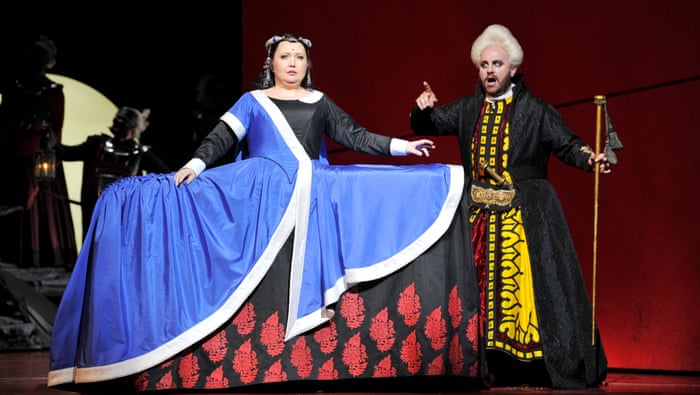 for Aspasia to walk through without turning sideways. She later appeared as though sitting behind a large bedecked dinner table, as pictured. Indeed the striking costume design was one of the main features of this production, which included a number of impressively choreograph set-piece dances, at one stage complete with a lot of foot-stomping, stick-banging and skirt-twirling, the whole more in Japanese than Anatolian (or 18th century European) style.
Continue reading
The Italian Job
Baroque Instrumental Music from the Italian States
La Serenissima, Adrian Chandler
Rachel Chaplin and Gail Hennessy, oboes, Peter Whelan, bassoon
Avie AV2371. 76’23
Music by Albinoni, Caldara, Corelli, Tartini, Torelli, and Vivaldi
 For the past year La Serenissima have been performing a series of concerts based on music from different cities in Italy. This CD, recorded in St John’s, Smith Square after one such concert, forms a summary of the extraordinary music from that concert series. the cities, and composers, represented are Venice (Albinoni, Caldara, Vivaldi), Bologna (Torelli), Padua (Tartini) and Rome (Corelli). Apart from some glorious music, one of the features of this recording is the instrumental colour, with prominent roles for oboes, bassoons, trumpets, trombone, timpani and strings. Continue reading
Hitchcock: The Lodger
with live improvised organ accompaniment by David Briggs
Royal Festival Hall. 24 June 2017
The history of improvisation on the organ is almost as old as the history of the organ itself. From medieval times to the present day, the ability to compose at will has been an essential part of an organists skills, whether adding a simple counter melody to a plainchant to improvising a complete symphony. Although the tradition is not as strong in the UK as it is in, for example, France, recent decades have seen a UK revival in the art of composing at sight. On this occasion, it was a specific branch of improvising that was on display, that of accompanying a silent film. There are many organists, past and present, who specialise in the cinema organ genre, but this performance was given by a classical organist, David Briggs, formerly organist at three cathedrals, and now best known for his organ transcriptions of symphonies by Mahler et al, as well as for his film accompaniments. Continue reading
JS Bach: Complete Organ Works – Volumes 5, 6 & 7
Breitkopf & Härtel
Volume 5: Sonatas, Trios, Concertos
Ed. Pieter Dirksen
Edition Breitkopf EB8805.
216 pages | 32 x 25 cm | 926 g | ISMN: 979-0-004-18366-3 | Softbound + CD-ROM Continue reading
Monteverdi: Il ritorno d’Ulisse in patria
The Grange, Northington, Hampshire. 18 June 2017
The Grange, in Northington, Hampshire, achieved it current form in the early 19th century, when the architect William Wilkins (later to design the National Gallery) encased a 17th century house in grand Greek revival style. Further work by Robert Smirke, architect of the British Museum, and Charles Robert Cockerell completed the scheme. It came to public notice in 1975 when the owners, a junior branch of the Baring banking family, attempted to demolish the building. The exterior was listed by the Government, on  account of its appearance and landscape importance, and placed into the guardianship of English Heritage, who instigated major restoration of the exterior of the building and opened the site to the public. It reached much wider appreciation in 1998 when the new Grange Park Opera took a 20 year lease from the Baring landlords, and started a summer opera season. In 2002 they built an award-winning new opera house within the shell of the old orangery, investing several million pounds in the project. They also did a considerable amount of work inside the shell of the building, including reinstating the dramatic staircase (pictured below). Disagreements with the Baring family led to Grange Park Opera decamping to a new home at the Theatre in the Woods at West Horsley Place, Surrey, not surprisingly taking many of the internal fittings from their Grange opera house with them. Continue reading
Mozart: Apollo et Hyacinthus
Classical Opera, Ian Page, Thomas Guthrie
St John’s, Smith Sq. 13 June 2017
‘Lambach’ Symphony in G; Grabmusik, Apollo et Hyacinthus
As part of their ambitious Mozart 250 project (presenting Mozart’s music on the anniversary of their composition, culminating in 2041), Classical Opera presented the last of four concerts focussed on 1767, Mozart’s 11th year, with a staged performance of Apollo et Hyacinthus, preceded by his ‘Lambach’ Symphony in G and the Grabmusik, also staged. This was a very clever and extremely well performed concert, exploring music that is not as well-known as it should be, with very sensitive stagings conceived and directed by Thomas Guthrie. The ‘Lambach’ Symphony in G (K45a) is believed to have been written in 1766 by the 10-year old Mozart. It was found in two manuscripts in Lambach Abbey, Austria. Like many other early Mozart works, it is beguiling in its elegant simplicity and harmonic inventiveness, here added to by having the first movement main theme first appearing in the bass, although on this occasion it wasn’t all that prominent. While it was playing, people walked across the St John’s stage, their relevance becoming clear when the bustling final movement of the Symphony segued directly, and very effectively, into the opening of the Grabmusik. Continue reading
Late Night Lute
Matthew Wadsworth, lute and theorbo
Deux-Elles DXL 1175
Dowland, Rosseter, Johnson, Piccinini, Kapsberger, and Stephen Goss
I  can vividly remember the first time I heard Matthew Wadsworth playing, in 1999, in the bowels of the Royal Academy of Music, during the debut of what was then a student group, all four of whom (Kati Debretzeni, Alison McGillivray, Matthew Wadsworth, and Robert Howarth) have gone on to achieve prominence in the world of music. This CD stems from an overheard comment at a late night gathering of friends, when somebody searching through CDs commented “I need lute, late night lute”. In the intervening years, the frequency of invitations to present late night lute concerts reinforced the feeling that there was indeed something of the night about lute music. Continue reading
Handel: Radamisto
Guildhall School of Music and Drama
Milton Court Theatre. 12 June 2017
Watching people watching opera was the premise behind John Ramster’s production of Handel’s Radamisto at the Guildhall School of Music and Drama’s Milton Court Theatre. A Heads of State meeting has been arranged in a museum, displaying artifacts from the ancient kingdoms of Armenia and what is now eastern Turkey. As they take their seats on opposite sides of the stage, the bristle between them is palpable. A crusty army figure on one side, and a thrusting young woman on the other, with the museum and security flunkies flitting about between them. And then the entertainment begins, in the form of Radamisto. The interaction between the two VIPs, as well as their own interaction with the opera, became key to the development of this production. Continue reading
Leoš Janáček: Jenůfa
Grange Park Opera, BBC Concert Orchestra, William Lacey
Theatre in the Woods, West Horsley Place. 11 June 2017
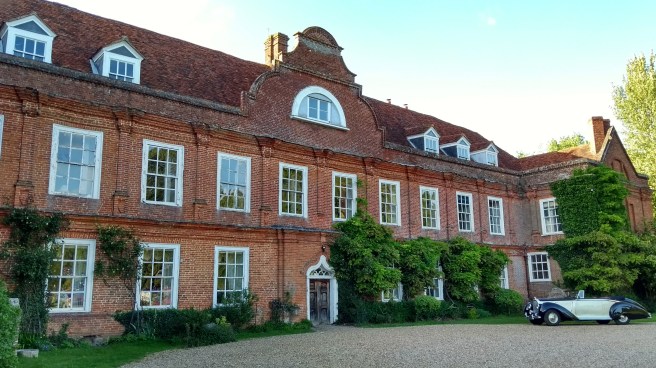
Not for the first time in recent years, an opera company has planned, designed, funded and constructed a brand new opera house having been required, for various reasons, to move from the original home. In the most recent case of Grange Park Opera, the background to the move from their founding home at The Grange, Hampshire, was not without controversy, and the new opera house is not quite finished, or, indeed, fully funded. But nonetheless they managed to put on an impressive indication of what will be the new home for the next 99 years, the Theatre in the Woods, hidden away behind the massive medieval pile of West Horsley Place (pictured), rather unexpectedly inherited by former television personality and writer, Bamber Gascoigne, from his Duchess Great Aunt. Continue reading
A Rose Magnificat
The Gabrieli Consort, Paul McCreesh
St John’s, Smith Square. 8 June 2017
Leighton Of a Rose / Tallis Videte Miraculum á 6
Warlock As dew in Aprylle / White Magnificat á 6
Macmillan / Sheppard / Park Ave maris stella
Wylkynson Salve Regina á 9 / Howells Salve Regina
Lane There is no rose / Matthew Martin Rose Magnificat (world premiere)
This fascinating concert collected together a seemingly random selection of pieces from old to very new, all dedicated to the Virgin Mary. Grouping the pieces in twos or three enhanced the experience of contrast, starting with the pairing of Kenneth Leighton’s setting of the 15th century text Of a Rose with Tallis’s magnificent 6-part Videte Miraculum. Soprano Ruth Provost was the soloist in the Leighton, weaving the refrain Of a Rose around and through the rhythmically homophonic choir texture. The contrasting tight-knit and multi-stranded polyphony of Tallis, with his distinctive ‘false relations’ provided a perfect contrast. This pair was followed by the slithering close harmonies of Warlock’s short and rhythmically complex double choir As dew in Aprylle, contrasted with White flamboyant and expansive six-plus part Magnificat, the continuous inner movement and long melismas of the latter giving the piece a timeless quality. Continue reading
Zefiro Torna
Les Talens Lyriques
St John’s, Smith Square. 7 June 2017
This concert celebrated the 450th anniversary of Monteverdi’s birth, as well as the 25th anniversary of Les Talens Lyriques. Tenors Emiliano Gonzalez Toro and Anders J. Dahlin joined with director and keyboard player Christophe Rousset, cellist Emmanuel Jacques, and violinists Gilone Gaubert-Jacques and Josépha Jégard to explore Monteverdi’s more intimate, but nonetheless dramatic music. Each half concluded with opera extracts, but started with extracts from four of Monteverdi’s madrigal books. Throughout these madrigals, we had to work around the curious implications of two men both singing about the same love interest. Continue reading
 Andrew Benson-Wilson : Early Music Reviews +