Mozart 250: 1768 – a retrospective

Mozart 250: 1768 – a retrospective
The Mozartists, Ian Page, Chiara Skerath
Wigmore Hall. 23 January 2018

Classical Opera’s ambitious ‘Mozart 250’ project is now in its fourth year. The project started in 2014, taking its title from the number of years since Mozart’s childhood visit to London (1764) when he composed his first significant works. The project aims to “follow the chronological trajectory of Mozart’s life, works and influences”, by performing annual concerts and operas based on the music composed 250 years earlier, culminating in 2041, the 250th anniversary of Mozart’s death. The Mozartists (the concert-performing wing of Classical Opera) opened the 2018 incarnation of the project with an insight into the music that was composed in 1768, the year that Mozart turned 12. It wasn’t a good year for him. It started with his recovery from smallpox and continued with rejection from the Viennese musical coterie, who prevented the production of Mozart’s first opera, La finta semplice. Classical Opera performed this later this year, as well as his Bastien und BastienneContinue reading

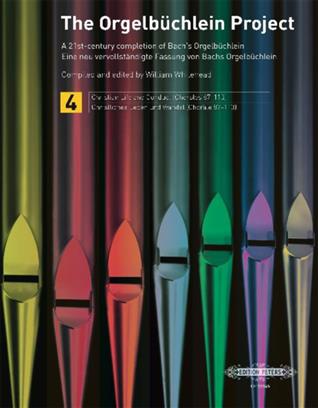
The Orgelbüchlein Project

The Orgelbüchlein Project
A 21st-century completion of Bach’s Orgelbüchlein
Compiled and edited by William Whitehead
Volume 4: Christian Life and Conduct (Chorales 87–113)

152 pages  • ISMN 979-0-57701-498-2  • Softbound
Edition Peters EP73145

OB.jpg

The Orgelbüchlein Project is one of the most exciting and ambitious musical projects of recent years. Bach’s Orgelbüchlein was intended to be a set of 164 chorale preludes covering the whole liturgical year. It was started during Bach’s time in Weimar (1708-17) with a few additions after he arrived in Leipzig. In a tiny manuscript book, Bach wrote the titles of all 164 Lutheran chorales at the top of the pages, but only managed to complete settings of 46 of them. Most titles were allocated a single page, with some given more space. When he came to write out the chorale preludes, he occasionally ran out of space and packed in a few more bars at the bottom of the pages in the more compact (but old-fashioned) German tablature letter notation. The title page of the autograph copy (pictured below) notes Bach’s intention for the collection that “a beginning organist receives given instruction on performing a chorale in a multitude of ways while achieving mastery in the study of the pedal, since the chorales contained herein the pedal is treated entirely obbligato . . . that my fellow man may hone his skill.” The Orgelbüchlein Project is an international project, founded and curated by organist William Whitehead, to complete the Orgelbüchlein by commissioning composers to write settings for the 118 missing chorale preludes.

Continue reading

Telemann: Fantasias for Viola da Gamba

Telemann: Fantasias for Viola da Gamba
Robert Smith
Resonus RES10195. 79’15

Telemann is the gift that keeps on giving. His latest offering was the discovery in 2015 of the previously lost set of Gamba Fantasies. In accordance with his very successful business approach, they were published two at a time over six fortnights in 1735. Aimed at the upper performing end of the amateur market, they also present many challenges for the professional musician. As Robert Smith writes in his own programme notes, a performer can approach these pieces with no preconceived ideas of how they might be performed. Unlike, for example, the Bach Cello Suites with many decades of recording and teaching, these Telemann Fantasias have a clean performing slate. Continue reading

François Couperin: Lumière et Ombre

François Couperin: Lumière et Ombre
Les Talens Lyriques, Christophe Rousset
Barbican/Milton Court. 14 January 2018

IMG_20180114_151717705.jpg

We are used to hearing French Baroque music in the grand style of the likes of Lully and Rameau, but the more delicate and sensitive music of François Couperin (referred to as le Grand to differentiate him from the rest of his extended musical family) is often overlooked. 2018 is the 350th anniversary of his birth, so is a good time to reassess his music. These two concerts in Milton Court, together with a panel discussion, explored some of his chamber and harpsichord music, concluding with his three Leçons de ténèbres. The two concerts were titled Lumière and Ombre, each containing solo harpsichord, vocal and instrumental music. Continue reading

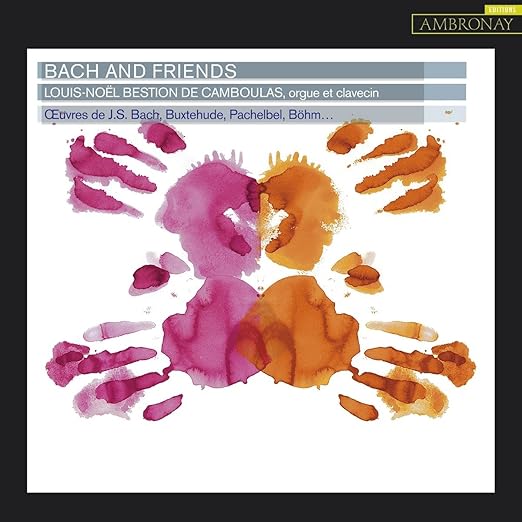
Bach and Friends

Bach and Friends
Louis-Noël Bestion de Camboulas
Ambronay AMY048. 79’54

Music by Böhm, Buxtehude, J. C. F. Fischer, Georg Muffat, Pachelbel, and Scheidemann

Ambronay Editions continue their support for younger musicians with a first recording by the organist, harpsichordist and musical director Louis-Noël Bestion de Camboulas. I have previously reviewed him (here) as the director of the group Ensemble Les Surprises. This programme contrasts music for harpsichord and organ, genres quite often interchangeable in the Renaissance and Baroque periods. Many manuscripts of the period include pieces suitable for one or other instruments, or both. The absence of an independent pedal does not always imply performance on a stringed keyboard instrument. That said, the pieces on this recording are generally well suited to the chosen instrument, although the title of Bach and Friends is a little off-kilter. Few could be seriously considered as personal friends of Bach. But all influenced him in one way or another, even if, like Scheidemann, they died well before Bach was born. Continue reading

Renaissance: Groningen Lutherse Kerk

Renaissance: Groningen Lutherse Kerk
Tymen Jan Bronda, organ
Colophon LBE 2017. 76’59

Music by Frescobaldi, Scheidemann Buxtehude, Bõhm, Weckmann, and Bach.

The 2017 Groningen Schnitger Festival (reviewed here) focussed on the opening of the new organ in the Lutherse Kerk, a reconstruction of the Schnitger organ that was built for the church in 1699, with extensions to Schnitger’s plans in 1717. Schnitger gifted the organ to the Lutheran community in recognition of the time he and his German workforce spent in the church while working in Groningen on the now internationally famous organs in the Martinikerk and Aa-Kerk. Since 2001 the Lutherse Kerk reintroduced the tradition of Bach cantatas into the services, leading to the foundation of the period instrument Luthers Bach Ensemble and plans for an organ suitable for use with Bach cantatas. The Groningen born but Swiss-based organ builder Bernhardt Edskes was commissioned to build the new organ, based on the 1717 incarnation of the original Schnitger organ. This CD by church organist Tymen Jan Bronda is the first to be made of the new Schnitger organ.  Continue reading

Bach, the Universe & Everything

Bach, the Universe & Everything
Orchestra of the Age of Enlightenment
Kings Place. 14 January 2018

The Orchestra of the Age of Enlightenment’s regular Kings Place Sunday morning ‘Bach, the Universe & Everything‘ series is billed as a “Sunday service for inquiring and curious minds; a place to bond with music lovers and revel in the wonders of science.”. In conjunction with The Institute of Physics, each event includes a Bach cantata and a talk from a distinguished scientist. This first event of 2018 reflected the Kings Place theme for 2018, ‘Timed unwrapped‘, with a talk by Professor Helen F Gleeson on Time and Perception. These are very popular events, but it was my first visit. Although not in the style of the many totally secular Sunday ‘services’ that have sprung up around the country in these post-religious days, there were elements of a church service in the organ pieces played before the start (of non-conformist, rather than C of E length), a reading, a choir ‘anthem’, notices, a hymn (in this case, of course, a Lutheran chorale) and a ‘collection’ at the bar in return for coffee and cake.

Continue reading

Return of Ulysses

he KingMonteverdi ‘The Return of Ulysses’
Royal Opera House, Early Opera Company, Christian Curnyn
The Roundhouse. 10 January 2018

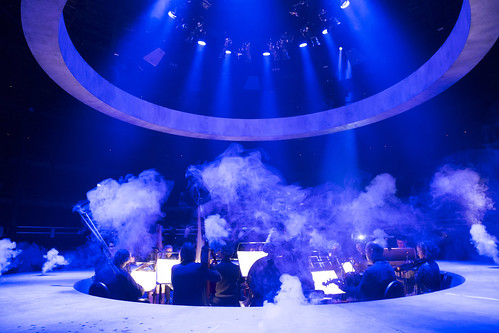
After the success of their 2015 production of Monteverdi’s Orfeo at the Roundhouse (reviewed here), the Royal Opera House returned with an English language version of Il ritorno d’Ulisse in patria, under the title of ‘The Return of Ulysses’. As its name suggests, the Roundhouse is a large circular building in Camden, North London, built in 1854 by a railway company as the Great Circular Engine House and used, albeit only for a few years, as a maintenance depot. It had a central turntable to switch engines into the surrounding maintenance bays. John Fulljames’s production for the Royal Opera House maintains the link with this central turntable with a doughnut-shaped staging with an outer raised ring for the singers with the orchestra in the central circle. Both rotated, the instrumentalists going very slowly clockwise (a bit slower than the hour hand of a watch) and the singers intermittently rotating anti-clockwise. on their circular stage.

Continue reading

Salome

Richard Strauss: Salome
Royal Opera House. 8 January 2018

This third revival of David McVicar’s 2008 production of Salome is directed by Bárbara Lluch and conducted by Henrik Nánási. Although I saw the ROH’s predecessor to this production in the late 1990s, this was my first viewing of McVicar’s production. He adds several additional layers to Strauss’s (and Oscar Wilde’s) already complex take on the sparse biblical/Josephus story. Although Strauss’s music is firmly rooted in the post-Wagnerian idiom of the fin de siècle pre-Expressionist era, the nature of the plot continues to disturb and shock; perhaps more so today, when it is all too easy to relate aspects of opera plots like this to present day news items, people, and social concerns.

The setting was a large rather decrepit basement with bare walls, exposed pipework and a smattering of naked young women. Anybody expecting to have to wait an hour or so for the famous dance before a flash of female flesh had ample opportunities early on – but none in the actual dance. A sweeping staircase to one side led up to an almost hidden upper dining room where Herod and friends are feasting. All the action takes place in the basement space as the upstairs party slowly descend to the depths, in more ways than one. Most of the cast remained onstage throughout, along with several non-singing actors, mostly standing around watching events unfold. Towards the end, it was male nudity that was more apparent, with the executioner, for no apparent reason, stripping to the buff before descending into the cistern to behead Jokanaan. Although silent, as depicted in the libretto and music, this turned out to be a messy affair, the executioner returning completely covered in blood, front and back, top to toe. Continue reading

Christopher Purves sings Handel

Christopher Purves sings Handel
Arcangelo, Jonathan Cohen
Milton Court, 7 January 2018

Distinguished bass/baritone singer Christopher Purves has long been a mainstay of the opera and concert stage. His broad repertoire perhaps evidenced by the fact that my last three reviews of him were in operas by Mozart, George Benjamin, and Georga Enescu. On this occasion, he was the focus of the evening. But this wasn’t one of the usual, and rather predictable, ‘star singer and backing orchestra’ events. Purves and Arcangelo shared the honours in a well-planned partnership of vocal and orchestral music. Purves remained on stage throughout, sitting at the side during Arcangelo’s moments. His jovial introductions to the pieces were relaxed and approachable, not least his opening comment that we were about to hear music for some “complete and utter bastards as well as a couple of real sweeties”. Although many of the protagonists in the programme were clearly in the former category, there were enough of the latter to bring some relief to the bluff and bluster of many of Handel’s music for bass.

Continue reading

Baroque at the Edge

Baroque at the Edge Festival
LSO St Lukes & St James Clerkenwell. 6 January 2018

IMG_20180106_150750319_BURST000_COVER_TOP.jpg
With a headline of “Imagine if Bach was a jazzman, Vivaldi a folk-fiddler, or Handel a minimalist…”, the new Baroque at the Edge festival launched itself onto the London musical scene. Headed up by Lindsay Kemp and Lucy Bending (the pair who for many years ran the London Festival of Baroque Music and its predecessor the Lufthansa Festival), the festival invited musicians from the classical, jazz, and folk world to “take the music of the Baroque and see where it leads”. They promised “No rules, no programme notes, no lectures: all you need to know is how to listen”. The Baroque at the Edge title was also given to the May 2017 LFBM festival, the last to be directed by Lindsay Kemp and managed by Lucy Bending – a nice link to their then unannounced new festival. The Baroque at the Edge festival included six concerts and a family event, spread over a three day weekend. After an opening Friday night piano recital, the Saturday (6 January) featured four events, starting with a lunchtime concert in the impressive late Georgian church of St James, Clerkenwell.

Continue reading

Schmelzer: Sonatas

Schmelzer: Sonatas
Le Concert Brisé, William Dongois
Accent ACC24324. 69’21

Johann Heinrich Schmelzer (c1623-1680) was born in central Austria, moving to Vienna sometime in the 1630s where he spent the rest of his life working in the court of the Hapsburg emperors. He lived at a time when the cornett was beginning to lose position to the violin as the principal treble instrument. This is evidenced by Schmelzer’s own career, which started as a cornettist in the Vienna Stephansdom before making his name as a violin virtuoso, becoming court violinist to Ferdinand II/III and Leopold I. This CD redresses the balance towards the earlier instruments a little, by including arrangements for the cornett of pieces intended for the violin or other string instruments ‘played on the shoulder’. It also includes samples of the extraordinarily colourful instrumentations used by Schmelzer (and his Germanic colleagues), for example in the Sonata La carolietta written for violin, cornett, trombone and fagotto, and, in the Sonata à 5 adding a trumpet to that line-up.  Continue reading

Mallorca Edition Historic Organs

Mallorca Edition Historic Organs
Martin Schmeding
CYBELE 6SACD 
001404. 6 SACDs. 7h 39’31
1. Padre Antonio Solèr (1729-1783): Sonatas, Fugues and Fandango
2. Domenico Scarlatti (1685-1757): Sonatas
3. José Lidon (1748-1827): Complete Works for Organ
4. Sebastián Aguilera de Heredia (1561-1627): Organ Works
5. Pablo Bruna (1611-1679): Organ Works

Following his 17-part Max Reger Edition Martin Schmeding turns his hand to music from the Iberian Baroque. In addition to the 5 CDs of music, a 6th CD includes talks (in German) with Martin Schmeding and the organ builder Gerhard Grenzing who restored two of the three organs used. 

The first question when approaching this set of CDs is what is the best order to play the CDs? The published order makes no sense to me. Chronologically the order should be 4, 5, 2, 1, 3 (from the earliest to most recent). I would strongly recommend listening in that order, not least because it will help to give a  sense of the evolution of Iberian keyboard music. But if you want to annoy your neighbours and frighten the cat, start with CD1 and the opening blast of en-chamade trumpets. Spain is rather like France in that the peak period for the organ in construction terms was mid to late eighteenth century, but by then the music composed for the organ was, arguably, in musical decline. Starting with the earliest composers will demonstrate that development, and will also help you to appreciate the earlier repertoire without the blast of the later composers still ringing in your ears. But if you are one of those people who assume all organ music is dull and boring, then start with the later composers, whose music is certainly more fun.  Continue reading

Liszt: Une Divine Tragédie

 Liszt: Une Divine Tragédie
Thomas Ospital, organ
Editions Hortus: 149. 67’16

Orphée (transcription: Louis Robilliard)
Fantaisie et Fugue Ad nos, ad salutarem undam
Funérailles (transcription: Louis Robilliard)
Am Grabe Richard Wagners
Consolation IV

According to the programme notes, this recording takes the form of a ‘mini-opera’ (or Divine Tragedy), centred around Liszt’s monumental Ad nos, ad salutarem undam. The other four pieces on the CD, two of them modern transcriptions for organ, frame Ad nos, creating a wordless story that may (or may not) be based on the opening transcription (by Louis Robilliard) of Orphée. This arch-form piece introduces us to the concept of performing Liszt on a French, rather than German romantic organ, including an unusual cinema organ effect in the Molti più lento section. The organ is the 1989 van den Heuvel organ in the church of Saint-Eustache, Paris, an enormous instrument built in the grand tradition of the 19th-century French symphonic organ combined with many elements of the 20th-century neo-baroque that so influenced later French music from Messiaen to the then Titular Organist, Jean Guillou. A complex set of electronic wizardry was added in 2010, creating new interpretational and registration possibilities. Unfortunately, the CD includes practically no information about the organ, but it is readily available online. Continue reading

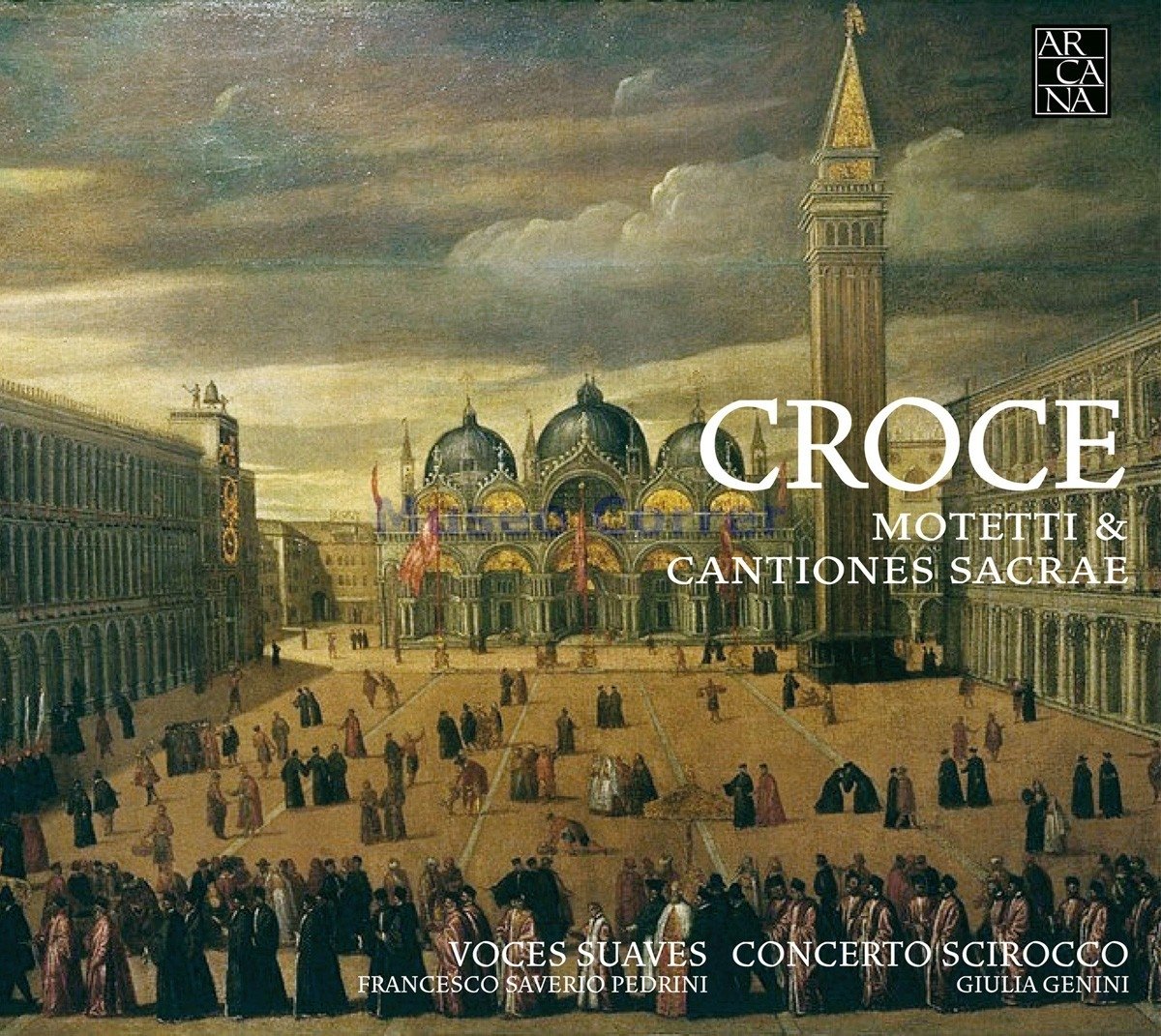
Croce: Motetti & Sacrae Cantiones

Croce: Motetti & Sacrae Cantiones
Voces Suaves, Concerto Scirocco
Arcana A439. 52’19


Giovanni Croce (also known as Il Chiozzotto) was a choirboy in St Mark’s Venice under Zarlino, eventually becoming maestro di cappella around six years before his death in 1609, four years before Monteverdi took up the same post. He was also connected to Santa Maria Formosa, possible as a priest as well as a singer. Although renowned in his own day, he has been overshadowed by his most illustrious predecessors and successors. His music is not as grand as the Gabrielli’s, or a refined as Monteverdi, although the influence of the former is clear, notably in his polychoral writing.  Continue reading

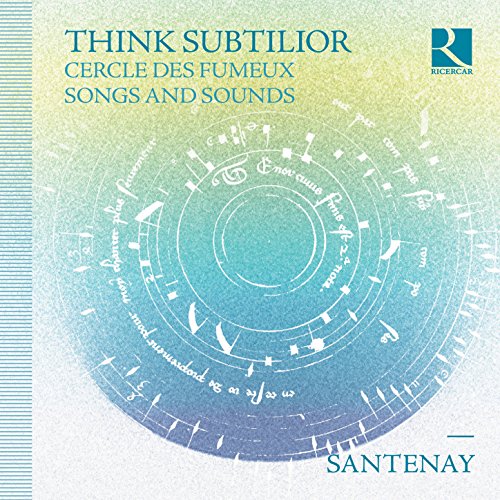
Think Subtilior

Think Subtilior
Cercle des fumeux & Songs and Sounds
Ensemble Santenay
Ricercar RIC386. 51’13

Think Subtilior (Cercle des fumeux & Songs and Sounds)

Ensemble Santenay is a group of four musicians who met during their studies of medieval music in Trossingen, Germany. Using the simplest of instrumentation (flute, fiddle, lute, and organetto) and one (soprano) singer, their approach to performance combines innovation with simplicity. Their choice of repertoire for this CD is apt: the so-called Arts Subtilior period from the end of the 14th-century. Stemming from the Parisian confraternity of ‘eccentric young intellectuals’, Cercle des fumeux, the style spread to Avignon, Northern Italy and Cyprus. Arts Subtilior uses simple but expertly crafted musical means and complex rhythms to express emotion. What Ensemble Santenay uniquely bring to the music is their esoteric introductions to several of the pieces: little soundscapes with titles like ‘haze, ephemeral, emanation, exhalation and perfume’. These are based on improvisations on some of the musical themes of the songs and the sounds of the instruments, all subjected to some technical wizardry by their musical produced Thor-Harald Johnsen. The longest, ’emanation’, lasts nearly three minutes and features the organetto phasing in and out of flute sounds within an atmospheric background.  Continue reading

Bach in Advent: Clavier-Übung III

Bach in Advent
David Titterington, Siglo de Oro, Patrick Allies
Bach Clavier-Übung III ‘German Organ Mass’
St John’s, Smith Square. 21 December 2017

During the three-week run-up to Christmas, St John’s, Smith Sq has been running a series of free early evening organ recital, given by the curator of the SJSS Klais organ, David Titterington, and focussed on the music of JS Bach. The two I had intended to hear before evening concerts were both cancelled, but I did catch the evening concert that concluded the series. This was a performance of the major pieces from Bach’s Clavier-Übung III, occasionally referred to this Bach’s monumental work, the largest single collection of his organ music. It was published in 1739 and includes a wide range of musical style, in the form of chorale preludes (in pairs, with larger pedaliter and smaller manualiter arrangement) based on the German Lutheran Mass, together with four duets, the whole enclosed with a large-scale Praeludium and Fugue – the latter known in the UK as the ‘St Anne Fugue’ after the hymn tune which the theme resembles.  Continue reading

Opera: Passion, Power and Politics & Monteverdi Trilogy

 Opera: Passion, Power and Politics
Highlights from the Monteverdi Trilogy
Monteverdi Choir, English Baroque Soloists
Victoria & Albert Museum. 15 December 2017

As part of the V&A’s Opera: Passion, Power and Politics exhibition, the Monteverdi Choir returned to the site of their very first concert, 50 years ago in the museum’s Raphael Cartoon gallery to conclude their 2017 tour of Monteverdi’s three operas with a concert of extracts from all three. In the tradition of the V&A’s ‘Friday Lates’, they started at 6.30 with a series of Promenade Performances given in different galleries of the museum, starting with the L’Orfeo Overture performed from the gallery of the Grand Entrance before moving to the adjoining Medieval & Renaissance galleries for Duo seraphim, performed from the three projecting balconies. The audience was then shepherded through the massive Hertogenbosch choir screen for from two extracts from Il ritorno d’Ulisse in patria, a flash-mob style Coro di Feaci and Ulysses’s Dormo ancora sung by Furio Zanasi in the Renaissance chapel originally in Florence’s Santa Chiara church. Continue reading

Heigh Ho Holiday

Heigh Ho Holiday
Christmas Revels in 17th-century London

The City Musick, William Lyons
St John’s, Smith Square. 13 December 2017

King James I issued his ‘Declaration of Sports’ in 1617, noting that he had heard that people had been ‘barred from all lawfull Recreation, & excercie vpon the Sundayes afternoone, after the ending of all Diuine Seruice‘. So wrote Wiliam Lyons, director of The City Musick in his programme note for this concert, as an example of the encouragement of festivals and holy days during the early 17th century, despite opposition from Puritans and Catholic gentry. These occasions included Christmastide festivals, a time when the virtuosi musicians of the local city waits came into their own, perhaps with the opportunity to relax a little from their normal role of providing music for civic ceremonies, processions, dances, masques etc. Their musical repertoire was wide, as was the range of instruments that they played, both aspects revealed in this concert by a 21st-century incarnation of the waits – the seven musicians of The City Musick. Continue reading

Lully: Alceste

Jean-Baptiste Lully: Alceste
Les Talens Lyriques, Namur Chamber Choir, Christophe Rousset
Launch concert: Opéra Royal, Versailles, 10 December 2017
CD: Aparté AP164, 2CDs. 80’+70.59′

Lully: Alceste

Alceste ou Le Triomphe d’Alcide is an early example of Lully’s tragédie en musique in its fledgeling form of a Prologue followed by five Acts. It uses a libretto by Philippe Quinault, based on Euripides’ Alcestis. The first performance was given in January 1674 by the recently formed Académie Royale de Musique (later known as the Opéra de Paris) at the Théâtre du Palais-Royal, adjoining the then residence of the King, the Louvre Palace. The occasion was the Louis XIV’s victory against the Spanish held Franche-Comté during the complexities of the Franco-Dutch War. Lully had only recently taken control of the opera scene in Paris and Versailles, and this was the second of the many operas created during this monopoly. Even though Versailles was not, at the time, the seat of Louis XIV (and indeed, most of it was not yet built), the sumptuous Opéra Royal (built around 100 years later, in 1770) was an appropriate venue for Les Talens Lyriques to launch this CD, with a concert performance.

IMG_20171210_141343569.jpg

Continue reading

Monteverdi: Selva morale e spirituale

Monteverdi: Selva morale e spirituale
Les Arts Florissants, William Christie
Barbican, 9 December 2017

Monteverdi’s 8th book of madrigals, the Selva morale e spirituale (Moral and Spiritual Forest”), was published in 1641 when Monteverdi was in his 70s. It seems to have been intended as a culmination of his musical career at St Marks Venice, and contains a vast array of compositional styles, as reflected in this Barbican concert by the eight singers and eight instrumentalists of Les Arts Florissants. They opened with one of the most dramatic pieces from the collection, the extended seven-voice Gloria, the clear articulation of the singers allowing the flourishes of the musical lines to shine. Here, as in many of the other pieces, the two violinists made significant contributions. Continue reading

Praetorius: Mass for Christmas Morning

Praetorius: Mass for Christmas Morning
Gabrieli Consort & Players, Paul McCreesh
St John’s, Smith Square
7 December 2017

The 500th anniversary of the Reformation gave the Gabrieli Consort & Players the chance to revisit the music of their most successful recording, Praetorius’s Mass for Christmas Morning. The recording dates from 1994 and was recorded in the splendour of Denmark’s Roskilde Cathedral. That venue was chosen because of the historic Roskilde organ, dating back to 1544 with additional work in 1611, 1654 and the 1690s, the whole restored back to its pre-1700 state. For this short tour, the Gabrieli Consort & Players visited Hull, Bradford and London’s St John’s, Smith Square, on each occasion joining with local choirs to expand the resources.  Continue reading

Schumann Street

 Schumann Street
Spitalfields Music Festival 2017
Huguenot houses in Spitalfields
9 December 2017

The 2018 incarnation of the Spitalfields Winter Festival concluded with Schumann Street, an ambitious weekend ‘installation’ based in eight of the historic former Huguenot houses in the streets next to the traditional home of the festival, Christ Church, Spitalfields, Hawksmoor’s architectural masterpiece. The festival was founded (by Richard Hickox) in 1977 specifically to help to save Christ Church from demolition. For many years, concertgoers stepped over the rough brick floors to hear a glittering array of top-flight early music performers and established contemporary composers, one example of the latter being the 1991 performance of John Tavener’s The Protecting Veil. A timeline of the Spitalfields Festival and its associated activities, most notably in community and education projects, can be seen here. Since then, Christ Church has completed a major restoration but, unfortunately, no longer hosts the festival that was instrumental, in so many ways, in its continuing existence and restoration.

For the Schumann Street installation,  which had four runs over the weekend, each of eight Huguenot houses accommodated two performances, all sixteen based on Schumann’s 1840 Dichterliebe (A Poet’s Love). Although usually performed with a male voice and piano, it was dedicated to a soprano. For this event, the 16 performers (individuals or groups) were given free rein to interpret the verses in their own way and style. The audience met in the crypt of Christ Church, where we were divided into eight groups and were eventually, after quite a delay, led to one of the houses. From then on, we were all left to our own devices, with a map to show where the houses were, but no indication of who would be performing where or when, or any idea of the length of the 16 performances.  Continue reading

In the Light of Air

In the Light of Air
Pauline Oliveros, Anna Thorvaldsottir
London Contemporary Orchestra
Spitalfields Music Festival 2017
St Leonard’s Church, Shoreditch
8 December 2017

The new-look, or should I say the new-hear Spitalfields Music Festival continued with In the Light of Air, the title of the main piece of the evening, by Anna Thorvaldsottir. It was preceded by a sequence of works by the American founder of ‘Deep Listening’, Pauline Oliveros from her Anthology of Text Scores. The theme was mindfulness and meditative, with the audience encouraged to join in and respond to the music. Most of the pews had been removed, leaving the instrumentalists in the centre of an open space. Continue reading

Renegade New Classical

Renegade New Classical
Nik Colk Void, Daniel Brandt
s t a r g a z e
Spitalfields Music Festival 2017
St Leonard’s Church, Shoreditch
6 December 2017

Once upon a time, pop music was divided into just two genres – Beatles or Rolling Stones, with a possible sub-set of John or Paul. Things are more complicated nowadays. Every single piece within the broad contemporary music scene has its own distinctive moniker. For this concert, we were told that we would see “the realms of classical collide with minimal techno, experimental and electronic music. Electronic it certainly was, as the rustle of the players sorting their music out was picked up by their microphones, followed by an enormous amplified explosion from the banks of speakers. I was relieved there wasn’t any lightning forecast.   Continue reading

House of Monteverdi

House of Monteverdi
Spitalfields Music Festival 2017
St Leonard’s Church, Shoreditch
2 December 2017

Things have changed at Spitalfields Music, as the opening night of their annual Winter Festival demonstrated. They have traditionally concentrated on early and contemporary music and, to a certain extent, continue that focus, although the target audience now seems very different from previous years. For the first of their new-style Winter festivals, they have bought in an Artistic Curator, André de Ridder, a conductor who crosses musical borders, not least in his involvement with electronic and pop music. His concept was for a festival made up of a series of ‘mini-festivals’, combining different genres and musicians. The focus is on much younger composers and performers that hitherto. The opening mini-festival, House of Monteverdi, was a 4½ hour marathon featuring four featured young composers, together with the four members of the Hermes Experiment, who jointly composed one of their pieces. The four world premieres and two UK premieres were contrasted and alternated with (and were sometimes influenced by), extracts from Monteverdi’s Eighth Book of Madrigals – the Songs of Love and War.  Continue reading

Mozart Chamber Music: Vol. 1

Mozart Chamber Music Vol. 1
Ensemble DeNOTE
Devine Music DMCD007. 70’43
Mozart DMCD007

Sonata for Piano and Violin in B flat, K.454
‘Kegelstatt’ Trio for Clarinet, Viola and Piano in E flat, K.498
Piano Quartet in G minor, K.478

There is more to this recording than meets the eye – or, indeed, the ear. At one level it is an excellent recording of some, perhaps lesser-known, music by Mozart, played on period instruments with considerable (and appropriate) style by Ensemble DeNOTE. On that basis alone, it is well worth getting hold of. But what marks this out as being very different from a normal run-of-the-mill Mozart CD is its background. It grew out of 2016 staged performances of Mozart given by DeNOTE as part of their (Arts Council funded) Mozart Project Live!, itself an extension of the earlier Mozart Project, an award-winning interactive digital book with contributions from DeNOTE’s director, fortepianist, John Irving. For their Mozart Project Live! they performed extracts from the three pieces on this recording, along with spoken and acted introductions from two actors, in period dress but clutching 21st-century tablets, and audio and video material from the digital book. But there was not enough time for complete performances of the three pieces demonstrated, hence this recording.  It contrasts three works from the 1780s for two, three and four instruments, all including the fortepiano.

The opening K.454 Sonata for Piano and Violin was written in 1784 for the Viennese debut of the Mantuan violinist Regina Strinasacchi (a former student of the Ospedale della Pietà in Venice), then in her early 20s. It was written in some haste, to the extent that Mozart had no time to write out his piano part. For the public performance, apparently in the company of the Emperor Joseph II, he put a blank sheet of paper on the music desk, but played from memory and, presumably, a great deal of improvisation. It is a piece full of contrast, unusually starting with an expansive Largo before bursting into a lively Allegretto. The compositional blend between the two instruments is notable, each sharing the limelight alongside lengthy passages where the two combine in close consort. The players’ subtle additions to the text are entirely appropriate.

The incorrectly named Kegelstatt Trio (for Clarinet, Viola and Piano) (the name was intended for another piece, not this one) breaks the conventional rules of composition, the three movements (Andante, Menuetto, Rondeaux: Allegretto) bearing little relation to the expected three-movement sequence. Although the instruments (unique at the time) in the final movement, the fortepiano takes centre stage for a while, before the other two instruments have their moments in the foreground. Incidentally, Mozart is said to have played the viola for this, not the piano.

The concluding Piano Quartet in G minor (K.478) also has a back story – or might have. Although commissioned (as a set of three) for Vienna’s amateur performers, the piano part turned out to be far too difficult for them to play. Along with that, the thought of four amateur musicians attempting to play this complex work was deemed, at best, undesirable. Refusing to write something easier, the commission was cancelled, leaving this one Quartet, one of the first of its kind in musical history. That is the story, but recent scholarship, outlined in the CDs liner notes, casts doubt on this story. In the dark key of G minor, it is certainly of an emotional depth and intensity that requires musical and expressive experience possibly beyond many amateurs. Only in the final movement does any semblance of domestic music-making begin to appear. As with the other pieces on this recording, the four instruments are treated as equals and, as with the other pieces, the recording balance is well judged between them, the fortepiano (a copy of a c1795 Walter) being at just the right volume to blend without dominating.

The individual performances, from Marcus Barcham-Stevens, violin, Oliver Wilson, viola, Ruth Alford, cello, Jane Booth, clarinet, and John Irving, fortepiano, are excellent. But, more importantly, the overall result greatly exceeds the sum of the individual parts – as it always should in consort playing.
The Art of Heinrich Scheidemann

The Art of Heinrich Scheidemann
Le Concert Brisé, William Dongois
Accent ACC24302. 68′ 

This is an important recording as it brings the music of Heinrich Scheidemann to a wider audience than just organists. Unfortunately, many organists are not aware enough of the organ compositions of this major North German composer of the early Baroque era. He was one of the most important pupils of Sweelinck in Amsterdam in the early 17th century, moving on (as did several other Sweelinck pupils) to an important organist post in Hamburg; at the enormous organ of Hamburg’s Catharinenkirche, recently restored back to the time of Bach’s famous visit, but still containing many pipes from Scheidemann’s time. He was part of an extraordinary tradition of North German organ playing that led to Buxtehude and, ultimately, the young Bach. It seems that the only surviving Scheidemann pieces are for organ, plus a few for a stringed keyboard. So this instrumental interpretation, although not without a number of issues for the purist, is a very welcome addition to the many CDs of Scheidemann’s organ music.  Continue reading

L’Héritage de Rameau

LHéritage de Rameau
Ensemble Les Surprises, Louis-Noël Bestion de Camboulas
Yves Rechsteiner
Ambronay Editions AMY050. 54’54

CD

Music by Rameau, Rebel and Francoeur

I heard Ensemble Les Surprises and Yves Rechsteiner perform music from this recording during the 2017 Ambronay Festival (review here), noting that is was the first time the group had played without using a full-sized French Classical church organ, relying instead on a small chamber organ. That is more than made up for by this recording, which uses the important 1783 François-Henri Clicquot organ in the historic priory church of Saint-Pierre-et-Saint-Paul, Souvigny (Allier).

The premise of this recording is the programme of the Concert Spirituel given on 8 December 1768 in Paris. It refers to a ‘Suite of symphonies by Rameau executed with full orchestra on the organ by Balbastre’. It seems that Balbastre (the leading organist in pre-Revolutionary Paris) had reconstructed an organ concerto from existing works by Rameau, having already played many solo organ transcriptions from Rameau’s opera for the Concerts Spirituel. Despite being a keen organist, Jean-Philippe Rameau left no organ music. Yves Rechsteiner has already published and recorded his own arrangements of some of Rameau’s operatic and instrumental works for organ solo. For this recording, he has reconstructed three organ concertos from Rameau’s works as they might have been performed by Balbastre (a pupil of Rameau) in the 1768 Concert Spiritual.  Continue reading

Monteverdi Apprentices

Monteverdi Apprentices
Final Recital
The Warehouse, 26 November 2017

apprecntices lowres

The Monteverdi Apprentice programme gives young musicians, on the verge of entering the profession, the chance to spend a year working alongside experienced professionals from the Monteverdi stable, with opportunities for performing as ensemble members or soloists with the various groups under the Monteverdi umbrella. The scheme started in 2007, initially for singers only. It runs every other year and, with one exception, alternates singers with string players. For the 2016/17 cohort, nine instrumentalists were chosen from around 100 applications. This was their final recital together, although many of them will be performing in the two forthcoming Monteverdi Bach cantata tours.  Continue reading