Muffat Festival
The Brook Street Band
St John’s, Smith Square, 25 February 2018
With four concerts, a dance workshop and a talk spread over a weekend, the St John’s, Smith Square Muffat Festival focussed on Georg Muffat (1653-1704), that most innovative of composers, and the music that both influenced him and was, in turn, influenced by him. Curiously, of the 26 works played during the weekend, only six were actually by Muffat, a sadly missed opportunity to highlight more of his music, much of which is underperformed. The first concert (23 February) concentrated on the German Violin School, with pieces by Schmelzer, Biber and Krieger following the opening Muffat Sonata 2 from his 1682 Armonico Tributo. Dance was the focus of the second concert (24 February), with Muffat sharing the honours with Lully, Handel and Bach. The Italian Influence was explored in the first of two Sunday concerts (25 February), with pieces by Corelli and Handel and a Muffat Violin Sonata. The weekend finished with a focus on the Concerto, with more Bach and Handel along with Geminiani, all at least one generation younger that Muffat. It concluded with Muffat’s Sonata No. 5 in G from Armonico Tributo with its extraordinary extended concluding Passacaglia – one of the highlights of Muffat’s orchestral output. Continue reading
 After reforming, renaming, and regrowing itself from the long-running Lufthansa Festival, the London Festival of Baroque Music has become, phoenix-like, one of the most important early music festivals in London. Under the banner of ‘Baroque at the Edge: pushing the boundaries‘, this year’s LFBM used the music of Monteverdi and Telemann, from either end of the Baroque (and both with anniversaries this year) to explore ‘some of the chronological, geographical and stylistic peripheries of Baroque Music’. With one exception, all the concerts were held in the Baroque splendour of St John’s, Smith Square.
  One of the key events of the London Festival of Baroque Music was final concert of the current incarnation of the European Union Baroque Orchestra, and orchestra I have been reviewing enthusiastically for many years. After extensive annual training auditions attracting around 100 applicants, aided by leading period performers, around 30 instrumentalists are selected each year to tour a series of concerts around Europe. But this concert was also, very sadly, the very last EUBO concert in its present state as a UK-managed organisation. Founded 32 years ago as a UK initiative (during the 1985 European Music Year), and managed ever since from its base near Oxford, the vote by a small percentage of the UK population to drag the UK out of the European Union means that it is no longer viable to run an EU venture from the UK. In its 32 years, EUBO has encouraged and nurtured around 1000 young musicians, giving some of the finest period instrumentalists around an early grounding in performance practice at the start of their careers. For the future, after a hiatus of a year to allow for the transfer, when there will be no auditions or orchestra , EUBO will restart from a new base, and with new management, based in the music centre AMUZ in Antwerp.
  The St John’s, Smith Square Holy Week Festival (also reviewed
 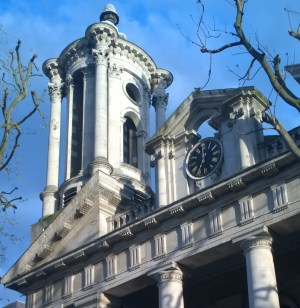 After the Holy Week Festival showcase Good Friday afternoon St John Passion came a concert focussed on one of England’s finest composers, Thomas Tallis. Living though the reigns of five monarchs (from Henry VII to Elizabeth), and composing in the latter four of them, Tallis managed to negotiate the complex religious twists and turns of Tudor life. The highlights of the evening came at the end, with the first modern performance of David Skinner’s reconstruction of a piece composed by Tallis (an early version of the famous Gaude gloriosa Dei mater), but with new words (See, Lord, and behold) added by Katherine Parr, Henry VIII’s eighth and final Queen.
  The St John’s, Smith Square Young Artists scheme gives emerging soloists and ensembles a platform to showcase their talents through three SJSS concerts, a chance to commission new music, and opportunities to develop skills in marketing, education and outreach. The latest batch of six (for the year 2016/17) includes the recorder quartet Palisander. They already seem pretty adept at marketing, and took the opportunity of the first of their three concerts (given under the title Antidotum Arachne) to launch their debut CD, Beware the Spider!.
  The Musicall Compass have undertaken some fascinating projects in the past, combining vocal music with, for example, dance in a memorable performance of Buxtehude’s Memba Jesu Nostri in Christ Church Spitalfields. On this occasion they interspersed the nine five-voice Lamentations of Orlando di Lasso with folk laments from Eastern Europe, sung by Moira Smiley. Written to be performed during the three days leading up to Easter, the Lamentations set verses from Jeremiah’s rather morbid reflections on the decline of Jerusalem: ‘How doth the city sit solitary .. she has become a widow’. Three settings are sung on each day, each finishing with the lament Ierusalem, Ierusalem, convertere ad Dominum Deum tuum (Jerusalem, Jerusalem, return unto the Lord thy God).
 The 31st St John’s, Smith Square Christmas Festival features most of the usual suspects, including regulars, The Cardinall’s Musick. As is typical of their concerts, the focus was on Catholic liturgical music from the Renaissance, on this occasion in honour of the Virgin Mary. In a ‘greatest hits’ line-up of Renaissance composers, the first half was built around Lassus’s Missa Osculeter me osculo oris sui alternating with motets by Victoria; the second centered on Byrd’s Propers for the Nativity of the Virgin Mary and concluded with Palestrina’s Magnificat primi toni a 8.
  largest church in Christendom. Well before the completion of the Basilica, a musical foundation had been established (in 1436), and in 1476 a magnificent organ was built on one side of the choir. This was enlarged, and a corresponding organ added to the gallery on the other side of the choir, in 1596. Both organs survive to this day, in more-or-less original condition, and are amongst the most important surviving historic organs in the world.
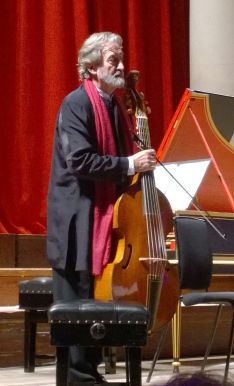 As part of the Southbank Centre’s International Chamber Music Series (currently taking place in St John’s, Smith Square while the Queen Elizabeth Hall is being refurbished), Jordi Savall and Le Concert des Nations presented a sell-out concert of music from the 1991 film Tous les matins du monde. Savall’s pre-concert chat with Radio 3’s Sara Mohr-Pietsch revealed some of the differences between the film’s portrayal and the actual life of Sainte-Colombe and Marais, but confirmed that Marais did crawl beneath Sainte-Colombe’s garden shed to listen to him practicing, that Sainte-Colombe developed a new style of fingering, and added a 7th string to the viol. He also explained how they achieved the voices of the two young girls singing in the film, by speeding up two adult female singers.
 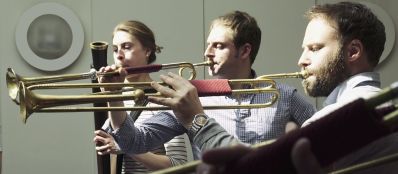 performance was that the trumpets were not only valveless, but also had no finger holes to assist in the tuning of notes. These finger holes (or ‘venting’ or ‘nodal’ holes) are in any case a relatively recent innovation, and may not have been used in early natural trumpets, at least not for the purpose to which they are now used; to make the tuning of the higher harmonic notes easier. Indeed, it seems that the original holes found in some instruments were actually place at the anti-node, rather than the node, and were therefore intended to silence the tricky notes altogether, rather than to try to bring them into tune.
 The players of the Early Opera Company, directed by Christian Curnyn, stepped out of their more usual orchestra pit for an almost instrumental evening of music making at St John’s, Smith Square, with music generally representing the Concerto Grosso format.
 opening with Bach bustling Sinfonia from the cantata Am Adend aber desselbigen Sabbats, composed in 1725, the lengthy instrumental opening (pictured) was apparently intended to give the singers a bit of a break after a busy week. It has a jovial, extended and rather convoluted initial theme which bubbles along until a concluding, and very clever, skipped beat. A conversation between strings and two oboes and bassoon, this is the type of piece that Bach probably scribbled down before breakfast but, 300 years later, stands as an extraordinary example of his genius and skill at turning a string of notes into something inspired and divine.
 Tabea Debus is a young recorder player, currently studying at the Royal Academy of Music. She first came to my attention when she sent me a review copy of her first CD (
 As part of the 30th annual St John’s, Smith Square Christmas Festival, Ensemble Plus Ultra contributed a programme of Advent and Christmas music from Spain, England, and Germany. The rather curious opening had three female singers on stage, while five men approached down the two side aisles, deconstructing the Advent chant Veni, veni Emmanuel by passing it between all three groups. The rest of the first half was a very effective interspersing of Victoria’s 1600 Missa Ave Regina caelorum with Byrd’s 1607 five-part Propers for Lady Mass during Advent. This was preceded by Victoria’s 1581 double choir setting of the Missa Ave Regina caelorum antiphon, upon which the parody mass was based. Although the
  Andrew Benson-Wilson : Early Music Reviews +