Bach St Matthew Passion (1727 version)
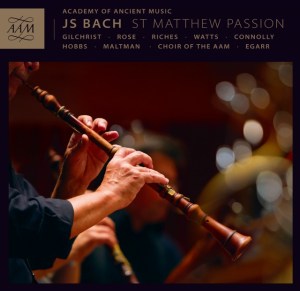
Academy of Ancient Music, Richard Egarr.
AAM Records. AAM004.
Richard Egarr director & harpsichord, James Gilchrist Evangelist, Matthew Rose Jesus, Elizabeth Watts soprano, Sarah Connolly alto, Thomas Hobbs tenor, Christopher Maltman bass. Choir of the AAM. 3 CDs. 58’40+49’39+36’19=144’38
Richard Egarr’s introductory article to this new recording of Bach’s most famous work is headed ‘Oh No, not again’. It concludes with ‘Don’t be a bowl of petunias’, an enigmatic reference to the frequently reincarnated bowl of petunias in ‘The Hitchhikers Guide to the Galaxy’. His article questions the perceived wisdom of assuming that later incarnations of a piece of music are inevitably the best and most complete. Like Handel, Bach often changed and re-ordered his music, often for the most pragmatic of reasons. Normally heard in the version developed from performances in 1736, 1742 and 1746, the Academy of Ancient Music has returned to its first known incarnation of the Matthew Passion, dating from an (assumed) Good Friday Vespers performance in Leipzig’s Thomaskirche in 1727. This early version was copied down a few years after Bach’s death by a pupil of one of Bach’s singers, but we do not know why. It is a remarkable survival.
There are several differences from the later version, many very subtle. The major ones include the fact that the double choir and orchestra structure is weakened by having just one continuo group, rather than two. This implies that the two choirs and their orchestras would have been positioned closer together, as they are on this recording. In contrast, the separation of the two orchestras is then emphasised by having both orchestra leaders (rather than just one) take on the two big violin solos, the solo in Erbame dich played from orchestra 2, accompanied by orchestra 1, with Gebt mir meinen Jesum wieder the other way round. Part One ends, not with the usual O Mensch, bewein dein Sünde groß, but with the simply-stated chorale Jesum lass ich nicht von mir. The Second Part opens with Ach, nun ist mein Jesus hun!, but sung by a bass rather than an alto. This might have spiritual significance, but could equally have been the purely practical result of which singer happened to be in best voice at the time. Perhaps the most distinctive change from the later version comes closer to the end, with the famous bass aria Komm, süßes Kreuz. This is normally the moment when the viola da gamba player takes centre stage for the complex obligato accompaniment. But here Bach chooses the elegiac sound of the solo lute (with organ), a strikingly compelling tonal alteration to the more usual sound. Other changes in instrumentation include the use of the organ and winds (rather than a ripieno choir or soloist) to bring out chorale melody in the opening chorus. More subtle changes are found in the relative reduction in ornamentation, notably in the lack of appoggiaturas (for example, in the orchestral accompaniment of So ist mein Jesus nun gefangen) – often tricky in performance.
Stephen Rose’s intelligent programme note introduces the liturgical and musical background to the Leipzig Passion. It is difficult to imagine the response of the Leipzig congregation to first hearing a work of such power, but Rose helpfully analyses the Passion’s arias within the context of Luther’s 1519 three stages of meditation and contemplation on the Passion story, something listeners of the day would have understood better than we do today.
The Academy of Ancient Music field a strong cast of soloists and instrumentalists, with an exceptional performance from James Gilchrist as the ever-communicative Evangelist. The two 10-strong choirs give gutsy readings of the turbo choruses although, when at full throttle, the sopranos display rather too much vibrato for my taste.
Richard Egarr’s interpretation is characteristically distinctive, not least for his occasionally relaxed approach to pulse and rubato. For example, in the alto aria, Buß und Rei, (CD1:10) he lingers on the penultimate note of phrases, perhaps signifying the repentance and regret of the opening line. Moments like this certainly attracted attention on my first listen, but I found my initial surprise lessened with repeated listening. Indeed, the performance as a whole combines musically strength with sensitivity, and can be thoroughly recommended, not just for the undoubted importance of hearing this rarely performed 1727 version. I have only heard it live once before, during the 2012 Leipzig Bachfest performed by Bach Collegium Japan and the Tölzer Knabenchors under Masaaki Suzuki.
The CD was recorded over a 7-day period in St Jude-on-the-Hill, with Philip Hobbs as the distinguished producer and engineer. It comes in a hardback booklet format, with the full text and an English translation. A sound sample and an introductory video can be found at http://www.aam.co.uk/#/recordings/discography/js-bach/bach-matthew-passion.aspx.
[https://andrewbensonwilson.org/2015/03/29/bach-st-matthe…n-1727-version/]

 A number of churches are accepting the inevitable reduction in congregations and opening their buildings to wider community use. Heath Street Baptist Church, prominently positioned in the middle of Hampstead, is one such, reducing their services to Sunday mornings, but enabling a wide variety of activities during the rest of the week, including frequent lunchtime and evening concerts and, on this occasion, a complete weekend devoted to the ‘Hampstead Baroque Festival’. After four earlier events of English, Italian and French music, all accompanied by food, the weekend concluded with a Sunday evening concert devoted to ‘Bratwurst, Beer & Bach’, given by the newly-formed group L’Istante (not, incidentally, the only early music group to adopt that name *and now renamed as Isante) directed by harpsichordist/conductor Pawel Siwzak.
 The programme notes explain the rational for recording these pieces on clavichord rather than harpsichord, with a convincing argument based on the four-octave compass of the pieces and the didactic nature of their composition, in this case, for his recent (and second) wife Anna Magdalena. This is private, domestic music for home performance or teaching purposes, rather than the more elaborate pieces Bach wrote for public performance, using the larger compass of the harpsichord, for example the three non-organ parts of the Clavierübung. It is also the case that the clavichord was the principal home practice instrument for organists, because the arm to finger weight transfer required is similar for both instruments.
 Christ’s Chapel of Alleyn’s College of God’s Gift in Dulwich was consecrated 400 years ago, in 1616. The chapel and adjoining almshouses were the first of the charity foundations set up by the wealthy actor, Edward Alleyn, owner of the manor of Dulwich. Shortly afterwards, the foundation’s status as a educational college was confirmed, leading to the present day Dulwich College.
 time the Chapel’s first organ was installed. In 1760 it was replaced by a new organ by George England which, despite the usual additions and alterations over the years, still survives with a considerable amount of mid- 18th century pipework and a fine Gothick case. In 2009 it was restored back to its 1760 state (with modest additions) by the UK’s leading specialist on historic organs, William Drake. The original pitch (A430) and modified fifth-comma meantone temperament was restored. It is now one of the most important historic instruments in the UK.
 opening with Bach bustling Sinfonia from the cantata Am Adend aber desselbigen Sabbats, composed in 1725, the lengthy instrumental opening (pictured) was apparently intended to give the singers a bit of a break after a busy week. It has a jovial, extended and rather convoluted initial theme which bubbles along until a concluding, and very clever, skipped beat. A conversation between strings and two oboes and bassoon, this is the type of piece that Bach probably scribbled down before breakfast but, 300 years later, stands as an extraordinary example of his genius and skill at turning a string of notes into something inspired and divine.
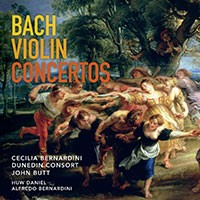 This is a spectacular CD from the ever excellent Dunedin Consort and their leader, violinist Cecilia Bernardini, this time in a solo role. She opens and closes the programme in partnership, first with her father, the distinguished oboist, Alfredo Bernardini, and then with fellow violinist Huw Daniel. Apart from the short central Sinfonia from the cantata Ich hatte viel Bekümmernis, with its exquisite oboe solo, the rest of the nicely symmetrical programme is devoted to the playing of Cecilia Bernardini, with Bach’s E major and A minor violin concertos. And what playing it is. Subtly sensitive, and superbly articulated, she demonstrates a real grasp of Bach’s often complex melodic lines. Her delicacy of tone is matched by her fellow instrumentalists, the chamber-like quality of their playing, and John Butt’s direction and harpsichord continuo playing, being just right for the music, which was almost certainly intended for small-scale performance amongst fellow music lovers.
 the late Renaissance, but with three of Bach’s motets and one by his second cousin and near contemporary, Johann Ludwig Bach. As is so often the case with programmes like this, the sheer power and musical conviction of JS Bach’s motets put all the other composers into the shade, but I guess the audience would have been smaller if JS Bach wasn’t represented.
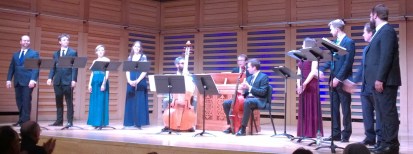 A simple chorale-like setting of Ein neues Lied wir heben an by Johann Walther (1496-1570) was segued into Schütz’s sumptuous 8-part setting of Singet dem Herrn ein neues Lied, the voices swinging from left to right in the Italian polychoral tradition. It was noticeable how Schütz used longer melismas for the passage referring to the joyful noise of the harp, trumpets and cornets. The one non-German composer was Giovanni Gabrieli, with his gentle double-choir O Domine Jesu Christe, here using high-low and well as left-right contrasts. Christian Erbach is a composer that deserves far more exposure than he usually gets. He was represented here by his Domine, Dominus noster, the rhythmic complexity and complex inner movement marking out a composer of distinction. The slightly later Martin Roth also impressed with his Allein zu dir, with its contrasting chorale-like sections and bouncy left-right altercations. However I found the lengthy organ introduction that preceded it rather curious; not least because of the harpsichord-like rapidly spread chords.
 Tabea Debus is a young recorder player, currently studying at the Royal Academy of Music. She first came to my attention when she sent me a review copy of her first CD (
 The 30th St John’s, Smith Square Christmas Festival ended on 23 December with the traditional Messiah, with Stephen Layton directing Polyphony and the Orchestra of the Age of Enlightenment. The evening before saw what has become another tradition, the appearance of the Choir of Trinity College Cambridge (where Stephen Layton is Director of Music), also with the OAE. I missed their concert last year, but I think it was the same work with the same group of soloists (Katherine Watson soprano, Iestyn Davies countertenor, Gwilym Bowen tenor, Neal Davies, bass). Although it lacks the seasonal element of Messiah, it is an extraordinary and uplifting work, whatever your belief in the words and sentiments might be. It also has an fascinating history, reflecting insights into Bach’s character and emotional response to his own compositions. Part of that complex history is that Bach never called it the B minor Mass, only part of it is actually in B minor, and he never heard it performed.
  Returning for their fifth visit to the St John’s, Smith Square Christmas Festival, the Solomon’s Knot Baroque Collective presented a concert based on Advent and Christmas music from Leipzig, with pieces by the three successive Thomaskantor’s. The seating in St John’s was reconfigured from the usual facing-the-stage layout to one where the orchestra and choir were to one side, projecting about two-thirds of the way into the floor space, with the audience arranged on three sides. This was undoubtedly excellent for about one-third of the audience who found themselves sitting directly in front of them, but most of the audience had only a side (or a rear-end view) of the performers.
  Jacques van Oortmerssen was one of the most influential organists and organ teachers of his generation. His untimely death on Saturday 21 November is a great loss to music. In his memory, I am posting extracts from some of my reviews of his Bach organ CDs.
![JS Bach:Violin Concertos [Alina Ibragimova; Arcangelo, Jonathan Cohen ] [HYPERION: CDA68068]](https://i0.wp.com/ecx.images-amazon.com/images/I/618CLr8euKL._SY355_.jpg) I first encountered Alina Ibragimova when she was part of a little student group playing in a lunchtime concert in 2007. Two years later (after she had already won several prestigious awards and released three CDs, of works by KA Hartmann, Roslavets, and Symanowski) I reviewed her extraordinary solo Bach recital at her alma mater, the Yehudi Menhuin School. In my review (in Early Music Review) I wrote that “I don’t think I have ever heard a more promising musician on any instrument – or, indeed, such an intensely musical (and moving) performance of Bach’s unaccompanied violin works . . . She has an extraordinarily compelling stage manner – quite, focused and seemingly at one with her instrument, she quietly walks on stage, stands and plays, looking at her violin with intense concentration and involvement with the music. Alina Ibragimova has an exquisite musical talent and an inspiring musical mind.” Her subsequent CD of the
I first encountered Alina Ibragimova when she was part of a little student group playing in a lunchtime concert in 2007. Two years later (after she had already won several prestigious awards and released three CDs, of works by KA Hartmann, Roslavets, and Symanowski) I reviewed her extraordinary solo Bach recital at her alma mater, the Yehudi Menhuin School. In my review (in Early Music Review) I wrote that “I don’t think I have ever heard a more promising musician on any instrument – or, indeed, such an intensely musical (and moving) performance of Bach’s unaccompanied violin works . . . She has an extraordinarily compelling stage manner – quite, focused and seemingly at one with her instrument, she quietly walks on stage, stands and plays, looking at her violin with intense concentration and involvement with the music. Alina Ibragimova has an exquisite musical talent and an inspiring musical mind.” Her subsequent CD of the  Bach solo violin works (CDA67691/2) remains one of my favourite interpretations. And, for many people, the highlight of the 2015 BBC Proms was Alina’s two late-night solo Bach performances. So another Alina Ibragimova Bach recording is something to look forward to.
 This timely (but subtle) release for the season includes three choral preludes on the Advent choral Nun komm, der Heiden Heiland, the Italianate Pastorella and the Canonic Variations on the Christmas choral, Vom Himmel hoch, together with the Prelude and Fugue in C (BWV 547) which some commentators have associated with Christmas performance. These works are enclosed within the well-known Fantasia and Fugue in G minor (BWV 542) and the final exhilarating Prelude and Fugue in G (BWV 541).
 This recording comes with several health warnings, not least the fact that none of the five featured Sonatas are quite what they seem. The three Bach sonatas were, as the CD title implies, intended for the viola da gamba. The Scarlatti Sonata was probably intended for solo harpsichord although there is an argument that it, and some of its fellow sonatas, could have been performed as a violin sonata. The Handel Sonata was originally for oboe but was transcribed for the violin with a scribbled note that it could be played on the viola da gamba. None were intended for the cello.
  As a supplement to Margaret Phillips’ 16 CDs of Bach organ works (published as eight double CDs plus this volume), this CD includes alternative versions, pieces usually allocated to but probably not by Bach, pieces not intended for organ, and one piece had not been rediscovered when the other Bach pieces were recorded, between 2005 and 2009. You could fill a further 16 CD with such peripheral and alternative pieces, so the selection of these 16 must have been quite a task. The choice is an excellent one, balancing well-known pieces such with little-known works like the Fantasia duobus subjectis.
 I have been watching violinist Johannes Pramsohler make his mark in the world of period violin playing over the past few years, and this CD shows that his growing reputation is well deserved. This well-chosen programme of relatively unknown Sonatas from the Bach circle, is a telling reminder that although his later fame came from his organ playing, Bach’s early childhood was spent learning the violin from his violinist father. As Pramsohler’s notes point out, it was only when the 10 year-old Bach, now orphaned, moved into his organ-playing elder brother’s house, that he started to focus on the organ. But he kept his father’s violin, his only inheritance, all his life. Although only one work is definitely by Bach, with two possibly Bach’s, Bach is suffused throughout the other works, by Pisendel, Graun and Krebs, representing the extraordinary flowering of musical talent in 18th century Weimar, Leipzig and Dresden. The Graun and Krebs works are world premiere recordings, taking us into a slightly later musical period. The CD ends with Bach’s extraordinary Fugue in g (BWV 1026).
 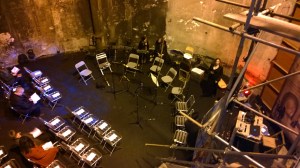 railway system, and the shaft has been re-opened with a concrete floor inserted to separate it from the trains below. It is currently only accessible by wriggling through a 1.3m high entrance and clambering about 12m down on some rickety scaffolding stairs.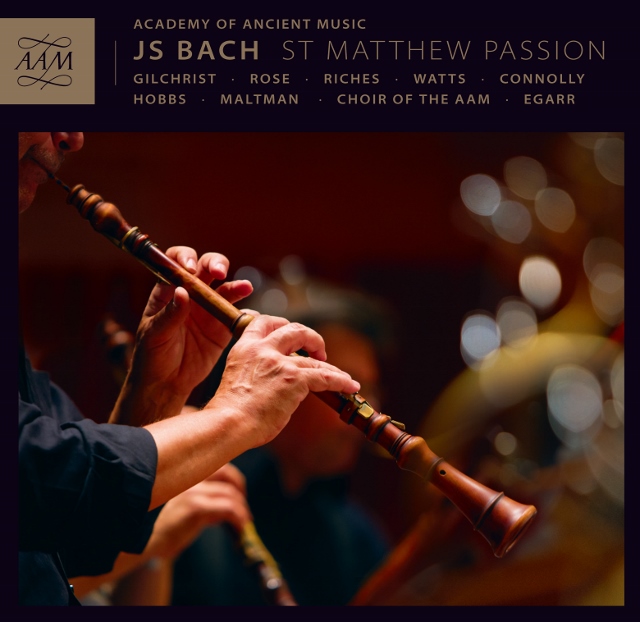
 Andrew Benson-Wilson : Early Music Reviews +