A New Song: Bach and the German Baroque
Oxford Baroque
Kings Place, 11 February 2016
JS Bach: Singet dem Herrn ein nein neues Lied (BWV 225), Lobet den Herrn (BWV 230), Jesu, meine Freude (BWV 227); J Ludwig Bach: Das ist meine Freude; Schütz Singet dem Herr ein neues Lied (SWV 35), and pieces by Gabrieli, Calvisius, Johann Walther, Hassler, Erbach, Roth, Handl.
The Kings Place ‘Baroque Unwrapped’ series continued with a fascinating concert by Oxford Baroque exploring the rich history of the German motet, generally focussing on  the late Renaissance, but with three of Bach’s motets and one by his second cousin and near contemporary, Johann Ludwig Bach. As is so often the case with programmes like this, the sheer power and musical conviction of JS Bach’s motets put all the other composers into the shade, but I guess the audience would have been smaller if JS Bach wasn’t represented.
As David Lee pointed out in his programme note, writers often assume that Bach’s motets are an essay in an outdated form, rather like Purcell’s Fantasias for the viols. But they are in fact a continuation of an important Lutheran tradition. Described (by JG Walther, in 1732) as a “composition on a biblical text, to be sung with only continuo instruments, richly ornamented with fugues and imitations”, they reflect Luther’s insistence on the importance of music as “the greatest treasure in the world”.
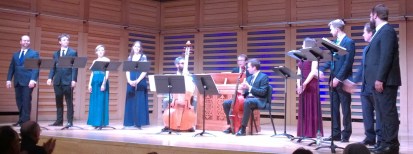 A simple chorale-like setting of Ein neues Lied wir heben an by Johann Walther (1496-1570) was segued into Schütz’s sumptuous 8-part setting of Singet dem Herrn ein neues Lied, the voices swinging from left to right in the Italian polychoral tradition. It was noticeable how Schütz used longer melismas for the passage referring to the joyful noise of the harp, trumpets and cornets. The one non-German composer was Giovanni Gabrieli, with his gentle double-choir O Domine Jesu Christe, here using high-low and well as left-right contrasts. Christian Erbach is a composer that deserves far more exposure than he usually gets. He was represented here by his Domine, Dominus noster, the rhythmic complexity and complex inner movement marking out a composer of distinction. The slightly later Martin Roth also impressed with his Allein zu dir, with its contrasting chorale-like sections and bouncy left-right altercations. However I found the lengthy organ introduction that preceded it rather curious; not least because of the harpsichord-like rapidly spread chords.
Johann Ludwig Bach’s Das ist meine Freude was an attractive piece in a later idiom, the repeated opening phrase being a notable feature throughout. Jacob Handl’s a capella Ecce Quomodo moritur Justus was a gentle introduction to the second half, and was followed by the equally early motet by Sethus Calvisius, a composer unknown to me, and I suspect many others. He was a predecessor of Bach’s as Cantor of the Leipzig Thomasschule, and Bach purchased copies of his music when he was in Leipzig. Unser leben währet siezig Jahr slipped in and out of triple rhythms and also contrasted faster and slower sections.
After a further two JS Bach motets, Oxford Baroque finished with a gentle Gute Nacht encore. The eight singers occasionally revealed what was possibly limited rehearsal time, and I found the vibrato of the two otherwise impressive sopranos, although mild by some standards, a little too prominent for my tastes. But otherwise they all sang with a commendable sense of style, conviction and occasional gusto. It was refreshing to see a choir singing without an obvious director, any needed coordination coming from within the group. They were accompanied by a viola da gamba, violone, and organ. It was good to be able to actually hear the organ during the Bach motets.
 The London Festival of Baroque is growing from strength to strength after its rebirth from its previous incarnation as the Lufthansa Festival. Shorn of the former funding stream, it has had to rebuild its financial stability. The increase in the number of this year’s events over last year is one sign of their success. One of the big advantages of the former sponsorship deal was that it enabled many non-UK groups to travel to London for the festival, so it is encouraging that such visits by musicians from abroad continue to be a feature of the festival. Also most encouraging is their focus on young musicians, with three concerts specifically devoted to them under the banner of ‘Future Baroque’. They also included a late-night concert by the young folk-inspired singer-songwriter, Olivia Chaney.
 Johannes Pramsohler and his three fellow musicians of Ensemble Diderot relished the contrast between and within the various pieces, playing with an exquisite combination of consort and individuality. Their intonation was perfect throughout, and they managed to bring exaggeration to the already exciting music without ever pushing things too far. I particularly liked the fact that, despite having a clear group leader, his playing never dominated. These were true Trio Sonatas, where the balance between the three voices is vital – and Roldán Bernabé and Gulrim Choi had important contributions on second violin and cello. Philippe Grisvard’s harpsichord continue was delicate and sensitive, correctly avoiding the temptation to do too much.
 The untimely death in August 2015 of the eminent organist and choral director John Scott was a shock to many. Organist and Director of Music of St Paul’s Cathedral from 1990 to 2004, and then at St Thomas Church on Fifth Avenue, New York, John’s reputation as solo organist and choir director seemed to be on a perpetual rise. His memory remains strong in St Paul’s Cathedral, as was evident from the packed Service of Commemoration and Thanksgiving to mark his life, held in place of the usual Evensong on Friday 6 May.
 This is the penultimate recording in The Cardinal’s Musick’s Tallis Edition, and it opens with a masterpiece, the two settings of the Lamentations of Jeremiah. As Andrew Carwood explains in his programme notes, it seems that they were written during the reign of Queen Elizabeth, rather than the earlier Catholic Queen Mary. It is not clear why these, and other similar Lamentations, were composed or when they would have been performed, if not in the Holy Week Tenebrae service in the Catholic rite – hence the usual assumption of composition during Queen Mary’s reign. They are remarkable pieces, using the simple textural style of one note per syllable encouraged by Archbishop Cranmer. The Hebrew incipits are particularly well set, as are the concluding, and rather sombre
  It is when you hear music from composers like Niccolò Jommelli (1714-74) that you realise just how deep the musical well is, if you peep behind the wall of well-known composers. Writing in that fascinating limbo period between the Baroque and Classical era, Jommelli perhaps completed too many operas for posterity to master. Il Vologeso is one of his best-known works and, on the strength of this performance by Classical Opera Company (giving the UK premiere), deserves to be heard more, and in a full staging rather than this concert performance. This was another part of their MOZART 250 project, aimed at exploring the works of Mozart and his contemporaries on the anniversary of their composition – which, in the case of Il Vologeso, was on 11 February 1766, in the enormous theatre at the Duke of Württemberg’s Ludwigsburg Palace near Stuttgart.
 The evening started, slightly unfortunately, with the Tragic Overture of Brahms, the bête noire of Bruckner and Hans Rott (pictured), and several others of a progressive ilk, such as Mahler. Unfortunate, because of the effect that Brahms’ withering comments on Hans Rott’s First Symphony had on the young composer. The unfortunate Rott (1858-84) was a student contemporary of Mahler and Hugo Wolf at the Vienna Conservatory, and studied organ with Bruckner, who saw him as his ‘favourite pupil’. Although Rott hadn’t impressed a conservatory competition panel with a piano reduction of the first movement, he went on to expand it into a four movement symphony. For reasons unknown, and certainly ill-advised, the then 22 year-old Rott showed the score to Brahms, an enemy of anything musically progressive, and of Bruckner and the Vienna conservatory. Brahms advised the already vulnerable young man to ‘give up composing’, leading to a possibly hallucinatory incident that resulted in him being committed
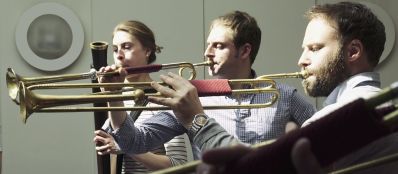 performance was that the trumpets were not only valveless, but also had no finger holes to assist in the tuning of notes. These finger holes (or ‘venting’ or ‘nodal’ holes) are in any case a relatively recent innovation, and may not have been used in early natural trumpets, at least not for the purpose to which they are now used; to make the tuning of the higher harmonic notes easier. Indeed, it seems that the original holes found in some instruments were actually place at the anti-node, rather than the node, and were therefore intended to silence the tricky notes altogether, rather than to try to bring them into tune.
 A number of churches are accepting the inevitable reduction in congregations and opening their buildings to wider community use. Heath Street Baptist Church, prominently positioned in the middle of Hampstead, is one such, reducing their services to Sunday mornings, but enabling a wide variety of activities during the rest of the week, including frequent lunchtime and evening concerts and, on this occasion, a complete weekend devoted to the ‘Hampstead Baroque Festival’. After four earlier events of English, Italian and French music, all accompanied by food, the weekend concluded with a Sunday evening concert devoted to ‘Bratwurst, Beer & Bach’, given by the newly-formed group L’Istante (not, incidentally, the only early music group to adopt that name *and now renamed as Isante) directed by harpsichordist/conductor Pawel Siwzak.
 The players of the Early Opera Company, directed by Christian Curnyn, stepped out of their more usual orchestra pit for an almost instrumental evening of music making at St John’s, Smith Square, with music generally representing the Concerto Grosso format.
 Christ’s Chapel of Alleyn’s College of God’s Gift in Dulwich was consecrated 400 years ago, in 1616. The chapel and adjoining almshouses were the first of the charity foundations set up by the wealthy actor, Edward Alleyn, owner of the manor of Dulwich. Shortly afterwards, the foundation’s status as a educational college was confirmed, leading to the present day Dulwich College.
 time the Chapel’s first organ was installed. In 1760 it was replaced by a new organ by George England which, despite the usual additions and alterations over the years, still survives with a considerable amount of mid- 18th century pipework and a fine Gothick case. In 2009 it was restored back to its 1760 state (with modest additions) by the UK’s leading specialist on historic organs, William Drake. The original pitch (A430) and modified fifth-comma meantone temperament was restored. It is now one of the most important historic instruments in the UK.
 opening with Bach bustling Sinfonia from the cantata Am Adend aber desselbigen Sabbats, composed in 1725, the lengthy instrumental opening (pictured) was apparently intended to give the singers a bit of a break after a busy week. It has a jovial, extended and rather convoluted initial theme which bubbles along until a concluding, and very clever, skipped beat. A conversation between strings and two oboes and bassoon, this is the type of piece that Bach probably scribbled down before breakfast but, 300 years later, stands as an extraordinary example of his genius and skill at turning a string of notes into something inspired and divine.
 It was a mark of the respect that the viola da gamba player, Richard Campbell, is held that so many people came to the Guildhall School of Music & Drama to celebrate his 60th birthday. The evening also marked the presentation to the Guildhall School of a Lirone and a Bandorra from Richard’s own collection, both to be made available to any young musician for study and performance. The choice of two such unusual instruments was a nice reflection of Richard’s wide-ranging musical interests.
  (every other month) at St Michael’s, on South Grove, Highgate. They opened the series with a concert of music from the North German masters, Dietrich Buxtehude and his predecessor at the Lübeck Marienkirche (and father-in-law), Franz Tunder. Tunder is usually unfairly overlooked in favour of his successor, but it was he who started the famous series of Lübeck Abendmusik concerts that traditionally took place on the five Sundays before Christmas every year; a tradition that lasted until 1810. They (and the then aging Buxtehude) famously attracted the young Bach in 1705.
 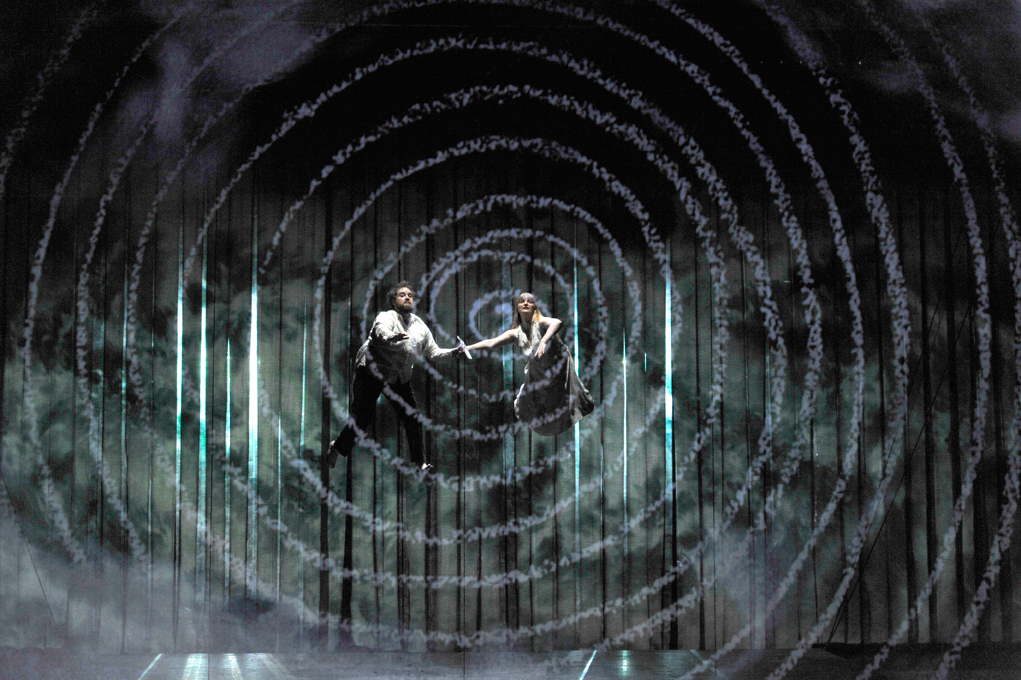 nal take. My review of the opening of McBurney’s version included “In contrast to the previous production, this Magic Flute is dark, mysterious and more than a little weird. A flood of ideas drenched the stage, aided by a commentator sitting in a box in the corner, chalking up comments onto a large video screen. But there seems, at least to me, on first sight, little coherence to link it all together. Masonic references are played down, but the element of cult is still stressed through colour-coded camps in conflict . . . It may well be that, in 25 years time, I will miss this production. But, in the meantime, it will certainly take me some time to get used to it”.
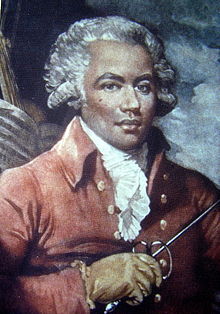 centred on the fascinating character Joseph de Bologne, Chevalier de Saint-George (b1745), the son of a wealthy French plantation owner in Guadeloupe, and his African slave. Educated back in France from the age of 7, he first became known as a fencer, graduating from the Academy of fencing and horsemanship aged 21 and somehow collecting the title of chevalier (knight) on the way. Quite how he achieved his skills in music is not known, but the composers Lolli and Gossec had already dedicated works to him before he was 21. He quickly became one of the leading Parisian violinists and orchestra leaders. He briefly lived in the same house as Mozart (the mansion of his mentor, the Duke of Orléans in Paris), and was leader of the enormous Masonic Loge Olympique orchestra, for which Haydn wrote his Paris Symphonies.
 Tabea Debus is a young recorder player, currently studying at the Royal Academy of Music. She first came to my attention when she sent me a review copy of her first CD (
 For years now Andreas Scholl has had the ability to fill stadia and opera houses, although his singing usually seems more suited to smaller spaces. He is often derided by opera critics for the comparatively low volume of his voice, although I often think that he has it about right, and the others sing too loudly, at considerable cost to their voices. But in the compact environment of the Sam Wanamaker Playhouse (the Shakespeare Globe’s reconstruction of a Jacobean theatre), he had no fear of being thought too quiet.
 Andrew Benson-Wilson : Early Music Reviews +