Meister: Il giardino del piacere
Ensemble Diderot, Johannes Pramsohler
Audax ADX13705. 66’45
Johann Friedrich Meister: Il Giardino Del Piacere (La Musica Terza, Settima, Ottava, Nona, Prima & Duodecima).
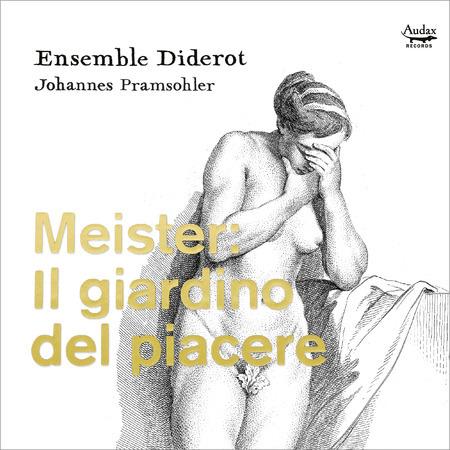 About ten years after Reinhard Goebel’s Musica Antiqua Köln disbanded, Ensemble Diderot have completed their last CD project by recording the remaining six Trio Sonatas from his Il giardino del piacere, overo Raccolta de diversi fiori musicali, come sonate, fughe, imitationi, ciaccone, passagaglie, allemande, correnti &c. We know little of Johann Friedrich Meister. He seems to have come from Hanover, and certainly worked in the Ducal Court there. After a dispute about pay, he moved to the Lübeck area before moving north to Flensburg in Schleswig (then part of Denmark and now the most northerly city in Germany) where he was organist of the Marienkirche and work for the local Ducal Court. His collection, Il giardino del piacere (pleasure garden), was published in Hamburg in 1695, shortly before his death.
Meister’s music seems to sum up the varied and exciting music of that period in German musical history, a period dominated by the stylus phantasticus (fantasy style) of free and often rather anarchic musical structures. The latter is shown in the fact that none of the Sonatas on this CD have the same format. Although all open with a Sonata, usually with a central fugal section, the following dances seem to be in almost random order and style, although they all end with a Gigue.
Johannes Pramsohler and his three fellow musicians of Ensemble Diderot clearly relish the contrast between and within the various pieces, and they play with an exquisite combination of consort and individuality. Their intonation is perfect throughout, and they manage bring exaggeration to the already exciting music without ever pushing things too far. I particularly like the fact that, despite having a clear group leader, his playing never dominates. These are true Trio Sonatas, and the balance between the three voices is vital – Roldán Bernabé and Gulrim Choi have important contributions on second violin and cello. Philippe Grisvard’s harpsichord continue is delicate and sensitive, correctly avoiding the temptation to do too much. And Johannes Pramsohler is a very talented violinist that is well worth watching out for.
The recording is of excellent quality. I like the fact that the little up-beat breaths before pieces start are retained. These are an essential part of performance practice but are usually inaudible from the concert stage, or edited out from recordings. The CD was launched at their concert in London’s St John’s, Smith Square on 8 May, reviewed here.

 Recorded in 2003, this is presumably a reissue, although I couldn’t anything to confirm that. It is not listed on il Gardellino’s website. Matthessohn seems to have been one of the first to wonder how Telemann managed to compose so much music. This, and the dominance of Bach in the revival of German baroque music, has always been a bit of a problem. The opening Concerto in this CD helps by including several moments that many listeners might recognise. Matthessohn also commented that “Telemann alone is beyond all praise and lauds”, and this CD demonstrates the exceptional quality of his music. Both technically and musically, his compositional skill is self evidence, as is the breadth of his creative imagination. Continue reading
  With the subtitle of ‘Franz Tausch in Context’, this début recording by Boxwood & Brass explores the music of the clarinettist and composer Tausch as he moved from Mannheim to Munich and then to Berlin. His XIII Pièces en Quatuor for two clarinets, horn and bassoon was his most substantial chamber work, and is performed here complete, in two suites. Published in 1812, the pieces might have been intended for Taush’s own saloon concerts – they are clearly music to be listened to, rather than the mere background music of some of the harmoniemusik repertoire. This is the first time that they have been recorded complete, an important occasion for Tausch and Boxwood & Brass.
 Joanne Metcalf: Il nome del bel fior;
 Nevermind is a rather quirkily named group of four musicians (Anna Besson, flute, Louis Creac’h, violin, Robin Pharo, viola da gamba, Jean Rondeau, harpsichord) who met while studying at the Conservatoire Supérieur National de Paris (CNSM). They share an interest in early music, jazz and traditional music. In 2014, they won the Special Price of the Van Wassenaer Competition in Utrecht. They take their name from a quotation by the 19th
  This CD reflects the tradition of polyphonic singing in the style of Palestrina that developed during the 19th century in the collegiate church of Our Lady of the Old Chapel in Regensburg, a tradition that later extended to the Cathedral and its famous Domspatzen boys choir. The recordings are intended as a tribute to the conductor Josef Kohlhäufl, director of music at the Alte Kappelle from 1984 to 2011, who revived the polyphonic tradition during his tenure.
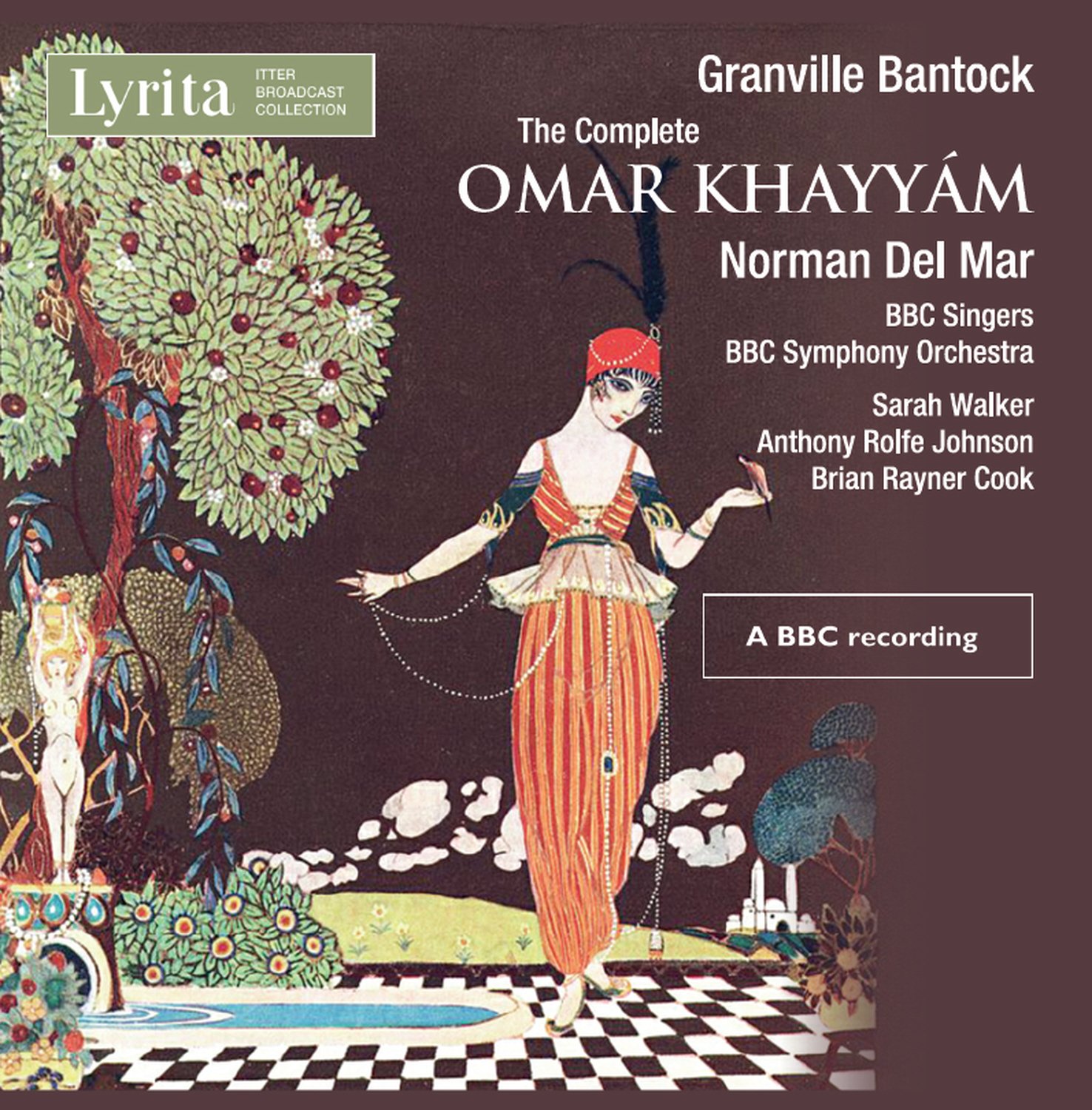 Bantock: Omar Khayyám (172’ 33),
 This is a rather curious CD, subtitled “Ramon Llull – chronicle of a medieval voyage: conversion, study and contemplation”. When I first saw the CD, with its mention of Ramon Llull (Raymond Lully), I wondered if this was a discovery of a previously unknown mediaeval composer. But it turns out the Llull/Lully has nothing to do with the music on the recording. The ‘bouquet of pieces’ on the disc are apparently an offering to the admirers of Llull on the 700th anniversary of his death. A rather curious offering, considering that for most of his life, Llull had little or anything to do with music, and certainly not for the sort of music on this CD.
 Mozart: Sonata in D, K381; Sonata in C, K521; Sonata in B-flat, K358, JC Bach: Sonata in A.
 Despite their name the Elysium Ensemble, at least on this recording, consists of just two people, Greg Dikmans and Lucinda Moon, playing flute and violin respectively. Founded in 1985, the Australia-based Elysium Ensemble has in recent years concentrated on the instrumental duet, with research and concerts exploring the concept of ‘Dialogue: the Art of Elegant Conversation’. The foundation of this is the concept of rhetoric, or “the art of discourse and communication, of speaking with elegance and eloquence.” With roots in Aristotle’s discussions on oratory, and 18th century musicians and writers such as Quantz, they explore the concept of rhetoric in music through Boismortier’s Six Sonatas pour une flute traversiere et un violin par accords, published in Paris in 1734.
 This fascinating double CD stems from the 800th anniversary (in 2011) of the laying of the first stone of the Cathedral of Reims, where Nicolas de Grigny, the finest organist composer of the French Baroque era, served as organist from 1696 until his premature death in 1703. The current organ in the cathedral is not suitable for the performance of their most famous composer’s music, but the nearby Basilique St-Remi has a Bertrand Cattiaux organ, built in 2000, with the registrations required for the French Baroque repertoire. In an enterprising initiative, the “Association Renaissance des grandes orgues de la Basilique St-Remi” started a musical project in homage to de Grigny by inviting five contemporary composers to write a new work for organ based on one of de Grigny’s five hymn settings.
  Much of Vivaldi’s music was written for the Venetian Ospedali della Pietà, one of many such orphanages set up to cater for the many unwanted, and usually female, babies that seemed to appear some nine months after the carnival season. Although originally funded as charities, they quickly established a reputation for their musical activities, attracting large crowds and provided a secure, and indeed rather opulent, financial establishment. Firmly on the tourist essential to-do list, these female choirs attracted such comments as the one by Charles de Brosses in 1739 who wrote that “there is nothing so pleasant as to see a pretty young nun in a white habit, with a bunch of pomegranate blossoms over her ear directing the orchestra … their voices are delightful in their elegance and lightness”.
 For many years I was invited to review the International Young Artists’ Early Music Network Competition, held every other year in York. Apart from initially getting to know the young musicians competing in the final, one of the most rewarding aspects was that competitors would keep me in touch with their developing careers, which usually included them sending me their first CD a few years later. The winner of the 2007 competition was Le Jardin Secret (centred on soprano Elizabeth Dobbin) who, rather unusually for competitions, also won the audience prize. In their case, I seem to have missed out their first two CDs, but have new received this, their third, CD.
 Some of Handel’s most exciting and dramatic music was composed during the three short years he spent in Italy, starting when he was just 21. Despite offers of financial assistance from a Medici Prince, Handel famously ‘made his way on his own bottom’, as his biographer Mainwearing put it. Mainwearing suggests that prior to his visit, Handel ‘could see nothing’ in Italian music which, if it is true, is rather surprising, as Italian music had been at the forefront of much of the European Baroque, not least because of the developments in opera, oratorio and cantata. Handel very quickly absorbed the taste and style of Italian musicians both from Rome and also from his shorter visits to Venice, Florence and Naples. In his compositions from this period, he often outdid the Italians in writing in their style – as he did in England later in his life.
 The creation of the opera-ballet Les Éléments has links with the courtly and musical politics of Paris. Louis XIV died in 1715, leaving as his successor a five-year old fragile child. One of the focuses of the Regency was to ensure that the young Louis XV would survive at least as long as it took for him to father a successor to the throne. Dance was seen as a suitable approach to both encourage his own development, and to show to others that he was capable of succeeding his long-lived father and, eventually, to do his bit for the future of the royal line. To this end, several ballets were commissioned, usually giving the King a moment to strut his stuff in front of the assembled courtiers.
 Antonio Maria Montanari (1676-1737) was one of the most celebrated violinists in Rome during the period when Handel was there. He played in the orchestras of many of Rome most extravagant families and cardinals, including the Borghese, Ruspoli, Colonna and Pamphilj. He played in the first performance of Handel’s La Resurrezion in 1708. After Corelli’s death in 1713, Montanari took over some of his concertmaster roles. He is little known today, but his Opus 6 collection of violin concertos was one of the most advanced sets of the period. This inspiring CD of six of his concertos (all but one being first recordings – the Concerto in A Major, Op1/8 has been recorded by EUBO, the European Union Baroque Orchestra) will do much to return him to his former fame.
  Nicolaus Bruhns (1665-1697) is one of the most important organist/composers of the North German 17th century Baroque: that extraordinary outpouring of music that over the whole century developed and honed a distinctive style that the likes of Handel and Bach carried forward into the 18th century. The favourite pupil of the famed Lübeck organist, Dietrich Buxtehude, Bruhns came from a family of musicians. He came from Husem, then part of Denmark, but his family had strong musical connections with Lübeck. After a time in Copenhagen, Bruhns returned to Husem as city organist, where he remained until his untimely death, aged just 31.
 The music on this recording reflects the music in and around Elizabeth I’s court. A keen lute player herself, at the height of her Golden Age, she employed some 70 musicians in her court. Rather surprisingly, the first piece is by Orlande de Lassus, Susanne un jour, somebody with no Elizabethan connection at all. But this became very popular throughout Europe, and is played here in a contemporary version found in the Matthew Holmes Manuscript in Cambridge University Library.
  What a gorgeous CD! As well as Dowland’s famed seven ‘tears’ (lasting around 26’) we also have a balancing succession of dances, many based on Dowland songs. The pieces in the 1604 Lachrimae publication were used by generations of other composers’ in their own versions and variations. Key to viol consort music like this is the balance between the instruments. Unlike some of their concerts, where the treble viol can dominate, here the balance is perfect, not just between the five viols, but also with the delicate tone of the lute, played with superb conviction and musicality by Elizabeth Kenny.
  This is the third of The Orlando Consort’s recordings of Machaut’s secular songs, following on from their ‘Songs of Le Voir Dit’ and ‘The Dart of Love’ CDs. Music like this can be appreciated at many different levels, and perhaps one of the most satisfactory (unless your mediaeval French is up to scratch) is to ignore the programme notes or translations of the text, turn the lighting down and just let the music wash over and through you. Although it might appear disrespectful to the enormous amount of research that has to go into producing a recording like, it really does work as a musical experience.
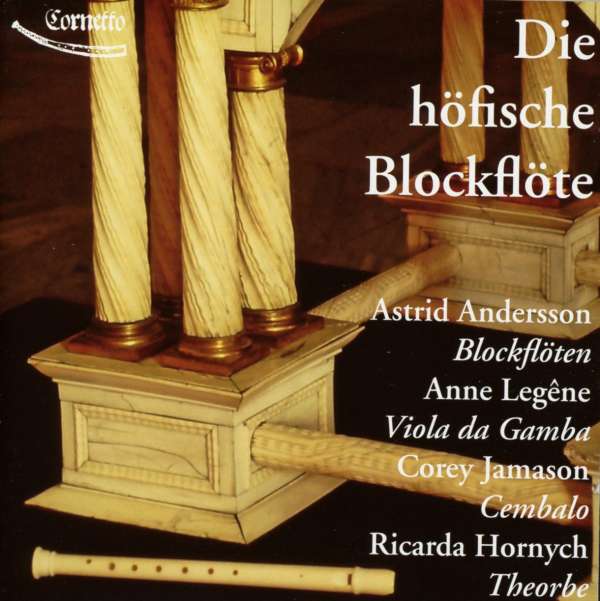 Using modern copies of seven different types of historic recorder (blockflöte), Die höfische Blockflöte (The Royal Recorder) explores the link between musical instrument making and the various royal courts of Europe. The recorders range from two different versions of the two mid-17th century Rosenborg soprano recorders, one made in maple, the other (at higher pitch) in the original material, narwhale tusk, both made by Fred Morgan. The originals are to be found amongst the Crown Jewels in the Royal Collection in Rosenborg Castle, Copenhagen. It can bee heard in Jacob Van Eyck’s Prins Robberts Masco.
 :format(jpeg):mode_rgb():quality(90)/discogs-images/R-7937697-1452199530-8698.jpeg.jpg) One of the most distinctive sounds of the early German Baroque is the sensuous combination of voices and viols, here represented by music by the little-known Samuel Capricornus. Born in Bohemia, Capricornus’s Protestant family soon fled to Bratislava for fear of the Counter-Reformation. After studies in more religiously tolerant Silesia, Capricornus moved first to Stuttgart and then briefly to Vienna at the end of the devastating Thirty Years War. In Vienna he joined the sumptuous musical court of Ferdinand III, whose death shortly afterwards led to another move, this time back to Bratislava (the Preßburg) before being invited to the prestigious post
One of the most distinctive sounds of the early German Baroque is the sensuous combination of voices and viols, here represented by music by the little-known Samuel Capricornus. Born in Bohemia, Capricornus’s Protestant family soon fled to Bratislava for fear of the Counter-Reformation. After studies in more religiously tolerant Silesia, Capricornus moved first to Stuttgart and then briefly to Vienna at the end of the devastating Thirty Years War. In Vienna he joined the sumptuous musical court of Ferdinand III, whose death shortly afterwards led to another move, this time back to Bratislava (the Preßburg) before being invited to the prestigious post  Jean-Christophe Dijoux was the winner of the harpsichord category of the 2014 Leipzig International Bach Competition, and this CD stems from that success. Born in Réunion, Dijoux studied in Paris, Freiburg and Basel, spent a year touring with the European Union Baroque Orchestra (EUBO), and won awards for continuo playing at the 2013 International Telemann Competition. Using two harpsichords (built by Matthias Kramer of Berlin after 1701 and 1754 originals) and four different temperaments, he explores music with a connection to Hamburg. Both instruments have 16’ stops, adding an impressive gravitas to the sound.
 Domenico Zipoli is often seen as a rather insubstantial composer compared to his contemporaries, his surviving organ pieces being generally short and sometimes rather light pieces intended for use in the Catholic service. Although his harpsichord suites were not constrained by such circumstances, they are also attractive, rather than emotionally intense, works. This double CD, one each devoted to organ and harpsichord, present his complete keyboard works and might help to put Zipoli in a better light. They were published in two volumes of Zipoli’s 1716 Sonata d’intavolatura per organo e cimbalo while he was organist of the Jesuit church in Rome. Shortly afterwards, he moved to Seville en route to Paraguary but, after an eventful voyage, ended up in
  Eamonn Dougan, associate conductor of The Sixteen, continues his exploration of music from Poland with this CD of music by Italian musicians in the late 16th century during the reign of Sigismund III Vasa. Sigismund III ruled the Polish/Lithuanian state at a time of religious upheaval. Raised a Catholic his Polish mother in the Protestant Sweden of his father (the King of Sweden), he soon became involved in the Counter-Reformation, seeking out musicians from Rome to help in his quest.
 If the composers aren’t familiar to you, some of the melodies will be in this selection of 19th century guitar pieces inspired by Scotland during the early Romantic era. Scotland was an influence to many artists and musicians of that period, famously Mendelssohn after the 1829 visit that produced the Scottish Symphony, Hebrides Overture and Fingal’s Cave. Giuliani Mauro is given most coverage, with six simple pieces, some of which are enlarged into a larger format by combining, repeating, and adding a prelude. Fellow Italian Lauigi Legnani has the most extended and elaborate pieces with his two variation sets on themes from Rossini’s opera La donna del lage, based on Sir Walter Scott’s poem on James V of Scotland.
 Hindorõdin hindodre (One of the Cragich),
 Andrew Benson-Wilson : Early Music Reviews +