The Image of Melancholy
Barokksolistene
Sam Wanamaker Playhouse, 20 September 2015
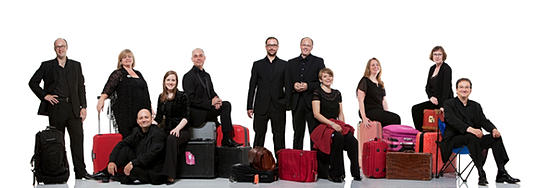
The Norwegian group Barokksolistene make a point of ‘pushing boundaries’ with their occasionally curious mixture of Norwegian folk music, early music and electronic jiggery-pokery, played on period string instruments. They brought this combination to the Globe’s Sam Wanamaker Playhouse for a programme based on their recent CD, The Image of Melancholy. The electronic jiggery-pokery opened the show with ambient background sounds whilst two of the Globe’s candle-lighters slowly lit the 48 candles on the six central candelabra, seemingly designed specifically to drip molten wax on to the performers below. As the background electronics began to merge with an off-stage violin sound, the eight musicians (an enlarged string quartet, plus archlute and what was described as an organ) entered the stage one by one and sat in a circle, as if waiting for a group therapy session. It was clear from the title that this evening was unlikely to be a bundle of fun, but I wasn’t quite prepared for it actually turned out to be.
The thing that was ‘described as an organ’ turned out to be one of those little hand-pumped squeeze-box reed organs usually to be found in Indian ashrams, with what looked like a tiny midi keyboard sitting on top, linked to a laptop. I originally wondered if all the electronic sounds were coming via the latter combination, but it turned out that there was somebody sitting in the gallery producing ‘soundscapes’. By and large, these consisted of the ambience background sounds we had already heard, reminiscent of Brian Eno’s early pieces, plus some very electronic-sounding organ tones of the type used in late 1960’s alternative rock groups. Very few of the pieces we heard were without some sort of background sound like this, whether by the likes of Holborne, Dowland, Gibbons or Byrd or obscure (at least to me) Norwegian folk melodies.
Staging is key to Barokksolistene’s performances, and much thought had gone into this, with on and off stage comings and goings including, at one stage, a bizarre dance given by the group’s leader Bjarte Eike, out of sight of most of the audience behind the central door at the back of the stage. His rocking back and forth on his own in the dark reminded me of scenes from The Wicker Man. This came as the culmination of an extended passage of what I initially thought was tuning up (and still might have been), but which then morphed into this rather ritualistic scene. Eike sees himself as very much the centre of attention, visually and aurally, and despite the mood of a particular piece, was often to be found standing in the middle of the sitting circle. Not surprisingly, the concert ended with an extended violin solo with Eike standing at the front of the gallery to the accompaniment of phase-shifting ambient sound and the archlute while the candelabra rose and fell, seemingly randomly. There was a large and enthusiastic crowd of friends and family whose whooping and yelling at the end of the concert seemed slightly out of keeping given the subject matter of the evening’s concert and, particularly, the last piece, a lament on the death of the composer’s wife. But perhaps they do things differently in Norway – judging by the encores, Norwegian weddings have more than a touch of melancholia to them.
 The highlight was the singing of soprano Berit Norbakken Solset (left), both in the folk songs and the early pieces, notably in Buxtehude’s bittersweet lament for his father, the Klag-Lied, and in the equally expressive Byrd ‘Ye sacred muses’, a lament on the death of Tallis with the mournful phrase “Tallis is dead, and music dies”. Instrumentally the finest sounds came from strings in the early pieces, producing a muted tone quite close to that of the viol consort which would have almost certainly been the preferred accompaniment to singers of the time. I am not sure what the likes of Dowland or Holborn would have made of the frequent foot-tapping from one of the players, but it seemed more of a performance tic than relating to any sense of rhythmic enhancement. The foot-tapping turned into foot-stomping from Bjarte Eike during some of the livelier Norwegian contributions and early English dance pieces.
Barokksolistene’s describe their take on early music as treating it as “just old pop music”. I did wonder whether the rather new-age sonic background to much of this music gave it the feel of ‘old pop music’, but from around 50 years ago.
 Medieval music is a bit of a journey into the unknown, with many questions about the nature of the surviving music and many doubts about how, and on what instrument, the music was played. Iconography gives some clues as to the instrumental forces adopted, but much is left to interpretation – and dispute. On this CD (‘The Medieval Art of the Plectrum’), José Luis Pastor leads us through a comprehensive survey of music for plectrum (la Péñola) instruments from the 13th and 14th centuries, playing a 13th century Spanish lute, Vihuela de péñola, Cítola, Çinfonía de Trastes (organistrum), a 14th century Italian lute, and a Ghiterne (medieval guitar). You will need to read the CD notes carefully to follow what is being played on what, as the various instruments are not grouped together: track 1 to 3, for example, feature the Vihuela de péñola, Spanish lute, and a Cítola respectively.
 What a fascinating CD! With music ranging from the Renaissance, via the early Baroque to a composer born in 1984, the programme explores the musical colours of Venice and a none-too-subtle focus on its current environmental issues. Acqua Alta is a collaboration between the Renaissance ensemble Serikon, conductor Erik Westberg and the Artists for the Environment organization, and apparently also involves a meteorologist and climate specialist. With Venice flooding from rising sea levels with increasingly frequently and with higher water levels, it is an obvious city to focus on.
  The latest release in The Cardinall’s Musick Tallis Edition focuses on some lesser-known, but nonetheless fascinating pieces. The piece that gives the CD its title is one of Tallis’s earliest works, but probably not the first. It is nearly 16 minutes of rather convoluted praise to the Virgin Mary in which Tallis shows a considerable amount of early promise, not least in some of what was to become his trademark harmonic twists and turns. Detective work by David Allison has not only reconstructed the work from its surviving incomplete state, but has also explored the similarities between it and Robert Fayrfax’s setting of the same text. I would have preferred it to have started the disc (not least to match the order of the liner notes), but it appears after three opening Latin Responsories, the only other pieces in Latin.
 You really do need to like the sound of the harpsichord to appreciate this CD, with its two powerful French harpsichords doing battle with each other and, on occasion, the eardrums. Guillermo Brachetta’s arrangement of pieces from Rameau’s Platée lasts about 50 minutes, and runs the whole gamut of the French Baroque vocal, instrumental and dance style. And it is an extraordinary style, aided by a very clever arrangement and the forthright and imaginative playing by Guillermo Brachetta and his former teacher, Menno van Delft.
  This recording comes with several health warnings, not least the fact that none of the five featured Sonatas are quite what they seem. The three Bach sonatas were, as the CD title implies, intended for the viola da gamba. The Scarlatti Sonata was probably intended for solo harpsichord although there is an argument that it, and some of its fellow sonatas, could have been performed as a violin sonata. The Handel Sonata was originally for oboe but was transcribed for the violin with a scribbled note that it could be played on the viola da gamba. None were intended for the cello.
  plainchant choir and organ sing and play alternate verses, a tradition dating from the late Medieval period through to the late Baroque). Then late 16th century intabulations of choral settings and variations and, thirdly, examples of the organ pastorella, a popular Christmas musical theme in southern Europe, representing the shepherds away the birth of Jesus, and often including well-known Christmas melodies such as the Resonet in laudibus.
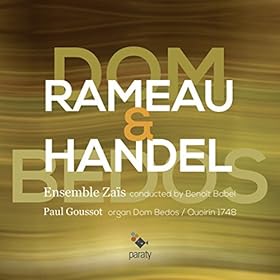 Handel and Rameau are both frustrating composers for organists. Both were very keen organists throughout their life, but Rameau left no organ music, and Handel very little. I have given many organ recitals solely devoted to Handel’s music, but only by drawing on music almost certainly intended for harpsichord. It works well, but I would love to have heard Handel (and Rameau) improvising on the organ. This CD is something of a nod towards that very happening. The unspoken premise of this recording seems to be that Handel and Rameau (born two years apart) meet near the west coast of France (which Handel certainly never ventured even close to) in a church housing one of the largest and most comprehensive French baroque organs ever built – the 1750 Dom Bedos organ of Saint-Croix in Bordeaux. There happens to be an orchestra present. They set about a run-through of some of their pieces, Handel expanding on his Organ Concertos and Rameau transcribing some of his orchestral and harpsichord ensemble works for organ and orchestra. Both improvise at will.




 As a supplement to Margaret Phillips’ 16 CDs of Bach organ works (published as eight double CDs plus this volume), this CD includes alternative versions, pieces usually allocated to but probably not by Bach, pieces not intended for organ, and one piece had not been rediscovered when the other Bach pieces were recorded, between 2005 and 2009. You could fill a further 16 CD with such peripheral and alternative pieces, so the selection of these 16 must have been quite a task. The choice is an excellent one, balancing well-known pieces such with little-known works like the Fantasia duobus subjectis.
  There is a current trend of building CD and concert programmes on collections of pieces made by others, one example being the Marian Consort & Rose Consort of Viols CD ‘An Emerald in a Work of Gold’. The music was drawn from the Robert Dow partbooks, copied in the mid-1580s and now housed in the library of Christ Church, Oxford. As well as being a major source of music of the period (with 134 pieces), Dow’s manuscripts are fine examples of musical calligraphy. The music is indicated as being suitable for voices and viols, so the pairing of the Marian Consort and the Rose Consort is appropriate, the latter providing accompaniment for five solo songs as well as instrumental solos.
  of some Mozart examples, a relatively unknown repertoire. The Harmonie usually described an ensemble of up to fifteen players, generally with pairs of oboes, clarinets, horns and bassoons, sometimes supplemented by a wide range of other instruments. With its roots in Viennese saloon and Imperial music, a parallel tradition was growing in France through military and revolutionary bands. Apparently there are some 12,000 works for the Harmonie band.
  Pergolesi is often seen as one-horse-wonder, rather unfairly as he died aged just 26, composing his famous Stabat mater just before his death. His other works, including several operas, are usually ignored. He was one of the first composers (of around 70) to write an opera based on Metastasio’s take on Adriano in Siria (Hadrian in Syria), two years after the libretto was written, and two years before his death. The plot is based on the story of Hadrian in his days as Governor of Syria in Antioch (where he first became Emperor), and his love for his prisoner (and daughter of the Parthian King Osroa) Emirena who, in turn, is betrothed to Farnaspe, a Parthian prince. As these things inevitably go in opera seria, Adriano is married to Sabina, who, in turn, is loved by Aquilio. Rather bizarrely, Osroa tries to rescue his daughter by setting fire to the palace that she lives in. Of course, it all ends up well – the condemned Osroa is forgiven, Farnaspe marries Emirena, and Adriano stays with his wife Sabina.
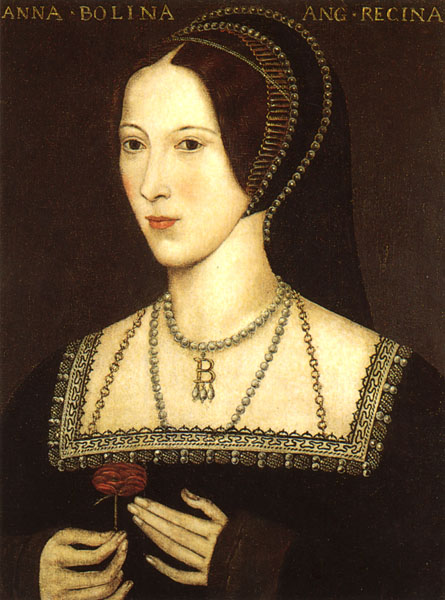 Having recently dusted off ‘The Spy’s Choirbook’, a manuscript by Alamire in the British Library, David Skinner and Alamire have now turned their attention to a manuscript that (arguably) belonged to Anne Boleyn, currently in the Royal College of Music (MS1070). The inscription ‘Mistres ABolleyne nowe this’ indicates the link to Anne, the ‘Mistres’ suggesting that the songbook was started before she became Queen in 1533 – and, I suggest, also before she became Marquess of Pembroke in 1532, and possibly before 1525 when her father was elevated to the peerage as a Viscount, or 1529 when he was created an Earl, both ranks giving Anne a courtesy title. ‘Nowe thus’ is her father’s motto.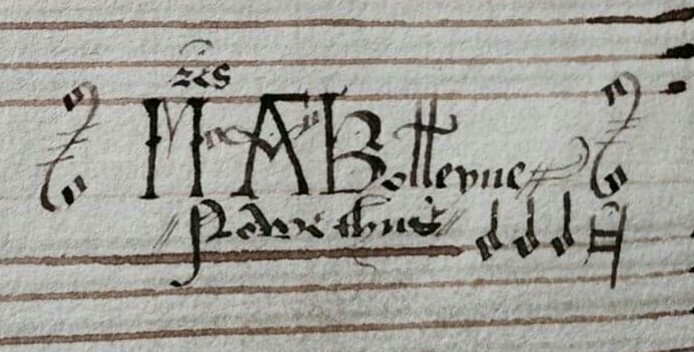
 Anon: And I were a maiden, De tous biens plaine, Fortuna desperate; Henry VIII: Helas madame, van Ghizeghem De tous biens plaine; Josquin: De tous biens plaine, attrib. Busnoys: Fortune esperée; Josquin: Fortuna desperate; Penalosa: Vita dulcedo / Agnus Dei II; Agricola: Cecus non iudicat de coloribus; Encina: Triste España; Martini: Des biens amors, La martinella; Josquin: In te Domine speravi; Anon: In te Domine sperabo, La quercia, Biblis; Encina: Fata la parte; Anon: La Spagna; Ponce: La mi sola Laureola; Cornysh: Fa la so; Anchieta: Con amores, la mi madre; Isaac: Agnus Dei II, Josquin: Adieu mes amours.
 Antonio Scandello:
 Wettin, rulers of Saxony, dating from just before 1600. Amongst the many decorative figures and sculptures on the upper levels of the chapel are several depictions of musical instruments. Some years ago, it was discovered that these instruments were not sculptural models, but real, playable, Renaissance instruments, complete with the maker’s signatures. It took many more years before these were properly
  For this 3-CD series of the Biber Rosenkranzsonaten, Anne Schumann and Sebastian Knebel have divided the work into its three sections (the ‘joyful’, ‘sorrowful’ and ‘glorious’ mysteries) and have chosen a different recording venue for each section, based on the organ in each church – a commendable approach, not least because we hear a full size church organ used as a continuo instrument, rather than the silly little box organs so often heard.
  Buxtehude: Sonata in A Major (Op2/5), Praeludium in g (BuxWV 163);
 Bach: Partita No. 3 in E Major, BWV 1006; Cheryl Frances-Hoad: Suite No 1; Eugène Ysaÿe: Sonata for Solo Violin No 2; Gordon Crosse: Orkney Dreaming; Biber: Passacaglia; Piers Hellawell: Balcony Scenes; Cyril Scott: Bumblebees.
 Andrew Benson-Wilson : Early Music Reviews +