
Harrison Birtwistle: The Mask of Orpheus
English National Opera
The Coliseum, 29 October 2019
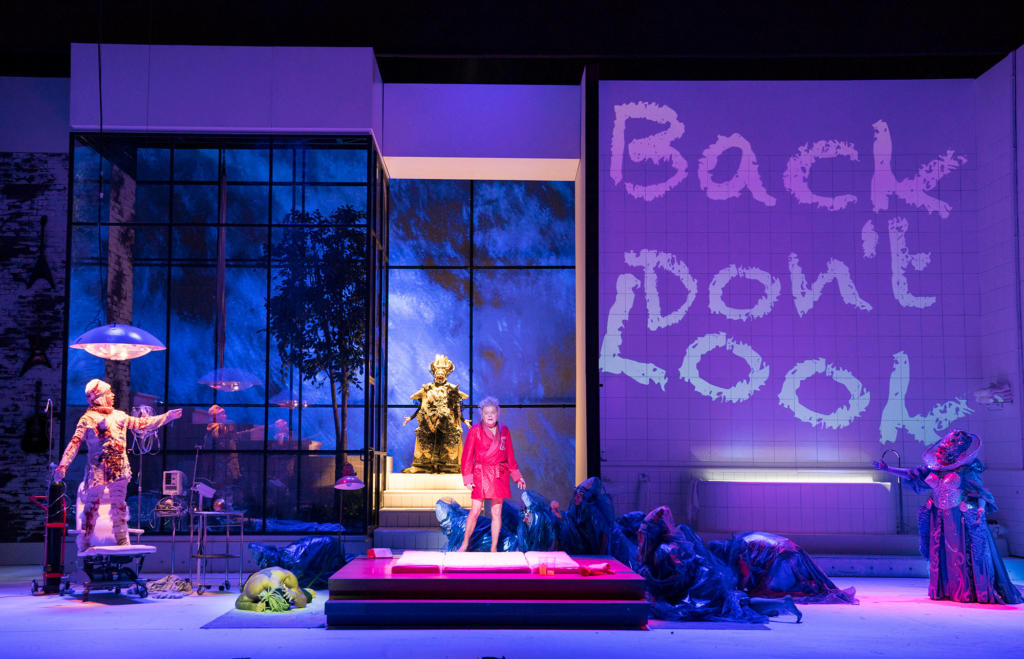
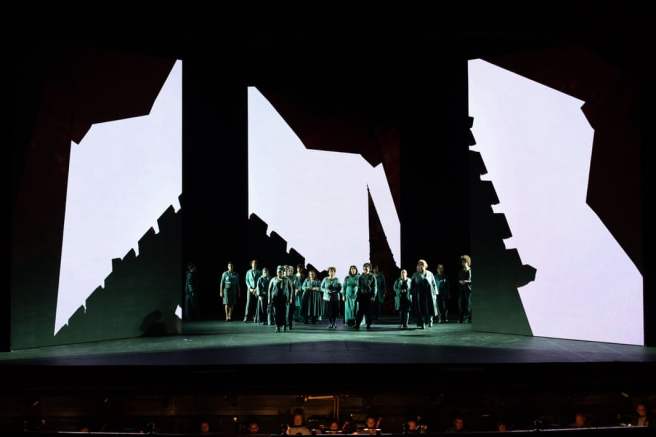
The world of ancient myths is a complex one, with many of the stories coming down to us in several different, and frequently conflicting, versions. One such is the Orpheus myth, the subject of four operas currently playing at the English National Opera’s Coliseum. After the sheer silliness of Emma Rice’s reconstruction of Offenbach’s Orpheus in the Underworld (reviewed here) we had Sir Harrison Birtwistle’s monumental The Mask of Orpheus (with electronic music by Barry Anderson), the premier at the Coliseum in 1986 being its only full staging until now. Birtwistle’s approach is to tell several versions of the myth all at the same time in one of the most complex operas of modern time. As the ENO publicity explains, “Harrison Birtwistle’s iconic masterpiece retells the Orpheus myth in a non-linear narrative, as the opera’s leading characters appear in three distinct guises”. It “explores the contradictions in the various versions of the famous Greek tragedy, building a three-dimensional picture that leads us from inconsolable grief to acceptance and transformation”.

 Grange Park Opera has been one of the UK’s musical successes since it first set up shop in 1998 in the derelict shell of The Grange, a country house in the centre of Hampshire. Owned by the Baring banking family, The Grange dates from the early nineteenth century when William Wilkins, architect of the British Museum, transformed an earlier 17th century brick building into Britain’s most important example of the Greek revival architecture, notable for its imposing temple-style portico. It was saved from demolition in 1975 after a public outcry and the intervention of the Government, who spot-listed the exterior shell of the building, in recognition of its important as a landscape feature. English Heritage took over custodianship of the building, although the ownership remained with the Baring family.
 Andrew Benson-Wilson : Early Music Reviews +