Hymnes – tribute to Nicolas de Grigny
Olivier Latry, Jean-Baptiste Robin, Benoît Mernier, Pierre Farago, Vincent Dubois (Organ)
Basilique Saint-Remi, Reims.
Aeolus AW-11101. 60’19+57’25
 This fascinating double CD stems from the 800th anniversary (in 2011) of the laying of the first stone of the Cathedral of Reims, where Nicolas de Grigny, the finest organist composer of the French Baroque era, served as organist from 1696 until his premature death in 1703. The current organ in the cathedral is not suitable for the performance of their most famous composer’s music, but the nearby Basilique St-Remi has a Bertrand Cattiaux organ, built in 2000, with the registrations required for the French Baroque repertoire. In an enterprising initiative, the “Association Renaissance des grandes orgues de la Basilique St-Remi” started a musical project in homage to de Grigny by inviting five contemporary composers to write a new work for organ based on one of de Grigny’s five hymn settings. Continue reading
 Much of Vivaldi’s music was written for the Venetian Ospedali della Pietà, one of many such orphanages set up to cater for the many unwanted, and usually female, babies that seemed to appear some nine months after the carnival season. Although originally funded as charities, they quickly established a reputation for their musical activities, attracting large crowds and provided a secure, and indeed rather opulent, financial establishment. Firmly on the tourist essential to-do list, these female choirs attracted such comments as the one by Charles de Brosses in 1739 who wrote that “there is nothing so pleasant as to see a pretty young nun in a white habit, with a bunch of pomegranate blossoms over her ear directing the orchestra … their voices are delightful in their elegance and lightness”.
 For many years I was invited to review the International Young Artists’ Early Music Network Competition, held every other year in York. Apart from initially getting to know the young musicians competing in the final, one of the most rewarding aspects was that competitors would keep me in touch with their developing careers, which usually included them sending me their first CD a few years later. The winner of the 2007 competition was Le Jardin Secret (centred on soprano Elizabeth Dobbin) who, rather unusually for competitions, also won the audience prize. In their case, I seem to have missed out their first two CDs, but have new received this, their third, CD.
 Some of Handel’s most exciting and dramatic music was composed during the three short years he spent in Italy, starting when he was just 21. Despite offers of financial assistance from a Medici Prince, Handel famously ‘made his way on his own bottom’, as his biographer Mainwearing put it. Mainwearing suggests that prior to his visit, Handel ‘could see nothing’ in Italian music which, if it is true, is rather surprising, as Italian music had been at the forefront of much of the European Baroque, not least because of the developments in opera, oratorio and cantata. Handel very quickly absorbed the taste and style of Italian musicians both from Rome and also from his shorter visits to Venice, Florence and Naples. In his compositions from this period, he often outdid the Italians in writing in their style – as he did in England later in his life.
 this distinguished orchestra has built an enormous international reputation, not least during the years from 1998 to 2011 when Sir Roger Norrington was their chief conductor, bringing his noted ‘historically informed’ performance practice to this modern instrument orchestra, producing a distinctive style – the ‘Stuttgart sound’. The two merging orchestras are both under the auspices of Südwestrundfunk (South West Radio), the public broadcaster for Baden-Württemberg and Rhineland-Palatinate, and have very different repertoires and styles. It was entirely appropriate that Roger Norrington, now their Conductor Emeritus, was the conductor for their final concert.
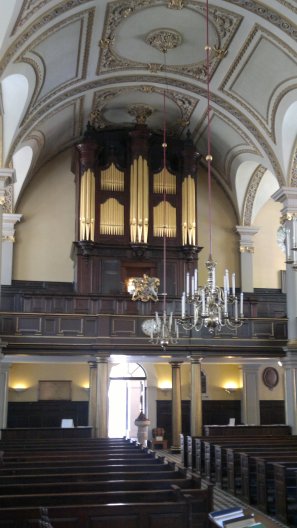 child prodigy, writing his first oratorio, Ruth, aged 6. When he was 8, the composer Dr William Boyce referred to him as the ‘English Mozart’. His family moved to London when he was about 12, living in Marylebone. He led a colourful life, some of his apparent eccentricities possibly being caused by a serious head injury when he was about 21. An organ virtuoso, Samuel Wesley was the leading pioneer of the Bach revival in England. Bach seems to have been a strong influence on his Opus 6 Organ Voluntaries, published between about 1807 and 1820, and the focus of this recital.
 The creation of the opera-ballet Les Éléments has links with the courtly and musical politics of Paris. Louis XIV died in 1715, leaving as his successor a five-year old fragile child. One of the focuses of the Regency was to ensure that the young Louis XV would survive at least as long as it took for him to father a successor to the throne. Dance was seen as a suitable approach to both encourage his own development, and to show to others that he was capable of succeeding his long-lived father and, eventually, to do his bit for the future of the royal line. To this end, several ballets were commissioned, usually giving the King a moment to strut his stuff in front of the assembled courtiers.
 Antonio Maria Montanari (1676-1737) was one of the most celebrated violinists in Rome during the period when Handel was there. He played in the orchestras of many of Rome most extravagant families and cardinals, including the Borghese, Ruspoli, Colonna and Pamphilj. He played in the first performance of Handel’s La Resurrezion in 1708. After Corelli’s death in 1713, Montanari took over some of his concertmaster roles. He is little known today, but his Opus 6 collection of violin concertos was one of the most advanced sets of the period. This inspiring CD of six of his concertos (all but one being first recordings – the Concerto in A Major, Op1/8 has been recorded by EUBO, the European Union Baroque Orchestra) will do much to return him to his former fame.
  Grange Park Opera has been one of the UK’s musical successes since it first set up shop in 1998 in the derelict shell of The Grange, a country house in the centre of Hampshire. Owned by the Baring banking family, The Grange dates from the early nineteenth century when William Wilkins, architect of the British Museum, transformed an earlier 17th century brick building into Britain’s most important example of the Greek revival architecture, notable for its imposing temple-style portico. It was saved from demolition in 1975 after a public outcry and the intervention of the Government, who spot-listed the exterior shell of the building, in recognition of its important as a landscape feature. English Heritage took over custodianship of the building, although the ownership remained with the Baring family.
 Nicolaus Bruhns (1665-1697) is one of the most important organist/composers of the North German 17th century Baroque: that extraordinary outpouring of music that over the whole century developed and honed a distinctive style that the likes of Handel and Bach carried forward into the 18th century. The favourite pupil of the famed Lübeck organist, Dietrich Buxtehude, Bruhns came from a family of musicians. He came from Husem, then part of Denmark, but his family had strong musical connections with Lübeck. After a time in Copenhagen, Bruhns returned to Husem as city organist, where he remained until his untimely death, aged just 31.
 The music on this recording reflects the music in and around Elizabeth I’s court. A keen lute player herself, at the height of her Golden Age, she employed some 70 musicians in her court. Rather surprisingly, the first piece is by Orlande de Lassus, Susanne un jour, somebody with no Elizabethan connection at all. But this became very popular throughout Europe, and is played here in a contemporary version found in the Matthew Holmes Manuscript in Cambridge University Library.
  What a gorgeous CD! As well as Dowland’s famed seven ‘tears’ (lasting around 26’) we also have a balancing succession of dances, many based on Dowland songs. The pieces in the 1604 Lachrimae publication were used by generations of other composers’ in their own versions and variations. Key to viol consort music like this is the balance between the instruments. Unlike some of their concerts, where the treble viol can dominate, here the balance is perfect, not just between the five viols, but also with the delicate tone of the lute, played with superb conviction and musicality by Elizabeth Kenny.
 Jeremy Summerly’s comprehensive programme note opens with the suggestions that “Early Tudor England was insular and the attitude of its people xenophobic”, quoting an Italian visitor in 1497 that “they have a antipathy to foreigners”, an unfortunate habit that sadly still seems to be the case, at least for around 52% of the population. John Taverner was very clearly an exception to this view, at least musically, for he relished the music coming from the continent. This CD indicates two particular influences, with the complex polyphony and imitative writing of the likes of Josquin featuring in the Missa Mater Christi sanctissima and, in the Western Wynde Mass, as Summerly puts it “a Lutheran dexterity in his use of a secular model for a piece of sacred music”.
  Frescobaldi’s Fiori Musicali was published in 1635. He was at the height of his musical powers, having just returned to Rome (after six years with the Medici’s in Florence) to work for the Barberini Pope and Cardinals, and continued his post as organist of St Peter’s in Rome, a post he had held throughout his many travels. Although many pieces in Frescobaldi’s earlier books of Toccatas (1615/16 and 1627) were clearly intended for organ and would have presumably have been playing in a liturgical setting, Fiori Musicali is his only organ book specifically geared towards use in the Mass. It was his last publication of new music, although he did re-issue some earlier volumes. It quickly became one of his most popular publications, and was used as an exemplar of polyphonic writing well into the 19th century. Bach also studied it and copied it out.
  This is the third of The Orlando Consort’s recordings of Machaut’s secular songs, following on from their ‘Songs of Le Voir Dit’ and ‘The Dart of Love’ CDs. Music like this can be appreciated at many different levels, and perhaps one of the most satisfactory (unless your mediaeval French is up to scratch) is to ignore the programme notes or translations of the text, turn the lighting down and just let the music wash over and through you. Although it might appear disrespectful to the enormous amount of research that has to go into producing a recording like, it really does work as a musical experience.
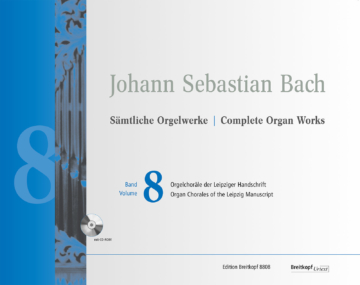 Editions of Bach’s organ works are something of a minefield, even when there are clear autograph scores available. In many cases that is not the case, so the role of the editor and the availability and accuracy of available sources becomes an important consideration. Of all the publishers to be involved in Bach, Breitkopf & Härtel are perhaps the most appropriate. Founded in Leipzig in 1719 four years before Bach took up his post there, they were the first to publish the complete works of Bach, between 1851 and 1900 for the Bach-Gesellschaft. Unfortunately, at the moment, I only have access to one volume of their latest complete Bach Organ Works, so cannot comment on the 10 volume set as a whole.
 Andrew Benson-Wilson : Early Music Reviews +