Ristori: Cantatas

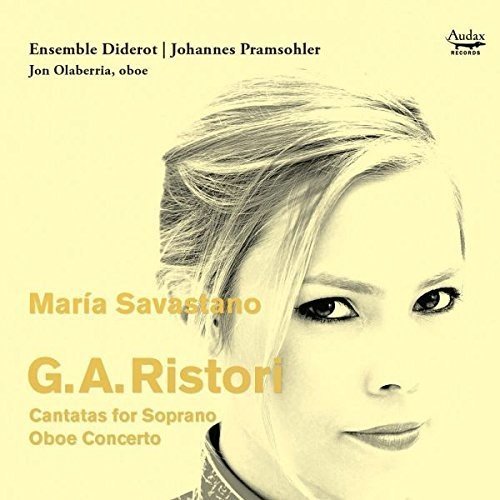
G A Ristori: Cantatas for Soprano
Ensemble Diderot, Johannes Pramsohler
Maria Savastano, soprano, Jon Olaberria, oboe
Audax Records ADX 13711. 68’12

Ensemble Diderot has built an enviable reputation for their instrumental recordings, based on the violin playing of their founder director Johannes Pramsohler. But on this occasion, they appear as a backing group to soprano Maria Savastano, who gets prominent billing. Sensibly, the programme is based on a single, and lesser-known Italian composer, Giovanni Alberto Ristori (1692-1753). He was probably born in Bologna but spent much of his life in Dresden in the court of the Electors of Saxony, surviving the musical cull after Augustus the Strong’s death in 1733, presumably on account of his having been music tutor to the new Elector when he was Crown Prince.  The Elector’s wife, Maria Antonia, wrote the text of the three cantatas on this recording. The daughter of the Bavarian Elector, she was an accomplished singer and poet.

Continue reading

HMSC @ 35: Lions of St Mark

Lions of St Mark
His Majestys Sagbutts & Cornetts
35th-anniversary concert
St John’s, Smith Square
27 October 2017

His Majestys Sagbutts & Cornetts (named after a reference in Matthew Locke’s music for Charles II’s 1661 coronation) celebrated their 35th anniversary in style with an impressive concert in St John’s, Smith Square, a few yards from the site of Charles II’s coronation and a short walk from the site of their debut concert in St Martin’s-in-the-Fields. It says something for their early promise, and the recording industry of the early 1980s, that they were offered a recording contract during the interval of that concert. Times have changed in the recording world, but HMSC continue to reinforce their reputation as pioneers of period instrument and performance practice. Two of the original members were playing (Jeremy West and Stephen Saunders), and several more were in the audience. They have replenished themselves over the years, and now include one player who is younger than the group. They also brought in two recently graduated sackbutt players for the 8 and 10-part works that concluded each half.

Continue reading

Rodelinda

Handel: Rodelinda
English National Opera
The Coliseum. 26 October 2017

I avoid checking back on my past reviews before going to an opera revival, but will sometimes do so after the event to see if my views have changed. In the case of this revival of Richard Jones’ production of Handel’s Rodelinda, they haven’t. A very popular production at the time, and gaining enthusiastic applause from the opening night of the revival, this left me less than inspired, with a few specific exceptions.

To start with the positive exceptions, I cannot praise the ENO orchestra high enough for their absorption of period style in recent years, despite remaining a modern instrument band. It has been a long road, aided by the influence of a series of inspirational conductors, the most recent being the excellent Christian Curnyn (who also conducted the first run in 2014). He is the current ENO go-to conductor for Handel, succeeding Laurence Cummings who did so much to start the ENO period performance revival. The orchestra played with stylistic conviction, and Christian Curnyn continued to confirm his reputation as a leading interpreter of Handel – his control of the pacing was exemplary. Continue reading

Baroque Voices at The Music Room

Baroque Voices at The Music Room
Rachel Ambrose Evans, Joy Smith
The Music Room, 26 October 2017

One of the most rewarding aspects of this reviewing lark has been spotting talented young musicians in the early stages of their musical careers. There are several well-known singers who I first noticed singing in choirs, and many instrumentalists who I first heard in their student days. One such singer is the soprano Rachel Ambrose Evans, who I first noticed after a tiny step-out-from-the-choir role in a Proms concert and, shortly afterwards, as a chorus fairy in a production of the Fairy Queen, noticing on both occasions what I consider to be an ideal ‘early music’ voice. That early music voice was very apparent in Rachel’s concert with harpist Joy Smith in The Music Room, hidden away above an antique emporium close to London’s Oxford Street, and until now used as an exhibition and events space. It was part of a new series of lunchtime concerts. Continue reading

AAM: Italy in England

Italy in England: When Handel met Corelli
Academy of Ancient Music, Bojan Čičić, Frank de Bruine,
Milton Court. 19 October 2017

Corelli Concerto Grosso in D major Op. 6 No. 4
Handel Concerto for Oboe No. 3 in G minor
Geminiani Concerto Grosso Op. 5 No. 3 (after Corelli)
GB Sammartini Sinfonia in G major
Avison Concerto Grosso in D minor No 3 ‘The garden of harmony’ (after Scarlatti)
G Sammartini Concerto for Oboe in E flat major
Handel Concerto Grosso Op. 6 No. 5

Aided by some excellent programme notes by Lindsay Kemp, we were led gently through an exploration of the influence of Italian musicians, notably Corelli, on performers and composers in England during the 18th century, many of whom were themselves, immigrants. The opening Corelli Concerto Grosso demonstrated the influence of the concerto grosso form. The opening Adagio is written in the score as nine simple chords, but Bojan Čičić’s beautifully elegant violin flourishes turned it into a complete musical experience and demonstrated the importance of ornamentation in music of this period. Directing the Academy of Ancient Music from the leader’s position Čičić demonstrated his extraordinary musicianship, the delicacy of his violin tone always blending with the orchestral timbre, even when in a clear solo role – a very welcome change from violinist directors whose sound dominated their companions. As a director, his sense of timing and the cooperative way he worked with his companions were an inspiration. An example was the timing of the final ‘that’s it folks’ cadence of the opening Concerto grosso – a lovely moment after a frenetic movement where all the players seemed to be bowing as fast as they possibly could.  Continue reading

OAE: Semele

Handel: Semele
Orchestra of the Age of Enlightenment, Christophe Rousset
Royal Festival Hall, 18 October 2017

Handel’s Semele is a curious work. Described at the time as a “musical drama . . . after the manner of an oratorio”, it is positioned rather awkwardly between opera and oratorio. It was first performed in concert format during the 1744 Lenten oratorio season, the decidedly secular story causing an inevitable shock to those expecting a piously biblical seasonal oratorio. Nowadays it is usually performed as a fully staged opera, but this dramatically performed concert performance gave us a chance to absorb the music, without interference from a director. Despite fairly obviously moralistic undertones, the story is about as far from the biblical oratorio as you can get. Continue reading

Boxwood & Brass

Discovering Harmoniemusik
Boxwood & Brass
The Arts Club, Waterloo. 18 October 2017

IMG_20171018_181931904.jpg

In a dual exercise of launching their 2017/18 programmes combined with trying out a possible venue for small-scale musical events, the innovative wind-music group Boxwood & Brass held a ‘Harmoniemusik Discover Evening’ in the 1901 Arts Club (in the fascinating hinterland of Waterloo station), a former schoolmasters house now converted to an events venue in the style of a late 19th century saloon. The six members of Boxwood & Brass played music by Mozart and Beethoven, starting with their own arrangement of the opening Allegro of Mozart’s 1782 Serenade in C minor (K.388, aka Nacht Musique), the two original oboe parts redistributed amongst the pairs of clarinets, horns and bassoons of their evening’s line-up. Mozart had made his own arrangement, for string quintet. This curious work is some way from the usual style of a Serenade, being far more musically intense and written in a minor key. In the intimate space, the complexity of the writing was prominent, as was the distinctive colour of the Harmoniemusik instruments.  Continue reading

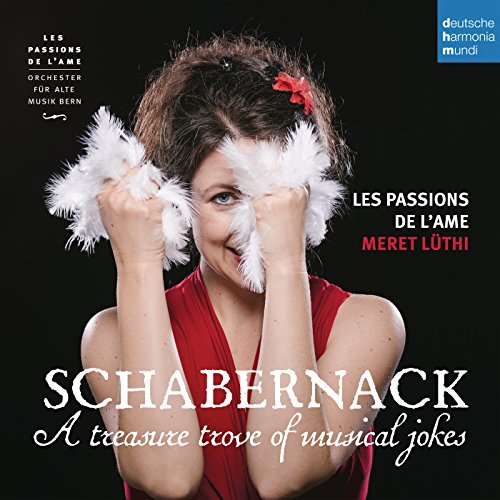
Schabernack

Schabernack: A treasure trove of musical jokes
Les Passions de l’Ame, Meret Lüthi
Deutsche Harmonia Mundi. 88985415492. 56’46

Music by Fux, Schmeltzer, Biber, and Walther

Schabernack - A Treasure Trove of Musical Jokes
Schabernack 
translates as ‘prank, practical joke, hoax or shenanigans’, and the underlying theme of this CD by the impressive group Les Passions de l’Ame emphasises that aspect of the musical world of the Austrian and Hungarian Empires during the Baroque period.  The CD cover promises “Characters from the commedia dell’arte, playful birds, an astonishing virtuosity and a colourful instrumentation – the vivid imagination in late 17th century Austrian-German instrumental music loves to surprise”. But humour is only part of the inspiration for this recording. At the time, these Hapsburg domains were part of the defence of Europe from attacks from the east by the Ottoman Empire. Ottoman influence was spreading into Viennese life and music, with Turkish, or Janissary, music and instruments becoming part of the musical language of the time. Continue reading

Edinburgh 1742

Edinburgh 1742
Ensemble Marsyas
Alec Frank-Gemmill and Joseph Walters, horns,
Emilie Renard, mezzo-soprano, Peter Whelan, director
Linn CKD567. 68′

The rather underwhelming title of this CD doesn’t really do justice to the wealth of surprises within. Barsanti’s Horns might be just one possible alternative, and a listen to track 2, the Allegro from Francesco Barsanti’s Concerto grosso in D (Op3/3) will explain why. Horn players Alec Frank-Gemmill and Joseph Walters and timpanist Alan Emslie mount an extraordinary attack on the senses with some of the most thrilling writing for horns and timpani that I can think off. The return with gusto at the end of the innocently entitled Menuet. This recording includes the first five of Barsanti’s ten Opus 3 Concerti grossi, all with dramatic writing for the horns and times, and four of his arrangements of Scottish songs, enclosing a central burst of Handel.

Francesco Barsanti (c1690-1775) was one of many Italian musicians that came to England during the 18th century, arriving in London in 1723. He earnt his living from teaching, music copying and occasional oboe playing. He was a companion of his fellow import from Lucca, Francesco Geminiani, who invited to join his short-lived Masonic lodge. He spent a year or so in York around 1732, and moved to Edinburgh in 1735 to join the Edinburgh Musical Society and playing in their professional orchestra. He returned to London with a Scottish wife in 1743, the year that his Opus 3 concertos were published. They followed much earlier collections of recorder and flute Sonatas (opus 1 and 2) in the 1720s. Back in London he started playing the viola rather than the oboe, and became involved with the Academy of Ancient Music and the Madrigal Society.

Emilie Renard joins in the Barsanti fun with one of Handel’s most dramatic arias, Sta nell’Ircana pietrosa tana from the 1735 Alcina, metaphorically depicting an angry tigress trying to protect her young from approaching hunters, to the inevitable accompaniment of the two horns. Emilie Renard enters into the drama of the aria with some brilliantly executed runs and ornaments, although she seems to have developed a rather alarming depth of vibrato since I raved about her singing in years gone by. This is followed by Handel’s arrangement of two movements from The Water Music as a Concerto for horns in F (HWV 331), seemingly first performed in 1723, and the little March in F for two horns and bassoon (HWV346, known as the ‘March in Prolemy’ on account of its appearance in the overture to his 1729 opera Tolomeo. 

As a contrast to the energy of the horn dominated programme comes a selection from Barsanti’s Old Scots Airs, published some time before the 1743 concertos, and here performed with violin and harpsichord. They reflect the enormous interest in all things Scottish in the decades after the Act of Union.

Michael Talbot’s notes give a fascinating insight into the Edinburgh Musical Society and the life of the hitherto overlooked immigrant musician Barsanti. The performances from Ensemble Marsyas, and the direction of Peter  Whelan, are excellent. They met during studies in Basel and touring with the influential European Union Baroque Orchestra.

Returning to the opening query about the CDs title, I still haven’t managed to work out the relevance of the year 1742. Perhaps I have missed something obvious, but the date doesn’t seem to be mentioned anywhere in the CD notes. A follow up CD of the rest of Barsanti’s 1743 Opus 3 concertos, written for trumpet and two oboes is inevitable, and I look forward to it.
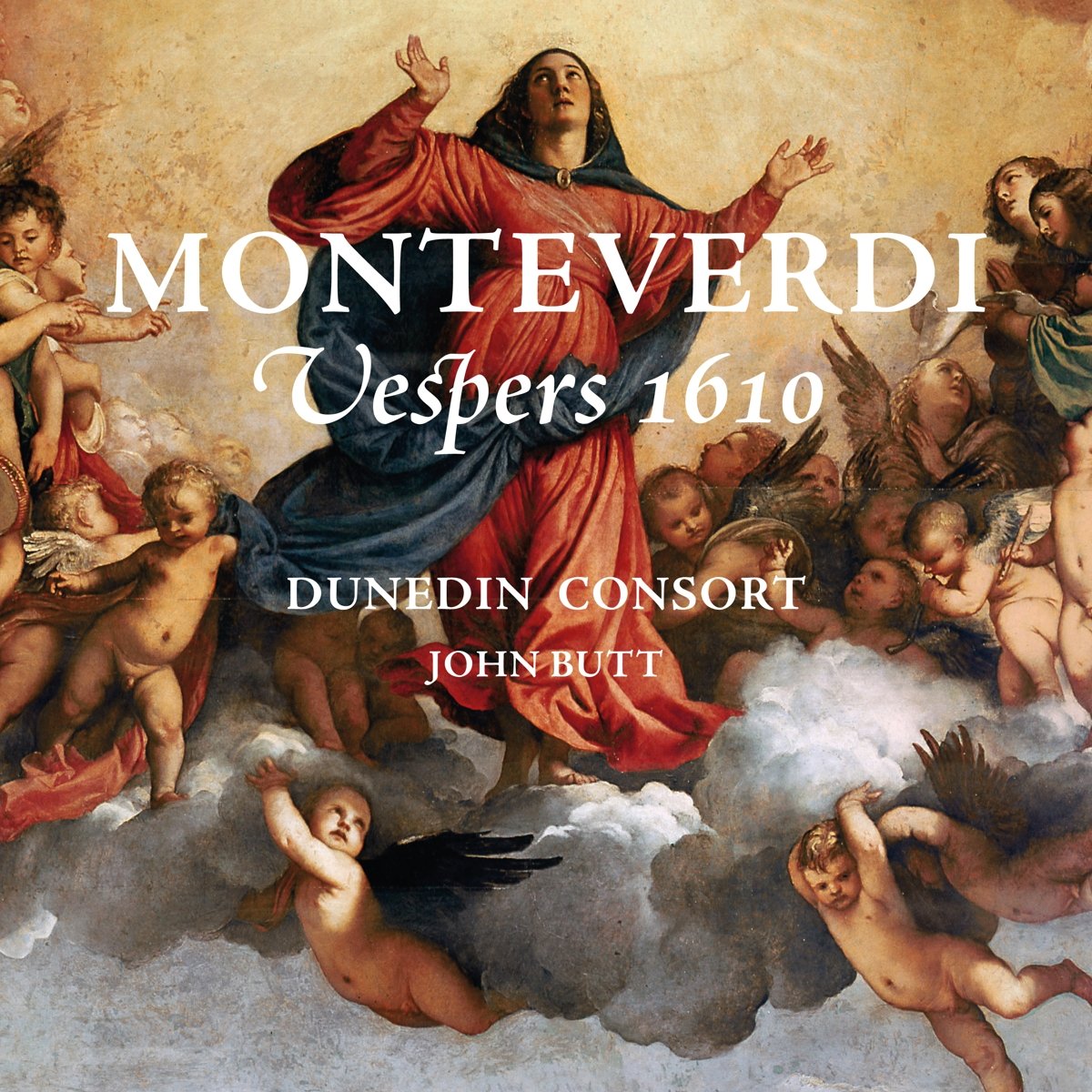
Dunedin: Vespers 1610

Monteverdi: Vespro della Beata Vergine
Dunedin Consort, His Majestys Sagbutts & Cornetts, John Butt
Linn Records. CKD 569. 2CDs 94′

During this 450th anniversary year of Monteverdi’s birth, there have been a plethora of performances and recordings of his 1610 Vespro della Beata Vergine. It’s not an easy work to address, not least because of the many complex musicological and performance issues that surround it.

The first point of call for anybody remotely interested in such things is to read the programme notes. The second is to glance at the track list. If it has more than 12 separate items, then it is probably placed in a quasi-liturgical, and almost certainly spurious, setting, with additional plainchant and instrumental pieces intended to represent how it might if it were performed liturgical. But it is most unlikely ever to have been thus performed.  Scholarship changes almost daily, but it seems likely that this is Monteverdi showing what he is capable of, exploring differing style of music on the cusp of the transition from the Renaissance to the Baroque (the prima pratica to the seconda praticca), and possibly (rather like Bach’s B Minor Mass) as a calling card; in Monteverdi’s case, for potential posts in Venice and Rome.  Continue reading

Classical Opera @ 20

Classical Opera 20th Birthday Concert
Orchestra and Choir of The Mozartists, Ian Page
The Barbican. 9 October 2017

Classical Opera was founded in 1997 and has carved out an important place in the musical world for its exploration of music of the classical era, in particular, Mozart. He is the inspiration for their ambitious Mozart 250 project, a chronological exploration of Mozart’s life, works and influences that each year will explore the music of Mozart and his contemporaries exactly 250 years previously. Now joined by a companion branding as The Mozartists, their name for increasing concert, rather than opera work, they celebrated their 20th birthday with a spectacular concert in London’s Barbican. The opening sequence of pieces, interspersed with reading, focussed on themes of “birth and rebirth, compassion and forgiveness, human inspiration and . . . what Beethoven and Schiller called brotherhood”.  Continue reading

Rameau: Dardanus

Rameau: Dardanus
English Touring Opera, The Old Street Band, Jonathan Williams
Hackney Empire, 6 October 2017

I have been a little lukewarm about some previous English Touring Opera productions, but this staging of Rameau’s Dardanus ticked all the boxes. The first box tick comes for performing this work in the first place, an example of the adventurous approach to programming of the English Touring Opera and their first venture into the complex world of French Baroque opera. It formed part of their Hackney Empire opening to their autumn tour of the country, with Dardanus visiting Oxford, Buxton, Snape, Saffron Walden and Exeter. Its companion opera, Handel’s Giulio Cesare has a much larger tour, calling additionally at Portsmouth, Norwich, Durham, Bath, Keswick, and Great Malvern. Giulio Cesare, rather curiously, divided into two separate and overlapping, parts, under the titles of The Death of Pompey and Cleopatra’s Needle, with the last half hour of the first repeated at the start of the second, to the chagrin of some reviewers. Continue reading

Festival d’Ambronay

Festival d’Ambronay
28 September to 1 October 2017

Since 1980, when it was founded, the Ambronay Festival has been a key part of the early music world. In recent years, the activities of the Ambronay Cultural Encounter Centre (based in the former Abbey buildings adjoining the magnificent Romanesque Abbey church) have expanded, and now includes impressive provision for young musicians. For the past couple of years, Ambronay has been part of the European Union supported eeemerging project (Emerging European Ensembles), an EU-wide cooperation project dedicated to the selection, training and promotion of young early music ensembles. The last of the four long weekends of the annual Ambronay Festival (which runs annually from mid-September to early October) is devoted to these eeemerging ensembles, but several of them also performed in the previous three weekends of the Festival. The theme for this year’s Festival was ‘Vibrations: Souffle’, roughly translating as Vibrations: Breathing, part of a triptych of festivals under the same Vibrations theme.

IMG_20170930_125119869.jpg

I attended the penultimate weekend of the Festival, from Thursday 28 September to Sunday 1 October 2017. The first two day’s concerts took place in Lyon, about 60km south-west of Ambronay.
Continue reading

Organ Reframed: Six New Works

Organ Reframed: Six New Works
London Contemporary Orchestra, James McVinnie

Union Chapel, Islington. 13 October 2017

IMG_20171013_191732091.jpg

Organ recitals, at least of the traditional English sort, tend to attract relatively small, rather aged, and predominantly male audiences. They usually feature music written between the time of Bach and the early 20th century. Occasionally forays into more contemporary (or contemporary sounding) music – even Messiaen, most of whose organ music was composed more than 70 years ago, can frighten off audiences. But the weekend Organ Reframed festival at the spectacular Union Chapel in Islington demonstrated that both organ and contemporary music can have a huge following, if presented in an imaginative way. Continue reading

Jacob Praetorius and Heinrich Scheidemann

Grosvenor Chapel
South Audley Street, Mayfair, London
Tuesday 17 October, 1:10

Andrew Benson-Wilson
plays
Jacob Praetorius and Heinrich Scheidemann

WP_20150721_15_17_12_Pro.jpg

Andrew Benson-Wilson’s exploration of the 17th century North German organ repertoire continues with a recital of music by two influential pupils of Jan Pieterszoon Sweelinck, the famous ‘Orpheus of Amsterdam’. Jacob Praetorius (1586-1651) and Heinrich Scheidemann (c1595-1663) both went on to prestigious posts in Hamburg churches. Praetorius taught Weckmann and Scheidemann taught Reinken and, possibly, Buxtehude.

Jacob Praetorius (1586-1651)
Praeambulum in F
Von Allen Menachem abgewandt

Heinrich Scheidemann (c1596-1663)
Praeludium in F
Magnificat Sexti Toni
Alleluja Laudem dicite Deo nostro

Continue reading

Sally Beamish: The Judas Passion

Sally Beamish: The Judas Passion
Orchestra & Choir of the Age of Enlightenment, Nicholas McGegan
St John’s, Smith Square, 25 September 2017

One of many puzzles that leap from the pages of the Bible is the curious position of Judas Iscariot in the wider scheme of things. The synoptic gospels do not agree on his role or the story of his apparent ‘betrayal’ of Jesus: actually, a literal ‘handing-over’ or ‘delivery’ of Jesus if the word paradidomi is more correctly translated. Two of the gospels suggest that the ‘devil’ entered him, something that Jesus had already proved adept at dealing with by a bit of casting out. Why didn’t he do so on this occasion? And if, as seems likely, Jesus foresaw, and may have actively encouraged Judas’s paradidomi, then it was not an act of free will and should not be punishable, let alone seen as the ultimate betrayal for which the ‘loving and forgiving God’ has left the hapless Judas to be almost alone among the irrevocably damned, notwithstanding his clear remorse. And if preordained, why the personal condemnation of the man who fulfils the prophecy – “It would be better for that man if he had never been born”? It was one of many New Testament events that were, apparently, preordained in the Old Testament, the juggling of which has caused many problems of Christian interpretation.

IMG_20170925_164831117.jpgEdward Armitage: The Remorse of Judas, 1866. Tate Britain

Continue reading

Enescu: Oedipe

Georga Enescu: Oedipe
London Philharmonic Orchestra, Vladimir Jurowski
Choir of the George Enescu Philharmonic, Romanian Radio Children’s Choir
Royal Festival Hall, 23 September 2017

A pupil of Faure and a teacher of Yehudi Menuhin, the Romanian composer and violinist George Enescu occupied a key, but usually overlooked, position in the musical world of the first half of the last century, a time of musical experimentation that he, by and large, avoided. Oedipe was his only opera and has been largely forgotten since its first performance in 1936 in Paris. It took him around 2o years to write. According to Menuhin, he kept the score by his bed so that he could jot down ideas easily.

IMG_20170908_131716512.jpg

Unusually amongst the many tellings of the Oedipus myth, Enescu covers the whole of Oedipus’s life, from birth to apparent death. Edmond Fleg’s libretto (much reduced from his original version, which would have entailed an opera spanning two evenings) draws on Oedipus Rex for Act 3 and uses part of the plot of Oedipus at Colonus for Act 4.  Continue reading

Da Camera & Carolyn Sampson

Telemann, Bach, & Scarlatti
Da Camera with Carolyn Sampson
Kings Place. 20 September 2017

I reviewed Da Camera’s very first concert, in March 1999 at Hampstead’s Burgh House, noting that “Emma Murphy is a superb recorder player … she combines outstanding virtuosity with musical intelligence and sensitivity”, and that harpsichordist Steven Devine was (amongst other things) “clearly blessed with enviable technical skills”. In 2001, I commented on their “well-balanced programme, a friendly and informal stage manner, fine musicianship and superb playing” – a comment that they quoted in the programme for this Kings Place concert. In a later review, I praised Susanna Pell for producing a “wide range of tones and textures from her gamba, both in accompanying and in solo pieces”. Since those early days, they have each developed their own independent careers (and, indeed, families), but have now returned to the musical fray with a series of concerts and a new Telemann CD. Continue reading

BBC Proms: La Clemenza

Mozart: La Clemenza di Tito
Glyndebourne Festival Opera, Orchestra of the Age of Enlightenment
BBC Prom 59. Royal Albert Hall. 28 August 2017
 

The tradition of bringing one of the season’s Glyndebourne Festival Opera productions to the Proms continued this year with their version of Mozart’s often overlooked opera La Clemenza di Tito. Although I didn’t see the fully staged version at Glyndebourne, I did see the live webcast of the performance, and my feelings about the much-reduced staging in the Albert Hall is influenced by that.

Director Claus Guth and designer Christian Schmidt’s Glyndebourne staging divided the world of Tito into two, a clean modernist upper floor executive office positioned above a reed-clogged swamp where much of the action took place. A video played during the overture (or didn’t, depending on which performance you saw) which explained, apparently, the director’s interpretation of why Tito relationship with his boyhood chum Sextus went sour. The transfer to the Proms retained the dual levels, but with Tito’s domain behind the orchestra on the upper steps of the stage, the swamp rather pathetically alluded to by about half a dozen clumps of reeds and a rock on the stage in front of the orchestra. But, as is so often the case with semi-staged or concert performances of opera, this rather helpfully pulled the opera away from being the inspiration of the director towards being that of Mozart. Continue reading

Innsbrucker Festwochen der Alten Musik 2017

Innsbrucker Festwochen der Alten Musik
Innsbruck, 21-23 August 2017

The Innsbruck Festival of Early Music runs annually for about three weeks during August. It was founded in 1976 and since the start has focussed on Baroque opera, in recent years usually performing three each season. Between 1991 and 2009 René Jacobs was the director of the opera programme and, from 1997, the entire festival. Since 2010 the festival has been directed by Alessandro De Marchi, who instigated the International Singing Competition for Baroque Opera Pietro Antonio Cesti, named after Antonio Cesti, a 17th-century Italian singer and composer who served at the Innsbruck court of Archduke Ferdinand Charles of Austria.  The focus this year was on the music of Monteverdi, and included a staged performance of Il ritorno d’Ulisse in patria. Unfortunately, I was only able to attend for three days, so my review is necessarily limited in scope.  Continue reading

Secret History

John Potter: Secret History
Josquin/Victoria

ECM New Series ECM2119

It’s been a while since the names of John Potter and ECM have been linked in an ‘early music’ recording, the last being back in Potter’s Hilliard Ensemble days. This recording was made in 2011, and was the first time this group of musicians had got together. It pre-dates their later recording Amores Pasados published in 2015. The result is a radical re-think of Renaissance music performance, not least in reducing complex polyphony to just one or two vocal lines, sung by John Potter and Anna Maria Friman, the remaining voices being played on vihuelas (an early form of guitar, tuned like a lute) by Ariel Abramovich, Jacob Haringman, and Lee Santana. In the opening eight-part Mouton Nesciens mater for example, they sing the two paired superius lines, in the form of a canon at the fifth, very occasionally switching to one of the other six voices. The three vihuelas play the remaining pairs of voices, which are all also in the same strict canonic form. An extraordinary feat of contrapuntal writing, reduced to comparative simplicity.  Continue reading

BBC Proms: Reformation Day

BBC Proms: Reformation Day
Prom 47: Bach’s ‘Little Organ Book’ past and present
Prom 48: A Patchwork Passion
Prom 49: Bach’s St John Passion
Royal Albert Hall, 20 August 2017

Prom 47: Bach’s ‘Little Organ Book’ past and present
William Whitehead, Robert Quinney, organ

The BBC Proms’ acknowledgement of the anniversary of the Lutheran Reformation came with three concerts on Sunday 20 August, starting with a lunchtime organ recital featuring the premieres of three pieces from The Orgelbüchlein Project played by its founder/director, the organist William Whitehead. The programme opened and closed with Bach’s Prelude and Fugue in E flat (from the Clavierübung III, BWV 552), played by Robert Quinney (who also played Mendelssohn’s Organ Sonata in A major (Op. 65/3)). It also included the fourth of Schumann’s Fugues on B-A-C-H and two of Bach’s own Orgelbüchlein chorale preludes played by William Whitehead and, just before the final Bach Fugue, Samuel Sebastian Wesley’s ‘Prelude to the Grand Organ Fugue by Johann Sebastian Bach’: a duet for both organists. Continue reading

Schoenberg: Verklärte Nacht

Schoenberg: Verklärte Nacht / Brahms: Andante from Sextet Op18/1
Orchestra of the Age of Enlightenment: Night Shift
Baroquestock Summer BBQ weekend special
Heath St Baptist Church, Hampstead. 17 August 2017

This turned out to be a Tale of Two Churches. On my way to Hampstead for the first event of the Baroquestock Summer BBQ weekend at Heath Street Baptist Church in Hamstead, I stopped off at the church of St Sepulchre-without-Newgate in Holborn, known for many years as the Musicians’ Church, and an important venue for rehearsals and concerts for many musicians and choir. There I joined a flashmob drawing attention to the recent decision by the church (now run as a ‘plant’ of the evangelical Holy Trinity Brompton) to stop all rehearsal and concert bookings – an extraordinary decision that has caused a justifiable uproar.

IMG_20170817_194155010_HDR.jpgIn sharp contrast to the situation in, of all places, the Musicians’ Church, Heath Street Baptist Church in Hamstead is one of many London churches that have actively embraced music and musicians, running a regular series of lunchtime concerts as well as occasional musical festivals, the latter recently under the title of Baroquestock in food-related weekend festivals. Their latest Baroquestock weekend includes concerts by Spiritato and Istante Classical, the latter including Haydn’s La Poule Symphony to the accompaniment of BBQ chicken. Their opening event was a performance of Schoenberg’s Verklärte Nacht, to the culinary accompaniment of, you’ve guessed – Schoenbergers!  Continue reading

Lully: Armide

Lully: Armide
Les Talens Lyrique, Choeur de chambre de Namur, Christophe Rousset
Aparte AP135. 2CDs. 75’+74′

In sharp contrast to the pared down version of Lully’s Armide I reviewed here, this CD is the real thing, in a stunning performance by Les Talens Lyrique under Christophe Rousset, with a fine cast of soloists and the Choeur de chambre de Namur in support. It is a live recording of a concert given in the Grande Salle Pierre Boulez of the Philharmonie de Paris in December 2015, although there is no evidence of an audience or other extraneous noises that I could hear. Continue reading

Grimeborn: Armide

Lully: Armide
Ensemble OrQuesta Baroque

Grimeborn. Arcola Theatre. 9 August 2017

IMG_20170809_204353174.jpgAs the deliberately chosen name suggests, Grimeborn is not Glyndebourne, its location in the Arcola Theatre, a converted textile factory in Dalston, East London, being just one of the differences. Founded in 2007, the Grimborn opera festival focuses on new operas and experimental productions of more established repertoire. The limited space and budget in comparison to its more glamorous inspiration is one of its main strengths, as it forces directors, singers and instrumentalists to rethink basic opera practice. One key factor for the singers is that, rather like the more glamorous Iford Opera season, the singers are performing within a few feet of the audience, sitting on three sides of the central stage area.  Continue reading

BBC Proms: Berlioz Faust

Berlioz: The Damnation of Faust
Orchestre Révolutionnaire et Romantique
Monteverdi Choir, National Youth Choir of Scotland, Trinity Boys Choir
BBC Prom 31: Royal Albert Hall. 8 August 2017

Whoever thought of turning Berlioz’s Damnation of Faust into a staged opera seems, to me, to be missing the point. Quite apart from the extraordinary challenge of depicting the dramatic scenes on stage, the sheer drama of which would distract from what the music and the libretto is telling us, it is clear that Berlioz intended this as music to be listened to, not watched. That said, there was plenty to see in this Proms performance given by the period instruments of the Orchestre Révolutionnaire et Romantique together with the Monteverdi Choir, the National Youth Choir of Scotland, and Trinity Boys Choir, directed by John Eliot Gardiner. Continue reading

Itinéraire Baroque: A Telemann year

Itinéraire Baroque en Périgord Vert
‘A Telemann Year’

27-30 July 2017

IMG_20170731_122006589.jpgThe annual Itinéraire Baroque en Périgord Vert festival is based in the communes of Ribérac and Verteillac in the northern part of the Dordogne region of south-western France. It was founded by Robert Nicolas Huet and Ton Koopman, the former a local resident and now President and Director of the organising committee, the latter the Artistic Director and an occasional import from The Netherlands, together with his musical friends and family. The festival was initially the one-day event that still gives the now festival its name – the Itineraire Baroque, a musical tour of some of the extraordinary Romanesque churches of the region. But it has now expanded to fill four days over the last weekend in July with a wide range of concerts of Baroque music.

The focus for this year’s festival (the 16th) was Georg Philip Telemann (on the 250th anniversary of his death), a composer now usually overlooked by Bach and Handel (both of whom he knew personally), but who in his time was held in equally high esteem. A self-taught musician, he started to study law in Leipzig, but quickly moved into the city’s musical world. After short spells in princely courts, he moved to Frankfurt and eventually Hamburg where he directed the music in all the city churches. He was the first choice for the Leipzig post that Bach, the third choice, eventually accepted in 1723. He left an enormous amount of music, demonstrating his musical talent and ability to absorb national styles into his own music, notably from France and Poland. Continue reading

Path of Miracles

Owain Park: Footsteps & Joby Talbot: Path of Miracles
Tenebrae, Nigel Short
Signum Classics. SIGCD471. 79’22

This release combines the re-release of a 2005 recording of Joby Talbot’s Path of Miracles with Footsteps, a companion work composed by Owain Park, recorded in 2016. Both are commissions by Tenebrae, the Park piece apparently in answer to requests from amateur singers for a less complex piece than the Talbot. Continue reading