
Schoenberg: Verklärte Nacht / Brahms: Andante from Sextet Op18/1
Orchestra of the Age of Enlightenment: Night Shift
Baroquestock Summer BBQ weekend special
Heath St Baptist Church, Hampstead. 17 August 2017
This turned out to be a Tale of Two Churches. On my way to Hampstead for the first event of the Baroquestock Summer BBQ weekend at Heath Street Baptist Church in Hamstead, I stopped off at the church of St Sepulchre-without-Newgate in Holborn, known for many years as the Musicians’ Church, and an important venue for rehearsals and concerts for many musicians and choir. There I joined a flashmob drawing attention to the recent decision by the church (now run as a ‘plant’ of the evangelical Holy Trinity Brompton) to stop all rehearsal and concert bookings – an extraordinary decision that has caused a justifiable uproar.
 In sharp contrast to the situation in, of all places, the Musicians’ Church, Heath Street Baptist Church in Hamstead is one of many London churches that have actively embraced music and musicians, running a regular series of lunchtime concerts as well as occasional musical festivals, the latter recently under the title of Baroquestock in food-related weekend festivals. Their latest Baroquestock weekend includes concerts by Spiritato and Istante Classical, the latter including Haydn’s La Poule Symphony to the accompaniment of BBQ chicken. Their opening event was a performance of Schoenberg’s Verklärte Nacht, to the culinary accompaniment of, you’ve guessed – Schoenbergers! Continue reading
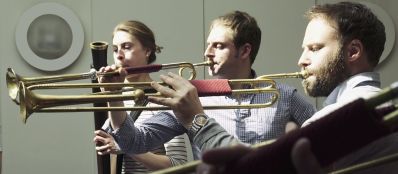 performance was that the trumpets were not only valveless, but also had no finger holes to assist in the tuning of notes. These finger holes (or ‘venting’ or ‘nodal’ holes) are in any case a relatively recent innovation, and may not have been used in early natural trumpets, at least not for the purpose to which they are now used; to make the tuning of the higher harmonic notes easier. Indeed, it seems that the original holes found in some instruments were actually place at the anti-node, rather than the node, and were therefore intended to silence the tricky notes altogether, rather than to try to bring them into tune.
 returned to Dresden where he became more involved in composing for the Court Church(left), which had taken on a new significance after the closure of the city opera house in 1720. His career path didn’t go quite to plan. Having been temporary Kapellmeister for a short period of time, he was pipped to the post of Senior Kapellmeister by JA Hasse in 1733. He was then appointed as a church composer. A few years later JS Bach, who knew and admired Zelnka’s compositions, was appointed as an (honorary) Royal Court Composer as a result of his well-known petition accompanying his 1733 ‘Dresden Mass’ – the Kyrie and Gloria of what later part of the Mass in B minor (See PS below). On his death, his compositions were purchased by the Saxon Court as valuable objects rather than performing scores, and remained hidden away in their archives until the 1950s.
 Andrew Benson-Wilson : Early Music Reviews +