Divine Songs of Passion
Fair Oriana, with David Wright & Harry Buckoke
St Bartholomew the Great, West Smithfield, London EC1A
13 April 2022
(and at Sands Films Music Room on 21 April)
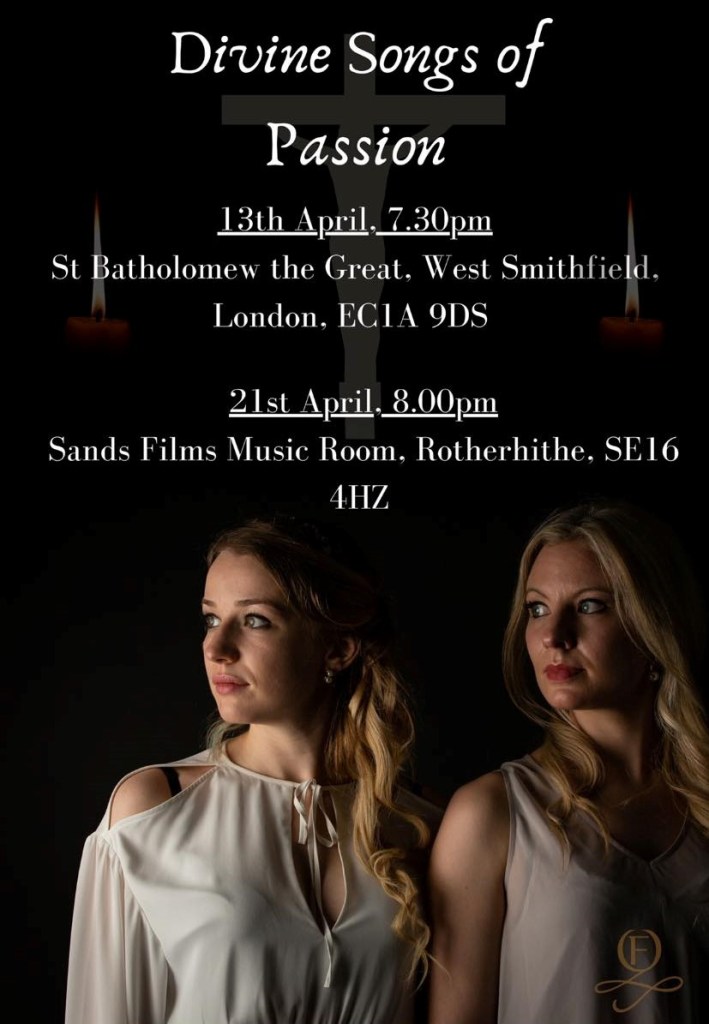
As part of their Holy Week Mass and Music series of events, the historic church of St Bartholomew the Great in London’s Smithfield invited the soprano duo, Fair Oriana, to perform their programme Divine Songs of Passion. This well-constructed concert was based around François Couperin’s c1714 Leçons de ténèbres pour le mercredi saint, contrasted with music by d’Anglebert, Purcell, Pergolesi and Blow. The date of the concert was appropriate, as the only surviving part of the Couperin Leçons de ténèbres is the one for the Wednesday of Holy Week. The other two sets of three Leçons composed for the following two days are lost. Although the Lamentations of Jeremiah depict the destruction of Jerusalem by the Babylonians, they have long been associated with Holy Week.


 Pergolesi is often seen as one-horse-wonder, rather unfairly as he died aged just 26, composing his famous Stabat mater just before his death. His other works, including several operas, are usually ignored. He was one of the first composers (of around 70) to write an opera based on Metastasio’s take on Adriano in Siria (Hadrian in Syria), two years after the libretto was written, and two years before his death. The plot is based on the story of Hadrian in his days as Governor of Syria in Antioch (where he first became Emperor), and his love for his prisoner (and daughter of the Parthian King Osroa) Emirena who, in turn, is betrothed to Farnaspe, a Parthian prince. As these things inevitably go in opera seria, Adriano is married to Sabina, who, in turn, is loved by Aquilio. Rather bizarrely, Osroa tries to rescue his daughter by setting fire to the palace that she lives in. Of course, it all ends up well – the condemned Osroa is forgiven, Farnaspe marries Emirena, and Adriano stays with his wife Sabina.
  Andrew Benson-Wilson : Early Music Reviews +