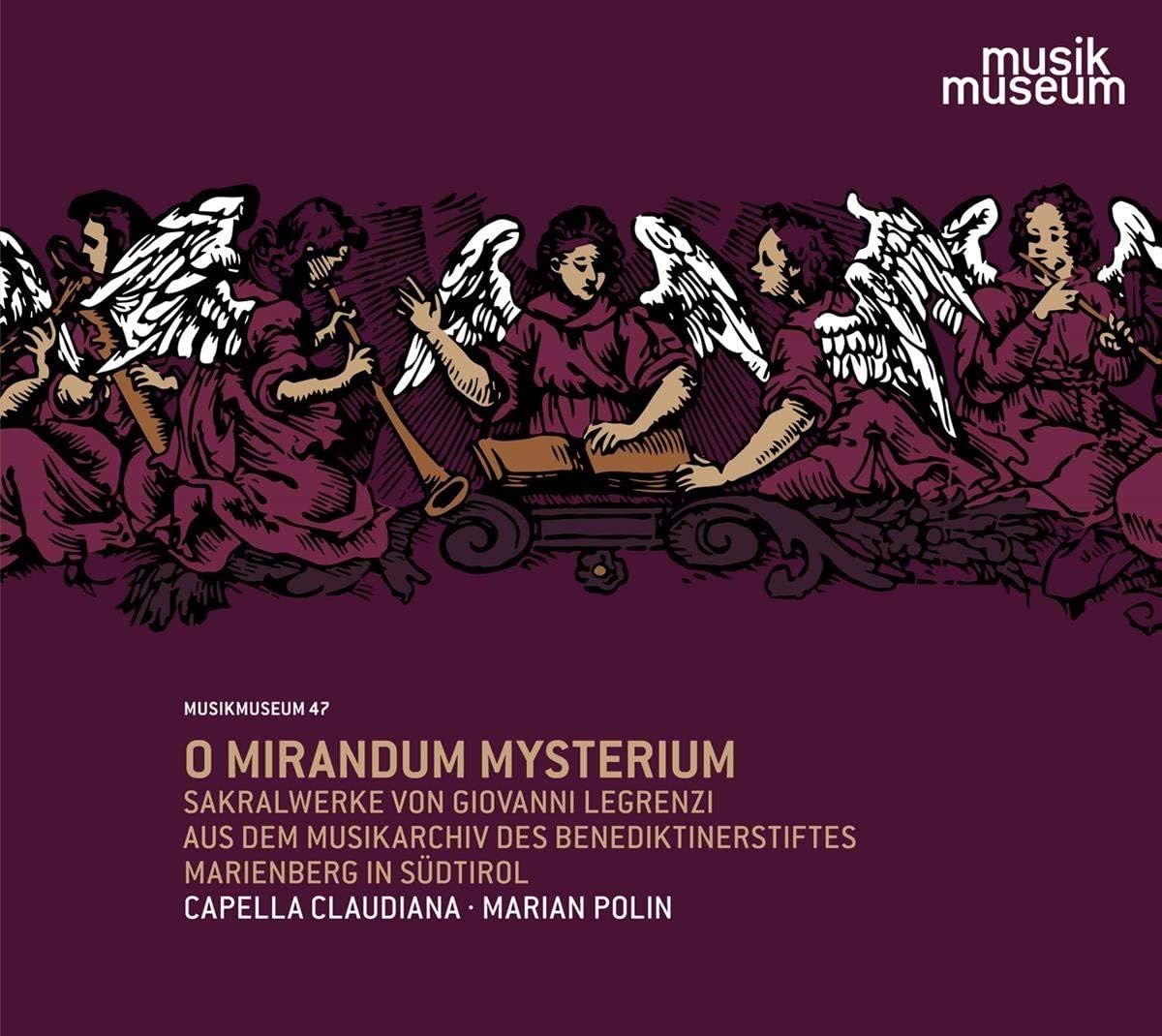
O Mirandum Mysterium
Sacred works by Giovanni Legrenzi from the music archive of the
Benedictine monastery in Marienberg in South Tyrol
Capella Claudiana, Marian Polin
Tiroler Landesmuseen. Musikmuseum 47, CD13046. 52’00
Although Giovanni Legrenzi (1626-1690) was well known in his own lifetime, he is one of those frequent composers whose name and music is almost unknown today. In Legrenzi’s case, he is probably only known through Bach’s youthfully flamboyant organ Fugue “on a theme of Legrenzi”, although this is either based on a lost Legrenzi work or one that is not a by Legrenzi at all. This compelling recording should help to bring him to the attention of a much wider audience. It is based on music by Legrenzi found in the remarkably wide-ranging musical archive of the remote Marienberg monastery in Vinschgau in the South Tyrol.


 The Innsbruck Festival of Early Music celebrated its 40th anniversary this year, although its roots go back a further 14 years or so. After some preliminary events, the festival proper ran for the last two weeks in August. It usually features three fully staged operas, although this year the third of them was reduced to a one-night concert performance of the Ruhrtriennale festival’s production of Gluck’s Alceste, conducted by René Jacobs who until 2009 was artistic director of the Innsbrucker Festwochen and, incidentally, the singer at the first concert of the first festival on 24 August 1976.
 There cannot be a more appropriate merging of organ and music than is found on this CD. Although there is no specific evidence, the Klagenfurter Orgeltabulatur seems to have been written around 1560 and was possibly written for a Carinthian monastery in central Austria. It is now in the state archives of the state of Carinthia (as Klagl. 4/3). It is the earliest known collection of keyboard music in Austria, and one of the first to use the ‘New German Organ Tablature’ letter notation. At the same time as it was being prepared, Jörg Ebert was making a bit of a meal of building the organ commissioned by the Holy Roman Emperor Ferdinand I for the Court Church in Innsbruck in the Austrian Tyrol. He had been appointed in 1555, but progress was slow and, as a result, he nearly lost the contract. But by 1558 the organ was substantially complete, and was inspected and approved in 1561. A seminal restoration in the 1970s (by Ahrend) produced an excellent, and rare, example of a Renaissance organ, with only three stops having to be reconstructed from new. I gave a recital on it last year, and it is an absolute joy to play.


 Andrew Benson-Wilson : Early Music Reviews +