JS Bach: Two organ Chaconnes

Johann Sebastian Bach: Two organ Chaconnes
Ciacona ex d BWV 1178, Ciacona ex g BWV 1179

Ed. Peter Wollny
Supplement to Bach Complete Organ Works, Volume 4

 24 pages, 32x23cm, 137g, ISMN: 979-0-004-19141-5, Saddle Stitch
Edition Breitkopf 9648, 2025

The much hyped promotion by the Bach Archive Leipzig of two organ Chaconnes that have recently been attributed to the young J.S. Bach has resulted in a torrent of internet posts raising every possible view of the music and how it should be performed. This commenced with the first performance of the new attributions given by Ton Koopman, playing the 2000 Bach organ at an official ceremony on 17 November 2025, livestreamed from Bach’s own Thomaskirche Leipzig. The two pieces have been available for a while on IMSLP, in facsimile and typeset, under the tentative attribution to Johann Christoph Graff. They are now published by Breitkopf in an edition by Peter Wollny, director of the Bach Archive Leipzig and the scholar who attributes the two pieces to JS Bach. A detailed Preface in German and English (four pages each) outlines the voyage of discovery over a period of more than 30 years. The new Breitkopf edition of the two pieces is beautifully produced and presented, with clear musical text.

Continue reading

Melomania: Bojan Čičić & Stéphanie Brochard

Melomania
Bojan Čičić & Stéphanie Brochard

Oxford Festival of the Arts
Festival Hall, Magdalen College School. 10 July 2025


melos = music | mania = madness

It was Goethe who suggested that “Music is liquid architecture and Architecture is frozen music”. Something very similar could be said of the link between dance and music. From medieval times up to the present day, most music has been linked in some way to dance, with many pieces directly related to a specific dance form. For example, the well-known Baroque Suite genre with an opening Prelude followed by a sequence of dance movements, traditionally allemande, courante, sarabande, and gigue. The traditional musical forms of Passacaglia and Ciacona are both dance-based. This extraordinary duo performance between violinist Bojan Čičić and dancer and choreographer Stéphanie Brochard, commissioned by the Oxford Festival of the Arts, presented a unique combination of music for violin and a range of dance movements. It was called Melomania and was described as neither a dance performance nor a concert but a “danced concert that embodies an intense passion for music, awakening the senses”.

Continue reading

Bach: The Art of Fugue

Bach: The Art of Fugue
on Bach’s Original Instruments

Collegium Musicum ’23
OUTHERE/RAMEE
RAM2406. 82’41


Bach left many unanswered questions with his monumental Art of Fugue, one of which was which instruments they were intended to be played on – if, indeed, they were intended to be played at all. It was presented in open score, with a separate line for each line of music. This was common practice for many decades for music intended for scholarly or didactic purposes, particularly for organists. Samual Scheidt, for example, used the same format in his 1624 Tabulatura Nova, asking organists to copy the music into their own preferred format for performance. The instruments chosen for this interpretation by Collegium Musicum ’23 are very special: two 1729 violins and a viola by Johann Christian Hoffmann from the Leipzig Thomaskirche’s own collection of instruments of Bach’s time. The anonymous cello is from 18th-century Central Germany from the same collection. They are all usually displayed behind glass in the side room of the church.

Continue reading

AAM. Bach: Art of Fugue

Bach: Art of Fugue
Academy of Ancient Music, Concert Theatre Works
Laurence Cummings, Bill Barclay
Peter Bray, Steffan Cennydd, Imogen Frances, Simon Slater
Milton Court, 15 May 2025

Photo: Mark Allan

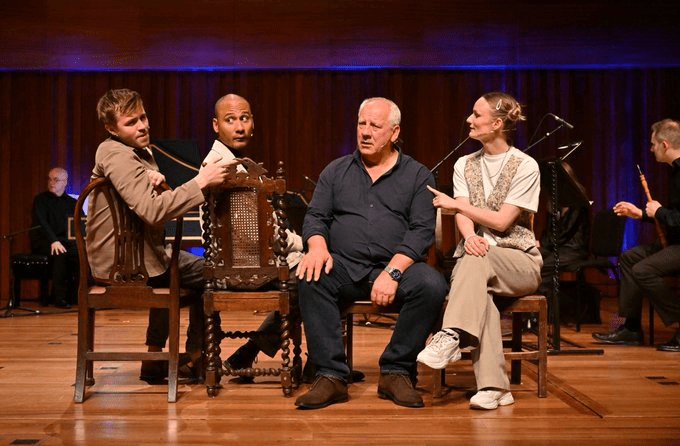
Johann Sebastian Bach’s Art of Fugue (Die Kunst der Fuge) is one of the greatest monuments of Western music. You mess with it at your peril. And mess with it at their peril is just what writer and director Bill Barclay with Concert Theatre Works did with the connivance of Lawrence Cummings and the Academy of Ancient Music (AAM), who commissioned this particular messing.

The Art of Fugue was composed during the last decade of Bach’s life, although the spurious accounts of Bach dying while composing the final fugue, on which much of the plot of this concert-theatre production relies, have long since been discredited. It was not published until shortly after Bach’s death, although autograph manuscripts of most of it survive. It consists of fourteen fugues (each called Contrapunctus) and four canons, all in D minor, and all using the same main theme, albeit in many varied forms. With the exception of the final fugue, which is written in conventional two-stave keyboard format, each piece has a separate line for each of the four voices (open-score) in a similar fashion to several learned musical works of the previous century or more. There is no indication of which instrument Bach intended or, indeed, if he intended it for performance at all, using it as an example of his skill in contrapuntal composition. There are no orchestral instruments of the time that could play all the lines on the same instrument, leading to the assumption that it was intended for the harpsichord. Performance on the organ is common, although there are many questions to be considered, not least the choice of registrations.

Continue reading

Bach: St John Passion

Bach: St John Passion
Academy of Ancient Music, Lawrence Cummings
Barbican Hall, 18 April 2025


Nicholas Mulroy, Evangelist, Dingle Yandell, Christus,
Carolyn Sampson, soprano, Helen Charlston, alto, Ed Lyon, tenor, Jonathan Brown, bass

Music has played a key role in religious occasions since the earliest times, and has played a notable role in most aspects of Western Christianity. When listening to pieces like the John or Matthew Passions or Messiah, I often wonder whether it is the words and the story, or the music that has the most highly charged emotional effect on those listening. For Christians, 3pm on Good Friday is one of the most sacred times of the year: according to one of the gospels, the moment when Jesus died after a three-hour-long crucifixion. In many Christian traditions, the whole day is devoted to fasting. But, for around 2000 people, 3pm was the start of the Academy of Ancient Music’s performance of Bach’s St John Passion in a packed Barbican Hall.

Continue reading

Polyphony/OAE. Christmas Oratorio

Bach: Christmas Oratorio
Polyphony, Orchestra of the Age of Enlightenment, Stephen Layton
St John’s, Smith Square. 22 December 2024


The Christmas Festival at St John’s, Smith Square (now rather boringly renamed as Smith Square Hall) has been a key part of London’s Christmas music season for nearly 40 years. The climax of these festivals has been the traditional two performances of Bach’s Christmas Oratorio and Messiah from Polyphony and, in recent years, the choir of Trinity College Cambridge, conducted by the artistic director of the festival, Stephen Layton. Having recently left his post of Director of Music at Trinity College, both events now feature Polyphony together with the period instrumentalists of the Orchestra of the Age of Enlightenment.

Continue reading

OAE: The Six Brandenburgs

J S Bach: The Six Brandenburg Concertos
Orchestra of the Age of Enlightenment

The Anvil, Basingstoke. 12 November 2024


Performing all six of Bach’s Brandenburg Concertos in a single concert is a relatively rare occurrence, so this was a very welcome event in Basingstoke’s Anvil concert hall, a favourite venue for the Orchestra of the Age of Enlightenment, one of the Anvil’s Associate Orchestras. One of the problems of playing all six concertos is the logistics of gathering so many instrumentalists together, with several only needed for one piece. Another is the length, on this occasion lasting from 7.30 until nearly 10pm. Although the programme suggested the concertos would be played in their numbered order, the Orchestra of the Age of Enlightenment performed them in the sensible order of 1, 3, 5 + 4, 6, 2, as they did in their St John’s, Smith Square concert in 2017, reviewed here. This order provides some key contrast, and saves the most powerful concerto to the end, made more dramatic by following two more intimate concertos.

Continue reading

Krebs: Keyboard Works Volume 3 & 4

Johann Ludwig Krebs (1713 – 1780)
Keyboard Works Volume 3 & 4
Steven Devine, harpsichord
Resonus Classics RES10329 (77’30) & RES10344 (63’50)


Steven Devine continues his crustation-inspired (Krebs = crayfish or crab) series of recordings of Krebs’ keyboard works with Volumes 3 and 4. They follow the two earlier recordings reviewed here (Volume 1) and here (Volume 2). I understand there will now be two further CDs after the originally planned series of four, an essential and welcome addition needed to cover Krebs’ known harpsichord works. I should repeat the warning I gave in earlier reviews of this series that it only represents a part of Krebs’ keyboard music. The programme note essay gives the far more accurate ’Works for Harpsichord’ title. The works for organ fill another 7 full-sized CDs. Many of Krebs’ organ compositions show a direct Bach influence, often to a specific piece that Krebs then expands, often to enormous length and complexity. That is far less apparent in the harpsichord works on this recording, although the Bach-inspired moments are fairly easy to spot.

Continue reading

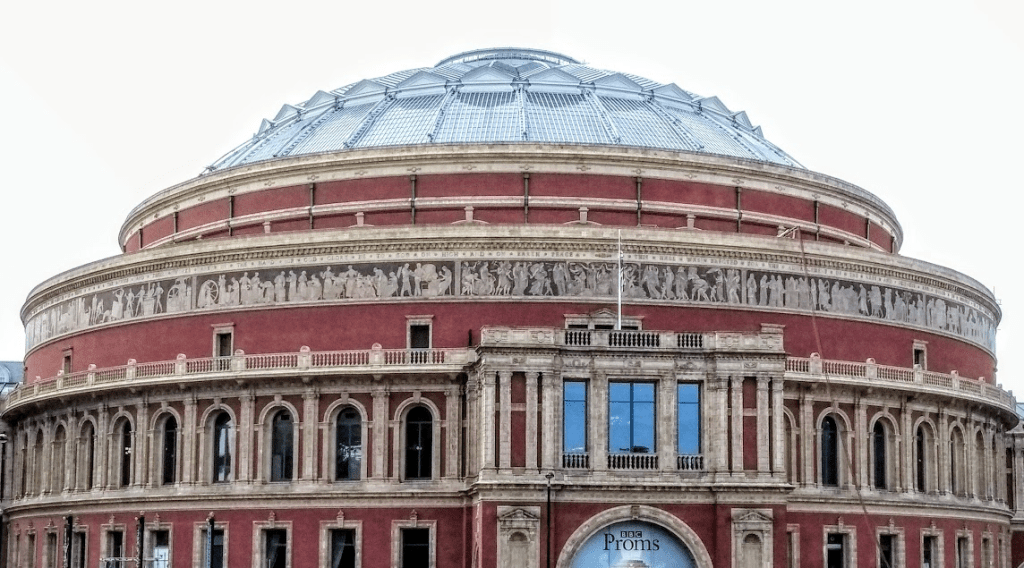
Prom 40: St John Passion

BBC Proms: Bach’s St John Passion
Bach Collegium Japan, Masaaki Suzuki
Royal Albert Hall, 19 August 2024


Bach’s Passio secundum Joannem, the St John Passion, was first performed on 7 April 1724 during the Good Friday Vespers at the Nicholaskirche in Leipzig, a last-minute change from the originally planned Thomaskirche. It was less than a year since he took up the post of Thomaskantor, a post that, infamously, had been first offered to both Telemann and Graupner who both turned the offers down. The 300th anniversary of the first performance was one of several anniversaries celebrated during this year’s BBC Proms at the Royal Albert Hall. It was first performed complete at the Proms in 1967, although extracts had been incorporated into the popular ‘Bach Wednesdays’ since 1924.

Continue reading

Bojan Čičić. Bach: Partitas & Sonatas

Bach: Partitas & Sonatas
Bojan Čičić, violin

Delphian DCD34300. 78’46+67’14, 2CDs


Many of Bojan Čičić‘s recordings have focussed on lesser-known composers, their music brought to life with inspiring performances. He now turns his attention to Bach with this recording of the Partitas & Sonatas (Sei solo à violin senza basso accompagnato), BWV 1001-1006. Unusually, the Partitas are on the first CD with the Sonatas on the second, rather than in the order that Bach seems to have intended with the two genres alternating. This allows us to concentrate on how Bach deals with the sequences of dance movements in the Partitas and the more formal Corelli-inspired four-movement structure of the Sonatas.

Continue reading

Royal Festival Hall organ @ 70

The Royal Festival Hall organ @ 70
Saturday 23 March 2024


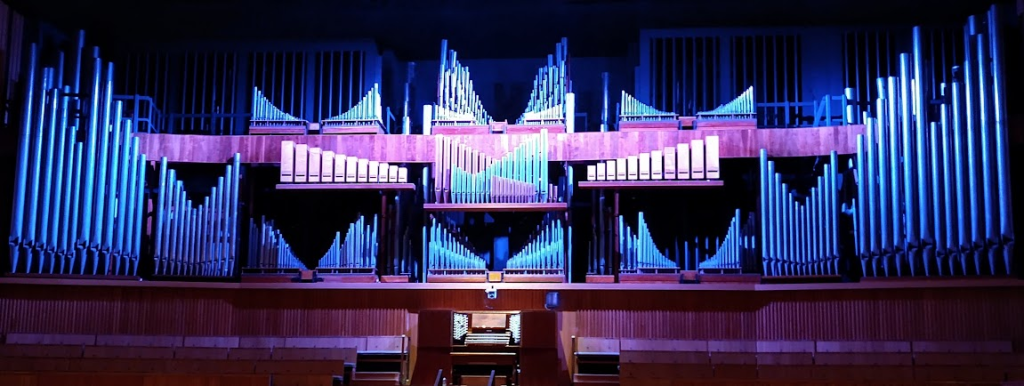
I have played organs dating back to the fifteenth and sixteenth centuries, so the 70th birthday of an organ might not appear to be that big a deal. But the organ in London’s Royal Festival Hall made an important, if controversial, contribution to the post-war British organ world. Designed by Ralph Downes, it was based on the Organ Reform Movement (Orgelbewegung) which started in Germany in the 1920s (with the enthusiastic support of Albert Schweitzer) and sought to reflect the style and construction techniques of pre-19th century organs, notably, in the early days, with a focus on the more historically informed performance of Bach. A detailed history of the RFH organ can be found here. Below is a photo of Ralph Downes inside the RFH organ with one of the tuners from the organ builders Harrison & Harrison of Durham, from his book Baroque Tricks.

Continue reading

Bach: Harpsichord Concertos

J S Bach: Harpsichord Concertos
BWV 1052, 1054, 1055 & 1059
Steven Devine, Orchestra of the Age of Enlightenment
Resonus RES 10318. 63’30

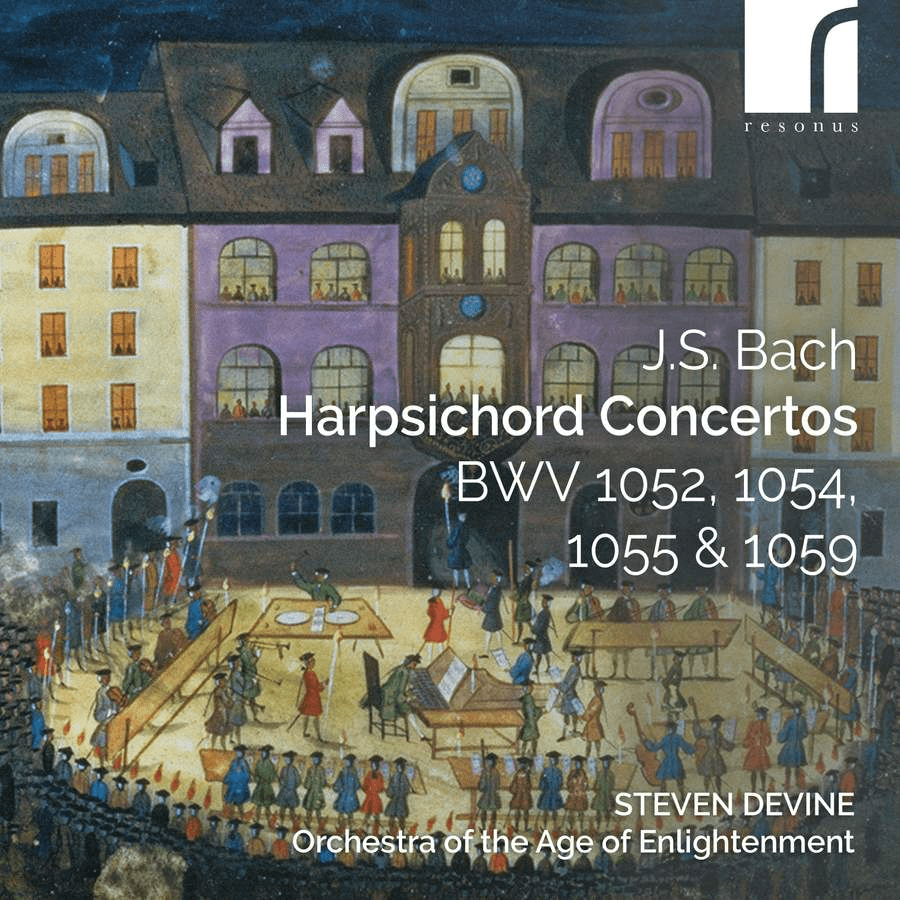
This very welcome addition to the world of Bach recordings features three well-known harpsichord concertos plus what is, in effect, an entirely new concerto. Steven Devine’s programme essay sets out the often complicated history of the music played. The manuscript of these concertos is in Bach’s own hand. It contains seven concertos and nine bars of a D minor concerto, BWV 1059. There is strong evidence that only the first six concertos were intended as a set, with Bach’s traditional sign-off (Finis. S. D. Gl.) appearing at the end of the sixth concerto. The following BWV 1058 seems to have been an unsuccessful attempt at converting a violin concerto into a harpsichord concerto. The few bars of a D minor concerto (given the BWV number of 1059 despite its brevity) are of particular interest in this recording.

Continue reading

Sietze de Vries: Bach’s Missing Pages

Bach’s Missing Pages: An Expanded Orgelbüchlein
Sietze de Vries, organ
Fugue State Films
. DVD (223′) & 2CDs (73’+68′)

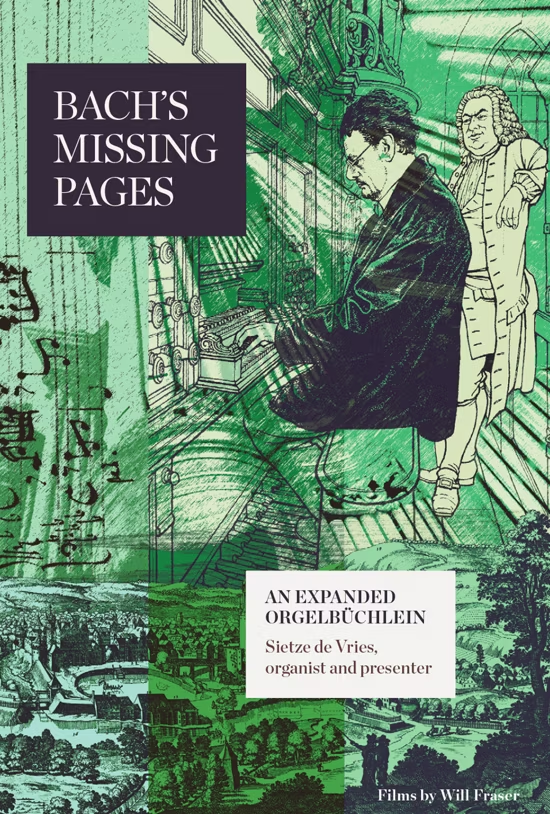
Hot on the heels of the extended, and now completed, Orgelbüchlein Project (which commissioned 118 new pieces to complete the chorales that Bach did not compose), comes this offering from Fugue State Films and Sietze de Vries. Over seven c30′ films (on one DVD) and two related CDs (which contain all the music from the films), Sietze de Vries plays all of the 45 chorales of Bach’s Orgelbüchlein. He then plays his own improvised chorale preludes in the style of Bach, using 45 of the 118 chorale melodies that Bach left titles for, but didn’t compose. In the videos, alongside his improvisations, he explores the philosophy of improvisation and shows how to improvise in the style of Bach, using the important historic organs in the Martinikerk, Groningen and the Petruskerk, Leens, both tucked away in the top right-hand corner of The Netherlands.

Continue reading

Bach: A Cembalo Certato E Violino Solo

A Cembalo Certato E Violino Solo
Bach: Complete Sonatas for obligato harpsichord and violin, plus 
Sonatas by CPE Bach, Graun, Schaffrath, Scheibe, Telemann

Phillipe Grisvard, Johannes Pramsohler
Audax Records. ADX 13783. 3CDS. 60’28, 73’10,75’07


Johann Sebastian Bach: Complete Sonatas for Harpsichord and Violin
BWV 1014–1019, BWV 1022, BWV 1020
Johann Adolph Scheibe: 3 Sonatas for Violin and Harpsichord
Christoph Schaffrath: Concerto in A Minor CSWV F:30
Carl Philipp Emanuel Bach: Sonata in B Minor, Wq 76
Johann Gottlieb Graun: Sonata in B-flat Major GWV Av:XV:46
Georg Philipp Telemann: Concerto in D Major, TWV 42:D6

This 3-CD package sets Bach’s Sei Sonate a Cembalo certato e Violino solo (together with two others whose authenticity is questioned) against similar pieces by other composers of Bach’s time, several of which are world premiere recordings. Each CD is a complete concert in itself, with two or three of the Bach Sonatas, a Sonata by Johann Adolph Scheibe plus related pieces by Georg Philipp Telemann & Christoph Schaffrath (CD1), Johann Gottlieb Graun (CD2), and Carl Philipp Emanuel Bach (CD3).

Continue reading

Bach: Music for alto

Bach: Music for alto
Barnaby Smith, Katie Jeffries-Harris

The Illyria Consort, Bojan Cičić
VOCES8 VCM152
. 72’16


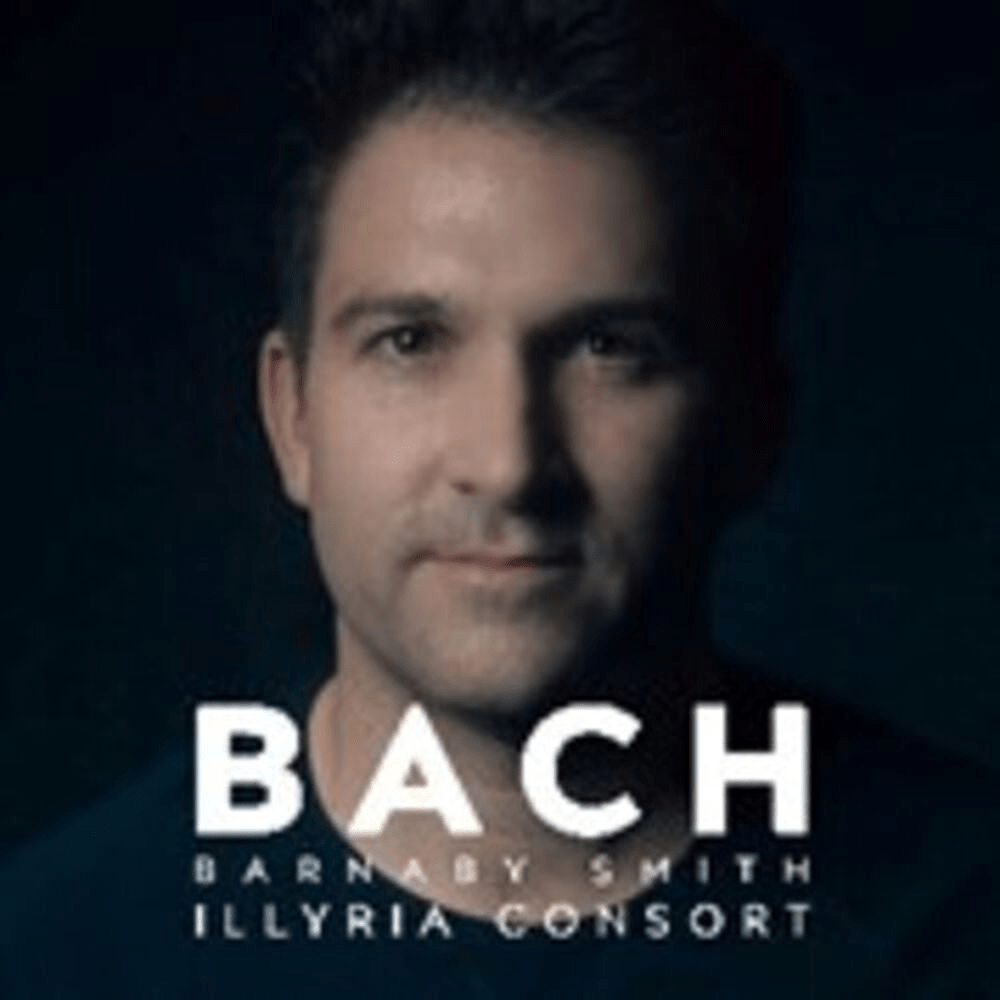
Bach composed some of his finest music for the alto voice. This recording from countertenor Barnaby Smith and Bojan Čičić’s Illyria Consort features two of the best-known alto cantatas, Ich habe genug (BWV 82) and Vergnügte Ruh, Beliebte Seelenlust (BWV 170) alongside a wide selection of Bach’s other pieces for alto from the Matthew and St John Passions, the Mass in B minor, the Easter Oratorio and, on the digital version, the Christmas Oratorio. The music is arranged in a cycle moving from Candlemas, through the Passion to the Resurrection.

Continue reading

Fugue State Films: Bach and Expression

Bach and Expression
Fugue State Films: Organ Cinema

Film documentary.


Will Fraser’s Fugue State Films have built an impressive reputation for producing high-quality film documentaries on the world of organ music. Originally available in sumptuous box sets of DVDs and CDs and illustrative booklets, they have since expanded into digital access for their film. In the light of changing aspects of access to recorded content and the increase in streaming media, Fugue State Films, in conjunction with the Royal College of Organists have just announced an important new initiative, Organ Cinema. To celebrate and promote the launch, they are allowing free access to all their film documentaries for three days over this weekend, Friday 31 March to Monday 3 April. After that, a range of subscription options will be available.

Continue reading

OAE: Bach B Minor Mass

Bach in Excelsis
Bach B Minor Mass
Orchestra of the Age of Enlightenment, Václav Luks
Royal Festival Hall, 19 March 2023


Making his debut with the Orchestra of the Age of Enlightenment and the Royal Festival Hall, Czech harpsichordist Vaclav Luks presented what was advertised as a “chamber interpretation” of Bach’s Mass in B Minor, “based on his study of the performance practices of recent decades”. Vaclav Luks is best known for his orchestra and vocal consort Collegium 1704 and his championing of the Czech composer Zelenka. I have only heard him conduct his orchestra once before, in Leipzig in 2015 when Collegium 1704 was the orchestra in residence (whole festival review here). His excitement at this RFH booking was evident, not least bringing his own score onto the podium several minutes before the start (a ritual usually undertaken by an underling), peeping out from the stage entrance and snapping a mobile phone photo of the audience. Of course, a conductor only sees the audience as he walks on and at the end, so I can fully understand his wanting a preliminary peep.

Continue reading

Programme notes: Bõhm & Bach

Mayfair Organ Concerts
The Grosvenor Chapel, Mayfair

Tuesday 21 March 2023


Andrew Benson-Wilson
plays music by
Bõhm & Bach

Bõhm. Partita: Freu dich sehr, o meine Seele
Trio: Freu dich sehr, o meine Seele
Bach. Fantasia pro Organo a 5 Vocum BWV 562i
Bõhm. Vater unser Im Himmelreich
Bach. Praeludium con Fuga in c BWV 546

This special Early Music Day concert contrasts two of Bach’s most powerful organ works with the music of one of his earliest influences. When he was 15, Bach became a student at the Michaelisschule in Lüneburg. Georg Böhm (1661-1733) had recently been appointed organist of the nearby Johanniskirche, the principal town church with its 1553 Hendrik Niehoff organ. The young Bach certainly knew Bõhm, and may have been a pupil of his – one of the earliest Bach manuscripts is a copy of a piece by Reinken that Bõhm owned.

Continue reading

Bach: Six Motets

Bach : Six Motets
BBC Singers, Academy of Ancient Music, Peter Dijkstra
Milton Court Concert Hall, 3 March 2023

This BBC Singers’ Milton Court performance of the traditional grouping of Bach’s Six Motets (BWV 225–230) was imaginative and thoughtful, notably in two specific aspects. With one exception, they were sung in reverse order of BWV numbers, that exception being Komm, Jesu, komm (BWV 229) which was sung in the middle of the cantata Laß, Fürstin, laß noch einen Strahl. The concert will be broadcast on Wednesday 22 March on BBC Radio 3.

Continue reading

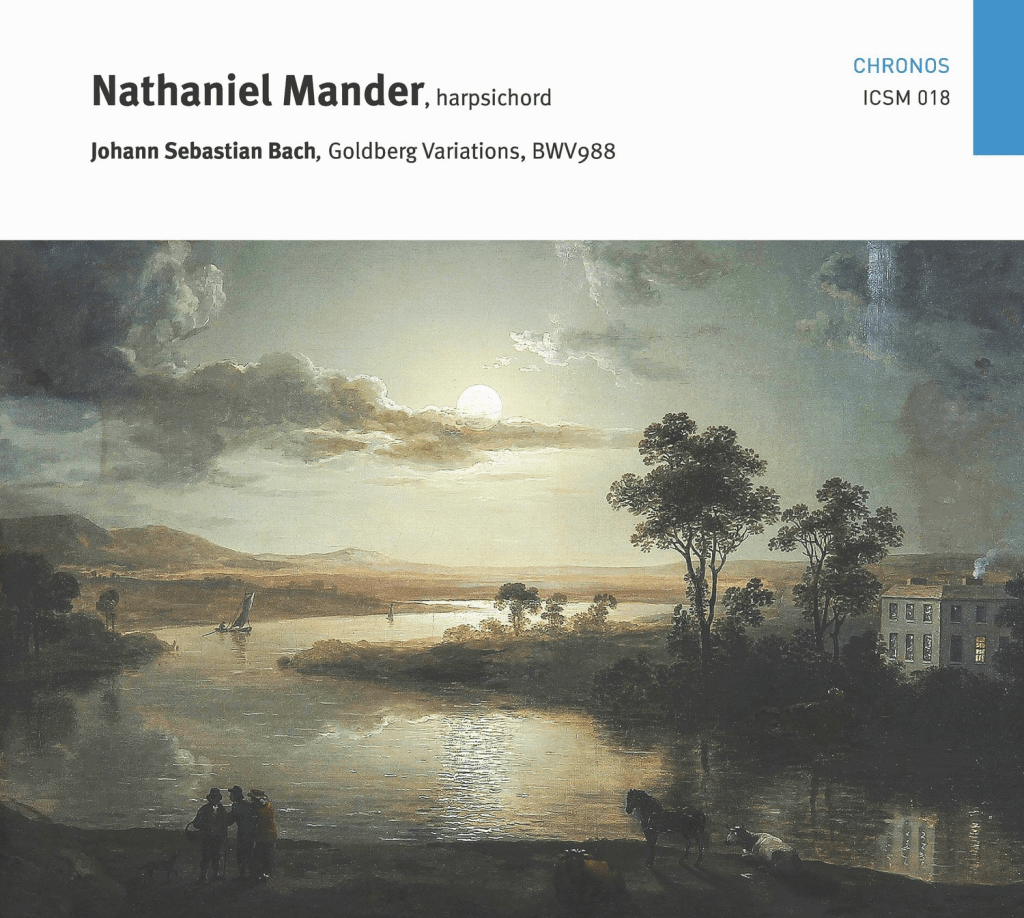
Goldberg Variations

Bach: Goldberg Variations
Nathaniel Mander, harpsichord
ICSM / Chronos ICSM018. 42’28

The Goldberg Variations is one of the most complex of all Bach’s keyboard works to understand and perform, so it is a brave move for anybody to make it their debut recording. However, Nathaniel Mander does have at least one distinguished predecessor in Glen Gould’s 1955 debut recording. It was published in 1741 under the (publisher’s) title of Clavierubung IV, following the earlier Clavierubung I, II, and III. The title implies that it is ‘Keyboard practice’, but it certainly is far more than that. Bach (who called it Aria with diverse variations for a harpsichord with two manuals) notes that it was “composed for connoisseurs, for the refreshment of their spirits”, which gives a far more appropriate impression of its status. The legend that Bach wrote the variations for Johann Gottlieb Goldberg is almost certainly not true, not least because Goldberg was just 13 at the time. But he was clearly a gifted player, and was a student of Bach’s son, Wilhelm Friedemann in Dresden, and also took lessons with J.S. Bach in Leipzig.

Continue reading

Early Music Day concert – Bach & Böhm

Andrew Benson-Wilson, organ
Mayfair Organ Concerts
The Grosvenor Chapel
South Audley Street, Mayfair, London W1K 2PA
Tuesday 21 March 2023, 1:10


Bõhm: Partita Freu dich sehr, o meine Seele
Trio Freu dich sehr, o meine Seele
Bach: Fantasia in c BWV 562i
Bõhm: Vater unser Im Himmelreich
Bach: Praeludium con Fuga in c BWV 546

This recital is a contribution to Early Music Day, the international celebration of early music that takes place annually on 21 March, the anniversary of Bach’s birth. The programme contrasts the music of one of Bach’s earliest influences with two of his mature organ works. When he was 15, Bach became a student at the Michaelisschule in Lüneburg. Georg Böhm was organist of the nearby Johanniskirche, the principal town church. The organ there was built in 1553 by Hendrik Niehoff, and is pictured below.

There is clear evidence that the young Bach knew Bõhm, and may have been a pupil of his. One of the earliest Bach manuscripts is a copy of a piece by Reinken owned by Bõhm. The two Bach pieces are powerful examples of his mature style, the first demonstrating the clear influence of French music, that he may have first experienced in Lüneburg and nearby Hamburg. The monumental Praeludium et Fuga in c shows the influence of Italian music, notably in the concerto-like Praeludium. Both Bach pieces were played as final voluntaries during the late Queen’s funeral and committal.

Continue reading

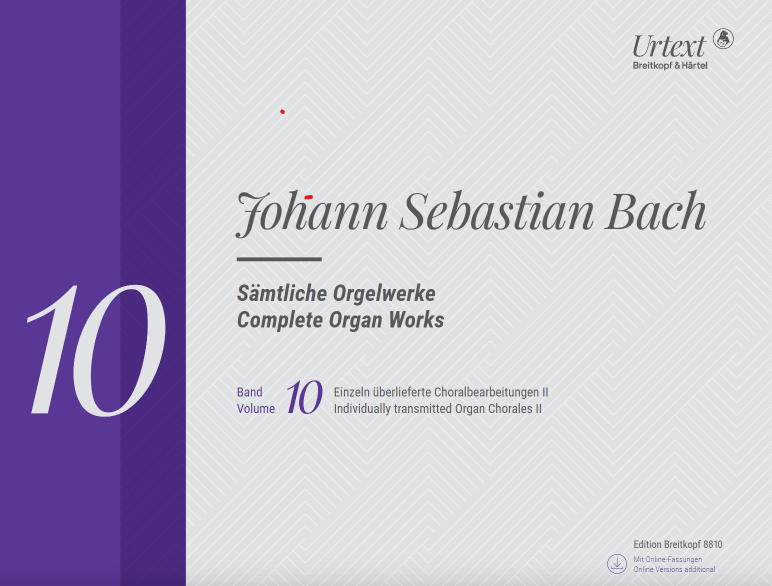
Breitkopf – Bach: Complete Organ Works, Vol 9 & 10

Johann Sebastian Bach: Complete Organ Works
Breitkopf & Härtel10 Volumes

Volume 9: Choral Partitas / Individually transmitted Choral Settings I
Ed. Reinmar Emans and Matthias Schneider
Edition Breitkopf EB8809.
184 pages | 32 x 25 cm | 783 g | ISMN: 979-0-004-18378-6 | Softbound

Volume 10: Individually transmitted Choral Settings II
Ed. Reinmar Emans and Matthias Schneider
Edition Breitkopf EB8810.
200 pages | 32 x 25 cm | 847 g | ISMN: 979-0-004-18379-3 | Softbound


Breitkopf & Härtel bring their ten-volume edition of the Complete Organ Works of Johann Sebastian Bach to an end with these two final and the offer of a complete package of all ten volumes. Volumes 9 and 10 bring together the Chorale Partitas and choral settings that have been individually transmitted rather than appearing in published collections (Clavierübung, Schübler, Orgelbüchlein, Leipzig/18). My reviews of previous Volumes can be read at these links: Volume 1, 2 & 4; Volume 3; Volume 5, 6 & 7; and Volume 8.

Continue reading

Scheidemann: Chorale Fantasias

Scheidemann: Chorale Fantasias for Organ
Ed. Pieter Dirksen
Breitkopf & Härtel 2022
92 pages | 30.5 x 23cm | 361gm | ISMN: 979-0-004-18607-7 | Softbound
Edition Breitkopf EB8938


Although the rather retro style of the cover might suggest a reprint, this is a new edition of nine Chorale Fantasias on Lutheran chorales by the pivotal North German organist composer Heinrich Scheidemann (c1595-1663). One of the key students of Sweelinck in Amsterdam (1611 to 1614), Scheidemann’s return to Hamburg was key to that city’s extraordinary 17th-century flowering of organ music: a fusion of organ design and musical development that culminated in the music of Buxtehude and, ultimately, Bach whose early experience was strongly influenced by this North German school of organ composition.

Continue reading

The Orgelbüchlein Project: Volume 3

The Orgelbüchlein Project: Volume 3
A 21st-century completion of Bach’s Orgelbüchlein
Volume 3: Catechism, Penitence and Communion (Chorales 61–86)
Compiled and edited by William Whitehead
119 pages  •  230x323mm  •  ISMN 979-0-2650-2810-9  •  Softbound
Musica Baltica


The recent celebration of the completion of The Orgelbüchlein Project (reviewed here, with background information on the project) included the launch of the second volume (actually Volume 3) of the published chorales. This followed the earlier publication of the first volume (labeled Volume 4, and reviewed here). Since the first volume, there has been a change of publisher, the latest volume (and the remaining ones) is published by Musica Baltica. Each volume is dedicated to a specific liturgical group of chorales, in this case relating to the Catechism, Penitence and Communion (chorales 61–86 of the original Bach Orgelbüchlein).

Continue reading

BBC Proms: OAE – Bach Mass in B Minor

BBC Proms
Bach: Mass in B Minor
Orchestra & Choir of the Age of Enlightenment, John Butt
Royal Albert Hall, 29 March 2022

How should an atheist approach Bach? And, in particular, his Mass in B minor, arguably his finest work and one that, to him, seemed to sum up a lifetime of music dedicated to Soli Deo Gloria (Glory to God alone) – the meaning of the S.D.G that Bach appended to all his sacred works?

Continue reading

Bach: Violin Sonatas

Bach: Sonatas
Plamena Nikitassova & Peter Waldner
Musik Museum 46, CD13045. 74’30

This recording is one of a series produced by the Tiroler Landesmuseum Ferdinandeum in Innsbruck. Although the title is just ‘Sonaten’, the programme is actually a selection of Violin Sonatas, three with obligato harpsichord (BWV 1016, 1017 & 1019), one for solo violin (BWV 1005) and an arrangement, possibly by Bach, of the first movement of that solo sonata for harpsichord (BWV 968).

Continue reading

The Mathematical Genius of Bach

Spitalfields Festival
The Mathematical Genius of Bach
Goldberg Variations

James Sparks, City of London Sinfonia, Alexandra Wood 
Christ Church Spitalfields, 30 June 2022


The opening concert of the Spitalfields Music Festival referred back to The Spitalfields Mathematical Society, a club that met from 1717 in taverns around Christ Church Spitalfields. Its aim was to give “the public at large an opportunity of increasing their knowledge, on terms so easy, as to be within the reach of every individual, who has a taste to cultivate, or curiosity to gratify.” It educated the working-class men of the district, who included “weavers, brewers, braziers, bakers, bricklayers”. It merged into the Royal Astronomical Society in the 1840s. The Festival continued the Society’s role of educating with a talk by James Sparks (University of Oxford) on the mathematical genius of Bach, illustrated with a performance of the Goldberg Variations, while the audience had access to interactive maths puzzles.

Continue reading

Music of Consolation: Bach, Schütz & Schein

Music of Consolation
Bach, Schütz & Schein
Monteverdi Choir, English Baroque Soloists, John Eliot Gardiner
St Martin-in-the-Fields, 16 June 2022

Two days before their St Martin-in-the-Fields concert, the culmination of a seven-concert European tour, the Monteverdi Choir and the English Baroque Soloists performed this programme in the Roman Odeon of Herodes Atticus on side of the Acropolis hill in Athens. The Romans in Britain buried at least one of their dead on the site of St Martin-in-the-Fields and, if they were around today, might recognize the Corinthian columns of the neo-Renaissance facade of James Gibb’s 1720s church, although they would be surprised at the neo-Gothic spire that he sat on top of it. The music, in contrast, was entirely Baroque from three composers born 100 years apart.

Continue reading

Bach: Art of Fugue

Bach Organ Works Vol. X: Art of Fugue
Margaret Phillips
Richards, Fowkes and Co. organ, 2012
St George’s Hanover Square, London
Regent Records REGCD558
. 2 CDs. 120’58

The Art of Fugue, BWV1080
Canonic Variations on ‘Vom Himmel hoch, da komm ich her’, BWV769
The Art of Fugue, Contrapunctus XIV completion by Kevin Korsyn

The final volume of Margaret Phillips’ complete Bach organ works is a version of The Art of Fugue, arranged for organ. I say ‘arranged’ because there is no indication of which instrument Bach intended his monumental work – if, indeed, he ever intended it for performance at all. It was written and published in open-score, with a separate musical stave for each of the four voices. There are no orchestral instruments of the time that could play all the lines on the same instrument, leading to the assumption that it was intended for the harpsichord. Performance on the organ is common, although there are many questions to be considered, not least the choice of registrations.

Continue reading

The Library of a Prussian Princess

The Library of a Prussian Princess
Ensemble Augelletti
Barn Cottage
Records BCR024. 60’25

Music by J S Bach, Handel, Corelli, Geminiani, C P E Bach, and Princess Anna Amalia

The Prussian Princess of the title is Anna Amalia (1723-1787), the younger sister of Frederick the Great. Despite the brutal childhood she shared with her brother, she managed to maintain a love of music, often in secret and aided by her brother. After a failed attempt to marry her off in her early 30s, she became the Abbess of the secular Imperial Abbey of Quedlinburg, a position of enormous wealth and power. Shortly after she started serious musical studies with Johann Philipp Kirnberger, a pupil of Bach and had a (still existing) organ built for her Berlin palace. She amassed an enormous library of music which is now part of the Berlin State Library. This imaginative and beautifully performed recording by Ensemble Augelletti is based on music from that library, including four pieces by Anna Amalia herself.

Continue reading