AAM: Messiah

Handel: Messiah
Academy of Ancient Music, Lawrence Cummings

Nardus Williams, Reginald Mobley, Thomas Walker, Ashley Riches
Barbican Hall, 15 December 2025


The Academy of Ancient Music (AAM) has a long and distinguished history with Handel’s Messiah, not least in being one of the first period instrument orchestras to record the piece in anything like the form, and with the soundworld of the original performance. After a stunning Messiah performance last year in the same Barbican venue, they returned for another sell-out performance with a new line of soloists Nardus Williams, Reginald Mobley, Thomas Walker, and Ashley Riches. I was impressed with all four of the coloists, although I did find the vibrato of the soprano a little disturbing, not least because the persistent pulse interfered with semiquaver runs. But, as with her colleagues, she expressed the words clearly and with meaning. The 18-strong choir similarly impressed, again with very clear diction and impressive consort. All four soloists excelled in adding historically appropriate ornaments and embellishments to the musical text. Of course, Messiah has no recognisable characters, as would be the case in an opera, so each recitative, accompagnato, and aria is a projection of the words, an essential component of Laurence Cummings’ interpretation, which he describes as a ‘Theatre of the Mind’.

Continue reading

AAM. Bach: Art of Fugue

Bach: Art of Fugue
Academy of Ancient Music, Concert Theatre Works
Laurence Cummings, Bill Barclay
Peter Bray, Steffan Cennydd, Imogen Frances, Simon Slater
Milton Court, 15 May 2025

Photo: Mark Allan

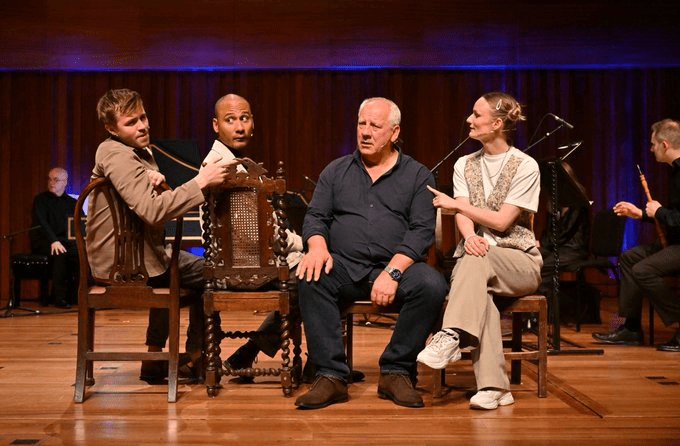
Johann Sebastian Bach’s Art of Fugue (Die Kunst der Fuge) is one of the greatest monuments of Western music. You mess with it at your peril. And mess with it at their peril is just what writer and director Bill Barclay with Concert Theatre Works did with the connivance of Lawrence Cummings and the Academy of Ancient Music (AAM), who commissioned this particular messing.

The Art of Fugue was composed during the last decade of Bach’s life, although the spurious accounts of Bach dying while composing the final fugue, on which much of the plot of this concert-theatre production relies, have long since been discredited. It was not published until shortly after Bach’s death, although autograph manuscripts of most of it survive. It consists of fourteen fugues (each called Contrapunctus) and four canons, all in D minor, and all using the same main theme, albeit in many varied forms. With the exception of the final fugue, which is written in conventional two-stave keyboard format, each piece has a separate line for each of the four voices (open-score) in a similar fashion to several learned musical works of the previous century or more. There is no indication of which instrument Bach intended or, indeed, if he intended it for performance at all, using it as an example of his skill in contrapuntal composition. There are no orchestral instruments of the time that could play all the lines on the same instrument, leading to the assumption that it was intended for the harpsichord. Performance on the organ is common, although there are many questions to be considered, not least the choice of registrations.

Continue reading

Bach: St John Passion

Bach: St John Passion
Academy of Ancient Music, Lawrence Cummings
Barbican Hall, 18 April 2025


Nicholas Mulroy, Evangelist, Dingle Yandell, Christus,
Carolyn Sampson, soprano, Helen Charlston, alto, Ed Lyon, tenor, Jonathan Brown, bass

Music has played a key role in religious occasions since the earliest times, and has played a notable role in most aspects of Western Christianity. When listening to pieces like the John or Matthew Passions or Messiah, I often wonder whether it is the words and the story, or the music that has the most highly charged emotional effect on those listening. For Christians, 3pm on Good Friday is one of the most sacred times of the year: according to one of the gospels, the moment when Jesus died after a three-hour-long crucifixion. In many Christian traditions, the whole day is devoted to fasting. But, for around 2000 people, 3pm was the start of the Academy of Ancient Music’s performance of Bach’s St John Passion in a packed Barbican Hall.

Continue reading

AAM. Transatlantic: Classical Masters

Transatlantic: Classical Masters
José Maurício Nunes Garcia, Haydn, Mozart
Academy of Ancient Music, Laurence Cummings, Katherine Spencer, clarinet
Milton Court, 13 March 2025

Nunes Garcia: Overture in D major; Dilexisti justitiam
Mozart: Clarinet Concerto in A major
Nunes Garcia: Tantum ergo
Mozart: Ave verum corpus
Haydn: Notturno in G major
Nunes Garcia: Litany for the Sorrows of Our Lady

The Acadamy of Ancient Music (AAM) continues its Transformation season with the programme Transatlantic: Classical Masters, focusing on the Brazilian composer José Maurício Nunes Garcia (1767-1830) and his heroes Haydn and Mozart. Nunes Garcia was born in poverty in Portuguese Rio de Janeiro to Afro-Brazilian parents, both seemingly the children of slaves, courtesy of their respective slave owners. An early musical talent was recognised, and Nunes Garcia was soon singing in Rio’s cathedral and, by the age of 12, was teaching music and learning keyboard instruments at the homes of his wealthy pupils. He was composing by the age of 16, and just a year later was sufficiently recognised as a music teacher to be a founding signature to the Brotherhood of Saint Cecilia. His wish to take Holy Orders was finally achieved at age 25 after being excused from the requirement to be “free from any colour defect” and becoming the required “estate owner”, courtesy of the father of one of his students. Shortly afterwards, he was appointed as “public music instructor” and set up a free music school for local children in his newly acquired house.

Continue reading

Italian Legacies: Geminiani and his English Contemporaries

Italian Legacies: Geminiani and his English Contemporaries
Academy of Ancient Music, Bojan Čičić, Anna Devin

Milton Court, 7 February 2025

Arne Overture in G major No. 3
Mudge Concerto No. 1 in D major
Geminiani Concerto Grosso in C major Op. 7 No. 3
Linley Music for The Tempest
Boyce Overture from Peleus and Thetis
Linley Violin Concerto in F major
JC Bach La Tempesta

Billed as “Swinging London meets Italian flair, 18th-century style”, this imaginative concert from the Academy of Ancient Music, directed from the violin by Bojan Čičić, took us on a tour of the music scene in 18th-century Britain: a place where “everything was up for grabs”. The blurb continued – “A nation was remaking its identity – embracing global fashions and diverse cultures, and locked in passionate debate about its relationship with Europe. English composers wrote Italian operas, the spirit of Shakespeare met the inspiration of Corelli and Vivaldi, and Bach’s youngest son carved out a musical niche that was entirely his own”.

Continue reading

AAM: Messiah

Handel: Messiah
Academy of Ancient Music, Laurence Cummings
The Barbican, 17 December 2024

Handel’s Messiah is a curious piece. Usually ritualistically churned out at Christmas and Easter, it was first performed at Easter in Dublin in 1742 after a mere 24 days of composition (a speed not unusual in Handel’s opera compositions), the autograph score bearing witness to the compositional haste. It went through several revisions in the following years, generally to suit the available forces for each performance. The score wasn’t published until eight years after Handel’s death. The version used for this Barbican performance from the Academy of Ancient Music stems from the early 1750s. The rather obtuse libretto was put together by the wealthy landowner, Charles Jennens, from the King James Bible and Psalms from the Book of Common Prayer, seemingly in support of his staunch Anglican leanings. The text is not easy to follow, let alone understand, but Handel composed with apparent relish, making no change to the texts to suit his musical ideas.

Continue reading

AAM: Viennese Virtuosity

Viennese Virtuosity: Symphonies by Mozart, Haydn and friends
Academy of Ancient Music,
Laurence Cummings
Milton Court, 14 November 2024

Wanhal: Symphony in D major, Bryan D17
Mozart: Symphony No 36, Linz
Dittersdorf: Symphony No 4 from Symphonies after Ovid’s Metamorphosis
Haydn: Symphony No 80

The Academy of Ancient Music (AAM) and Laurence Cummings continue their Transformation series of 2024/5 concerts with a concert of symphonies by Johann Baptist Wanhal, Wolfgang Amadeus Mozart, Carl Ditters von Dittersdorf and Joseph Hadyn. It was based on an occasion around 1784 when they played as a string quartet during a social gathering in Vienna. The story comes from an 1826 publication by a singer friend of Mozart, who noted that “… the players were tolerable, not one of them excelled on the instrument he played; but there was a little science among them, which I dare say will be acknowledged when I name them: The First Violin: HAYDN, Second Violin: BARON DITTERSDORF, Violoncello: VANHALL, Viola: MOZART“.

Continue reading

AAM: Charpentier’s Actéon & Rameau’s Pygmalion

Charpentier’s Actéon & Rameau’s Pygmalion
Academy of Ancient Music, Laurence Cummings

Anna Dennis, Rachel Redmond, Katie Bray, Thomas Walker
Milton Court, 9 October 2024

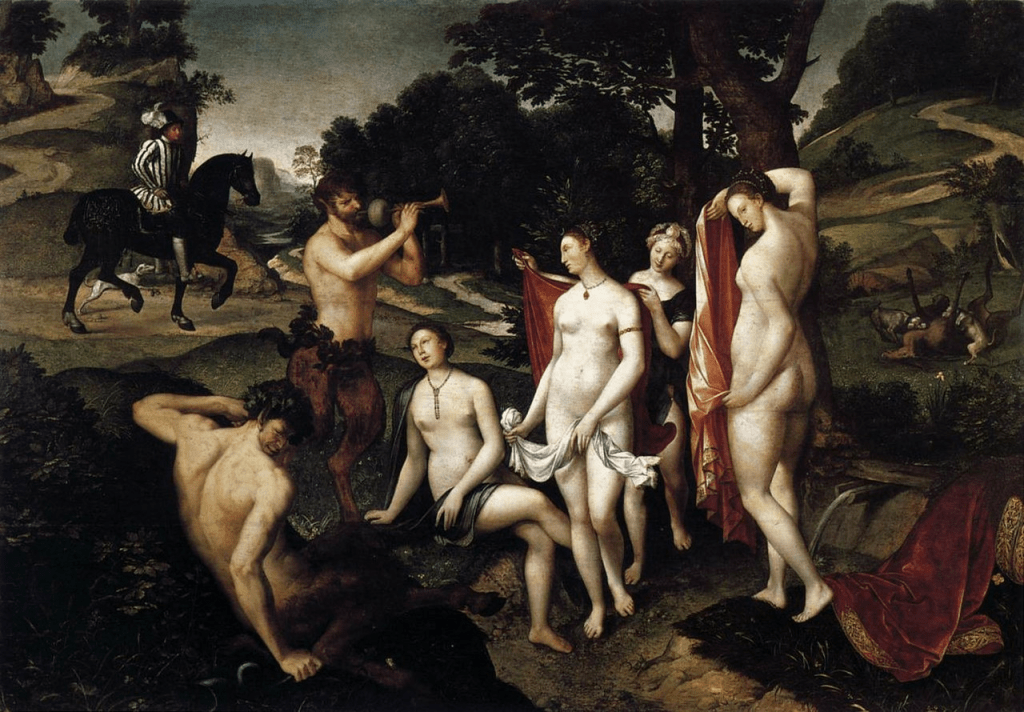
François Clouet: Bath of Diana (1558)

The Academy of Ancient Music opened its 2024/25 season, under the banner of Transformation, with a concert performance double-bill of French Baroque ‘operas’ or, more exactly, a Pastorale en musique and an Acte de ballet – Marc-Antoine Charpentier’s Actéon and Jean-Philippe Rameau’s Pygmalion. I am following those irritating promotional videos that encourage you to stay tuned until the end by urging you to read this review through to the end – this concert ended with one of the most extraordinary examples of musical professionalism and skill from the AAM’s musical director, Laurence Cummings, recently and deservedly appointed as an OBE.

Continue reading

Academy of Ancient Music. St Matthew Passion

St Matthew Passion
Academy of Ancient Music, Laurence Cummings
The Barbican, 29 March 2024


The Academy of Ancient Music (an Associate Ensemble at the Barbican Centre) is celebrating the 50th anniversary of its foundation by Christopher Hogwood. At a time when practically everybody else was concentrating on the St John Passion, in its anniversary year, they promoted a special performance of the Matthew Passion in the Barbican Hall, directed by their Music Director, Laurence Cummings. What was special about it was that they took the music back to its Leipzig roots, with a small orchestra (or, to be exact, two small orchestras) and a choir of just 8 (4+4) singers, all of whom contributed solos (of various importance), including, in Choir 1, the key roles of the Evangelist and Christus and the multi-character bass in Choir 2.

Continue reading

AAM: ‘Tis Nature’s Voice

‘Tis Nature’s Voice
Academy of Ancient Music
Bojan Čičić, Laurence Cummings
Barbican Hall, 30 June 2023


Mendelssohn: Hebrides Overture Op.26;
Violin Concerto in E minor, Op. 64
Beethoven: Symphony No. 6 ‘Pastoral’

The Academy of Ancient Music concluded its 2022/3 season, ‘Tis Nature’s Voice, with a venture into the early Romantic era, a suitable continuation of the theme of their opening concert, Hadyn’s The Seasons. They promised “thunderstorms, sea spray, nightingales and country dances and other beauties of nature as interpreted romantic style”. For those not used to music of the romantic era played on period instruments, this must have been a revelation. Indeed, it might also have been a revelation for some in the AAM as most of their repertoire stops before Mendelssohn and Beethoven.

Continue reading

Academy of Ancient Music: Il Trionfo del Tempo

’Tis Nature’s Voice
Handel: Il Trionfo del Tempo e del Disinganno (HWV46a)
Academy of Ancient Music, Laurence Cummings 
Milton Court, 11 May 2023


Il Trionfo del Tempo e del Disinganno was Handel’s first oratorio. It was composed a year after his 1707 arrival in Italy after three years in Hamburg where he exchanged his early career as a cathedral organist (in Halle) to that of a fledgling opera composer. He quickly fell in with an influential group of patrons in Rome, including Cardinal Pamphili who provided the libretto for Il Trionfo del Tempo e del Disinganno. Usually translated as The Triumph of Time and Disillusion, the alternative option of Time and Enlightenment was used for this excellent performance from the Academy of Ancient Music.

Continue reading

Hail! Bright Cecilia

Tis Nature’s Voice
Hail! Bright Cecilia
Academy of Ancient Music, Laurence Cummings
Milton Court. 9 March 2023

Matthew Locke etc. Suite from The Tempest
including Pelham Humfrey’s Masque of Neptune
Henry Purcell. Ode to Saint Cecilia: Hail! Bright Cecilia Z.328

Under the banner of the Academy of Ancient Music’s current concert series, ‘Tis nature’s voice! Laurence Cummings led them in a tour of English mid to late-17th-century music with a comparison between the music written by several composers for a 1674 production of The Tempest and the largest of Purcell’s Odes to Saint Cecilia, composed for the 1692 Saint Cecilia’s Day celebrations in Stationers’ Hall, a venue that still exists.

Continue reading

Bach: Six Motets

Bach : Six Motets
BBC Singers, Academy of Ancient Music, Peter Dijkstra
Milton Court Concert Hall, 3 March 2023

This BBC Singers’ Milton Court performance of the traditional grouping of Bach’s Six Motets (BWV 225–230) was imaginative and thoughtful, notably in two specific aspects. With one exception, they were sung in reverse order of BWV numbers, that exception being Komm, Jesu, komm (BWV 229) which was sung in the middle of the cantata Laß, Fürstin, laß noch einen Strahl. The concert will be broadcast on Wednesday 22 March on BBC Radio 3.

Continue reading

AAM. New Worlds: Genius – Mozart

New Worlds: Genius – Mozart
Academy of Ancient Music
Laurence Cummings

Ya-Fei Chuang, Robert Levin
Barbican, 1 July 2022


This concert saw the conclusion of the Academy of Ancient Music‘s New Worlds series, and the finale to Laurence Cummings’ first season as the AAM Music Director. Billed as “Grandeur, poetry and pure, unstoppable genius”, this imaginative programme contrasted Mozart’s Jupiter symphony with two little-known Mozart works, the Ballet sequence from Idomeneo (K367), and the Piano Concerto á3 (K242). The programme booklet for the concert can be accessed here.

Continue reading

AAM New Worlds Travelogue: Nicholas Lanier

New Worlds: TravelogueNicholas Lanier
Academy of Ancient Music
, Laurence Cummings
Anna Dennis, Thomas Walker
Milton Court & AAM LIVE stream. 18 February 2022

As part of their New Worlds series, the Academy of Ancient Music explored the life and times of the much-travelled lutenist, courtier and musical adventurer Nicholas Lanier in their Milton Hall and AAM LIVE streamed concert New Worlds | Travelogue. Lanier was from a French Huguenot family with an Italian mother. He was a court musician and composer to both King Charles I and Charles II, becoming the first Master of the King’s Music in 1625. He made several visits to Italy to acquire paintings for Charles I, during which he experienced the new style of Italian secondo pratica music from the likes of Claudio Monteverdi. He subsequently introduced the recitative style to England. He was painted by van Dyck in Antwerp and persuaded the King to bring Van Dyck to England.

Continue reading

AAM. Haydn: The Creation

‘A New Created World’
Haydn: The Creation

Academy of Ancient Music, Laurence Cummings, Nina Dunn Studio
Barbican Hall. 28 Sep 2021, and online

After a successful series of AAM Live 2021 live-streamed Covid concerts, the Academy of Ancient Music returned to live performance with Haydn’s Creation, conducted in the Barbican Hall by Laurence Cummings, making his debut as the AAM’s new Music Director. Haydn’s joyous paean of praise to the Biblical creation story was a splendid way to open their post-lockdown “New Worlds” themed season. Their performance also featured inventive and elaborate video designs by Nina Dunn Studio, projected onto the wide wooden rear screen of the Barbican stage.

Continue reading

Vivaldi’s Four Seasons

Vivaldi’s Four Seasons
Academy of Ancient Music
Richard Egarr, Rachel Podger

Live from The Barbican
First broadcast 27 June 2021. Available on-line until 29 June
.

Corelli: Concerto Grosso No 1 in D major, Op 6
Maria Grimani: Sinfonia to Pallade e Marte
Corelli: Concerto Grosso No 2 in F major, Op 6
VivaldiThe Four Seasons

Vivaldi’s Four Season’s is an inevitable war-horse guaranteed to attract audiences – in this case, a reduced socially-distanced audience for the live performance together with on-line viewers who have the option to view, for a modest fee, until 8pm on Tuesday 29 June. There are limits as to what performers can do with the Four Seasons, one being musical taste. But there is no limit as to the context in which a performance is set. And that is what makes this airing interesting, with its rare performance of the Sinfonia to Pallade e Marte by Maria Grimani, alongside two of Corelli’s well-known Concerto Grossi.

Continue reading

AAM Live: In stil moderno

In stil moderno: Castello, Strozzi & Claudio Monteverdi
Academy of Ancient Music

Streamed from West Road Concert Hall, Cambridge. 14 April 2021

Barbara Strozzi (1619-1677) : L’eraclito amoroso & Lagrime mie
Claudio Monteverdi (1567-1643): Et e pur dunque vero & Si dolce e’l tormento
Dario Castello (c1602-1631) : Sonate concertante in stil moderno, Libro Secondo

The second in the three-concert series of AAM Live 2021 events was initially billed as a farewell to their outgoing Music Director, Richard Egarr, who is now replaced by Laurence Cummings who directed the first of their AAM Live 2021 concerts, reviewed here. Although Egarr may have been an inspiration behind this programme of music from 17th-century Venice, the concert listed two directors, the AAM’s principal violinist Bojan Čičić and keyboard player Steven Devine. They were joined by mezzo Helen Charlston. Continue reading

Messiah

Handel: Messiah
Academy of Ancient Music, Richard Egarr

Live-stream from The Barbican, 19 December 2020

In what is becoming the ‘new normal’, the annual Academy of Ancient Music’s London performance of Handel’s Messiah was live-streamed (from behind a paywall) from London’s Barbican Hall. The socially-distanced, modest-sized period instrument orchestra (5,4,2,2,1 strings) and 17-strong choir filled the entire width of the stage with no apparent loss of acoustic focus in the recorded sound – the acoustics were excellent. Like any well-designed concert hall, the Barbican Hall retains the same acoustics whether or not there is an audience presence, the empty seats designed to have the same acoustic properties when empty as when sat upon. As far as I can tell, the concert is no longer available to watch, although this website might lead you to a possible viewing. The programme notes can be accessed here.

Continue reading

Le nozze di Figaro

Mozart: Le nozze di Figaro
The Grange Festival

Academy of Ancient Music, Richard Egarr
The Grange, Northington, Hampshire. 19 June 2019

What seemed to be the entire stage was visible to the arriving audience, a blank black space devoid of any scenery or clue as to the setting for the awaited Le nozze di Figaro. It was only when the Overture started that a rear curtain parted to reveal a shallow space at the back of the stage with tables set out for the servants of a great house. Said servants wandered in, some via the audience, with the usual paraphernalia of traditional country house of centuries gone, with guns and game slung over the shoulders of gamekeepers and bonny housemaids doing things with flowers. Were it not for the fact the much of adjoining The Grange mansion had long since been demolished, we could have been in the basement of the next door building.

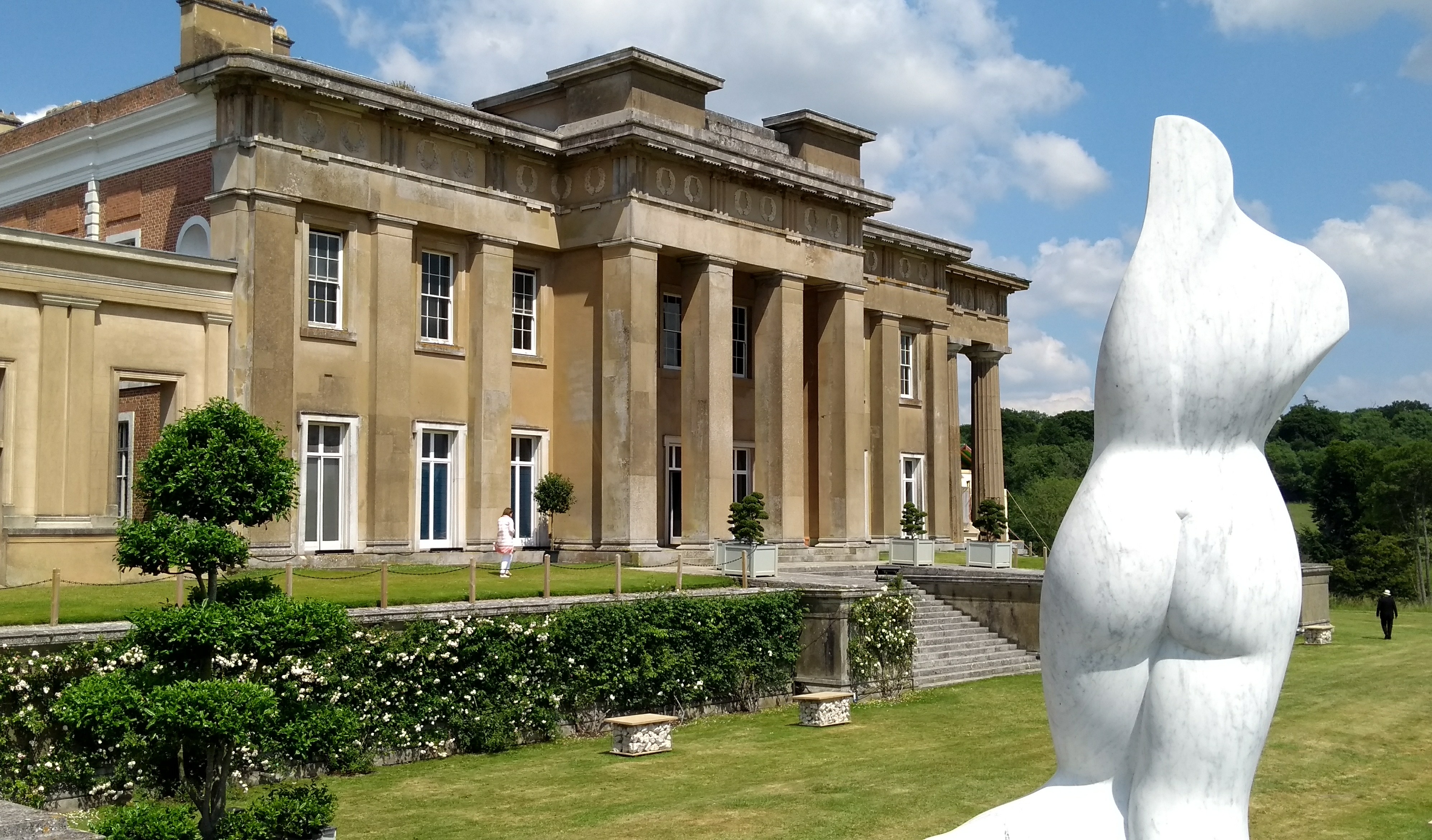
For those who do not know The Grange, what does survive is the important early Georgian Neo-Classical cement-rendered exterior, surrounding a mid-17th-century brick house, one wall of which is now exposed following the removal of the extensive Private and Bachelor wings. The interior is in a wonderfully evocative almost completely unrestored state. At the end of the surviving screen wall of the private wing is the remains of the early 19th-century conservatory, later converted into a ballroom. In 2002, this was further converted into a magnificent multi-award-winning opera house by Grange Park Opera who were the instigators and focus of opera productions at The Grange between 1998 and 2016. They have now relocated to the new Theatre in the Woods at West Horsley Place, Surrey to be replaced at The Grange by the three-year-old Grange Festival. Continue reading

French Baroque music meets Indian Classical Dance

French Baroque music meets Indian Classical Dance
BBC Singers, Academy of Ancient Music, Sofi Jeannin
Sanskriti UK & Ankh Dance
Milton Court, 19 October 2018

Lully: Te Deum 
Rameau: In convertendo Dominus;
extracts from 
Les Indes galantes, Les fêtes d’Hébé Castor et Pollux 

In what was a rather brave bit of programming for a live BBC Radio 3 broadcast, the BBC Singers and the Academy of Music, directed by Sofi Jeannin, the new Chief Conductor of the BBC Singers, presented an evening of French Baroque music, the second half of which was accompanied by two contrasting forms of Indian dance. The first half was of liturgical pieces, starting with Lully’s jubilant 1677 setting of the Te Deum. This was first heard at Fontainebleau and later became the piece that led to Lully’s death after he stabbed himself in the foot with his conducting baton during Chapel Royal celebrations for the Sun King’s recovery from surgery – surgery that Lully decided, fatally, to refuse. No such calamity occurred here as Sofi Jeannin demonstrated her commendably straightforward style of conducting, her focus clearly on the music itself rather than on any sense of self-aggrandisement. She coped well with the complications of this particular occasion, which included a late start after an overrun of the previous Radio 3 show, and complicated coordination between dances, singers, instrumentalists, a BBC announcer and the paraphernalia of a live BBC broadcast.  Continue reading

Academy of Ancient Music: Dido and Aeneas

Dido and Aeneas
Academy of Ancient Music, Richard Egarr, Thomas Guthrie
The Barbican, 2 October 2018

For anybody who was not already familiar with the story of Purcell’s Dido and Aeneas, the Academy of Ancient Music’s semi-staged performance (directed by Thomas Guthrie) at The Barbican opened with something of a plot-spoiler. The first half was a 40-minute exploration of the funeral rites of the dead Dido, albeit a couple of hours or more before she was ‘laid in earth’. Actually, laid in earth she wasn’t, instead lying on a funeral catafalque over which Belinda, Aeneas and assorted mourners (the AAM chorus, who opened the show with some rhythmic drum bashing) acted out their reaction to her death as they remembered her. And when I write ‘she’ in fact it was a half-size puppet of the upper half of Dido who represented her throughout the evening. The full panoply of puppets came to the fore in the second half performance of Dido and Aeneas itself where the entire cast of soloists and chorus sported puppets – torsos for Dido and Aeneas, heads and gauze cloths for the rest. Continue reading

Handel’s Agrippina at The Grange

Handel: Agrippina
Academy of Ancient Music, Robert Howarth
The Grange Festival, Hampshire. 16 June 2018

Handel’s Agrippina was first performed in 1709 during the Venice Carnival when he was just 23. It was towards the end of his three-year stay in Venice and used a considerable amount of borrowed material from Handel and other composers. It was an immediate success, with a further 26 performances, but was not revived again until modern times. It is now considered his first major operatic success. With its story of intrigue, rivalry, and deception in historic Rome, Cardinal Vincenzo Grimani’s libretto for Agrippina is said to reflect his own political rivalry with Pope Clement XI. The plot tells of Agrippina’s ruthless plan to usurp her husband Emperor Claudius and place her son, the youthful Nerone, on the throne. The sexually provocative Poppea joins in the fray in a complex plan to undo Agrippina’ plot, not least in her attempts to discredit Ottone, who Claudius wants to create Emperor as a reward for saving his life. It certainly had many political and cultural undertones at the time, and perhaps still does today.

Stefanie True (Poppea)_Jonathan Best (Lesbo)_Handel's Agrippina_The Grange Festival 2018 ©Robert Workman.jpg

Continue reading

AAM: Italy in England

Italy in England: When Handel met Corelli
Academy of Ancient Music, Bojan Čičić, Frank de Bruine,
Milton Court. 19 October 2017

Corelli Concerto Grosso in D major Op. 6 No. 4
Handel Concerto for Oboe No. 3 in G minor
Geminiani Concerto Grosso Op. 5 No. 3 (after Corelli)
GB Sammartini Sinfonia in G major
Avison Concerto Grosso in D minor No 3 ‘The garden of harmony’ (after Scarlatti)
G Sammartini Concerto for Oboe in E flat major
Handel Concerto Grosso Op. 6 No. 5

Aided by some excellent programme notes by Lindsay Kemp, we were led gently through an exploration of the influence of Italian musicians, notably Corelli, on performers and composers in England during the 18th century, many of whom were themselves, immigrants. The opening Corelli Concerto Grosso demonstrated the influence of the concerto grosso form. The opening Adagio is written in the score as nine simple chords, but Bojan Čičić’s beautifully elegant violin flourishes turned it into a complete musical experience and demonstrated the importance of ornamentation in music of this period. Directing the Academy of Ancient Music from the leader’s position Čičić demonstrated his extraordinary musicianship, the delicacy of his violin tone always blending with the orchestral timbre, even when in a clear solo role – a very welcome change from violinist directors whose sound dominated their companions. As a director, his sense of timing and the cooperative way he worked with his companions were an inspiration. An example was the timing of the final ‘that’s it folks’ cadence of the opening Concerto grosso – a lovely moment after a frenetic movement where all the players seemed to be bowing as fast as they possibly could.  Continue reading

Il ritorno d’Ulisse in patria

Monteverdi: Il ritorno d’Ulisse in patria
The Grange, Northington, Hampshire. 18 June 2017

The Grange, in Northington, Hampshire, achieved it current form in the early 19th century, when the architect William Wilkins (later to design the National Gallery) encased a 17th century house in grand Greek revival style. Further work by Robert Smirke, architect of the British Museum, and Charles Robert Cockerell completed the scheme. It came to public notice in 1975 when the owners, a junior branch of the Baring banking family, attempted to demolish the building. The exterior was listed by the Government, on IMG_20170618_142530147.jpgaccount of its appearance and landscape importance, and placed into the guardianship of English Heritage, who instigated major restoration of the exterior of the building and opened the site to the public. It reached much wider appreciation in 1998 when the new Grange Park Opera took a 20 year lease from the Baring landlords, and started a summer opera season. In 2002 they built an award-winning new opera house within the shell of the old orangery, investing several million pounds in the project. They also did a considerable amount of work inside the shell of the building, including reinstating the dramatic staircase (pictured below). Disagreements with the Baring family led to Grange Park Opera decamping to a new home at the Theatre in the Woods at West Horsley Place, Surrey, not surprisingly taking many of the internal fittings from their Grange opera house with them. Continue reading

AAM: Bach and the Italian Concerto

Bach and the Italian Concerto
Academy of Ancient Music
Milton Court Concert Hall, 15 February 2017

Bach: Concerto for oboe d’amore in D major
Vivaldi: Concerto for violin in G minor
Albinoni: Concerto for oboe in D minor
Vivaldi: Concerto for two violins in A minor
Bach: Italian Concerto
A Marcello: Concerto for oboe in D minor

Groups like the Academy of Ancient Music often perform with soloists drawn from their own ranks, with understandably excellent results. This was one such occasion, when four of the AAM’s regular orchestral players stepped into the soloist limelight. The focus was on the influence of Italian music on Bach, with a sub-plot of the Italian music that Bach transcribed for harpsichord organ. Indeed Alistair Ross, the AAM’s principal keyboard continuo player, suggested during the pre-concert talk that he could perform the entire concert programme on his own on organ and harpsichord.

The instrumental focus of the concert was on the oboe and oboe d’amore, played by Frank de Bruine. He opened with the latter instrument in Bach’s Concerto for oboe d’amore in D, the husky tone of the oboe d’amore (pitched lower than the normal baroque oboe) revealing exactly why it was one of Bach’s favourite instruments. Continue reading

Castello: Sonate Concertate in Stil Moderno, Libro Primo. 1621

Dario Castello: Sonate Concertate in Stil Moderno, Libro Primo 1621
Academy of Ancient Music, Richard Egarr
AAM Records AAM005. 68’39

Sonatas 1-12: for two violins; violin and cornetto; violin and violetta; violin and trombone; cornetto and violetta; violin and dulcian; cornetto, violin and dulcian; two violins and dulcian; two violins and trombone.

AAM005 Castello

Very little is known about Dario Castello. His birth and death dates are unknown, but are possibly something like 1590-1660. His two volumes of Sonate concertate were published in Venice in 1621 and 1629. The prefaces of his two volumes suggest that he was on the musical staff of San Marco under Monteverdi, and also leader of a group of piffari, playing cornetto or dulcianAlthough Castello was a common name in Venice, Dario wasn’t, so was probably a pseudonym. Records suggest that there were three Venetian Castello instrumentalists, one of whom seems to be Dario’s son.

His two volumes of Sonate concertate were immensely popular at the time, and remain so today. The first book consists of 12 Sonatas for two or three solo instruments and continuo. The second set of Sonatas range from one to four solo instruments. They are often heard today played by trio sonata groups, with two violins and continuo. But this Academy of Ancient Music recording of the complete 1621 Libro Primo introduces the wide range of instruments that Castello specified in his score, with the addition of a cornetto, violetta (here interpreted as basso violetta da brazzo, an instrument an octave lower than a violin), dulcian and trombone to the two violins.   Continue reading

James Gilchrist Directs: Bach and Purcell

James Gilchrist Directs: Bach and Purcell
Academy of Ancient Music
James Gilchrist, Pavlo Beznosiuk, Rachel Brown
Milton Court, 19 October 2016

The Academy of Ancient Music’s 2016-17 London and Cambridge concert series features two occasions when guest directors are being invited to plan programmes and direct the orchestra. The first of these was with the tenor, James Gilchrist. Renowned as a Bach performer (most notably in the role of Evangelist in the Passions) Gilchrist has been a regular soloist with the AAM. After a musical grounding as a boy chorister at New College, Oxford and a choral scholarship at King’s College, Cambridge, Gilchrist helped to pay his way through the rest of his medical training by singing in professional choirs such as The Sixteen, Tallis scholars and Cardinall’s Musick. He moved from his earlier career as a doctor to become a full-time musician twenty years ago.

On this occasion, the word ‘curator’ rather than ‘director’ is more appropriate. Gilchrist selected the vocal works from Purcell and the two Bach cantatas, handing over to the AAM’s leader, violinist Pavlo Beznosiuk, to select Continue reading

Academy of Ancient Music: The Bach Family

The Bach Family
Academy of Ancient Music, Lucy Crowe, Reinhard Goebel
Barbican. 18 June 2016

Unfortunately this concert will be remembered by me because, not for the first time, I found the behaviour of conductor Reinhard Goebel disturbing, both on and off stage. This started with his pre-concert talk, an event he totally dominated, arriving with his hands fumbling all over the hapless female AAM communications manager before announcing himself, and then suggesting that his much-handled companion also announce him. She then managed to ask one very simple question, which led to a rambling, incoherent, and often incorrect 30 minute monologue on practically anything but the question asked. For some reason, that probably didn’t reduce his ego, there was only one chair provided, meaning that the unfortunate communication manager ended up sitting at his feet on the floor at the edge of the dais. Amongst Goebel’s more alarming contentions was that Bach didn’t compose anything in the last two decades of his life, an extraordinary error that he only partially reined back on later in his talk. He also described Bach as a ‘nasty person’ who ‘hated the world’.

In the concert itself, Goebel pranced onto the stage clad in a clownish bright red cummerbund and matching bow tie and, bizarrely, carrying two batons. Continue reading

Monteverdi: Il Ritorno d’Ulisse in Patria

Monteverdi: Il Ritorno d’Ulisse in Patria
Academy of Ancient Music, Richard Egarr
Barbican, 29 September 2015

The Academy of Ancient Music completed their trilogy of Barbican performances of Monteverdi operas with Il Ritorno d’Ulisse in Patria in what was build as a ‘concert hall staging’, but was as close to a fully-staged opera as you could get without props or scenery. Rather like the recent Monteverdi Choir / London Baroque Soloists production of Gluck’s Orphée et Eurydice at the Royal Opera House, the stage depth was divided into three parts, with the instrumentalists occupying the centre ground. The Gods spent most of their time on the higher level behind the orchestra, with mortals at the front of the stage. Both had forays into the audience, accompanied by rather overdone spotlights brightly illuminating those of the audience sitting near the aisles. Continue reading