Bach back in Leipzig

This362ef9c2-c91b-465c-ba0d-5af7ac28ba76-627x720 evening, during the opening concert of the Leipzig Bachfest, the famous 1748 Haussman portrait of Bach was formally presented to the Bach Archive in Leipzig.

Inherited by CPE Bach, it was owned by the Jenke family from the early 19th century until 1952, spending time in a farmhouse in Dorset during the war years. It was then bought by the American Bach scholar William Scheide who left it to the City of Leipzig in his will. From tomorrow, 13 June, it will be displayed in the Bach Museum.

The photos below show the unveiling, and the donor’s daughter speaking in Leipzig’s Nikolaikirche.C__Data_Users_DefApps_AppData_INTERNETEXPLORER_Temp_Saved Images_Bachfest-in-Leipzig-eroeffnet-70_000-Besucher-erwartet_mobileWideWP_20150612_18_30_13_Pro-1

Catalina Vicens: ‘Cembalo Transalpino’

Catalina Vicens (c1622 harpsichord & 1664 virginals)
The Cobbe Collection, Hatchlands Park, East Sussex. 10 June 2015.

With the sponsorship and encouragement of the Keyboard Charitable Trust, the talented Chilean early keyboard player Catalina Vicens gave an outstanding lunchtime concert at Hatchlands, the National Trust home of The Cobbe Collection of historic keyboard instruments. Her short UK tour continues with two London concerts, tomorrow (11 June) in the Handel House Museum , and on Friday (12 June) at Fenton House.

Catalina VicensCatalina’s Hatchlands recital explored the influence of Italian Renaissance keyboard music on late 16th and early 17th century English music, focussing on some of the first music publications. England was just one of the countries that fell under the spell of Italian music and musicians as they ventured north over the Alps. Usefully played in chronological order, Catalina’s programme also provided a fascinating insight into the early development of keyboard music itself.

She started with Italian pieces played on the harpsichord attributed to Girolamo Zenti, dated 1622. Zenti also worked  in England for Charles II, so it was appropriate that the second part of the concert was played on the 1664 John Player virginals from Charles II’s Whitehall Palace.  This early repertoire includes many  Continue reading

Betrayal: A Polyphonic Crime Drama

I Fagiolini
Village Underground. 13 May 2015

It’s not often that I find myself standing in a long queue outside a venue controlled by bouncers. But this was, after all, an I Fagiolini event (commissioned by the Barbican), and the little beans had come up with yet another of their spectaculars. The venue was Village Underground, a performance and arts venue created out of a derelict railway viaduct and adjoining warehouse. The bouncers eventually let us in, after we had shown the ‘Crime Scene Inspection Permit’ we had been told to bring with us. We were immediately shrouded in thick smoke, the little blue-light torches were had been given not being a great deal of help. In the murk, we managed to find a series of display boards showing an enigmatic sequence of photos and poetic texts, all linked by lines. Several chalked body outlines could be seen on the floor, close to various seemingly random objects that had been grouped near the display boards. The investigation permit began to make sense. As the gloomy room filled up with people it became harder to move about, an issue that became more serious when the singers and dancers joined the scene. Continue reading

London Festival of Baroque Music – Day 4/5

‘Women in Baroque Music’
St John’s, Smith Square & Westminster Abbey, 18/19  May 2015

SJSS 2I couldn’t get to the lunchtime concert on day 3 of the festival, but it was given by soprano Rowan Pierce and the young group Medici, under the title of ‘Future Baroque’, with music by Handel, Bach, Royer, Telemann, Corelli and Vivaldi. Unless I have missed something, this was another event that seemed to bypass the festival’s theme, although it did include as its final work Agitata da due venti, a surviving fragment from Vivaldi’s opera L’Adelaide and later also included in his Griselda, composed for the virtuoso soprano Margherite Giacomazzi.

‘Leçons des ténèbres’
Julia Doyle & Grace Davidson, sopranos,
Jonathan Manson, bass viol, Steven Devine, harpsichord, organ & director

The Monday evening concert (St John’s, Smith Square, 18 May) Continue reading

St John’s Smith Square Young Artists’ Scheme, 2015/16

Congratulations to recorder player Tabea Debus (www.tabeadebus.de) and vocal ensemble The Gesualdo Six (www.thegesualdosix.co.uk) on representing the early music world as two of the four appointments to the St John’s Smith Square Young Artists’ Scheme for 2015/16. The other two awards go to violinist Joo Yeon Sir (www.jooyeonsir.com) and The Ligeti Quartet (www.ligetiquartet.com). Continue reading

London Festival of Baroque Music – Day 3

‘Women in Baroque Music’
St John’s, Smith Square, 17  May 2015

The third day of the festival started with ‘Sing Baroque’, with Robert Howarth, one of the Robert HowarthOrchestra of the Age of Enlightenment’s regular conductors, leading a Sunday morning workshop on the choral sections of Vivaldi’s Gloria – “for all aspiring Baroque singers – no experience necessary!”. This is certainly not the sort of event that should be reviewed, but I will comment on the experience of watching a conductor at work from the other side of the podium. Conducting styles vary by personality (and over historic time), but there is a generation of younger conductors who focus on using collaboration, cooperation and genuine good humour (rather than dictatorship or bullying) as the key to communicating their ideas. It was clear that Robert Howarth is one of those. As well as giving the gathered singers an excellent insight into the music and aspects of performing it, Robert Howarth also made it an extremely entertaining occasion. Music’s gain is stand-up comedy’s loss.

The Sunday afternoon included a guided tour of The Wallace Collection exploring ‘Music, Dance and Gallentry in 18th-century French Art’, followed by a concert focusing on the harpsichord music of Elizabeth Jacquet de La Guerre (1665-1729) given by Béatrice Martin. Continue reading

London Festival of Baroque Music – Day 2

‘Women in Baroque Music’
St John’s, Smith Square, 16  May 2015

‘Canto dell dame’
Concerto Soave
María Cristina Kiehr soprano, Jean- Marc Aymes, harpsichord, organ & director.

On the cover of the festival programme book are the words “Joy / Passion / Religion / Love / Death / Adoration / Intensity. The Saturday afternoon concert of 17th century Italian music given by Concerto Soave included all of those aspects, sometimes in the same piece. Featuring Concerto Soavefive female composers, the music ranged from the very beginning of the Baroque up to the end of the 17th century. The earliest composer was Francesca Caccini (1587-1641), daughter of Giulio Caccini (represented here by Peter Philips’ harpsichord transcription of his Amarillo, mia Bella). Francesca Caccini made her debut aged 13 at the Medici Court, singing at the wedding of Henri IV of France to a Medici bride. After time in France she returned to become the leading female singer in Florence. Apart from one opera (the earliest known one by a woman) her only surviving music was published in 1618. The three pieces demonstrated the early recitativo style of Continue reading

London Festival of Baroque Music – Day 1

‘Women in Baroque Music’
London Festival of Baroque Music
St John’s, Smith Square, 15 May 2015

This long weekend of Baroque music was both a 1st  and a 31st  event. The first event of the new London Festival of Baroque Music, and the 31st of a continuing festival that had hitherto been known as the Lufthansa Festival of Baroque Music. The Lufthansa Festival was an extraordinary example of collaboration between a sponsor (that in latter years also included Rolls Royce) and a music festival. Shorn of the funding of a major international sponsor, the LFBM_cropfirst London Festival of Baroque Music inevitably revealed its reduced financial resources, covering an 5-day extended weekend rather than earlier 8 or more days, and with a reduction in the number of groups from outside the UK. But a wealth of individual sponsors and some crowd-funding through social media has come up with the wherewithal to make for a rich and fulfilling series of concerts. And a capacity audience for the opening concert in St John’s, Smith Square showed the strength of public support. Continue reading

The OAE Night Shift – Classical Music: minus the rules

Orchestra of the Age of Enlightenment
Kati Debretzeni, director & violin
Frances Kelly, harp, Elizabeth Kenny, theorbo
Queen Elizabeth Hall, 12 May 2015

Despite being no spring chicken myself, the audience at most classical music concerts make me feel rather young –  perhaps naively. Not so the OAE’s innovative Night Shift events, specifically aimed at young people and therefore making me feel rather old. Although these events have taken place in pubs and bars, I usually experience them, like this one, as late-night one-hour events repeating part of the earlier evening OAE concert. On this occasion, the OAE included three of the  pieces played in the earlier concert reviewed below (Telemann’s Violin Concerto in Bb and Handel’s Concerto for harp & lute and he Concerto Grosso, Op 6/1), unfortunately omitting Stevie Wishart’s new work which had just been given its world premiere. I would have loved to have heard what the young audience thought of that work.

WP_20150512_21_59_23_Pro 1

The Queen Elizabeth Hall stage lighting was given a sexy twist Continue reading

The Rough with the Smooth

Orchestra of the Age of Enlightenment
Kati Debretzeni, director & violin
Chi-Chi Nwanoku, double bass, Frances Kelly, harp, Elizabeth Kenny, theorbo
Queen Elizabeth Hall, 12 May 2015

Telemann: Overture (Suite) in B flat, TWV.55:B8 (Ouverture burlesque), Concerto in B flat for violin, TWV.51:B1,
Stevie Wishart: Concerto à double entendre (World premiere)
Handel: Concerto in B flat for violin & orchestra, HWV.288 (Sonata a 5), Concerto in B flat, Op.4 No.6 for lute & harp, Concerto grosso in G, Op.6 No.1

Nestling in between the familiar OAE territory of Telemann and Handel was the world premiere of Stevie Wishart’s The Rough with the Smooth: Concerto à double entendre. Lasting about 23 minutes, it was structurally based on the traditional form of the concerto grosso, the three-movements headed Prelude and Fugue, Air, and Passacaglia. So far, so Baroque. But Stevie Wishart is a composer with roots in early and contemporary music. So rather than highlighting the melodic aspects of the instruments that are usually key to Baroque music, Wishart focused on the “resonance, overtones and sympathetic vibration” of the string orchestra, commenting that “the entire orchestra play only open strings and harmonics so that melodies only surface through a barrage of ‘sound clouds’ and gentle noise.” Continue reading

The 2014 Lufthansa Festival – end of an era?

As the 2015 London Festival of Baroque Music approaches, I thought I would re-publish my review of last year’s festival, under the then title of the Lufthansa Festival of Baroque Music.

“This year’s Lufthansa Festival (the 30th) marked the end of an era.  It was the last to benefit from the 30-year sponsorship of Lufthansa (and, for the past 12 years, also Rolls-Royce plc), one of the most remarkable musical/financial partnerships in the modern history of music.  The Festival will continue with the same wealth of performers and performances under the name of the London Festival of Baroque Music, and is seeking funding Continue reading

Candlelit Arcangelo

Arcangelo & Neal Davies
Sam Wanamaker Playhouse, 9 May 2015

Bach, Albinoni, Telemann

The latest of the candlelit concerts in the Shakespeare Globe’s Sam Wanamaker Playhouse was given by Arcangelo (9 May). They were founded in 2010 by Jonathan Cohen, and appear in formats ranging from a duo to a chamber orchestra. On this occasion they were a small string group plus oboe, theorbo, and continuo organ/harpsichord, joined at the end by baritone Neal Davis (replacing his indisposed cousin Iestyn Davies).

The programme was one of contrasts, ranging from the frolics of Telemann’s Don Quichotte Suite to Bach’s serene cantata Ich habe genug. The size of Continue reading

Purcell & Charpentier: Te Deum

Schola Cantorum of Cardinal Vaughan Memorial School
Spiritato!  Iestyn Davies
St John’s, Smith Square. 29 April 2015

Purcell: Suite from Abdelazer, Jehova Quam Multi Sunt Hostes Mei, Te Deum and Jubilate in D. Rameau: Suite from Les Indes Galantes, Charpentier: Te Deum

I wouldn’t normally review a concert given by a boys’ school choir, but the Cardinal Vaughan Memorial School is well-known for their music education and performances.  The Schola Cantorum supports the liturgy of the school services, but is better known as one of the few school choirs that are regularly called upon for professional engagements. These have ranged from the Harry Potter films to a recent live broadcast on BBC Radio 3 of James MacMillan’s complex St Luke Passion. Individual boy singers are also often to be heard at Covent Garden and the Coliseum.

Continue reading

J C Bach: Adriano in Siria

J C Bach: Adriano in Siria
Classical Opera.
Britten Theatre. 14 April 2015

Johann Christian Bach, JSB’s youngest son, arrived in London in 17 62, aged 26. He stayed for the rest of his life, earning the epitaph of the ‘London Bach’. Two years later, the 8-year old Mozart arrived in London with his family. During his 15-month stay, Mozart wrote his first symphonies and opera arias and absorbed the influence of the many musicians that had flocked to post-Handelian London. JC Bach was a particular influence on the young Mozart. He later wrote of Bach: “I love him with all my heart, and have the highest regard for him.”. This influence is reflected in Classical Opera’s choice of Continue reading

Bach Shafted!

Bach: St John Passion
Hieronymus
Thames Tunnel Shaft, Rotherhithe.  11 April 2015.

This must be one of the most bizarre musical venues I have ever been in, and an extraordinary place to hear one of Bach’s most sacred works. Between 1825/43, Marc Isambard Brunel and his son Isambard Kingdom constructed a tunnel under the Thames between Rotherhithe and Wapping, the first of its kind in the world. In order to construct the tunnel, they sank a 15m diameter shaft on the south side of the river in Rotherhithe. With the addition of stairs, this shaft later became the pedestrian entry to the tunnel, but was closed when the tunnel started taking trains rather than pedestrians. The Thames Tunnel is now an active part of London’sWP_20150411_19_23_30_Pro railway system, and the shaft has been re-opened with a concrete floor inserted to separate it from the trains below. It is currently only accessible by wriggling through a 1.3m high entrance and clambering about 12m down on some rickety scaffolding stairs. Continue reading

Handel: Giove in Argo

Handel: Giove in Argo
Britten Theatre, 26 March 2015
Laurence Cummings conductor
London Handel Orchestra

Like London busses, you can wait for ages to hear a pasticcio opera, and then three come along at once. After Fabio Biondi’s reconstruction of Vivaldi’s compilation L’Oracolo in Messenia at The Barbican and Opera Settecento’s excellent concert performance of Handel’s 1732 compilation opera Catone in Utica (both reviewed below), along came Handel’s 1739 Giove in Argo. It was considered lost until some arias were discovered a few years ago. John H Roberts has reconstructed and edited the score (for Bärenreiter), adding missing recitatives. After recent outings in Göttingen, Hanover and Halle, this was the first UK performance since 1739. It was given in the intimate space of the Britten Theatre with singers from the RCM International Opera School as part of the London Handel Festival.

The plot is loosely drawn from Ovid’s Metamorphoses. It focuses on the antics of a rather naughty Giove (Jove/Jupiter) and his attempts to seduce Continue reading

Tenebrae by Candlelight

Tenebrae by Candlelight
Chapelle du Roi – Alistair Dixon director
St John’s, Smith Square, 1 April 2015

Palestrina: Lamentations, Gesualdo: Tenebrae Responds, Victoria: O Domine Jesu, Mass: Ave Regina, Ave Regina Coelorum, de Monte: Super Flumina Babylonis, Tallis: Lamintations I&II,  In Jejunio et Fletu, Derelinquit Impius, Byrd: Emendemus in Melius, Guerrero: O Domine Jesu.

The regular pre-Christmas and pre-Easter concerts in St John’s, Smith Square given by the vocal group Chapelle du Roi continued with one of their best yet as they celebrated ‘Tenebrae by Candlelight’.  ‘Celebrated’ is a loose term, as this was not a liturgical reconstruction, but a reflection on the music for Holy Week generally intended for use during the Tenebrae service.  The monastic service of Tenebrae was a combination of the office of Matins, normally sung just before sunrise, and the sunrise service Continue reading

More on the European Union Baroque Orchestra

EUBO is proud to announce that it has been selected to receive Creative Europe funding from the European Commission. The activities of EUBO during the period 2015 to 2018 will take place under the auspices of its new project, the EUBO Mobile Baroque Academy (EMBA), which will be organised by EUBO together with its nine partners. EMBA will nurture the performance of Europe’s distinctive shared heritage of baroque music, and the education of emerging Europe-wide talent, bringing baroque music to new audiences in innovative ways across Europe.

The activities of the new co-operation project, subtitled Pathways & Performance, will focus on music education and performance training. EMBA will provide a significant touring programme with its training orchestra EUBO under the direction of Music Director Lars Ulrik Mortensen and other renowned baroque music specialists. EMBA will also organise orchestral courses, interactive digital masterclasses, audience development events and a comprehensive digital programme ‘Baroque Bytes’ including live streamings and recordings of historically informed performances of baroque repertoire.

Student musicians are invited to take part in the first year’s activities by applying for a place at the Audition Courses which will take place in Luxembourg from 29 July to 1 August and from 1 to 4 August 2015. Further information on the courses is available at http://www.eubo.eu/EUBO/courses.

The EMBA partners are –
E
uropean Union Baroque Orchestra (UK) www.eubo.eu
European Association of Conservatoires (BE) www.aec-music.eu
Concerto Copenhagen (DK) www.coco.dk
Estonian Record Productions (EE) www.erpmusic.com
Villa Musica Rheinland-Pfalz (DE) www.villamusica.de
Trifolion/Ville d’Echternach (LU) www.trifolion.lu
The Malta Council for Culture and the Arts (MT) www.teatrumanoel.com.mt
Koninklijk Conservatorium Den Haag (NL) www.koncon.nl
Universitatea Nationala De Muzica Din Bucuresti (RO) www.unmb.ro
St John’s Smith Square (UK) www.sjss.org.uk

Die Tageszeiten – Les Passions de l’Ame & Solomon’s Knot

Bach & Telemann’s Die Tageszeiten
L
es Passions de l’Ame, Meret Lüthi, Artistic Director
Solomon’s Knot, Jonathan Sells, Artistic Director
St George’s, Hanover Square.  17 March 2015

JS Bach: Orchestral Suite No 3 in D, Singet dem Herrn; GP Telemann: Cantata Cycle: Die Tageszeiten TWV20:39

The latter years of a composer’s life frequently see reflections on earlier times and a reversion to earlier compositional styles. But Telemann, one of the most prolific composers of the Baroque era, took the opportunity to take a peek into the musical future with his rarely performed cycle of four cantatas, Die Tageszeiten (Times of the Day), It was written in 1755 at the time when Telemann’s composing output was in decline and shows several musical insights into the forthcoming classical era. This was a difficult period in Telemann’s life – his eldest son was dead, leaving him to care for his grandson alongside his own declining eyesight and health. Although generally described as a ‘cantata cycle’, it has something of the feel of a fledgling oratorio to it, not least in its combination of elements of traditional sacred cantata and opera, both genres that Telemann had excelled in during his time in Hamburg. This performance, part of the London Handel Festival, brought together the Bern-based orchestra Les Passions de l’Ame, led by violinist Meret Lüthi, and the eight singers of Solomon’s Knot, directed by Jonathan Sells, who also sang bass.

Each of the four sections is in the same format (Aria – Recitative – Aria – Chorus), reflecting morning, midday, evening and night, and sung respectively by soprano, alto, tenor and bass – in this performance each voice type shared by two singers. Having a different soloist for the second, more reflective and sacred part of the second aria in each section emphasised the text’s link with the passing of life’s stages and the life of the Christian Soul. As if to emphasis this point, the last example was sung from the pulpit.

It was clear from the start that this was rather different to Telemann’s usual style, the opening Sinfonie seeming to switch style from Wagner to Vivaldi in just a few bars, linked by a nimble little viola figure.  The instrumental colour and texture that Telemann drew from his accompaniment continued to fascinate, another example being the halos of strings depicting first the shimmering morning stars and, later, the dew rising from an evening alpine meadow. A noisy brook murmured, the west wind swayed branches, bees raided the flowers with constant buzzing, and the death bell tolled, all meticulously reflected in Telemann’s score.

One of the delights of the score is Telemann’s use of colloquial descriptions of tempo and mood, for example noting the slow movement of the opening Sinfonie as “Dallying and dainty” and the second evening Aria as “Drowsily”. Each section uses a specific instrumental colour, most notably a viola da gamba for midday, played exquisitely by Heidi Gröger. Zoe Matthews provided the bassoon’s depiction of night.

During the first half on the evening, the two groups had performed separately, Les Passions de l’Ame giving an inventive and inspirational performance of Bach’s Orchestral Suite No 3 in D, the Ouverture being not too fast, and the ever-popular Air being not too slow, with a particularly delicate reading of the melody by Meret Lüthi.  Solomon’s Knot then gave a stunning performance of Bach’s motet Singet dem Herrn, the eight singers producing a rich timbre that suited both the madrigalian intensity and joyful bounce of Bach’s varied textures. As with Die Tageszeiten, they all sang from memory, creating an ideal connection with the audience. They all took solo roles in the latter piece, most impressive being soprano Zoë Brown and counter-tenor Michal Czerniawski.

This was an excellent performance by Les Passions de l’Ame and Solomon’s Knot, both individually and together. I hope this partnership will continue.

klingzeug – Secret Destinations

klingzeug – Secret Destinations
Austrian Cultural Forum, 19 Nov 2014

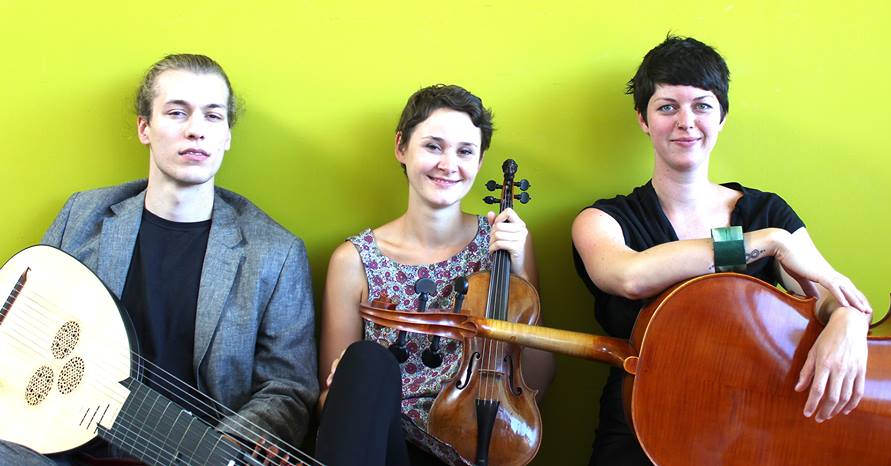
I first reviewed the three members of the young Austrian group klingzeug in the curious surroundings of an open-sided pavilion in Innsbruck’s Hofgarten, so it was good to be able to hear them playing indoors. The title of their programme, ‘Secret Destinations’ could have applied to the London venue, the intimate setting of the Austrian Cultural Forum, hidden away in the backstreets near the Albert Hall.  But, in reality, it referred to the Europe-wide range of pieces, from one of the first violin sonatas, by Cima (1610), to a lute concerto by the Austrian Johann Georg Weichenberger (c1700).  This was almost inaudible in Innsbruck, but here the delicacy of David Bergmüller’s playing was evident.

The highlight of the evening was the musically sensitive violin playing of Claudia Norz, notably in Pandolfi’s Sonata la Biancuccia (a musical reflection of a singer in the Innsbruck court) which also demonstrated the virtuosity of her technique.

klingzeug_crop

Opera Settecento – Catone in Utica

Handel/Leo/Hasse’ Catone in Utica
St George’s, Hanover Square.
17 March 2015

Opera Settecento.  Tom Foster, musical director.
Erica Eloff & Christina Gansch, sopranos, Emilie Renard, mezzo, Christopher Robson, counter-tenor, Christopher Jacklin, bass-baritone.  

This might be the year that we grow to love pasticcio operas, with Fabio Biondi’s well received reconstruction of Vivaldi’s compilation L’Oracolo in Messenia at The Barbican (see my review at https://andrewbensonwilson.org/2015/03/30/vivaldis-loracolo-in-messenia/) and now Opera Settecento’s excellent concert performance of Handel’s 1732 Catone in Utica, given in Handel’s own church of St George’s, Hanover Square as part of the London Handel Festival.

Handel used to present one pasticcio opera each season, a collecting together of arias, generally by other composers, some of it already well-known to the audience, to slot into the recitative of an opera. In the case of Catone in Utica, Handel drew principally on Leonardo Leo’s 1729 Catone, to a libretto by Metastasio.  Handel reduced Leo’s recitatives and jettisoned all but eight of his arias, adding six by Johann Adolf Hasse (although not from Hasse’s own 1732 version of Catone), along with other arias by Porpora, Vivaldi and Vinci. He also removed one of Metastasio’s characters, leaving just five protagonists. As with most pasticco operas, the recitatives are all-important in carrying the plot. However the arias were more plot-neutral, and were therefore more easily transferred from other operas to suit the strengths of Handel’s available singers.

Metastasio’s libretto is based on the historic Cato the Younger (Marcus Cato ‘Uticensis’), an adversary of Julius Caesar in the last days of the Roman Republic. After Caesar’s defeat of Pompey, Cato and Pompey’s widow Emilia have fled to Utica, near Carthage, on the North African coast. Caesar arrives and tries to toady up to Cato, much to the disgust of Emilia and the confusion of Marzia, Cato’s daughter.  She seems to be rather taken with Caesar, despite her father’s wish that she marry Arbace, Prince of Numidia. Cato rejects Caesar’s offer to share the dictatorship of the empire (and marriage to Marzia, already Caesar’s secret lover), and is eventually defeated by Caesar’s army, leading to his suicide and the start of the dictatorship of Imperial Rome.
Catone in Utica - George Frederick Handel - St George’s, Hanover Square - 17th March 2015Musical Director - Tom FosterMarzia - Erica EloffEmilia - Christina GanschArbace - Emilie RenardCatone - Christopher RobsonCesare - Christopher Jacklin

In Handel’s version, Cesare is changed to a bass, Cato was sung by the castrati Senseino, and Arbace was a contralto trouser role. One of the strengths of Opera Settecento’s performance was the excellent choice of singers. Christopher Jacklin was the imposing Cesare, his opening aria, Non paventa del mare le procella from Porpora’s Siface (one of four based on storm-tossed seas) being a spectacularly virtuosic showpiece with an enormous range, wide vocal leaps and rapid scales, all delivered with aplomb. Vivaldi’s So che nascondi was a similarly bravura aria.
Catone in Utica - George Frederick Handel - St George’s, Hanover Square - 17th March 2015 Musical Director - Tom Foster Marzia - Erica Eloff Emilia - Christina Gansch Arbace - Emilie Renard Catone - Christopher Robson Cesare - Christopher JacklinEmilia was sung by Christina Gansch, a young Austrian soprano who impressed me (and the judges) when I heard her singing in the final of Innsbruck’s Cesti Baroque Opera Singing Competition in 2013. Her opening aria, Chi mi toglie (from Hasse’s Attalo) demonstrated her beautifully warm and well-rounded tone. She later excelled in Sento in riva a l’altre sponde (from the same Hasse opera), accompanied by hushed strings and featuring an excellent expansion of the melodic line in the da capo.  Her concluding virtuosic showpiece Vede il nocchier la sponda, again with outstanding treatment of the da capo and a wonderful cadenza, drew enthusiastic approval from her fellow singersAlthough this was a concert performance, I was very impressed with Christina Gansch’s acting ability.

Catone in Utica - George Frederick Handel - St George’s, Hanover Square - 17th March 2015 Musical Director - Tom Foster Marzia - Erica Eloff Emilia - Christina Gansch Arbace - Emilie Renard Catone - Christopher Robson Cesare - Christopher JacklinErica Eloff was Marzia.  Her arias ended all three of the Acts, positively with È follia se nascondete, mournfully with So che godendo vai and stunningly virtuosic with the conclusion of the opera, Vò solcando un mar crudele.

Emilie Renard seems to be cornering the market in trouser roles, always helped by her choice of clothing and attractive acting Catone in Utica - George Frederick Handel - St George’s, Hanover Square - 17th March 2015 Musical Director - Tom Foster Marzia - Erica Eloff Emilia - Christina Gansch Arbace - Emilie Renard Catone - Christopher Robson Cesare - Christopher Jacklinability. Here she was Arbace, her showpiece coming with Vivaldi’s Vaghe luci, luci belle, featuring outstanding da capo ornamentation and vocal flourishes. The role of Catone was to have been taken by counter-tenor Andrew Watts, but his indisposition led to his very short notice replacement by Christopher Robson, much to his credit.  Sadly, he was not on good form vocally, with an over-use of portamento and awkward breaks of register, although his concluding Per darvi alcun pegno was touching as Catone resigns himself to his fate.

I was very impressed with Tom Foster’s light touch direction from the harpsichord, as well as his sensitive continuo realizations, allowing himself just one real flourish as Arbace and Cesare, rather awkwardly reveal their joint love for Marzia. The youngish instrumentalists of the Orchestra of Opera Settecento played with musical sensitivity, with a notable contribution from cellist Natasha Kraemer. Oboeist Leo Duarte was responsible for producing the score, based on a manuscript from Hamburg.

Forgotten Vienna: Amadè Players – St John’s, Smith Square

Forgotten Vienna: Amadè Players.
St John’s, Smith Square, 31 March 2015
Carl Ditters Concerto for Two Violins in C, Anon (Not-Haydn) Concerto for Horn in D, Johann Baptist Waṅhal  Symphony in aRequiem in E flat.
Dominika Fehér & George Clifford, violins, Ursula Paludan Monberg, natural horn, Amadè Players, Nicholas Newland, director, Choir of Sidney Sussex College, Cambridge.

Eighteenth century Vienna attracted many émigré musicians from Hungary, the Czech lands of Moravia, Silesia and Bohemia, and other smaller city states within the Hapsburg Empire.  Alongside composers such as Mozart and Haydn, they were important contributors to the development of the classical style during the mid to late 18th century. They included the composers Ditters and Waṅhal, the focus for the concert by the Amadè Players (St John’s Smith Square, 31 March 2015).  Both were known to have to have played in a string quartet with Haydn and Mozart, so were clearly a key part of Viennese musical life.  ‘AKA’ was a bit of a sub-plot of the impressively detailed programme notes – Ditters is usually referred to as ‘Carl Ditters von Dittersdorf’ (his post 1773 ennoblement name), while Waṅhal was also known as Vanhal, Vaňhal, Vanhall, Wanhall, Wannhall or Van Hall.

An extension of the post-doctoral research interests of the Amadè Players’ director, Nicholas Newland, the programme featured the British premières of Ditters’ Ccncerto for two violins (c1762) and Waṅhal’s Symphony in A minor (c1769) as well as the world première of the latter’s Requiem Mass in E flat, the second and smaller of the two Requiems he wrote in memory of his parents. A rather better-known piece came with the Horn Concerto in D, formally listed as being by Haydn, but now thought to be by one of a pair of Bohemian composers.

Dominika FehérAppropriately, given the programme’s focus, the opening double violin concerto featured an excellent young Hungarian violinist Dominika Fehér (right).  She was joined by the equally impressive George Clifford, concertmaster of the Amadè Players. During the 1760s, Ditters was listed as violin soloist more than any other player in Vienna, and it is assumed that this work was written for him to perform, perhaps with his brother. The original manuscript includes his written cadenzas. It is an attractive work, with idiomatic violin writing, even if some of the figuration and harmonic movement is slightly predictable. Both players complimented each other well, notably in the central slow movement where they moved in parallel.

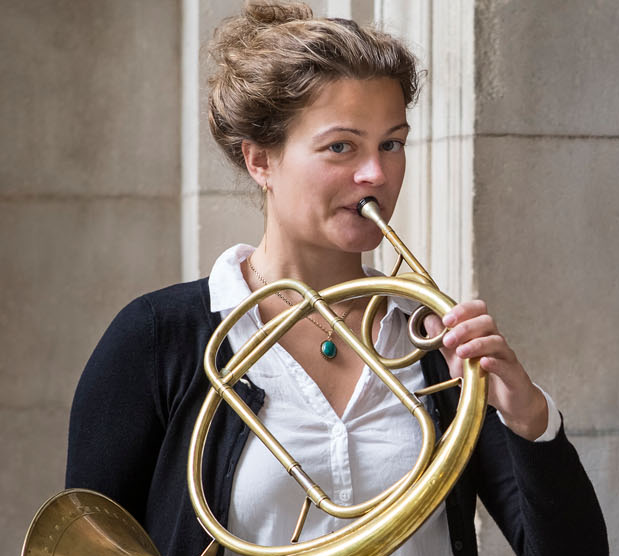
The not-Haydn Horn Concerto was given an extraordinary performance by the Danish Ursula Paludan Monberg_cropUrsula Paludan Monberg (left). I have raved about her playing in Early Music Review, notably after an exquisite performance of the notorious Quoniam tu solis from Bach’s B minor Mass in Bach’s own Leipzig Thomaskirche (with the English Concert, in 2012)  and last year’s performance of Handel’s Theodora at the Barbican. Despite having to hobble on stage on crutches with a broken foot, she was on top form playing the notoriously tricky natural horn. I was particularly impressed with her control of tone, using her hand in the horn’s bell – a technique that had only just been introduced at the time of this piece.  She played her own cadenzas, giving herself a monumental task, not least in the range of the notes, including what I think must be the lowest note I have ever heard played on a natural form.

After the interval, the orchestra expanded to include oboes and horns for the Waṅhal Symphony in a. Dr Charles Burney wrote that Waṅhal’s “symphonies had afforded me such uncommon pleasure, that I should not hesitate to rank them among the most complete and perfect compositions for many instruments, which the art of music can boast”. I am not sure if I would be quite so complimentary, but this example was certainly an impressive work. Despite the presence of four horns, they were only really used to fill out chords until a couple of flourishes towards the end of the bustling final movement.

The concert finished with Waṅhal’s E flat Requiem Mass, a relatively short work with an attractively lyrical Lux Aeterna. The choir of Sidney Sussex College, Cambridge made an impressively coherent sound. It is possible that this was written during (or for) one of Waṅhal’s periodic visits to the Croatian city of Varaždin, one of the seats of the Counts Erdödy and, between 1756 and the disastrous fire of 1776, the capital of Hapsburg Croatia. As it happens, my main exposure to Waṅhal’s music has been during my visits to the Varaždin Baroque Evenings festivals – I have been a member of the festival jury, and have given several organ recitals there. Varaždin’s imposing Stari Grad fortress contains a portrait of Waṅhal, and the baroque Erdödy Palace is now the Varaždin School of Music.

A CD with the same title, Forgotten Vienna, will be released later this year on the Resonus Classics label.

[https://andrewbensonwilson.org/2015/04/05/forgotten-vienna-amade-players-st-johns-smith-square/]

Le Création du Monde – European Union Baroque Orchestra

The annual St John’s Smith Square Christmas Festival has adopted a number of performers who seem to return each year, one being the European Union Baroque Orchestra.  As readers may know, EUBO have had a troubled year as their usual EU funding stream ground to a halt – hopefully temporarily.  Despite having had to cancel the 2014 cohort of auditioned players, they have continued to keep up some elements of their touring concert schedule, drawing on players from earlier incarnations of the training orchestra.

Their SJSS programme (11 Dec 2014) was Le Création du Monde, starting, perhaps appropriately given their current situation, with Rebel’s depiction of chaos at the opening of Les Elémens.  The second half Suite of pieces from three Rameau operas had a similar start with the Ouverture from Zaïs (a more hesitant depiction of chaos), closing with the tempest from Platée, with the filling between focussed on various wind-inspired pieces from Les Boréades. The other works were Muffat’s Propitia Sydera Concerto Grosso (with its fine Ciacono) and Rebel’s Les Caractères de la Danse.   As ever, the young players demonstrated characteristic grace and eloquence along with musical excellence, with notable contributions from flautists Emma Halnan and Flavia Hirte, violinists Yotam Gaton and Jamiang Santi and cellist Guillermo Turna Serrano.

Andrew Benson-Wilson
This review first appeared in Early Music Review, Feb 2015.

Purcell/Sellars – The Indian Queen. English National Opera

Peter Sellars has done it again!  Although billed as “Purcell’s” Indian Queen, the latest in his radical reinterpretations of opera is really Peter Sellars’ Indian Queen, the plot completely re-imagined as a vehicle for Sellars’ political and social views.   This spectacular production left me more conflicted than many Sellars’ shows that I have seen.  As a pure performance extravaganza, it certainly worked well. But in order for it to work, you needed to suppress any sense of history or musical integrity.

With his spiky lavatory-brush hair and right-on approach to contemporary politics, this impish and oh-so-American director has always taken a cavalier approach to opera, imposing his own views on whatever plot the composer might have chosen.  His latest London production, notionally based on Purcell’s The Indian Queen (English National Opera, 26 Feb), is one of the most extreme examples of this approach, not least because he has jettisoned the text entirely and replaced it with spoken text of his own choosing – principally extracts from the novel The Lost Chronicles of Terra Firma by the Nicaraguan author Rosario Aguilar.  Aguilar’s novel aims to “recapture the woman’s view of the conquest and colonisation of Central America through the lives of six women who participated in the encounter between Europeans and Amerindians”. The historical setting has been changed from the years before the Spanish conquest of Central America (and a conflict between the kings of Peru and Mexico) to a post-conquest scenario where the brutality of the Spanish invaders is intermixed with a curious love story between Teculihuatzin (the Mayan Indian Queen) and Don Pedro de Alvarado, one of the conquistadors.

The music is based on Purcell’s unfinished ‘semi opera’ The Indian Queen, original intended as incidental music to Dryden’s play. It was first performed in 1695 in the Theatre Royal, Drury Lane, a few months before Purcell’s death. Only about 50 minutes of Purcell’s survives, consisting of a series of musical interludes at the end of each act, never quite achieving the status of typical late 17th century ‘masques’.  The music is difficult to programme in concerts – a 50 minute series of seemingly unrelated short pieces of very different temperaments and moods.  But Purcell’s music has the ability to delve into unbearably intense emotional depths, so it deserves to be heard far more than it is.

To that extent, Sellars has done Purcell’s music a service, in that it gets performed.  This is a co-production between ENO and the Russian Perm State Opera and the Teatro Real, Madrid, and had been performed in both places, to varying degrees of success, before its London opening.  To turn it into a full length (indeed, an over-long) opera, Sellars has added other music by Purcell, sacred and secular.   Not content with the new post-conquest story, Sellars’ opens at the beginning of time, Mayan style, with five scenes from Mayan creation myths, with dancing to a backdrop of what was supposed to be jungle noise, but was in practice rather uncomfortable white-noise broadcast rather too loudly from loudspeakers.  We were sent out for the interval with an almost cartoon-style massacre and rivers of blood, all to the accompaniment of ‘Hear my Prayer, O Lord’.  Not surprisingly, this didn’t go down too well in Madrid.  Sellars’ trademark mannered infant-class gestures featured in many of the chorus’s actions – something I have never got used.

The staging, lighting, costumes and the large painted panels were all bold and impressive.  And the music was outstanding, with generally excellent singing from the youthful soloists. Lucy Crowe excelled as Doña Isabel, notably in O Solitude and See, even night herself is here.  Bass Luthando Qave impressed as a Mayan Shaman, as did Noah Stewart as Don Pedro de Alvarado.  Vince Yi (Hunahpú) is billed as a countertenor, but his voice had the timbre of a male soprano.  Luisa Julia Bullock (as Teculihuatzin/Doña Luisa) displayed far too much uncontrolled vibrato for my taste and for Purcell’s music, although she impressed in her late duet O Lord, rebuke me not with Lucy Crowe. The text was extremely well declaimed by actress Maritxell Carrero, portrayed as Leonor, the daughter of Teculihuatzin and Don Pedro, and therefore of mixed race; something key to the text.

Laurence Cummings directed the ENO house band, most playing modern instruments, but showing just how far they have come in recent year to understanding period performance – something that Cummings must take much of the responsibility and credit for.  The orchestra was lifted to almost stage level, making them visible to most of the audience.  An unfortunately un-named specialist period instrument continuo group deserved the special applause they got at the end.  Laurence Cummings got into the mood of Sellars’ directorial style, pushing the music to its limits albeit always within his own deep understanding of period style.  Notable were several moments when he paused, mid phrase, producing very effective dramatic moments.  My only musical quibble was with the chorus, whose unadulterated vibrato I would have found excessive in Wagner.  I know that is just what they might have had to sing the following evening, and that it is hard to rein in vibrato, but unless they can do it I do wonder if bringing a specialist choir might be a solution to what is, too often, an ENO issue.

I always approach Sellars productions with a degree of trepidation, as this evening was no exception. But, despite everything arguing against it, I quickly got into the spectacular of the production and the curious story. Yes, it was too long, but the music was something special.  I tried not to like it, but just couldn’t.

[https://andrewbensonwilson.org/2015/04/01/purcellsellars-the-indian-queen-english-national-opera/]

Ulysses returns to Iford

One of the posh frocks and picnic venues that combine musical excellence with spectacular gardens is Iford Manor, near Bath. This year’s early music offering was Monteverdi’s Il ritorno d’Ulisse in patria performed by the Early Opera Company (2 Aug 2014) in a setting that could not be more Italian. Iford’s Peto Garden is full of Italian references, and the operas take place inside a pastiche 100 year-old Italian cloister – one of the most intimate opera spaces I know.

The 12-strong (and vocally strong) cast was headed by mezzo Rowan Hellier as the complex and emotional confused Penelope with Jonathan McGovern as the returning Ulysses. Penelope’s three suitors were Callum Thorpe, Russell Harcourt and Alexander Robin Baker, with Oliver Mercer as their advocate Eurymachus. Elizabeth Cragg and Annie Gill made fine contributions as Minerva and Melanto, as did Daniel Auchincloss as Eumaeus, here portrayed as a gamekeeper. The Prologue was sensibly omitted, allowing the opening focus to be on Penelope’s grief.

The audience sit within a few feet of the central stage and it is impossible not to feel personally involved in the unfolding drama. It is a real test of the singers’ sense of character and voice to be able to project to such a close audience. Justin Way directed, using Christopher Cowell’s sensible ENO English translation, and an excellent and beautifully lit staging by Kimm Kovac, using imaginative and vaguely modern dress with a hint of the abdication era. Christian Curnyn directed his seven Early Opera Company players from the harpsichord, the violins of Catherine Martin and Oliver Webber being much in evidence.

[https://andrewbensonwilson.org/2015/03/30/ulysses-returns-to-iford/]

Garsington’s Fidelio

Garsington Opera opened its 25th anniversary season with a revival of Fidelio (13 July 2014), first heard (albeit not by me) in 2009, the opera company’s final year in Garsington village. Now planted just beyond the ha-ha of the Getty’s Wormsley estate, the extraordinary new opera house is a slightly incongruous setting for the bleakness of Fidelio’s prison, although it was a delight to see the prisoners brought into the (fading) light and out over the bridge into the ornamental gardens. But Fidelio remains a troublesome work. The elevated ideals that inspired Beethoven compositional struggles are marred by compromise of structure and plot, not least the rather inconsequential love scenes between Marzelline and Jaquino. Fidelio is frequently used as a vehicle for the political aspirations of the director, thereby overlying additional layers of complexity, usually very far from the original plot. But here, John Cox’s production plays it commendably straight, supported by period costumes and a neutral staging.

The character portrayals are convincing, notable in a young Fidelio/Leonore, sung with absolute integrity by the delightful Rebecca von Lipinski – a most impressive singer and actor, and equally believable in male and female incarnations. Stephen Richardson’s Rocco contrasted power with compassion – a nice twist is that it seems pretty clear that he knows exactly who Fidelio is. Peter Wedd’s Florestan dominated the second half, the sombre mood aided as the setting evening sun of the first half faded. Joshua Bloom’s Minister contrasted with the pantomime antics of Darren Jeffery’s Pizarro. Douglas Boyd conducted the house orchestra, playing modern instruments, with a fine sense of style and pace.

[https://andrewbensonwilson.org/2015/03/30/garsingtons-fidelio/]

Glyndebourne’s La Finta Giarineira

Rather surprisingly, given Glyndebourne’s devotion to Mozart, La Finta Giardiniera was the first time they have staged any of his early operas (6 July 2014). Although obviously not on a par with the da Ponte operas, these earlier works are fascinating.  Had he died aged 20, I reckon Mozart would still rate pretty highly in musical history. That said, La Finta Giardiniera is not amongst the Mozart greats, and needs careful handling. Covent Garden didn’t altogether succeed in their troubled 2006 attempt although, more recently, the Academy of Music gave a commendable concert performance at The Barbican.

The plot is the usual nonsense. Nardo (who is really Roberto disguised as a gardener) loves Serpetta who loves Don Anchise who loves Sandrina (who is really the Marchioness Violante, and is also disguised as the ‘secret gardener’ of the title) who loves Count Belfiore (who previously stabbed her and left her for dead) who loves Arminda who used to love Ramiro but jilted him and would be very surprised if he happened to turn up unexpectedly. Musically, the 19-year old Mozart is starting to challenge the supremacy of opera buffa by introducing elements of opera seria, treating this buffa plot with seria intensity. The opening is pure buffa, with the characters appearing to be happy bunnies until you hear the words of the individual solos and asides. Another feature of this work is Mozart’s early development of his complex Act finales, one magnificent example coming at the end of the first act.

Director Frederic Wake-Walker set the goings-on in a Germanic Rococco-style room, the fabric of which deconstructed as the evening progresses, as did some of the characters. Christiane Karg’s Sandrina was the vocal highlight from a very strong young cast, her pure tone contrasting with the rather silly portrayals of Belfiore (Joel Prieto) as a wimp and Ramiro (Rachel Frenkel) as a Goth. Robin Ticciati (Glyndebourne’s music director) directed the ever-excellent Orchestra of the Age of Enlightenment with a fine sense of pace. But, even with cuts, it was a rather long three hours.

[https://andrewbensonwilson.org/2015/03/30/glyndebournes-la-finta-giarineira/]

Royal Baroque in Battersea  

The enterprising new series of monthly early Sunday evening musical events at St Michael’s, Cobham Close, Battersea continued with Royal Baroque, a group of young multinational musicians who met in 2010 at the Guildhall School of Music (8 Feb).  Their programme focussed on the French style, as represented in suites by Rebel and Telemann.  The solo instruments were played by Christiane Eidsten Dahl, violin, and Rebecca Vučetić, recorders, with Kate Conway adding many solo moments to her continuo role on viola da gamba – and demonstrating impeccable tuning well above the frets.  Continuo support came from Kaisa Pulkkinen, who didn’t have much chance to show her wares on baroque harp, and Katarzyna Kowalik, harpsichord.  Christiane Eidsten Dahl’s sensitive and delicate violin playing blended well with the quieter sound of the recorder.  All the players were well versed in French performing style, particularly evident in the gentler lyrical movements.

[https://andrewbensonwilson.org/2015/03/30/royal-baroque-in-battersea/]

Mark Rylance v Iestyn Davies

As television screens seemed to be filled with lingering shots of Mark Rylance in his role as Thomas Cromwell in BBC’s Wolf Hall, he returned to his old hunting ground at the Shakespeare Globe to take the role of the dotty Philippe V of Spain, patron of Farinelli, in Claire van Kampen’s play with music ‘Farinelli and the King’ (Sam Wanamaker Playhouse, 24 Feb).  In a role that he could have been born to play, the mercurial Rylance mischievously teased and inveigled the audience into the world of the complexly depressive King, starting with the very opening scene where he chats to his goldfish as he tries to catch it with a fishing rod.

Better known as the composer of the music for many of the Globe’s Shakespeare productions (and, perhaps, also as Mrs Rylance) this was Claire van Kampen’s debut as a playwright.  She has produced a play that is full of humour and sensitive insight into the world of madness and depression, as well as a fascinating insight into the world of Farinelli in the court of the crazy king.  In a similarly excellent performance, the appropriately named Melody Grove played the King’s wife, Isabella, who had procured Farinelli from London to aid the King.   Sam Crane acted the role of Farinelli, but in an clever twist to the play, we also had the outstanding countertenor Iestyn Davies taking on the singing side of Farinelli’s life, the combination of both sides of Farinelli’s personality on stage at the same time adding a fascinating psychological aspect to the evening.  This worked a great deal better than I thought it would, and proved to be an illuminating insight into the often divided personalities of performers, with Farinelli’s insecure and reticent side becoming all too evident as the evening progressed, and as his relationship with Philippe and Isabella grew stronger.

The miniature band of musicians was directed from the harpsichord by Robert Howarth, although unfortunately his pre-play playing was drowned out by the chatter of the excitably audience.  I was rather glad that, despite Rylance’s extraordinary (and unashamedly crowd-pleasing) acting, it was for Iestyn Davies that the audience reserved its strongest applause.  And so they should.

[https://andrewbensonwilson.org/2015/03/30/mark-rylance-v-iestyn-davies/]

Vivaldi’s “L’Oracolo in Messenia”

Although initially sceptical, I have grown to respect the Barbican’s tradition of concert performances of operas.  Without the distraction of staging or directorial imposition, there is the chance to concentrate on the music itself.  One fine example of this came with the performance of Vivaldi’s pasticcio opera L’Oracolo in Messenia of 1737 (20 Feb).

Vivaldi’s habit of living and travelling with his former pupil Anna Girò (some 32 years younger than him) seems to have been instrumental in the genesis of this work, after the Archbishop of Ferrara refused him entry to his city on the grounds of his companion.  Vivaldi hurriedly arranged a season at Venice’s Teatro S Angelo which opened with L’Oracolo in Messenia.  As with so many of Vivaldi’s operas, only the libretto exists, but Fabio Biondi has reconstructed the musical score from clues as to the pieces that Vivaldi collected together, drawing on the Giacomelli work that Vivaldi used as the basis for his pasticcio.  

As is often the case in Vivaldi (and indeed in many other composers), the real musical interest often lay in the accompaniment, rather than the vocal line.  That said, there were some spectacular showpiece arias, the most extraordinary coming towards the end of Act 2 when Trasimede (the young Russian Julia Lezhneva, in one of the three trouser roles) who had hitherto had a relatively quite time suddenly burst into a stunningly virtuosic aria (Son qual nave, originally written for Farinelli by his brother Ricardo Broschi) that not only produced by far the loudest audience applause but also a young man who leapt onto the stage from the audience to present her with a bunch of flowers – not, I think, a spur of the moment thing, but nonetheless well deserved.

In a very strong vocal cast, the stand-out singers were Magnus Staveland (despite his voice sometimes seeming rather too nice for the villain Polifonte, who has murdered the previous King and all but one of his children and is now after his widow, Merope), Marianne Beate Kielland as the tragic heroine Merope, notably with her impressive mad scene, Vivica Genaux as Epitide, her clear voice having a fine lower register, albeit with rather too much vibrato for my taste, and Franziska Gottwald as the ambassador Licisco, making much of one of the lesser roles.  Of the remaining cast, Marina de Liso’s persistent vibrato was a turn-off, and Robert Enticknap, playing another nasty chap, struggled to demonstrate his ability in such a strong cast.  It takes a bit of a culture shift to appreciate the 18th century love of pasticcio opera, but this was certainly an effort by Fabio Biondi that was well worth while.  He also impressed as a director, leading his excellent group Europa Galante with his violin, and showing great respect for his singers and fellow musicians.

[https://andrewbensonwilson.org/2015/03/30/vivaldis-loracolo-in-messenia/]