Bach: Violin Concertos
Alina Ibragimova, Arcangelo, Jonathan Cohen
Hyperian CDA68068. 69’02
Bach: Violin Concertos BWV 1041, 1042, 1055R, 1056R, 1052R
![JS Bach:Violin Concertos [Alina Ibragimova; Arcangelo, Jonathan Cohen ] [HYPERION: CDA68068]](https://i0.wp.com/ecx.images-amazon.com/images/I/618CLr8euKL._SY355_.jpg) I first encountered Alina Ibragimova when she was part of a little student group playing in a lunchtime concert in 2007. Two years later (after she had already won several prestigious awards and released three CDs, of works by KA Hartmann, Roslavets, and Symanowski) I reviewed her extraordinary solo Bach recital at her alma mater, the Yehudi Menhuin School. In my review (in Early Music Review) I wrote that “I don’t think I have ever heard a more promising musician on any instrument – or, indeed, such an intensely musical (and moving) performance of Bach’s unaccompanied violin works . . . She has an extraordinarily compelling stage manner – quite, focused and seemingly at one with her instrument, she quietly walks on stage, stands and plays, looking at her violin with intense concentration and involvement with the music. Alina Ibragimova has an exquisite musical talent and an inspiring musical mind.” Her subsequent CD of the
I first encountered Alina Ibragimova when she was part of a little student group playing in a lunchtime concert in 2007. Two years later (after she had already won several prestigious awards and released three CDs, of works by KA Hartmann, Roslavets, and Symanowski) I reviewed her extraordinary solo Bach recital at her alma mater, the Yehudi Menhuin School. In my review (in Early Music Review) I wrote that “I don’t think I have ever heard a more promising musician on any instrument – or, indeed, such an intensely musical (and moving) performance of Bach’s unaccompanied violin works . . . She has an extraordinarily compelling stage manner – quite, focused and seemingly at one with her instrument, she quietly walks on stage, stands and plays, looking at her violin with intense concentration and involvement with the music. Alina Ibragimova has an exquisite musical talent and an inspiring musical mind.” Her subsequent CD of the  Bach solo violin works (CDA67691/2) remains one of my favourite interpretations. And, for many people, the highlight of the 2015 BBC Proms was Alina’s two late-night solo Bach performances. So another Alina Ibragimova Bach recording is something to look forward to.
The first surprise might be to find five Bach violin concertos listed, rather than the normally expected two, in A minor and E major. There is evidence that Bach rearranged many of his earlier instrumental pieces for other instruments, often for performance at the Leipzig Collegium Musicum. These included the two well-known violin concertos, which he transcribed for harpsichord. All too often, the scores of the original pieces have been lost, just leaving the revised versions. This recording includes three reverse reconstructions of these earlier versions. The first of these (BWV1055) seems to have been originally for oboe d’amore, but works well for violin, albeit with an emphasis on the lower registers. BWV 1056 is well-known as the Harpsichord Concerto in F, but could have derived from a violin or oboe original. BWV1052 is a backward reconstruction of the violin concerto, later reworked for harpsichord. Incidentally, for those who care about such things, the BWV numbers quoted on the CD refer to the later re-workings – the reconstructions included on this CD should have the suffix ‘R’ – BWV1055R etc. Richard Wigmore’s comprehensive notes set the works in context.
Alina Ibragimova plays with a lovely sense of freedom of the musical line, with attention to the little phrases and motifs that are the foundation of Bach’s extended musical lines. At times her playing can sound almost improvisatory, which suits the music perfectly. She has a light and delicate touch, both during the extraordinarily complex passages (during which she wears her virtuosity lightly) and also on those lovely occasions when she brings the volume down to a just audible level. Her slow movements are particularly beautiful, but it is a shame that the theorbo is frequently too prominent, often adding a distracting counter-melody. With that one exception, the accompanying forces of Arcangelo play with sensitivity, allowing Alina’s voice to be heard even at its most touchingly delicate.
An exceptional CD.
 When I last visited the Lausanne Bach Festival many years ago, it consisted of nine concerts over a long weekend. In its current incarnation (the eighteenth), it is spread over the period from 25 October to 28 November, with six concerts, three informal ‘Bach Days’, a short conference, and, on this occasion, the 5th International Organ Competition. Although having the events spread out in this way probably attracts more local residents, it makes it a less practical attraction for people from outside Switzerland. I was principally there to review the Organ Competition (reviewed here), but was also able to get to two of the festival concerts, starting with a performance of Messiah Continue reading
  For their Spitalfields Festival debut, The Marian Consort brought their programme ‘Christmas with the Shepherds’ (based on last year’s CD release) to St Leonard’s, Shoreditch at the conclusion of a national tour. In a very well conceived and planned programme, they traced the influence of Jean Mouton on composers of the following century, notably Cristóbel de Morales, whose Missa Quaeramus cum pastoribus formed the nucleus of the programme. After the opening motet Alma Redemptoris Mater by Victoria, the latest of the composers represented, we heard Mouton’s motet Quaeramus cum pastoribus, a work that stayed in the repertoire of the Sistine Chapel for more than 100 years and survives in 27 manuscripts and printed sources now to be found as far apart as Aberdeen and Guatemala. It is the best known of a series of ‘Noë’ motets found in the Sistine Chapel archive, the result of the Medici Pope Leo X whose after-dinner entertainment
  The marriage between the Queen Mary Tudor and Philip of Spain only lasted from 1554 to Mary’s death in 1558, but the resulting musical influence lasted for many years, as demonstrated in this concert from the vocal group Chapelle du Roi. Amongst the musicians that Philip brought with him to England was Philippe de Monte, director of the Spanish Chapel Royal. He seems to have met the young William Byrd during his few months in England. Many years later, after the 1583 execution of Mary Queen of Scots and the crushing of a Catholic revolt, de Monte wrote his motet Super flumina Babylonis (‘How shall we sing the Lord’s song in a strange land’) and sent it to Byrd. De Monte set four verses from the Psalm (137), and Byrd’s response was to write his own setting of de Monte’s final verse, adding a further three verses, and sending this motet, Quomodo Cantabimus, to de Monte. These two pieces
  CD 2, the ‘Sorrowful Mysteries’ (Sonatas VI-X), are recorded in Kaltenlengsfeld, next door to Friedelshausen, where CD 1 was recorded, south of the Bach town of Eisenach in Thuringia. The organ dates from 1755 and has, for Thuringian organs, a rather unusual configuration with a Ruckpositive. It is positioned above the altar in what appears to be almost a separate space from the main church volume, beyond a low arch and in a small space – presumably this explains the configuration, which takes up less vertical space. The recording is made fairly close to the organ, but still includes the acoustic bloom from the rest of the space. The violin
  Arvo Pärt provided a link between the earlier B’Rock/Julia Doyle concert and the later evening programme of a capella ‘Songs from the Northern Lands’ given by the Choir of Royal Holloway College. They opened with Pärt’s mesmerising Magnificat, the verse sections evolving around a high and long-held soprano note, and contrasting with fuller-textured passages. A similar drone note was at the core of Rihards Dubra’s ‘A child’s prayer’, again with a soprano solo. Vytautas Miškinis’s Oi šala, šala uses the ‘sh’ sound of ‘šala’ to invoke the sense of shivering in the frost. It is performed with three remote female voices (with noisy shoes!) echoing each other, a soprano solo and an almost inaudible little bell that reinforced the end of phrases.
  Corelli: Concertos grosso Op6/4 and Op6/8 ‘Christmas Concerto’; Handel: Gloria; Arvo Pärt arr Frank Agsteribbe: Fratres; A Scarlatti: Cantata ‘O di Betlemme altera’
 The English Concert was reduced to one of its smallest formations with just four instrumentalists plus tenor Mark Padmore for their Wanamaker Playhouse concert, based on Charles Burney’s writings on music. In 1770 and 1772, Burney (painting by
 g some 30,000 people a year. Their latest Winter Festival opened (in Shoreditch parish church) with a very apt programme based on the early 17th century vogue for composing music based on the hubbub of London’s street sellers and criers, reflecting a tradition of loudly publicising wares that exists to this day in placed like the nearby Petticoat Market.
 With 15 contributors, from Germany, Poland, the United States, Canada, and Australia, it covers the detailed history of the complex world of 15 Germanic Courts, of varying sizes. Many people’s knowledge of such institutions often only comes from the brief background knowledge of Bach’s various tenures in local Courts, before his eventual move to Leipzig. The essays in this book puts Bach’s career into a wider perspective, and one that is relatively little known. The Germanic system of often very small scale princely courts might have made for a complex hierarchy of aristocracy and governance, and some tricky questions of inheritance, but it made for an extraordinary flowering of art and music, as each little domain tried to outdo its neighbour.
 The start of the Renaissance is difficult to define. In organ music, around 1450 seems a reasonable date, with music from the likes of the Buxheimer Orgelbüch and the Faenza Codex combining elements of Medieval and Renaissance styles. By this stage, the organ had a fully chromatic keyboard, sometimes more than one manual, and independent stops were beginning to be separated out from the Medieval ‘Blockwerk’ – the equivalent of single mixture where one note plays a chorus of ten or more notes.
 Jacques van Oortmerssen was one of the most influential organists and organ teachers of his generation. His untimely death on Saturday 21 November is a great loss to music. In his memory, I am posting extracts from some of my reviews of his Bach organ CDs.
 The city of Toulouse has nine historic organs on the national protected listed monuments schedule, together with many other instruments in the surrounding Midi-Pyrénéés region. It is something of a pilgrimage site for organ lovers; an appropriate description, as much of its early importance came from the Basilica of St. Sernin and its key position on the Santiago de Compostela pilgrimage route. The Toulouse les Orgues organisation has a year-round responsibility for the maintenance of most of the organs in the city, as well as a thriving educational and outreach remit. In addition, they organise the annual international festival and the occasional International Xavier Darasse Organ Competition. This year was the 20th anniversary of the festival. It’s motto ‘The organ: fabulous musical machine” was reflected in a vast array of musical events and presentations, featuring not just the organ in its various incarnations, but also an impressive breadth of other musical activity.
  José Maurício Nunes Garcia: Missa pastoril para a noite de natal;
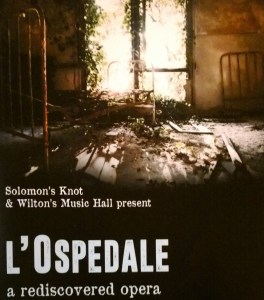 There are many operas that would appear to be taking place in a mental asylum, but the setting of the 17th-century ‘dramma burlesco’, l’Ospedale really is just that. It is based on a libretto by Antonio Abati and is set to music by an unknown seventeenth-century composer. As Naomi Matsumoto (who researched and prepared the score) explains in her programme essay, there are possible connections to the Hapsburg Court of the Holy Roman Emperor where an entertainment called l’Hospitale de’Pazzi is known to have been performed in 1667. Given its later history and famed inhabitants, Vienna does seem a rather apt location for the first performance – as was the delightful and historic surroundings of Wilton’s Music Hall for this, the first staged performance for centuries.
  There cannot be a more appropriate merging of organ and music than is found on this CD. Although there is no specific evidence, the Klagenfurter Orgeltabulatur seems to have been written around 1560 and was possibly written for a Carinthian monastery in central Austria. It is now in the state archives of the state of Carinthia (as Klagl. 4/3). It is the earliest known collection of keyboard music in Austria, and one of the first to use the ‘New German Organ Tablature’ letter notation. At the same time as it was being prepared, Jörg Ebert was making a bit of a meal of building the organ commissioned by the Holy Roman Emperor Ferdinand I for the Court Church in Innsbruck in the Austrian Tyrol. He had been appointed in 1555, but progress was slow and, as a result, he nearly lost the contract. But by 1558 the organ was substantially complete, and was inspected and approved in 1561. A seminal restoration in the 1970s (by Ahrend) produced an excellent, and rare, example of a Renaissance organ, with only three stops having to be reconstructed from new. I gave a recital on it last year, and it is an absolute joy to play.
  This timely (but subtle) release for the season includes three choral preludes on the Advent choral Nun komm, der Heiden Heiland, the Italianate Pastorella and the Canonic Variations on the Christmas choral, Vom Himmel hoch, together with the Prelude and Fugue in C (BWV 547) which some commentators have associated with Christmas performance. These works are enclosed within the well-known Fantasia and Fugue in G minor (BWV 542) and the final exhilarating Prelude and Fugue in G (BWV 541).
 Sarah Tynan, soprano; Jeremy Ovenden, tenor; Matthew Brook, bass-baritone
 John Taverner: Missa Corona spinea, Dum transisset Sabbatum I and II
 Andrew Parrott is one of the leading members of a particularly influential generation of musician/scholars who founded performing groups in the 1970s: in his case, the Taverner Consort, Choir and Players, founded in 1973 . They changed the way that we think about, perform, and listen to, ‘early’ music. Unlike many conductors who cut their teeth in the world of period performance, Andrew Parrott has retained his strong research interests, notably around the music of Bach and Monteverdi. Perhaps best known for his book, The Essential Bach Choir (published in 2000), an expansion of the theories of Joshua Rifkin that Bach’s choirs were essentially performing as one to a part, Parrott remains an essential component of the early music world. Hence the importance of his latest book: Composers’ Intentions? Lost Traditions of Musical Performance.
 Concert: Steven Devine, fortepiano, Jane Booth, basset horn, Anneke Scott, natural horn;
 Composed in 1647 (to a libretto by fellow Italian Francesco Buti), Rossi’s Orpheus is generally acknowledged to be the first opera specifically commissioned for France – one outcome of the appointment of an Italian Cardinal as the Prime Minister to Queen Anne of Austria, the Regent to the young Louis XIV, and his attempts to introduce Italian culture to the French Court. Buti’s libretto is a curious affair, adding a bewildering array of miscellaneous characters to the story together with extended
  The European Union Baroque Orchestra was formed in 1985, and has recently successfully negotiated its way through a difficult period of financial uncertainty. It celebrated its renewed, if short term security with the first short series of concerts for the newly formed orchestra of young musicians. They are selected anew each year through combined educational and selection courses and then usually meet five or six times a year to rehearse and then tour a new programme. One of the key features of EUBO is giving the musicians the chance to experience life as a touring orchestral musician, evidenced on this occasion by
  returned to Dresden where he became more involved in composing for the Court Church(left), which had taken on a new significance after the closure of the city opera house in 1720. His career path didn’t go quite to plan. Having been temporary Kapellmeister for a short period of time, he was pipped to the post of Senior Kapellmeister by JA Hasse in 1733. He was then appointed as a church composer. A few years later JS Bach, who knew and admired Zelnka’s compositions, was appointed as an (honorary) Royal Court Composer as a result of his well-known petition accompanying his 1733 ‘Dresden Mass’ – the Kyrie and Gloria of what later part of the Mass in B minor (See PS below). On his death, his compositions were purchased by the Saxon Court as valuable objects rather than performing scores, and remained hidden away in their archives until the 1950s.
 It is pretty certain that the organ in the church of Notre-Dame de l’Assomption in Longueville (southwest of Brussels) was built around 1690, but it is not clear who the organ builder was, although Blasius Bremser is a possibility. It was originally built for the Saint-Martinsdale Priory in Leuven but was moved south to Longueville when the priory was dissolved in 1785, placing it in the Walloon rather than the Flemish province. It has one manual with 12 stops, two of which are divided (in the Spanish fashion) to allow for bass and treble solos. The construction and style are Flemish.
  Andrew Benson-Wilson : Early Music Reviews +