Meister: Il giardino del piacere
Ensemble Diderot, Johannes Pramsohler
Audax ADX13705. 66’45
Johann Friedrich Meister: Il Giardino Del Piacere (La Musica Terza, Settima, Ottava, Nona, Prima & Duodecima).
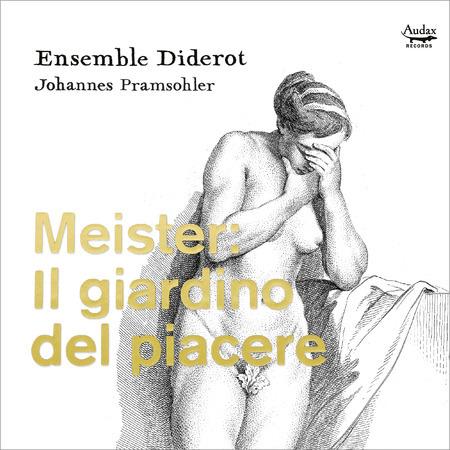 About ten years after Reinhard Goebel’s Musica Antiqua Köln disbanded, Ensemble Diderot have completed their last CD project by recording the remaining six Trio Sonatas from his Il giardino del piacere, overo Raccolta de diversi fiori musicali, come sonate, fughe, imitationi, ciaccone, passagaglie, allemande, correnti &c. We know little of Johann Friedrich Meister. He seems to have come from Hanover, and certainly worked in the Ducal Court there. After a dispute about pay, he moved to the Lübeck area before moving north to Flensburg in Schleswig (then part of Denmark and now the most northerly city in Germany) where he was organist of the Marienkirche and work for the local Ducal Court. His collection, Il giardino del piacere (pleasure garden), was published in Hamburg in 1695, shortly before his death.
Meister’s music seems to sum up the varied and exciting music of that period in German musical history, a period dominated by the stylus phantasticus (fantasy style) of free and often rather anarchic musical structures. The latter is shown in the fact that none of the Sonatas on this CD have the same format. Although all open with a Sonata, usually with a central fugal section, the following dances seem to be in almost random order and style, although they all end with a Gigue.
Johannes Pramsohler and his three fellow musicians of Ensemble Diderot clearly relish the contrast between and within the various pieces, and they play with an exquisite combination of consort and individuality. Their intonation is perfect throughout, and they manage bring exaggeration to the already exciting music without ever pushing things too far. I particularly like the fact that, despite having a clear group leader, his playing never dominates. These are true Trio Sonatas, and the balance between the three voices is vital – Roldán Bernabé and Gulrim Choi have important contributions on second violin and cello. Philippe Grisvard’s harpsichord continue is delicate and sensitive, correctly avoiding the temptation to do too much. And Johannes Pramsohler is a very talented violinist that is well worth watching out for.
The recording is of excellent quality. I like the fact that the little up-beat breaths before pieces start are retained. These are an essential part of performance practice but are usually inaudible from the concert stage, or edited out from recordings. The CD was launched at their concert in London’s St John’s, Smith Square on 8 May, reviewed here.

 Editions of Bach’s organ works are something of a minefield, even when there are clear autograph scores available. In many cases that is not the case, so the role of the editor and the availability and accuracy of available sources becomes an important consideration. Of all the publishers to be involved in Bach, Breitkopf & Härtel are perhaps the most appropriate. Founded in Leipzig in 1719 four years before Bach took up his post there, they were the first to publish the complete works of Bach, between 1851 and 1900 for the Bach-Gesellschaft. Unfortunately, at the moment, I only have access to one volume of their latest complete Bach Organ Works, so cannot comment on the 10 volume set as a whole.
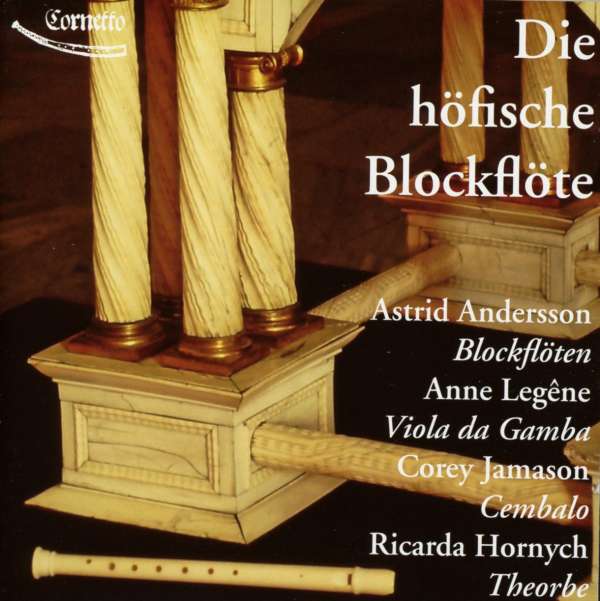 Using modern copies of seven different types of historic recorder (blockflöte), Die höfische Blockflöte (The Royal Recorder) explores the link between musical instrument making and the various royal courts of Europe. The recorders range from two different versions of the two mid-17th century Rosenborg soprano recorders, one made in maple, the other (at higher pitch) in the original material, narwhale tusk, both made by Fred Morgan. The originals are to be found amongst the Crown Jewels in the Royal Collection in Rosenborg Castle, Copenhagen. It can bee heard in Jacob Van Eyck’s Prins Robberts Masco.
 :format(jpeg):mode_rgb():quality(90)/discogs-images/R-7937697-1452199530-8698.jpeg.jpg) One of the most distinctive sounds of the early German Baroque is the sensuous combination of voices and viols, here represented by music by the little-known Samuel Capricornus. Born in Bohemia, Capricornus’s Protestant family soon fled to Bratislava for fear of the Counter-Reformation. After studies in more religiously tolerant Silesia, Capricornus moved first to Stuttgart and then briefly to Vienna at the end of the devastating Thirty Years War. In Vienna he joined the sumptuous musical court of Ferdinand III, whose death shortly afterwards led to another move, this time back to Bratislava (the Preßburg) before being invited to the prestigious post
One of the most distinctive sounds of the early German Baroque is the sensuous combination of voices and viols, here represented by music by the little-known Samuel Capricornus. Born in Bohemia, Capricornus’s Protestant family soon fled to Bratislava for fear of the Counter-Reformation. After studies in more religiously tolerant Silesia, Capricornus moved first to Stuttgart and then briefly to Vienna at the end of the devastating Thirty Years War. In Vienna he joined the sumptuous musical court of Ferdinand III, whose death shortly afterwards led to another move, this time back to Bratislava (the Preßburg) before being invited to the prestigious post  Jean-Christophe Dijoux was the winner of the harpsichord category of the 2014 Leipzig International Bach Competition, and this CD stems from that success. Born in Réunion, Dijoux studied in Paris, Freiburg and Basel, spent a year touring with the European Union Baroque Orchestra (EUBO), and won awards for continuo playing at the 2013 International Telemann Competition. Using two harpsichords (built by Matthias Kramer of Berlin after 1701 and 1754 originals) and four different temperaments, he explores music with a connection to Hamburg. Both instruments have 16’ stops, adding an impressive gravitas to the sound.
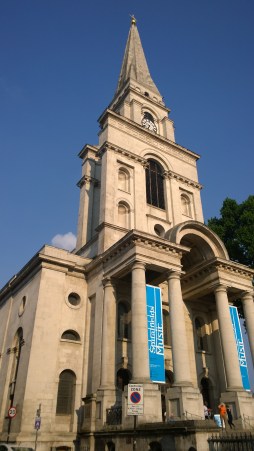 Spitalfields Music has been an extraordinary musical and community success since its foundation 40 years ago. Starting life with a 1966 concert to help save Nicholas Hawksmoor’s architecturally important Christ Church Spitalfields (which was then, unbelievably, under threat of demolition) it soon grew into a ‘Summer Festival of Music’ led by Richard Hickox. Initially under the auspices of the Friends of Christ Church, it became an independent organisation and charity in 1989, setting up their continuing community and education programme two years later. Under the artistic and managerial leadership of the likes of Judith Serota, Michael Berkely, Judith Weir, Jonathan Dove, Diana Burrel, Abigail Pogson and the current Chief Executive, Eleanor Gussman, it has grown into an major musical and community force in London, sharing their passion for music with nearly half and million people, attracting more than 325,000 audience members to events in more than 70 venues in the Spitalfields and Tower Hamlets area. Alongside their Summer and Winter Festivals, they run an enormous Learning & Participation programme involved more than 125,000 people.
 The Orchestra of the Age of Enlightenment have been celebrating their 30th anniversary year with a remarkably wide range of music, culminating with this Birthday Concert performance of Weber’s Der Freischütz. Perhaps most noted for their exploration of Baroque and Classical music, it can be forgotten that the OAE have also performed many pieces from the Romantic era, with remarkable success – indeed, their second concert, 30 years ago, under Roger Norrington, was devoted entirely to Weber. And so it was with this powerful semi-dramatised performance.
 Domenico Zipoli is often seen as a rather insubstantial composer compared to his contemporaries, his surviving organ pieces being generally short and sometimes rather light pieces intended for use in the Catholic service. Although his harpsichord suites were not constrained by such circumstances, they are also attractive, rather than emotionally intense, works. This double CD, one each devoted to organ and harpsichord, present his complete keyboard works and might help to put Zipoli in a better light. They were published in two volumes of Zipoli’s 1716 Sonata d’intavolatura per organo e cimbalo while he was organist of the Jesuit church in Rome. Shortly afterwards, he moved to Seville en route to Paraguary but, after an eventful voyage, ended up in
  Eamonn Dougan, associate conductor of The Sixteen, continues his exploration of music from Poland with this CD of music by Italian musicians in the late 16th century during the reign of Sigismund III Vasa. Sigismund III ruled the Polish/Lithuanian state at a time of religious upheaval. Raised a Catholic his Polish mother in the Protestant Sweden of his father (the King of Sweden), he soon became involved in the Counter-Reformation, seeking out musicians from Rome to help in his quest.
 Awaiting the construction of their new concert hall, the Royal Academy of Music have been trying out different venues in the past year. For their final opera of the season, Monteverdi’s L’incoronazione di Poppea, they chose Shoreditch Town Hall (a space new to me) in the middle of a very lively and cosmopolitan part of London. There was some awkwardness in the staging arrangement as the audience enter past what would normally be back-stage, but they coped with this well. The staging was simple, a three-sided box with three entrances on either side, and five in the rear wall. There were very few props, with much depending on Jake Wiltshire’s excellent lighting to provide mood, most prominently at the end of Act 1 when Seneca’s death is depicting by a flood of red light.
 The weekend traditionally opens on Friday evening with the famous Regensburg cathedral boys’ choir, the Regensburger Domspatzen,
  The London Festival of Baroque is growing from strength to strength after its rebirth from its previous incarnation as the Lufthansa Festival. Shorn of the former funding stream, it has had to rebuild its financial stability. The increase in the number of this year’s events over last year is one sign of their success. One of the big advantages of the former sponsorship deal was that it enabled many non-UK groups to travel to London for the festival, so it is encouraging that such visits by musicians from abroad continue to be a feature of the festival. Also most encouraging is their focus on young musicians, with three concerts specifically devoted to them under the banner of ‘Future Baroque’. They also included a late-night concert by the young folk-inspired singer-songwriter, Olivia Chaney.
 If the composers aren’t familiar to you, some of the melodies will be in this selection of 19th century guitar pieces inspired by Scotland during the early Romantic era. Scotland was an influence to many artists and musicians of that period, famously Mendelssohn after the 1829 visit that produced the Scottish Symphony, Hebrides Overture and Fingal’s Cave. Giuliani Mauro is given most coverage, with six simple pieces, some of which are enlarged into a larger format by combining, repeating, and adding a prelude. Fellow Italian Lauigi Legnani has the most extended and elaborate pieces with his two variation sets on themes from Rossini’s opera La donna del lage, based on Sir Walter Scott’s poem on James V of Scotland.
  Andrew Benson-Wilson plays the famous 1723 Hildebrandt organ in Störmthal, Leipzig (where Bach gave the opening recital), on Wednesday 15 June 2016 at 7pm, during the Leipzig Bachfest.
 Hindorõdin hindodre (One of the Cragich),
 Johannes Pramsohler and his three fellow musicians of Ensemble Diderot relished the contrast between and within the various pieces, playing with an exquisite combination of consort and individuality. Their intonation was perfect throughout, and they managed to bring exaggeration to the already exciting music without ever pushing things too far. I particularly liked the fact that, despite having a clear group leader, his playing never dominated. These were true Trio Sonatas, where the balance between the three voices is vital – and Roldán Bernabé and Gulrim Choi had important contributions on second violin and cello. Philippe Grisvard’s harpsichord continue was delicate and sensitive, correctly avoiding the temptation to do too much.
 The untimely death in August 2015 of the eminent organist and choral director John Scott was a shock to many. Organist and Director of Music of St Paul’s Cathedral from 1990 to 2004, and then at St Thomas Church on Fifth Avenue, New York, John’s reputation as solo organist and choir director seemed to be on a perpetual rise. His memory remains strong in St Paul’s Cathedral, as was evident from the packed Service of Commemoration and Thanksgiving to mark his life, held in place of the usual Evensong on Friday 6 May.
 This is the penultimate recording in The Cardinal’s Musick’s Tallis Edition, and it opens with a masterpiece, the two settings of the Lamentations of Jeremiah. As Andrew Carwood explains in his programme notes, it seems that they were written during the reign of Queen Elizabeth, rather than the earlier Catholic Queen Mary. It is not clear why these, and other similar Lamentations, were composed or when they would have been performed, if not in the Holy Week Tenebrae service in the Catholic rite – hence the usual assumption of composition during Queen Mary’s reign. They are remarkable pieces, using the simple textural style of one note per syllable encouraged by Archbishop Cranmer. The Hebrew incipits are particularly well set, as are the concluding, and rather sombre
 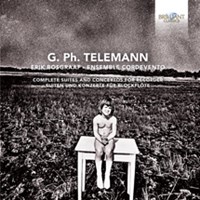 Telemann taught himself to play the recorder, violin and zither before the age of 10, and continued to practice the recorder well into his teens – something very few youngsters do today. He seems to have retained a love for the recorder, judging by the number of pieces he wrote for it, including these Suites and Concertos. Incidentally, the two Suites are both titled Ouverture in their manuscripts, and are examples of Telemann’s so-called concert en ouverture style of composition, which combines elements of the traditional suite with the overture. Apart from the E-flat suite (which is intended for the flute pastorelle, which perhaps means the panpipes), all the music is from the same manuscript surviving in the Hesse Court library in Darmstadt, suggesting that they were composed for Michael Böhm, Telemann’s brother-in-law and a virtuoso woodwind player. They are all written for alto recorder.
 It is when you hear music from composers like Niccolò Jommelli (1714-74) that you realise just how deep the musical well is, if you peep behind the wall of well-known composers. Writing in that fascinating limbo period between the Baroque and Classical era, Jommelli perhaps completed too many operas for posterity to master. Il Vologeso is one of his best-known works and, on the strength of this performance by Classical Opera Company (giving the UK premiere), deserves to be heard more, and in a full staging rather than this concert performance. This was another part of their MOZART 250 project, aimed at exploring the works of Mozart and his contemporaries on the anniversary of their composition – which, in the case of Il Vologeso, was on 11 February 1766, in the enormous theatre at the Duke of Württemberg’s Ludwigsburg Palace near Stuttgart.
 Andrew Benson-Wilson : Early Music Reviews +